

Developing policy and strategic road map for digital health has been recommended to expand the sector development with the engagement of the private sector.
Under consultations that evaluated to identify the opportunities and challenges in private health sector development, particularly along with; policy, regulations, standards, and procedural impediments for market entry and expansion, a recommendation has been put forth for the government to design a policy framework along with a strategic road map to boost the social sector with the latest development in the global arena.
The consultation that identified three critical areas of interventions for deep-dive analyses, included; the need to review health facility standards and licensing, the need to develop a new standard for office medical practice such as “doctors’ plaza”, and the need to review and expand private sector engagement whilst leveraging on digital health added that the need of paving a clear way for effective governance in digital health technology, is a necessity.
It has also recommended the establishment of a strong digital health platform, an Integrated and standardized digital innovations for health, cultivation for the digital health financial sources and investments, and enhancements on the digital health capacity and literacy.
Besides that it added the alignment of digital health policy and strategy to global, regional and national goals including developing a patient-centric digital health ecosystem.
The priority pillars to address for Ethiopia’s digital health ecosystem policy and planning process are: expand the literacy, integration of private sector under self organization and public sector integration initiative, and promotion of entrepreneurship via financial and other instruments to expand the sector for innovation.
“The two key building blocks for successful digital health ecosystem implementation in Ethiopia are; an effective, resourced inclusive digital health policy dialogue platform, and data integration and analytics to inform policy making that includes end users and providers,” it said.
The consultations confirmed that despite the country’s significant progress across key health indicators, the private sector in health remains small with limited engagement. “More needs to be done based on the known advantages of strategic private sector engagement in other countries to support and scale public health and government responses,” it amplified.
It added that the expansion of digital health have several initial strengths to achieve the expected goals, while weakness like not including the sector on the digital transformation and small private sector innovation, lack of skilled professionals and brain drain, financing and others derail the progress of the sector.
The consultations that were led by Precise Consult International also highlight in an outcome document, the various opportunities and possible threats like health data complexity that shall be seen on the implementation process.
Mapping a digital health blueprint

SunPay gears to join the FinTech space

Sunpay solutions S.C gears to knock on the doors of the Ethiopian digital payment landscape by offering a payment system set up with an initial capital of 100 Million Birr.
Sunpay Solutions, a sister company of Sunshine Investment Group, has developed its own digital payment platform “sunpay” by highly driven well-skilled individuals from the fintech industry and is set to launch the service in July 2021. Upon securing a license to become a Payment gateway and POS operator in Ethiopia, is also working with a plan to be a switch operator in the next few months.
The company is currently awaiting full approval from the national bank for two licenses in order to become a payment gateway and POS operator in the country. SUNPAY has managed to collect 13 million birr paid up capital and 87 million birr in subscribed capital, which bring the sum total to 100 million birr of which the minimum per value of each share is set at 1000 birr.
During the General Assembly of shareholders held at Marriott International Hotel on March 25, 2021, the shareholders reviewed the progress made and discussed directions and steps to be taken moving forward to make SUNPAY a reality in time. Under Sunpay, the Sunshine group is planning to start new products including the E-commerce, ride and delivery services.
Whilst at the press conference, Etsub Alemayehu, SUNPAY solutions representative highlighted, “we are excited about joining the growing retail payment sector and we believe it is the right time to do so in light of the Governments 10 years development plan which envisions to make the nation an African beacon of growth with the digitization of services provisions and accelerating growth in the fintech industry of the country.”
“Ethiopia is striving to adopt sunpay solutions to modernize the financial system. We are excited to join the industry where sunpay solutions could address many challenges in accessing financial services. The private sector, like Sunpay solutions, can play a paramount role in the Ethiopian economy is accelerating the rate of fintech adoption in the financial sector,” he further remarked.
This digital disruption comes in light of the National Bank of Ethiopia approving a directive to License and authorize the Payment Instrument Issuers which gives prominence to innovative payment instruments which NBE believes is important to increase the use of financial services. The development allows any qualifying business to offer basic financial transaction services, which under a standard license covers saving, credit, insurance and pension products, including cash-in and -out; domestic remittances; bill payments; retail payments; over the counter transactions; and inward international remittances.
With an expected launch of service in July this year, Sunpay solution is said to acquire local and international cards including visa, master card UPI, mobile payments bill payments, CNP and internet payment, card issuance and personalization, ATM and POS driving services.
Total Ethiopia’s solidarity in the pandemic

In its continuous support through its corporate social responsibility, Total Ethiopia has donated 80,000 Paris made gloves to the Ministry of Health to support the fight against the global pandemic, COVID 19.
On Thursday March 25, 2021, Total Ethiopia handed over the high quality gloves to the ministry to which Lia Tadesse, Minister of Health, received the total’s gift on behalf of the ministry from Thibault Leasure, managing director of Total Ethiopia.
According to the company, the packs of gloves cost about 800,000 birr. Lia Tadesse to this regard appreciated the support offered by Total during this critical times and commended the work that the firm is doing in Ethiopia.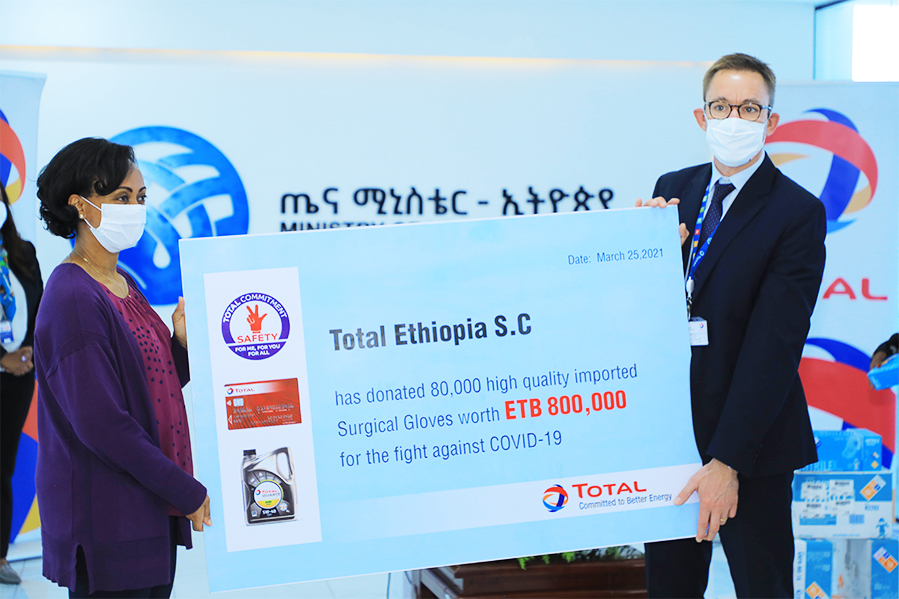
“My great appreciation to Total Ethiopia for donating surgical gloves worth 800,000 birr today and in their support in many ways throughout the year during the COVID-19 emergency response to help against the country’s fight against the pandemic,” stated the Minister.
Total Ethiopia, in its corporate social responsibility program has taken various pragmatic and targeted actions as part of the national effort to fight the spread of the COVID-19.
ECA and its partners urged to continue supporting Africa’s efforts to beat COVID-19
African Ministers of Finance, Planning and Economic Development have unanimously called on the Economic Commission for Africa (ECA) and its development partners to spearhead and support efforts that are important for Africa’s economic growth to rebound in the aftermath of the COVID-19 pandemic.
In a statement adopted at the end of the 53rd session of the Economic Commission for Africa’s Conference of African Ministers of Finance, Planning and Economic Development, the ministers commended the ECA and its partners for providing African countries with a platform to discuss several debt initiatives, such as the Group of 20 Debt Service Suspension Initiative (DSSI) and sovereign debt restructuring, to enhance member States’ access to finance to effectively respond to the pandemic.
The ECA has been advocating for the extension of the DSSI to the end of 2021 at least, to ensure countries have enough liquidity to respond and kick-start recovery by freeing up resources to pay for much-need vaccines and improve their buffers. The liquidity and sustainability facility (LSF) is another important vehicle the ECA and its partners have been working on to assist African countries increase liquidity. The think tank has been a leading advocate for a new issuance and re-allocation of Special Drawing Rights (SDRs) to low- and middle-income countries.
“We express particular concern that the COVID-19 pandemic could heighten debt vulnerabilities of African least developed countries,” read the ministerial statement.
“Five of the six countries in debt distress are African least developed countries and two of the least developed countries have decided to seek debt restructuring under the common framework for debt treatments beyond the Debt Service Suspension Initiative of the Group of 20.”
“We underline the need to revisit the current system of support for the least developed countries in the lead-up to the Fifth United Nations Conference on the Least Developed Countries, in January 2022, with a view to ensuring that international support measures provide the levels of assistance necessary for the African least developed countries and Haiti to break down the structural barriers to advancement that they face and overcome their vulnerabilities.”
In the statement, the ministers recognized that, before the COVID-19 outbreak, Africa had made considerable progress towards social outcomes, with a reduction in poverty levels in most sub regions, but the pace of poverty reduction has been slow, with gross domestic product per capita growth of 0.5 per cent, lower than the previous two decades, and that this growth trajectory, which has currently been stalled or even reversed due to the pandemic, has not been inclusive, with low job creation.
