

The 2020 Ibrahim Prize for Achievement in African Leadership has been awarded to Mahamadou Issoufou, President of Niger, the Mo Ibrahim Foundation announced following a meeting of its independent Prize Committee. President Mahamadou Issoufou served two five-year terms as President of Niger from 2011 to 2020. He is the sixth recipient of the Ibrahim Prize, which recognises and celebrates excellence in African leadership. The Ibrahim Prize aims to distinguish exceptional leaders who, during their time in office, have developed their countries, strengthened democracy and protected rule of law for the shared benefit of their people.
In its citation, the Prize Committee praised President Issoufou’s exceptional leadership after inheriting one of the world’s poorest economies, facing seemingly insurmountable challenges. Throughout his time in office, he has fostered economic growth, shown unwavering commitment to regional stability and to the constitution, and championed African democracy.
President Mahamadou wins 2020 Ibrahim Prize
Edget Betremariam

Name: Edget Betremariam
Education: Diploma certificate in Mosaic Art
Company name: Ab Edget restaurant
Title: owner
Founded in: 2006
What it does: Restaurant services
HQ: Near Lideta Federal High Court
Number of employees: 23
Startup Capital: 1,000 birr
Current capital: 50,000 birr
Reasons for starting the business: It was started as a family business
Biggest perk of ownership: Ability to support myself and my family
Biggest strength: Ability to work in a harsh environment and time management
Biggest challenging: Government system and Covid-19
Plan: Building an International Hotel
First career: DJ
Most interested in meeting: PM Abiy Ahmed
Most admired person: My parents
Stress reducer: Praying and music
Favorite past time: Sporting activities
Favorite book: Bible
Favorite destination: Dubai
Favorite automobile: Toyota Corolla
DEVELOPMENT ASSISTANCE
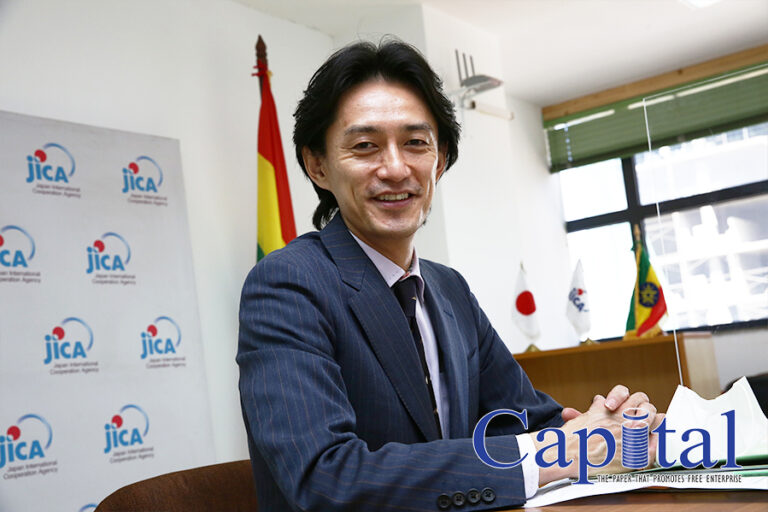
Official Development Assistance is a term coined in 1969 by the Development Assistance Committee (DAC) of the Organization for Economic Cooperation and Development (OECD) to measure foreign aid. Japan throughout this period has been a top tier contributor to development assistance across developing countries, through its governmental agency, Japan International Cooperation Agency (JICA). JICA for decades has played an integral part to the success of various projects for developing nations and is devoted to lead the world with trust. JICA, with its partners envisions on taking the lead in forging bonds of trust across the world, aspiring for a free, peaceful and prosperous world where people can hope for a better future and explore their diverse potentials.
Katsuki Morihara currently is the Chief Representative of JICA Ethiopia Office and has been spearheading the agency’s vision through various levels of capacity for over two decades. Capital linked up with Katsuki for an inside view of JICA and its progress. Excerpts;
Capital: Can you tell us about JICA’s activity in Ethiopia?
Katsuki Morihara: JICA opened offices in Ethiopia in 1972. The office at the time had a very limited function and it mainly handled the dispatch of Japan Overseas Cooperation Volunteers. We then upgraded the office in 1993. That is when we started expanding our operations. Ethiopia is an important partner in Africa. The Japanese government puts a great emphasis on Africa and it started a process called TICAD, Tokyo International Conference on African Development, in 1993 to address various development opportunities. The development and stability of the Horn of Africa are very important and Ethiopia plays a significant role within the region. The development of Ethiopia contributes to the development of Africa as a whole. The amount of our cooperation has been on the rise in the last 5 years. On average, it has been about 50 million USD a year, ranging from 30-70 million USD. Among sub-Saharan African countries, Ethiopia was the 5th largest recipient of JICA’s development cooperation in 2019. We have tried to support so-called “Quality Growth” in Ethiopia. Quality Growth is defined as growth which is inclusive, sustainable, and resilient. In order to realize such a growth, we focus on 5 main areas: agriculture and rural development, industrial promotion, infrastructure, education and health. Ethiopia has many development partners; however, we are trying to focus on areas where Japan has strength. Within agricultural, for example, we provide assistance in rice production because Japan is well-known for rice cultivation and JICA has a long history of cooperation in this field in many African countries. We also have on-going high-level industrial policy dialogues with the Ethiopian government. The Japanese development model is unique in the sense that our government played a very strategic role in developing our industries. We support small and medium sized enterprise development because in Japan we have a proven track record of supporting similar sectors. Our flagship project has been KAIZEN. KAIZEN, a Japanese word that literally means ‘change for good’ or ‘improvement’, is a Japanese management philosophy based on continuous improvement and it paves a path towards achieving efficiency, productivity and quality. Ethiopia has been a champion in implementing and introducing the concept. More than 700 companies are adopting KAIZEN. There is lots of tangible evidence coming out in terms of increasing profits and productivity gains. Within infrastructure, we cover power, road and water. Among these, Japan has a comparative advantage within geothermal development in particular. In terms of education, we are focusing on the improvement of math and science education.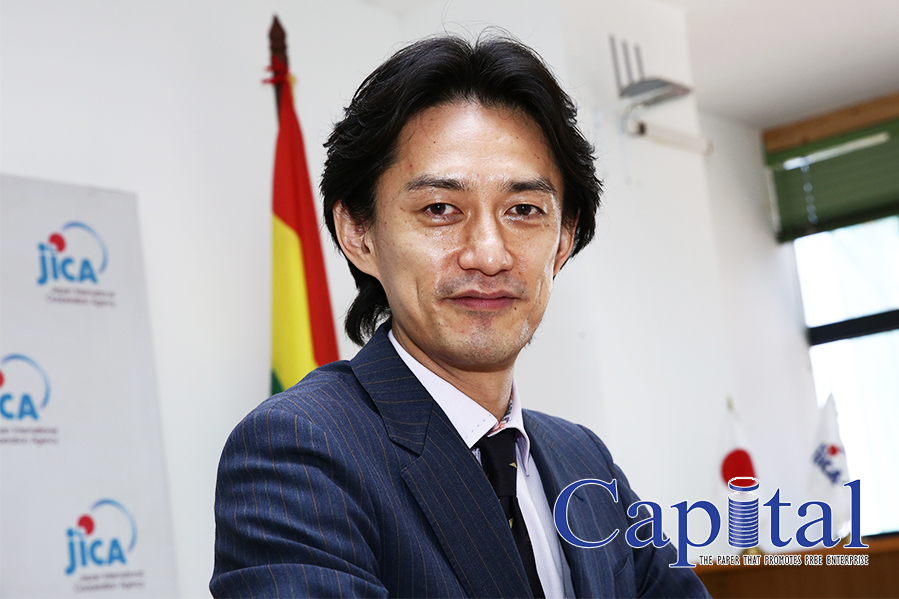
Capital: What are your projects in the water sector in Addis Ababa?
Katsuki Morihara: Broadly speaking we are trying to address the issue of urbanization in this country. Ethiopia’s urbanization rate is currently around 20% but it is expected to increase up to 35 to 40% in approximately 20 years’ time. There is a lot of work to be done to ensure the welfare of people living in the city. The Addis Ababa Water and Sewerage Authority (AAWSA) is facing the challenging task of reducing or eliminating non-revenue water, which happens when water is lost on the way to the pipe or it is not properly metered at the household level. In addition, non-revenue water reduces revenue that could be accrued and put towards the sustainability of AAWSA, thereby affecting the water that can be delivered to existing and new households. We will work with AAWSA to come up with mechanisms to detect the cause of non-revenue water as well as solutions for the problem.
Capital: What are the projects you are involved in with ERA and AACRA?
Katsuki Morihara: The Jimma-Chida Road Project is an extensive project with financing of about 100 million USD. We had the launching ceremony in late February in a town near Chida. The Prime Minister and members of the Cabinet were there, as was the Ambassador of Japan. The existing 80km road will be upgraded to asphalt. It is a very rich agricultural area so the road is going to facilitate the flow of agricultural products and will increase the quality and quantity of the goods like coffee and honey delivered to the domestic market as well as for export. As for the AACRA, we are providing Grant Aid and Technical Cooperation in the field of road maintenance. The construction of roads is important but the maintenance is equally as important. We have taken on other projects as well, including the Grant Aid worth 250 million USD for upgrading the Trunk Road Route 3 connecting Addis Ababa to Debre-Markos, which spans about 300 kilometers.
Capital: Japan used to be the biggest importer of Ethiopian coffee; do you have any projects connected to the coffee sector, or any plans to revive the import by Japan?
Katsuki Morihara: We have had a series of projects on coffee production. It’s combined with natural resource management and agroforestry coffee production. We believe that it is not enough to simply produce and harvest coffee but that we also have to maintain the natural environment so that the coffee production can be sustained for a long time. We have supported sustainable coffee production for many years and other Japanese companies have participated in that project in Belete-Gera Forest and surrounding areas. This project ended quite recently but we have a new project called Agriculture and Rural Development Climate Resilience. It focuses on climate-smart agriculture, forestry and natural resources management, which includes training stakeholders on sustainable coffee production. On the export-side, we provide assistance to the industrial sector through an export-promotion project. In the first phase of the project, we focused on the export of highland sheepskin leather and now in the second phase we started with the re-branding of Ethiopian coffee. We are not necessarily targeting the Japanese market but we are assisting in the branding and marketing of Ethiopian coffee so that it can compete in the global market.
Capital: As this is the fourth phase of KAIZEN implementation in Ethiopia, what are you planning to improve from past phases?
Katsuki Morihara: In the fourth phase, we are trying to expand our activities. We are expecting more companies to join. We are trying to apply KAIZEN methodologies to the management system of companies. KAIZEN in management is something new; it has been mainly applied to manufacturing processes. We are also trying to address IT issues in this phase. We are also trying to strengthen the linkage with ongoing cooperation in other industrial developments, such as SME development. We support business development services where business consultants advice SMEs on how to improve their business and management. We are also currently financing the construction of the TICAD Human Resource Development Center, which will be a training center under the Ethiopian Kaizen Institute, charged with disseminating KAIZEN in Ethiopia as well as to neighboring countries and eventually throughout Africa.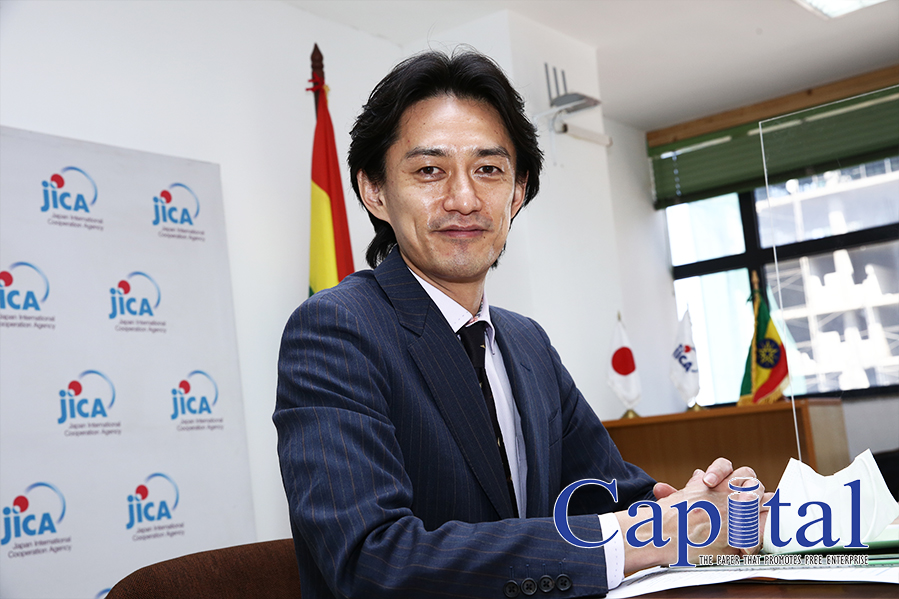
Capital: How are you involved with geothermal projects in the country?
Katsuki Morihara: We are providing Grant Aid worth about 18 million USD to introduce a portable geothermal power plant with the capacity of 5 megawatts. Its generation capacity is rather small but it is easy to install. We are also exploring the possibility of projects in the Afar area, as well as carrying out preparatory surveys for a large-scale geothermal power plant at Aluto-Langano. In addition, a JICA expert has been working in government institutions in the energy sector including the Ministry of Water, Irrigation and Energy to provide policy advice as well as coordinate JICA’s cooperation in the field.
Capital: Any last comments?
Katsuki Morihara: We have traditionally embraced the concept of self-help and ownership of partner countries. We have three major instruments in our systems. One is Concessional Loans; the other is a Grant Aid and lastly Technical Cooperation. Out of these three instruments, Technical Cooperation is the smallest, while Loans are biggest and Grant comes next. Despite its limited size, JICA particularly embraces the importance of Technical Cooperation for the capacity development of Ethiopian counterparts. That philosophy comes from Japan’s own experience of development because Japan developed by investing heavily in human capital. We are a tiny island country in the Far East and we do not have any natural resources – the only asset we have is human resources so we invested heavily in that. Japan is the first country of non-Western origin that has successfully become a developed country from a developing one while preserving most of its traditional values and cultures. We learned a lot from the Western countries like the US and Europe but we never simply copied and pasted their systems because we knew they would not work as they were in our culture. We always modified what worked in other countries to fit the context of our own society. This process of adaptation based on the country’s ownership is very important for development. Technical cooperation allows us to engage deeply with our Ethiopian counterparts rather than just giving out money. We can think and work together to figure out what worked in other countries, and how it can be adjusted to fit this country. We hope to impact Ethiopia’s human resources so that our experience-sharing will be sustained by the people of Ethiopia. Since last April, because of the COVID-19 situation, we needed to send many of our staff back to Japan, but I am glad to announce that everyone in our office is already back while many experts are starting to return. We are now ready to fully resume our operations and we will have 46 projects within the year, an increase from 23 projects we have now.
