

The Addis Ababa City Administration assures that it will support the new cooperative based housing scheme that is facilitated by Gojo Bridge Housing.
At the ceremony held at Hyatt Regency Hotel with the presence of Tiratu Beyene, Addis Ababa City Administration Manager and Deputy Mayor, and other city cabinet members, the project that will be commenced soon has been launched.
The new scheme that Gojo brings has invited landlords to come with their plots voluntarily to develop the property to different size apartments and interested co-builders to come up via hosing cooperative to secure houses.
Tiratu appreciated the convincing idea that led the city administration to accept the alternative on the housing scheme from the current condo projects lead by the government and private real estate developers.
He echoed that there is a huge mismatch between the demand and supply which is further burdened by mass migration to the city which presents an influx of new and more demand.
He reminded that over 600,000 dwellers are saving and waiting for house under the 20/80 and 40/60 condo housing scheme and says that the problem is stretching.
Tiratu explained that the issue will not be able to be covered by the government alone and as a result the real estate developers and other companies are expected to bring this project to a success.
“But there are issues on prudency and accountability on the private real estate activity that however should be stopped and will not be the case with this scheme,” he said expressing his hope that the new scheme that Gojo brings will change the dynamism.
According to the Gojo model, the cooperatives that would assign contractors will be responsible for the project that Almaw Gari, General Manager of Gojo Bridge Housing, said will make easy the concern of the city administration and the builders.
The City Manager stressed that the Gojo modality should be inclusive of new technologies that aim to make the projects’ cost effective and finalized in a short period. He emphasized that his government has appreciated the idea and will support the initiative.
The city administration has also appreciated the initiative that will restore the old face of the city with new and modern images in conjunction with the government.
Nadew Getahun, Founder and Deputy General Manager of Gojo Bridge Housing, said that in the past two years the company has been in the process to come up with this point. He said that 2,800 landlords and over 2 million square meter of land have been registered for the new development scheme.
He said that the schematic designs have been conducted by five companies and contractors have also been selected that builders will assign.
Almaw said that the project will also have a financial support modality which will take one and half year to realize.
He said that so far four banks; Dashen, Commercial Bank of Ethiopia, Awash and Oromia International Bank have agreed to work on the new scheme including providing finance for projects that will be settled by builders under mortgage scheme.
Almaw said the model mainly focus on middle and low income part of the society.
Nadew indicated that the project cost will be minimal since the charges that are requested by real estate developers is not applied on this scheme and the interior finishing work will be managed by the house owner itself.
On the new projects 1,000 houses in four sites that are located in Goro, Bulgaria Embassy, Italy Embassy and Lancia will be constructed, while in the coming five years Gojo expects 100,000 houses to be built.
According to the founder of Gojo one of the best advantages of the new scheme is undertaking projects at the centre of the city, which has been developed on basic infrastructure.
Gojo has also designed the rotating money and saving scheme that will be an instrument for the diaspora to save small amounts of money every month for several years which will allow building houses on sharing arrangement. Nadew said that rotating money and saving scheme that is common in other countries and will help the country to secure significant amount of foreign currency for decades.
New cooperative based housing scheme gains support

Tsehay Bank

Tsehay Bank, one of the under formation banks, held its first establishment general assembly at Sheraton Hotel last Thursday, February 18. The Bank had received permission from the Central Bank to begin selling shares last year in October 2020.

The organizing committee decided to go for the lowest share sell to be 100,000 birr whilst the highest a shareholder can buy was 100 million birr.
The Bank has amassed almost 735 million birr in paid-up capital from a total of 2.9 billion birr subscribed shares through 373 shareholders.
Tsehay Bank is among around a dozen banks that are currently under formation in the country.
Ethio-India ties continue to flourish

Demeke Mekonnen, Deputy Prime Minister and Minister of Foreign Affairs of the Federal Democratic Republic of Ethiopia, accompanied by a high-level delegation, paid an official visit to India from 17 to 19 February 2021, his first visit to Asia after taking over as Foreign Minister in November 2020.
Dr. S. Jaishankar, External Affairs Minister of India, held wide-ranging discussions with the Deputy Prime Minister on Friday 19 February 2021, during which they exchanged views on bilateral, regional and global issues. The External Affairs Minister also hosted the Deputy Prime Minister at lunch.
Earlier, the two Ministers jointly inaugurated the newly-constructed Chancery building and Embassy residence of the Embassy of Ethiopia in New Delhi on 18th February 2021. Demeke highlighted the importance of the India-Ethiopia relationship. He noted the historical people-to-people, trade, and investment relationship between the two countries that stretches back over many centuries and deeply entrenched with the beginning of formal diplomatic relations in 1948. He commended the high-level relationship that exists between the two countries which is manifested through expanding engagements in investment, trade, capacity building, and education sectors.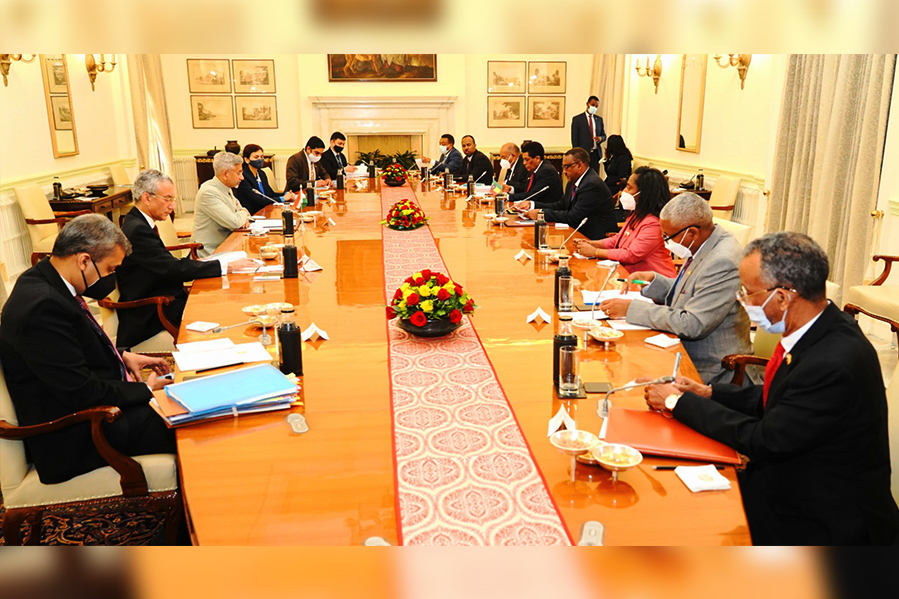
The External Affairs Minister of India addressed the gathering and spoke of the historic ties between India and Ethiopia and the fillip that these had received with the exchange of high-level visits over the last few years; he also touched upon the flourishing bilateral trade and investment ties and the growing people to people contacts.
ASSOCHAM, in association with the Embassy of Ethiopia in New Delhi, organized the India-Ethiopia Business Forum on 17th February, 2021 at which investment opportunities in Ethiopia were highlighted by the Ethiopian side and by Indian investors.
Demeke Mekonnen in his address, informed the gathering that the Government of Ethiopia was working on new measures to improve the business environment in Ethiopia. He noted the vibrant engagements of Indian companies in the economic life of Ethiopia serving as the main sources of FDI of the country and creating huge employment opportunities. Noting the current 1.3 billion US dollars’ worth of the trade volume between the two countries, the Deputy Prime Minister also appreciated the commitment of the 30 Indian companies who opted to invest in Ethiopia despite the global challenge posed by the Covid-19 pandemic. He said Ethiopia was working to be Africa’s beacon of prosperity by charting out a 10-year economic development plan where new frontiers of growth, such as the digital economy as well as science and technology are included, among others. The Minister also touched upon the advantage of doing business in Ethiopia stating its strategic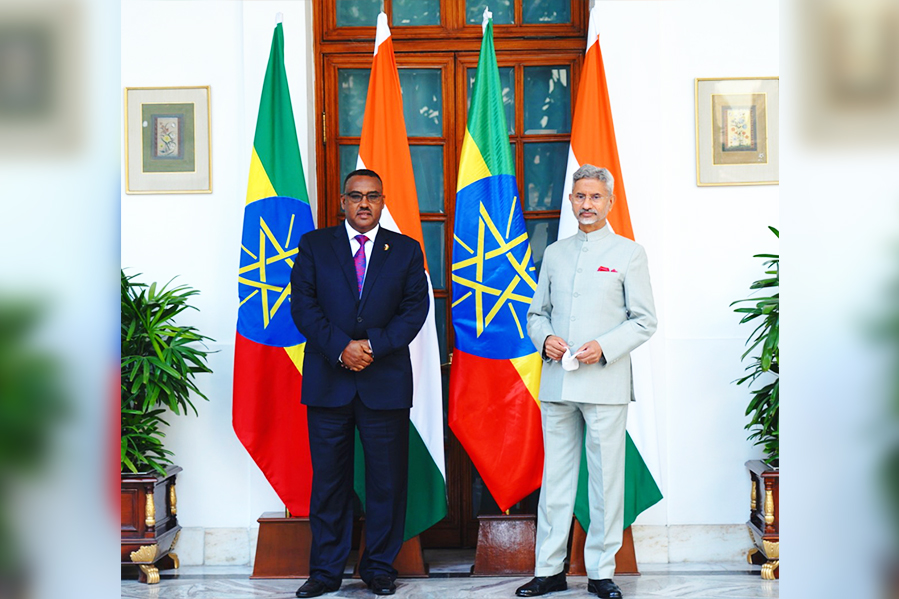 positioning in the continent, abundant and trainable workforce, competitive economic incentives, adequate guarantees for investors, and a policy of zero tolerance for corruption.
Shri V. Muraleedharan, Minister of State for External Affairs, attended the Forum and, in his address, invited the business communities to take advantage of the trade and investment opportunities on offer and expressed his satisfaction at the role played by Indian educators in Ethiopia.
During the visit, the two sides signed an Agreement on Mutual Visa Exemption for holders of Diplomatic Passports and a MoU between the Council of Scientific and Industrial Research – Central Leather Research Institute, India and Wollo University, Ethiopia.
The Sudan Military Another Problem of Africa in the 21st Century?

Present day African history is intertwined with West European history in the context of colonialism. The major colonial powers such as the United Kingdom and France have tried to shape the destinies of their colonial possessions well before independence. The current boundaries of African states are by and large inherited from the colonial times. The farther north of the continent was predominantly French colony except for Egypt, which was ruled by Britain with the name “Anglo Egyptian Sudan” at least between 1899 – 1956. Sudan was (and it still appears to be) a client state under the shadow of Egypt. The first president of “independent” Sudan (1956) – Ibrahim Abboud – was a military officer under the Anglo Egyptian army. The last king of Egypt and Sudan – Fuad II (Turkish ancestry) was deposed in 1953 through the Jemal Abdul Nasir revolution.
Sudan got its name from the Arab north (AL SOWD -SOWDAN) meaning BLACKS as the original inhabitants of the region including the southern part of Egypt are black people or mixed. I am not sure if present day borders of Sudan with Egypt are marked following this color line! The politics of both Sudan and Egypt have been dominated by the military upper brass. Egypt has been under military rule since 1952. A military group that changes its cloth to civilian and dominate the political and economic lives of the civilian population. One exception was a civilian President – Mohammed Morsi who was elected to office but whisked out of office by the military and jailed where he died in 2019. Similar patterns have been observed in Sudan since independence where the military steps in every time there is civilian movement against military rule. Although there were political parties the military intervenes in their activities and at times dissolves the parties to pave the way for military rule. The military has always been supreme. In the 1960’s Sudan had the oldest Communist Party in Africa in addition to other ideological parties. Nimeiri decimated the Communist party totally and other parties have been put to a position of subserviency to the Military. The military has been at the helm of power throughout– Ibrahim Abboud, El – Nimeiri, Omar Al Bashir, and currently Al Burhan.
In the same pattern today, the aspirations of the Sudanese people expressed during the September 2019 Revolution are being dashed by the military who hijacked the Revolution. The Transition period for the Sovereignty Council of Sudan led by Al Burhan and the civilian prime minister Abdalla Hamdok is ticking. The civilian groups appear to be struggling to form a government that should be approved by the military. Recent foreign relation activities by the military council members sidelining the civilian PM indicate the dominance of the military. The patience of the September revolutionaries has reached its limits and protests have been a daily occurrence since the end of January.
The Sovereignty Council has been taking diversionary actions in all directions. In addition to crippling the efforts of the civilian government one such grave mistake taken by the military was the invasion of lands in neighbouring Ethiopia. The reader may recall the role the Ethiopian Prime Minister played in reconciling the civilian and military groups to help form a transitional government in Sudan and the subsequent diplomatic supports provided to the Sudanese people. The current PM of Ethiopia is a Pan-Africanist leader who has repeatedly took initiatives to strengthen regional and continental cooperation to promote Africa’s focus to change the lives of ordinary citizens. I remember Abiy Ahmed with the Mandela African T-shirt on that fateful support rally in Addis Ababa where he escaped an assassination attempt just 3 months in office in June 2018.
The unprovoked invasion of Ethiopian lands does not answer the ideals of the Sudanese Revolution for which scores of people sacrificed their lives but just an attempt to divert the attention of the Sudanese people and create a pretext for the total assumption or domination of power by the Sudanese Military Council leaders. The invasion is part of the larger scheme hatched by Sudan and its backers. The larger scheme was to weaken Ethiopia using internal collaborators such as entities that organized itself in the context of the Ethiopian Ethnic Federalism. There is clear evidence suggesting that the Sudanese military has been working with the now defunct political group called TPLF to behave like a de facto state and also create chaos in other ethnic based regional states in Ethiopia. God willing, I will come back to the sinister reasoning for dividing Ethiopian regions based on ethnicity in the near future if need be. It was meant to divide and rule and attack Ethiopian nationalism. It has been evident that the TPLF was conducting foreign relations of its own particularly with the Sudan, Egypt, the media groups and some international and NGO organizations where it was receiving various assistance and encouragement. One should remember the repeated claim it made that if it is attacked by the Federal government the fighting will not stop within the Ethiopian border – it will be regional! It is not unreasonable to suggest that its provocative missile attack on Asmara was part of the scheme to regionalize the internal conflict – and hence invite others to come to its rescue.
The total decimation of the TPLF leadership has frustrated the Sudanese military and its backers’ plans and had to take action fast and chose to back stab Abiy Ahmed by invading Ethiopian territories and support other armed groups. The Sudanese military is currently recruiting fighters from the “refugees” that enter its territory from Tigray region. The young male “refugees” are those who committed genocide in Mycadra in northwestern Ethiopia. It has also received members of the TPLF militia and special forces who fled to Sudan as they were overwhelmed by the national army, they provoked to start the fighting. Today diaspora adherents of the TPLF are hailing the actions of the Sudanese military as an ally.
The Sudanese government has also startled the world with its changed position on the GERD negotiations sponsored by our continental organization – The African Union. All Sudanese professionals and politicians have been hailing the benefits of the GERD for protecting them from perennial flooding and the development potential it will create for agriculture in Sudan. However, Sudan has absented itself from 2 of the last meetings with no substantive rationale. This is a delay tactic to frustrate the negotiation and put pressure on Ethiopia and portray it as an unwilling partner in the process. This was how Ethiopia was presented to the Egyptian Parliament last week. It appears lies are becoming frequent now adays among Sudanese and Egyptian military leaderships. The alleged reason for the first absence for Sudan was reported to be lack of communication about the exact date for the meeting! The date that was broadcast all over the media world was not clear to the Sudanese leadership! Let me add another white lie – Al Burhan’s statement that stated – his army crossed the Ethio-Sudanese border by the invitation of the Ethiopian PM. And in the same line he states that Sudan did not cross any border but took what belonged to Sudan. I wonder how many lies he has been telling the Sudanese public to divert their attention from the failures of his government to address the demands of the September Revolution.
In addition to the brewing discontent within the civilian population that initiated the September Revolution, Sudan has internal ethnic/regional problems for a while now in Darfur west, South and other parts of the country. The agreement Khartoum inked with Kordofan has not dried yet. There is the questionable car accident death of the governor of the Blue Nile State which has been hash hashed for now. Sudan is as very diverse as Ethiopia both in ethnic and linguistic terms. It is black and mixed as is Ethiopia. Previous governments in the 1970’s and 1980’s in both countries had played Ethnic cards to destabilize the other. As a result, both countries were dismembered (Eritrea and South Sudan). For the Africa we aspire to unite and develop its citizens, using ethnic cards to destabilize each other is not a card Sudan should play in the 21st Century. As the old saying goes “one who is in a glass house should not be the first to throw stone”.
The Sudanese military brass appears to be unhappy by recent developments in Ethiopia. These are movements taking place in Ethiopia that worry its distractors in general. The first is the movement in action to depoliticize the national army and require it to play its mandated role of keeping the country safe by being within its barracks and not be involved in national politics. The second is the ascendance of a Pan-Ethiopian movement that transcend parochial ethnic affiliation and focus on what unites us and close ranks in light of the sinister motives of internal and external parties that perennially work to weaken our country. Such developments within Ethiopia are detrimental to their evil designs to destabilize Ethiopia.
One short note here: Ethiopia never crossed its borders to attack any neighboring country in its long history– all wars fought throughout its history have been waged to defend itself – Italy (1896; 1936); Egypt (1875;1876); Sudan (1889) and Somalia (1960’s; 1977). It had truth on its side and kept its independence. It has never ceded what belongs to us and never aspired to ask what belongs to others. Ethiopia is a Pan-Africanist nation that promotes good neighborliness, regional cooperation & development and African Unity. Ethiopian leaders have demonstrated this by Ethiopia’s participation in multitude of peace keeping missions in the continent (Congo in 1960 and others from the 1990’s to date) as well as in Korea in 1950; recently it boldly resolved the dispute with Eritrea and is closely working with other IGAD states including Sudan. War should not be Africa’s choice in the 21st Century.
The Sudanese military invasion of Ethiopia does not fulfill the national interest of the Sudanese people and particularly the requests of the September 2018 revolutionaries that sacrificed their lives. The Sudanese military should go back to its barracks and keep its hands out of civilian administration and the ECONOMY. Leave Ethiopian territory and reach an agreement on the border through diplomacy.
God/Allah Bless the People of Ethiopia and Sudan!
The writer can be reached via atachble@gmail.com
