Recent policy measures linked to the drop
The imposition of cash withdrawal limit and the recent demonetization policy measures has significantly contracted currency outside banks by more than 40 percent in the first quarter of the finance year compared with the preceding quarter.
In the first quarter of the year of 2020/21 that is from July 1 to September 30, 2020 the currency outside bank stood at 64.7 billion birr. In the fourth quarter of the 2019/20 financial year that amount was 109 billion birr.
The National Bank of Ethiopia (NBE), central bank, quarterly review indicated that in the first quarter the currency outside banks has contracted massively and showed a drop of 40.7 percent compared with the preceding quarter and 29.3 percent compared with the same period of last year.
At the end of the past financial year, the central bank had imposed the cash withdrawal limit directive that was followed by demonization of the birr, which was also a massive policy arrangement regarding cash management.
On its review, the central bank said that its latest policy measures have contributed to the drop of cash outside banks.
“Narrow money supply (M1) exhibited a 5.5 percent annual growth and 7.2 percent quarterly contraction mainly due to the imposition of cash withdrawal limit following the recent demonetization policy measures,” NBE said.
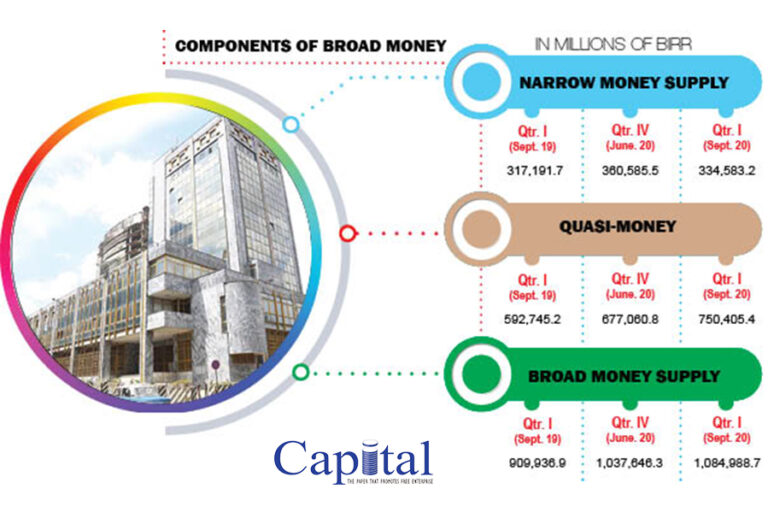
At the stated period, the broad money supply (M2) stood at 1.1 trillion birr at the end of first quarter of 2020/21, showing a 19.2 percent annual expansion owing to 136.0 percent surge in domestic credit despite 9.9 percent decline in external asset 21.3 percent growth in claims on government and 18.6 percent in increase in claims on non-central government were the major driving forces for the expansion in aggregate domestic credit.
The M2 has an increment of 4 percent compared with the preceding quarter, while the quasi-money supply from M2 showed a 26.6 percent annual and 10.8 percent quarterly expansion.
From the total M2 the quasi money, which includes saving and time deposits, share stood at 750.4 billion birr. On the other side the M1, which includes currency outside banks and demand deposits, share from the total 1.1 trillion birr of M2 is 334.6 billion birr.
The M1 has dropped by 7.2 percent because of the contraction of currency circulating outside banks, while the demand deposits from M1 has expanded by 19.6 percent of the same period of last year.
As expected, reserve of banks have also boosted by over double due to the latest measures taken by NBE on currency holding and demonization.
According to NBE, excess reserve of commercial banks surged 109.3 percent on annual and 27 percent quarterly basis, “Demonetization measures as well as the NBE directives setting cash holding and cash withdrawal limits have aided commercial banks to significantly increase their deposit mobilization and to improve their liquidity position.”
“Thus, money multiplier, measured by the ratio of broad money to reserve money and narrow money and reserve money declined on both annual and quarterly basis,” NBE explained the success achieved.
The excess reserve of commercial banks as of September 30 has stood at almost 68 billion birr from 32.4 billion birr of a year ago.
Banks despot at NBE has also expanded by 118 percent from September 30, 2020 and reached 137 billion birr from 63 billion birr.
NBE’s quarter review indicated that reserve money amounted to 261.4 billion birr at the end of first quarter of 2020/21, showing 39.9 percent year-on-year and 6.0 percent quarterly growth.
The reserve money currency in circulation has dropped by 11.5 percent compared with the preceding quarter from 140.5 billion birr to 124.4 billion birr, while it has a 0.3 percent a year-on-year increment.
The latest decision of the central bank on massive reforms helps banks to expand aggressively.
“The surge in quasi-money was the result of a successful effort made by banks in expanding their branch network and improving service outreach,” it says, “Moreover, currency demonetization and cash withdrawal limit helped commercial banks to mobilize more fresh deposits.”
The 19 banks operated so far have opened 117 new bank branches during the review period, thereby raising the number of bank branches to 6,628, while more than one third is located at the capital city.
The NBE review shows that total resources mobilized by the banking system (the sum of net change in deposit, loans collected and net change in borrowings) rose by 132.5 percent over last year due to the policy change made by the National Bank of Ethiopia; with respect to ‘Legal Tender Protection Directive’ that restricts cash holding and cash withdrawal limits and demonetization measures that led to result high deposit mobilization in the first quarter of 2020/21.
The banking system resource mobilization has shown drastic change compared with the same period of the preceding year and the previous quarter because of the NBE new laws and demonization.
The review indicated that the deposit mobilization has been expanded by fivefold compared with the 2019/20 first quarter and stood at 105 billion birr, which has also climbed by more than double compared with the last quarter of 2019/20 financial year.
The total resources mobilization that includes loan collection, borrowing and deposits has also increased by 132.5 percent and 25 percent from similar period of last year and proceeding quarters respectively and stood at 141 billion birr.
Banks liquidity has also surged by 5.5 fold and 75.4 percent from similar period of last year and preceding quarters respectively that stood 85 billion birr.
The total deposit liability has also expanded by a quarter annual growth rate and reached 1.15 trillion birr. “NBE’s Directives setting daily cash withdrawal and cash holding limits as well as demonetization measures have contributed to such a remarkable performance in deposit mobilization,” NBE amplified by its review.
Demand deposits, which accounted for 33.9 percent of the total deposits, reached 388.3 billion birr showing a 22.1 percent annual increase.
Similarly, saving deposits went up by 31.2 percent to Birr 659 billion and accounted for 57.5 percent of the total deposits. Time deposits, which constituted 8.6 percent of the total deposit liabilities, rose by 2.5 percent and reached Birr 99.1 billion. The share of state owned banks in total deposit was 57.3 percent while that of private banks was 42.7 percent.
During the review quarter, 55 billion birr was disbursed in fresh loans, indicating a 16.8 percent annual increase. Of the total new loans disbursed, the share of state owned banks was 30.3 percent and that of private banks was 69.7 percent.
The banking system collected loans to the tune of 35 billion birr, about 14.9 percent lower than a year earlier.
Total outstanding credit of the banking system (including corporate bond) reached 1.1 trillion birr, about 22.4 percent higher than last year same quarter.
NBE gross claims on the central government as of end September 2020 has reached 243.1 billion birr about 22 percent higher than a year earlier. Of this sum, government bonds accounted for 81.6 percent while direct advance constituted the remaining 18.4 percent.
The share of direct advance to central government dropped by76.7 percent compared with last year due to its conversion to government bond, thereby increasing the share of bonds.
The deficit in the overall balance of payments narrowed to USD 177.4 million during the first quarter of 2020/21 compared to USD 870.5 million deficit a year ago on account of slowdown in merchandise trade deficit coupled with an increase in net private transfers and net official transfers.
The private transfers that includes NGOs and private individuals has increased by 39 percent of a year ago and stood at USD 1.55 billion, while the private individuals transfer has climbed by 46.5 percent to reach USD 1.33 billion.
Similarly, the net official transfer has been USD 267 million that was 194 a year ago, but it has dropped by 57 percent compared with the preceding quarter that closed on June 30, 2020.