


Ethio Telecom asset valuation rise by 42%

First half of 2020/21 records success boom
On a press briefing held on the 21st of January 2021, Ethio telecom CEO, Frehiwot Taimru highlighted the developments of the firm for the first half of the fiscal year. She pointed out growth across the board from revenue increase, subscriber growth as well as a successful completion of the total asset evaluation of the firm. She expressed that the firm’s current and future successes are an attribute of the concerted efforts of all her diligent staff across all levels of management.
State-run Ethio Telecom which is expected to be partly sold off as Ethiopia liberalizes its economy has completed its asset valuation works. The telecommunication giant’s total asset value has increased by 42% using IFRS reporting standard, according to Ethio Telecom. This was the telecom service provider’s first time valuation.
As part of its six month plan according to Frehiwot Tamiru, CEO of Ethio-telecom, valuating the asset would help in the privatization as it better places the firm in the attraction of the market place.
In June 2019, Ethio telecom hired KPMG East Africa to conduct an asset valuation, and Deloitte and Touch was appointed as transaction advisor. “The valuation was done from floor to the book since it is for the first time,” said Frehiwot during the press conference she held on Thursday January 21.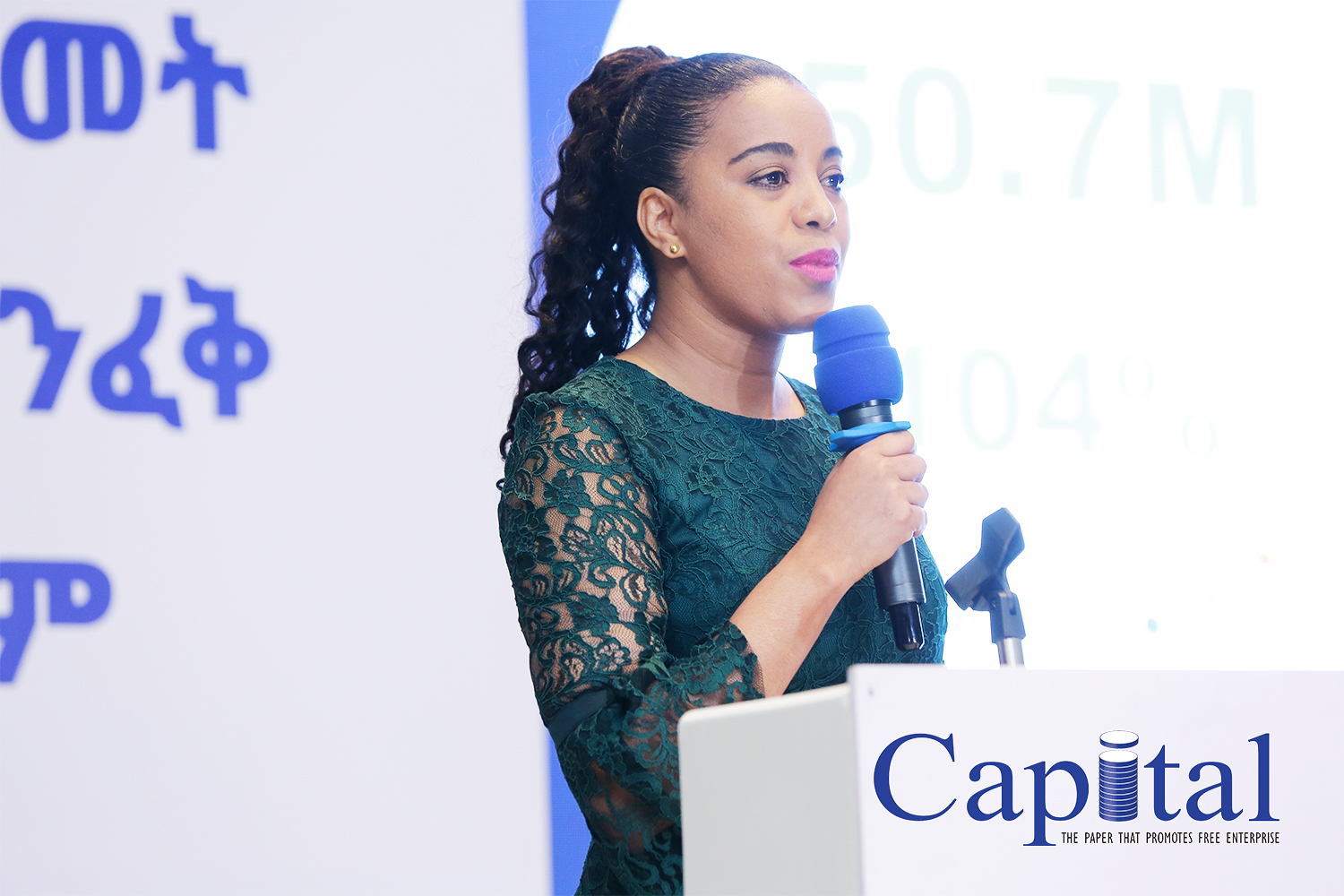
Statistic data released by statista.com on April, 2017 shows the value of the assets held by Ethio Telecom in 2015/16 fiscal year to be worth 37.9 billion Birr. This in alignment with the 42% increase given by the telecommunications giant can give a rough estimate of the value, although not fully conclusive when you factor in growth of the firm through the time gap of then to now.
Two weeks ago the Council of Ministers had enacted a regulation to adjust Ethio Telecom’s establishment regulation which integrates certain changes including allowing Ethio telecom to engage in Mobile Money and related digital finance services. Also regarding the authorized capital, the regulation increased to 400 Billion birr from 40 billion birr of the 2010 regulation. The regulation also gives the go ahead to engage in other related activities including forming an entity and gives the right to invest on equities locally and at international level.
Briefing journalists Frehiwot Tamru announced that for the first half of the fiscal year of 2020/21 the company had conducted vast reform activities and advancements to attain its set strategic objectives. The strategies include; preparing for the upcoming competitive market, enhancing customer experience and satisfaction through ensuring operational excellence, deploying new and enhancement of infrastructure and systems as well as service availability.
On matters enhancement of infrastructure and systems, Ethio Telecom has begun negotiations to lease the infrastructure as part of the company’s efforts to increase its revenue. The infrastructure is set to be leased to foreign companies. Ethio Telecom CEO Frehiwot Tamiru expressed that the company called on foreign companies to use their infrastructure whilst they enter the Ethiopian telecom sector. Moreover, she noted that the firm had begun talks with various international telecommunications companies who responded to the call. On similar lines, negotiations with the French Orange company are set to kick start in capital next week. As part of its preparation for the infrastructure sharing business, according to Frehiwot, the company has undertaken several initiatives to improve existing infrastructures and build new ones.
Currently Ethio telecom has more than 7,300 towers which are ready to be shared and has developed hybrid power solutions strategy to ensure site availability and made it scalable enough to accommodate additional tenant requirements.
“Currently, we are running 137 projects on infrastructure and system capacity enhancement, development and expansions aiming to boost network coverage capacity, and quality of services,” said the CEO noting that Ethio telecom will also launch mobile money services within short period of time.
With regards to the development of the firm for the first half of 20220/21 fiscal year, there has been a growth boom in all fronts. The state owned enterprise was one of the highest earning companies in the country and during the first half of the current fiscal year the company generated 25.5 billion birr revenue, which is 95 percent of the target and 12.3 percent increment from the previous budget year similar period.
Similarly, a rise in subscribers was accounted for during the period. Total subscribers reached 50.7 Million achieving 104 percent of the subscriber base target and an increase of 11.2 percent from June 2020 landing. Mobile voice subscribers reached 48.9 Million, Data and Internet users 23.5 Million, Fixed Services 981K and Fixed Broadband subscribers reached 309.4K. Population and geographic coverage are 95percent and 85.4 percent respectively. Telecom density has also reached 50 percent.
The CEO further highlighted that 80.2 dollar million was generated from international business, registering 105% of the target and 5.9% increase from same period last year.
The company for the first half also faced a set back through: COVID-19, fiber and copper vandalism, power interruption, land acquisition delay, and increasing operational costs. However, despite the challenges it remained steadfast in its growth.
The journey back to the stock market:

An In-depth review of the Capital Market Proclamation
The capital market proclamation that gives a minimum of quarter share for the government has been tabled to the parliament for ratification. For foreign investors they will play on the secondary market floor.
As the reason for the formation of the secondary market, the highly anticipated proclamation at its preamble stated that it has established a capital market to support the development of the national economy through mobilizing capital, promoting financial innovation, and sharing investment risks; adopt a legal framework for the regulation and supervision of the capital market to ensure the fairness, integrity, and efficiency of the market and protect investors; legislate uniform requirements for the regulation of issuers who desire capital from public investors, and necessary to adopt a legal framework for effective monitoring and surveillance of the capital market to detect, mitigate, and prevent systemic risk to the country’s financial market, the proclamation drafted.
The draft proclamation part two, articles three, indicated that Ethiopian Capital Market Authority will be established as a regulatory body of the secondary market and it will be accountable for the Prime Minister.
The authority will have the objective of protecting investors, ensuring the ecosystem of the market, reducing systematic risk and promoting the sector by creating enabling environment for long term investment.
The authority that will have a board as a higher body shall have the funds that consist of fees payable from services, administrative fines, and grant.
The proclamation article 31 also indicated that Ethiopian Security Exchange will be formed. The exchange will be formed as a share company by the government in partnership with the private sector which also includes foreign investors.
The same article sub article 2 said that the total ownership of the government and government owned entities shall not exceed 25 percent of the exchange’s capital.
“If there is insufficient interest from the private sector, the government’s ownership of the exchange can be increased to whatever amount is needed to establish the exchange,” sub article 3 three reads.
The fourth article further added that if there is no interest at all from the private sector, including from foreign investors, the exchange shall be established as a fully government owned public enterprise by regulation of the Council of Ministers.
Under the explanation document for the proclamation, it has been indicated that the intention of the government to take share at the company is only that the upcoming capital market is new for the country and that private inventors may not have eager to take share because of different reasons including clue about the business. Besides that, the involvement of the government as a shareholder is to boost the confidence of the private sector, which is expected to take the major share.
The proclamation has also given a green light for the formation of additional trading platforms under the securities exchanges as alternative or additional. But on the explanation document that has been presented to parliament, the article that mention for the formation of other capital market is considering the possibilities in the far future not the short- and medium-term situation.
“It is not expected that the country will have more than one capital market actor up to midterm but it is crucial to put the article on the proclamation since it may be required in the future when others demand to establish a similar share company,” the explanation document said.
Article 32 sub article one said that the authority may grant license to other securities exchanges or derivatives exchanges or over the counter trading platforms which shall be established as share companies.
Under part 8 of public offering and trading of securities article 79 that is ‘offer of asset backed securities’ sub article one said that an offer of asset-backed securities shall be made only if they are issued by a special purpose vehicle.
This may give right to foreign actors to be involved on the financial sector indirectly or allowed banks to borrow from foreigner sources in other direction than the existed banking law of the country.
“Such kind of sophisticated secondary market may not in the current level be present since the initial stage will focus on easy forms of the market,” the explanation says, “the authority will have additional legal frameworks to implement the article that stated in part 8 in the future.”
It added that the proclamation at the current stage shall benefit for the trading of simple asset backed securities.
“For instance foreign development partners may not be able to provide finance for small and medium companies since the existing banking business proclamation is closed for foreigners, while asset backed securities trading rules stated under this proclamation banks who provide loans for small and medium companies can created the loan or asset backed securities and trade it for foreign investors who are interested to invest on small and medium companies,” it said and explained that such scheme shall create conducive environment for small enterprises to assess who cannot be able to access the current financing platform besides supporting the overall economic growth.
The proclamation has also given a right for collective investment scheme that mobilize fund from small shareholders to invest on different securities.
The proclamation that is divided in 14 parts has 114 articles and it is expected to be ratified in the near future to realize the scheme which is also stated as alternative financial source besides the traditional scheme not only for the private sector but the government, who access finance from the central bank to fill the budget deficit but it is stated as one of the major instruments for inflation since it is a money print.
It has also stated to modernize the monetary policy of the country with additional alternative models.
About half a century ago Ethiopia had experienced a similar stock market that was regulated by the National Bank of Ethiopia but halted when command economy become effective in the second half of 1970.
