

Ethiopia finds suspects of the new COVID variants after preliminary research by the Ministry of Health /MoH/.
Dereje Duguma, /MD/, State Minister of Health told Capital that there are some suspected cases in which the ministry is working to figure out the type and the condition of the case. “Scientists are working to learn more about these variants to better understand,” said Dereje.
The COVID-19 pandemic continues to consume the Public Health sphere as multiple COVID 19 variants circulate globally. Several new variants emerged in the fall of 2020, most notably from UK, South Africa and the new one in Brazil. These variants seem to spread more easily and quickly than other variants. On variants, the WHO Emergency Committee /EC/ called for a global expansion of genomic sequencing and sharing of data, along with greater scientific collaboration to address critical unknowns.
As Dereje said, MoH in collaboration with other public health agencies is monitoring the situation closely to differentiate the type of the variant. As he said after full investigation and findings the ministry will officially disclose the case to the public in the coming week.
According to the center for disease control and prevention, the new strain has key gene changes to its spike protein that help the virus pass more easily from person to person. It is estimated to be about 50% more contagious than the main versions of the coronavirus circulating now. It was first detected in the U.K. called B117 strain and has forced England, Ireland, and Wales into another round of tight lockdowns as patients overwhelm hospitals there.
On 4th of January, South African health officials announced they, too, have detected a new, seemingly more contagious strain. Called the B.1.351 lineage, the new strain identified in South Africa is thought to be more transmissible.
As reports show, the B117 strain appears to spread much more easily than previous strains of COVID-19 that it spreads up to 70% more easily.
‘How widely these new variants have spread, How the disease caused by these new variants differs from the disease caused by other variants that are currently circulating How these variants affect existing therapies and vaccines’ is still under investigation by CDC.
In the United Kingdom (UK), a new variant of SARS-CoV-2 (known as 20I/501Y.V1, VOC 202012/01, or B.1.1.7) emerged with an unusually large number of mutations. This variant has since been detected in numerous countries around the world, including the United States (US) and Canada.
In South Africa, another variant of SARS-CoV-2 (known as 20H/501Y.V2 or B.1.351) emerged independently of B.1.1.7. This variant shares some mutations with B.1.1.7. Cases attributed to this variant have been detected outside of South Africa.
In Brazil, a variant of SARS-CoV-2 (known as P.1) emerged and was identified in four travelers from Brazil, who were tested during routine screening at Haneda airport outside Tokyo, Japan. This variant has 17 unique mutations, including three in the receptor binding domain of the spike protein.
New COVID variant looms over Ethiopia
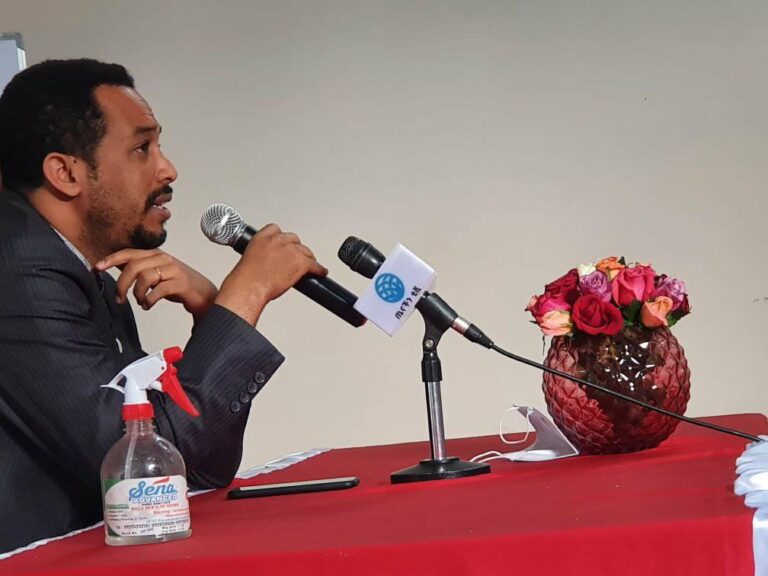
PPPDS annuls wheat bid due to defaults

The Public Procurement and Property Disposal Service (PPPDS) annulled the two milling wheat procurement awards for the purchase of 600,000 metric tons on two different bids.
PPPDS had awarded two companies for the supply of the milling wheat on behalf of National Disaster Risk Management Commission and Ethiopian Trading Business Corporation early November, while both foreign companies have disappeared to come up with the bid performance bond until the deadline of early this week.
PPPDS had awarded Rosentreter Global Food Trading to supply the 400,000 metric tons of milling wheat for Ethiopian Trading Business Corporation.
The grain that procured on the aim to stabilize the market was awarded to the Turkish firm at the cost of USD 76.89 million as per the bid offer opened October 13, 2020.
On the 200,000 metric ton milling wheat bid that opened on October 15, Marthina Mertens Sampl Lebensmittel Handel of German received the award at the total value of USD 40.39 million to supply for National Disaster Risk Management Commission.
However, according to Melkamu Defali, Public Relation Head of PPPDS, both companies did not come up with bid performance until the last minutes.
“As per the bid regulation the Service may take legal measure on the companies for their default,” he told Capital.
These procurements had taken several periods for different reasons, while the recent one has also failed to meet the target.
The six companies that were involved in the 400,000 metric ton bidding are; Green Export CA, Aston FFI (Suisse),Promising International Trading Co, HuytonInc, A plus Importer and Rosentreter Global Food Trading.
On the 200,000 metric tons bid Marthina Mertens, Promising International Trading Co, HuytonIncand, and Aplus Importer had participated.
Experts at the time expressed their concern that the winner may default since it did not have experience on the business in the country, while due to the country bid law, PPPDS did not refrain from awarding the company.
According to experts, Marthina Mertens on the other hand had some experience on the bid participation but they said that they did not remember the company winning such kind of bids in the country in times prior.
Melkamu told Capital that PPPDS may float another bid as per the interest to the public institutions.
Experts claimed that such kind of default costs the country since the price of the grain is increasing globally.
When the bid opened about three months ago, experts commented that the offer was comparably very good when it was measured against the global rate but they expressed their fear that the companies’ offers are unrealistic and may lead to default, which has now become real.
Wheat import costs the country up to a billion dollar per annum and the country has imported the grain for close to a decade and half on the aim mainly to fill the market gap.
The reformist government has announced that the country will cut the import by ample production locally. To meet the target, the government has taken different initiatives including allowing imports up to 560 agricultural equipment on duty free scheme and expanding irrigation that may allow farmers to produce the wheat on non rainy season or more than one harvest.
The government has also introduced a new initiative, ‘lowland wheat production’, which is unique for the country and in last year some harvest was reported from this initiative and this year it has expanded.
This year, the government has targeted to cover 250,000 hectare of land on wheat cultivation on irrigation schemes and so far 90,000 hectare have already been covered.
The Experts view
Experts, who demanded anonymity, expressed their concern for the frequent default on the wheat procurement. They suspect that it may be a political sabotage that targets the government that has been unable to buy the grain, “Such kinds of sabotage have been observed in other countries due to that the government should be alert on these frequent defaults because for about over a year the country has been unable to buy wheat because of the disappearance of bid winners.”
“We observed that bid winners disappear before signing the contract and another time with their bid performance, which forced the government to go through a lengthy procurement,” experts said.
“In the middle of this long process the country lagged to buy the product on time and that may force to use its stock,” they added.
They recommended that PPPDS should apply high bid security bond amounts that shall be at least one USD per ton. “In this case real bidders shall participate on the bid, otherwise if we go on the existed experience it would be difficult to determine if the bidders are real and ready for the business,” they said.
In June, 2020 Gemcorp and PPPDS had signed the award for the supply of 200,000 metric tons of wheat plus 20 percent or additional 40,000 metric tons at the total value of USD 48.8 million. Experts claimed that since then the grain has not been bought except the 80, 000 metric tons that was bought for safety net purposes for the World Bank.
Government re-imposes 5% tax on edible oil

As result of over invoice of edible oil, government has re-impose tax and tariffs on imported edible oil products which were removed for about four months to stabilize the market and minimize the economic effects of COVID 19 on households.
Eshete Asfaw, State Minister of Trade and Industry told Capital that the government’s initial removal of tax on the edible oil was to support the supply chain as well as unburdening citizens during the COVID 19. However as the State Minister explained government has decreased the amount of tax imposed on edible oils from 40 percent to 5 percent only.
There are over 900 companies importing different kinds of cooking oil mainly from Dubai, Netherlands, Indonesia, China and other Middle East countries. Also there are over 1,000 companies that are registered by the Ministry of Trade and Industry to process oil in the country. However, despite the price the supply has never met the demand. Currently, eight edible oil plants are under construction in Amhara region with an aggregate refining capacity of over 2,500 tons of edible oil. This is in addition to 11 huge edible oil refineries that are active in the country. Currently, the government only imports 40 million liters of edible oil every month; the country needs 57.2 million liters of oil every month.
As the minister highlighted, previously 40 percent of tax was imposed on imported edible oil, of which is 30 percent was of tariff and 10 percent for surtax (a tax levied on top of another tax). However on the re-approved tariff only 5 percent is imposed.
“Previously, the government had worked to fulfill basic needs of the people in helping them to pass the time and increase the supply to meet the demand in all different kinds of oil products,” said Eshete Asfaw, State Minister of Trade and Industry, adding that currently the economic pressure resulting from COVID has lessened and that activities are getting back to normal.
Through the past months the oil market has been showing massive reduction in the price including sun flower and other refined and standard oil products which on average then reduced by 20 birr per liter. However, as of the last three weeks the price seems to be back to its previous price. “There has been an over-hike to edible oils in the market that is not reflective of the current imposed tax. This to me is not fair at all to the consumer,” said Eshete, explaining that the situation will be put under control.
Currently the country imports 40 million liters of palm edible oil every month through 24 selected importers to distribute it with affordable price.
“The government will support local producers to increase their capacity and to begin their operation as soon as possible,” affirmed Eshete.
“Available capacity to expand production could make oil turn into one of the engines of economic growth of the country,” said Eshete.
The federal government spends USD48 million every month to import edible oil, underscoring the pressing need for import substitution, Ministry of Trade & Industry explained.
While import of edible oil is almost USD576 million annually, it accounts for almost five percent of the country’s imports, which stood at USD15 billion during the last fiscal year. As reports show the local production covers only 12 percent of the demand while the rest is covered by imports.
OLD LEFT & NEW RIGHT
It used to be somewhat easy to differentiate between the core essentials of the ‘left’ from that of the ‘right’, at least in the world of political analysis, if not praxis. Even though there are ideological beliefs (stated or otherwise) that are foundational to the respected adherents of these declared groups, the inclination not to be tied by strict doctrinal rules permeates general belief in the western world. To be sure, the distinction between ‘left’ and ‘right’ was never hard and fast in the West, particularly in the USA. What actually obtains is a conception that some issues are essentially regarded as ‘left’ issues while some others belong to the ‘right’. Theoretical, principled and thoroughgoing convictions in social thoughts never really caught in the ‘land of the free and home of the brave.’ Empiricism is what reigns in the Anglo countries. As a result, not-so-deeply principled arguments tend to sway day-to-day narratives, be they in politics, economics, etc.!
The neoliberalism of late 20th and early 21st century obliterated, to a large extent, the already superficial distinction between the traditional ‘left’ and ‘right’, to a point where differences arise mostly due to exigencies, rather than substance! What is currently witnessed via elections in the West is a testimony to the unraveling of the ‘old left’ and the ascendance of the ‘new right’. If truth be told, the ‘left’ in the West never really moved left of ‘social democracy’. By the same token the right or the general right, always tempered by labor, militant or otherwise, didn’t manage to go beyond ‘crony capitalism’, at least up to now. But things-are-a-changing! The custom in the core countries of the West (OECD=rich countries) used to be; any politician insisting his/her country leave NATO, a military treaty whose mandate has long expired, would be considered a ‘radical left’. Le Pen of France, a ‘rightist’, is one current politician advocating the withdrawal of her country, not only from NATO, but also from the EU! The lady commands significant followers in France. Jeremy Corby, head of the UK’s Labor party, considered a ‘lefty’ by many, also supports the idea of pulling UK out of the belligerent institution! So the two are in agreement in this particular issue. What is a ‘left issue’ or a ‘right issue’ is becoming difficult to answer.
What is not being revealed in the labeling game is the fact that many of the emerging right and the old left ensemble share one thing. They are willing to investigate ‘the truth and the whole truth’ behind many of the issues being pushed by the entrenched establishment. By doing so, they (the old left & the new right) have started to cover the same grounds and are discovering their current common enemy; ‘lies, damn lies and statistics’, to use Twain’s aphorism. Global dominant interests have leveraged all that is at their disposal to continuously hoodwink the gullible sheeple (human mass). So far the status quo has gotten away with murder, but now the sheeple is waking up. It has started to investigate/explore matters outside of establishment discourse, duly assisted by activist intellectuals. This is where the empowering & liberating feature of modern informatics comes in! To its dismay, the sheeple is finding out that almost all narratives of the status quo are, at the end of the day; lies, damn lies and statistics. For example, MSM (Main Stream Media) was forecasting that Mrs. Clinton would win the election hands down. Some forecasters even claimed this with a 90% probability! This numbing and misdirecting of the sheeple’s was done intentionally. Prior to this, Bernie Sanders’ chance of wining the democratic primary was systemically thwart off by the ever-manipulative ‘deep state’, which incorporates the MSM. When the sheeple, out of frustration, finally decides to go its own way, i.e., vote Mr. Trump, a candidate deemed an ‘’outsider, the deep state went berserk. Pathetic! After such obvious incidents, our extended definition of the ‘deep state’ is gaining traction amongst serious and independent articulators. Our definition of the ‘deep state’ is: It is the military-intelligence-industrial-banking-media-complex of (mostly) strong states.
When the likes of Wikileaks came to the fore, few years back, the global status resolved that they should be crushed. All sorts of pretexts, not excluding blackmailing, was/is used to achieve the objective. Nonetheless and gradually, the global sheeple developed the taste and the trust for alternative media outlets, thereby undermining the establishment’s outdated and lopsided narratives. Recent survey conducted using a large sample of people (about 100, 000) came up with the following astonishing result. Only 17% of those surveyed trust the government (CIA, etc.) or the MSM. The rest, 83% of them, trust Wikileaks! We think that says it all! The skewed narratives of dominant interest, fully enhanced by the MSM on Syria, Ukraine, Libya, Iraq, etc. were found to be outright lies, damn lies and statistics! The current on-going campaign of misinformation/deceit on; various issues like, ‘Russia hacking the US election, as if it were a mere ‘banana republic’ (Putin’s words) or ‘Trump is a Russian hand’ or ‘Syrian citizens being exterminated in Aleppo by their very liberators’, blah, blah are lies, damn lies and statistics!
One thing must be emphasized; at a deeper level there are thorny issues of principles that still separate the left from the right. Frankly speaking, there isn’t much one can do about the real foundational differences, except to appreciate and respect the other’s point of view and hopefully try to coexist harmoniously, assuming of course, the success/triumph of one is not predicated (necessarily) on the elimination of the other! As it stands, lies, damn lies and statistics is bringing the two traditional poles of political orientations together.
The ‘deep state’ has been implementing very destructive projects across the world and it is instructive to have a glimpse of the thinking behind the continuous atrocities. “The technotronic era involves the gradual appearance of a more controlled society. Such a society would be dominated by an elite, unrestrained by traditional values. Soon it will be possible to assert almost continuous surveillance over every citizen and maintain up-to-date complete files containing even the most personal information about the citizen. These files will be subject to instantaneous retrieval by the authorities. ” Zbigniew Brzezinski (1970). Good Day!
