

Human societies are organized around collective shared values, which arose from enduring social interactions/experiences. These common tenets were mostly derived from the transcending efforts of religious spirituality. From time to time established values need fine-tuning as the material condition of societies on the ground keeps changing, thanks to our obsessive/impulsive proclivity to disturb things around us, without much reflection. Be that as it may, absence shared values, human societies can hardly survive, let alone thrive. This critical cohesive feature of the dominant species seems to have been lost to the ever-expanding and irrational techno-sphere of late modernity fully supported by intellectual minions of the ‘learned’ types including the ‘Ivy Idiots’! We repeat; without some kind of socially constructed values governing, not only the social environment, but also our very interactions with the natural world, humanity will not survive as a creature of conscious, let alone conscience!
Late modernity is preoccupied with capitalist constructs based on the greed impulse (competition, etc.) of humans. As the ‘techno-sphere’ continues to forcefully dictate life, the far more important notion of cooperation is relegated to the backburner. Psychopaths/sociopaths who have been ruling the world have managed to systemically set up a global value system that neither respects altruistic social interactions between humans, nor the preservation of nature and natural processes! Modern human’s frightening infatuation with gadgets/processes, without much regard to the biosphere has now come to haunt us all! Life is sustained because of certain inalienable aspects of existence, based on loops within natural systems, living or otherwise. Unfortunately, our trinket obsessed civilization (techno-sphere) continues to undermine these critical preconditions of life, to such an extent that its immature import in the social realm (values) is now tearing apart the natural human tendency for harmonious coexistence. In this regard, the reigning shallow ‘capitalist ethics’ need to be interrogated with heightened morality.
The 20th ‘socialisms’ claimed, directly or in a round about ways, to be ethical systems of human organization, more than anything else. But the assertion was effectively destroyed when psychopaths/sociopaths ascended the ladder of political power. ‘Socialist ethics’ was formally established in a number of countries and tried to curtail the material base that facilitated excessive greed. The attempt failed to stop connected individuals/apparatchiks from practicing heightened greed and evils of all kinds. Even though the system’s general guideline was ‘……to each according to his/her needs……’, the practical application of the socialist doctrine ended up being nothing more than ‘…some are more equal……’ Along with this, the broader vision of socialist utopia (of the 20th century) was effectively lost in the game of ‘catching up’ or what is now termed Sovietism. Currently, mercantile neoliberalism is also gaining ground on Maoism! This brings us to the question; is ‘socialist ethics’ unrealizable? If so, current crony capitalism, hardly endowed with anything remotely ‘ethical’, will only proceed to create more chaos and havoc all over the world. Then, where will humanity head? At the dawn of the 21st century, this is a serious issue to be reflected upon! There are indications to suggest that all and sundry is grappling with this critical issue, in various domains. The ascending ‘Populism’ in the West, to use establishment lingua (which is always full of unsavory connotations) is a cry for more value based existence, grounded on objective reality and not fiction.
The multi-polarity that is in ascendance promises much more than what the west has done and keeps on doing. What the states in ‘the enlightened west’ lost in their greedy pursuit of domination is being recaptured (democracy, sovereignty, etc.) willy-nilly, both by ascending powers (Russia, et al) as well as by the very sheeple (human mass) of the Western world. Obviously this is driving the ‘deep state’ of the west to madness, literally! Global entrenched interests, driven by unlimited arrogance supported by their numerous institutions are not willing to tolerate the palpable unease of their disillusioned sheeple. When the sheeple starts to point out the stupidity of the eilites, in its own waywardly ways, (via elections, etc.) it is blamed for inciting ‘populism.’ After all what is populism, if not popular drive! The revolting ways of the ‘deep state’ is being exposed in many ways than one and it would be foolishly naive not to expect a drastic backlash from intransigent operators of the status quo. History is full of such incidents.
The new ethics must be defined by values that foster life while avoiding systemic greed. As it stands, systemic greed is well on track to destroy the biosphere and the social sphere. Individual greed might not be avoided, but can be managed, particularly by not allowing psychopaths/sociopaths to take over institutions of collective governance, be they in economics, politics, etc. As the highly experienced military officer put it: “In the councils of government, we must guard against the acquisition of unwarranted influence, whether sought or unsought, by the military-industrial complex. The potential for the disastrous rise of misplaced power exists and will persist…we must also be alert to the equal and opposite danger that public policy could itself become the captive of a scientific-technological elite…As we peer into society’s future, we – you and I, and our government – must avoid the impulse to live only for today, plundering for our own ease and convenience the precious resources of tomorrow.” General Dwight Eisenhower, President of the USA (….). Good Day!
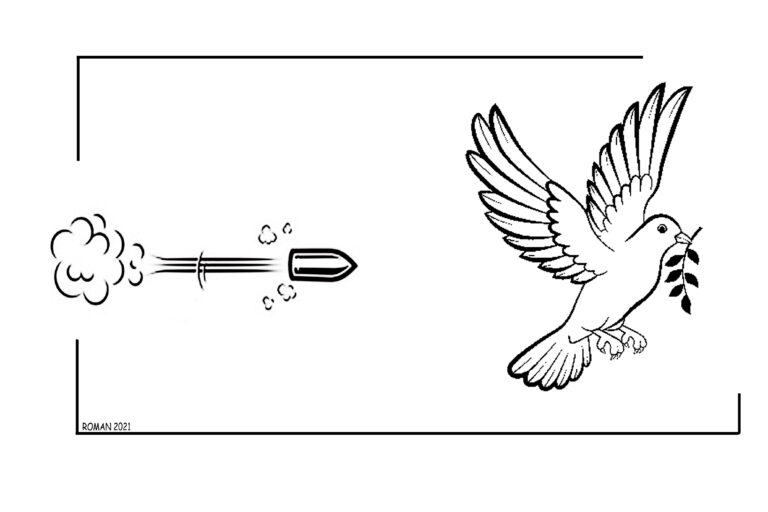
VALUES DEFINE HUMANITY
Wegagen proves profitable yet again
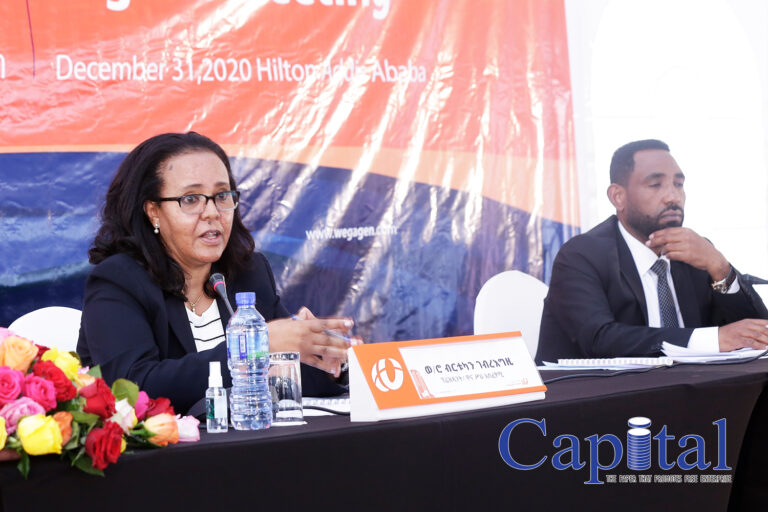
Deposit mobilization north of 30 billion birr recorded
Wegagen Bank conducts its general assembly with absentia of majority board of directors including the chairperson, while it concluded the year with massive achievements.
Wegagen, which is one of the top profitable financial firms, conducted its general assembly on December 31, 2020 and reported that the earnings per share (EPS) has increased by more than 22 percent.
Like EPS, in the financial year that ended on June 30, 2020, the bank has registered magnificent growth on different measurements of its bookkeeping.
For instance the bank profit before tax has expanded by 47 percent and reached almost 1.1 billion birr in the 2019/20 financial year compared with the 2018/19 performance that was 735 million birr.
Similarly, in the reported year the bank profit after tax has almost attained 35 percent additional growth compare with the preceding year.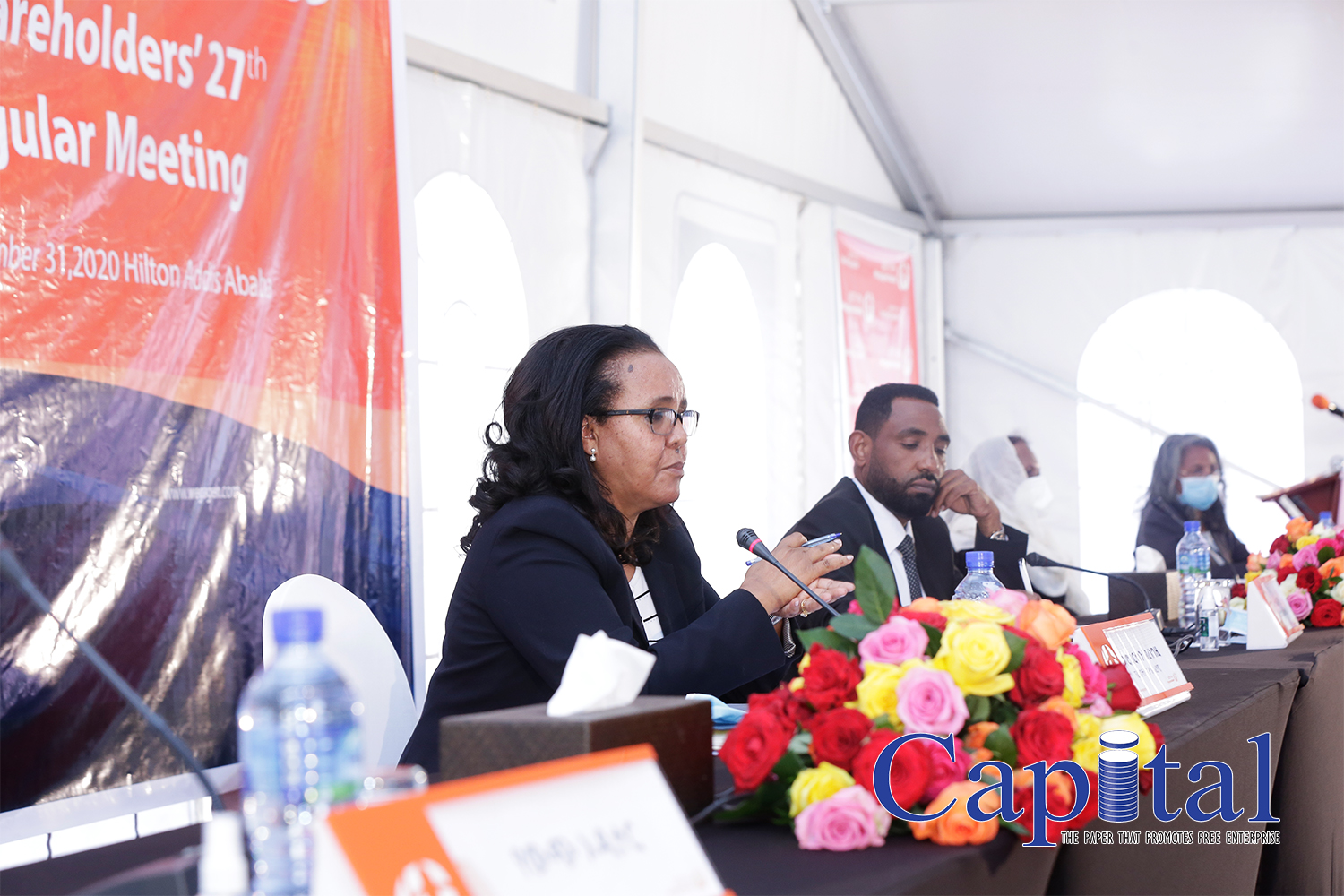
According to the annual report of Wegagen, on the 2019/20 financial year additional 217 million birr profit after tax gained and reached at 832 million birr from 621 million birr a year ago.
For the year, its total income was 4.4 billion birr with the growth of 38 percent or 1.2 billion birr compared with the 2018/19 performance.
“The growth registered was the result of the growth recorded in major income categories of commission and charges, which exhibited 71 percent increment, as well as interest on investment and interest on loans and advances that grew by 42 percent and 28 percent respectively,” the annual report of the bank explained.
The company asset has also boosted by 28 percent to reach at 38.2 billion birr that was about 30 billion birr a year ago.
Its total capital has also increased to 5.1 billion birr that was about 4.3 billion birr in financial year that was ended June 30, 2019.
From the total capital, the paid up capital has taken the lion share and reached at 2.9 billion birr from 2.5 billion birr.
One of the major achievement for the bank in the stated financial period was the deposit mobilization that reached at over 30 billion birr with 28 percent increment compared with the 2018/19, 23.5 billion birr.
Similar to other financial firms the saving deposit seat atop with 61 percent share from total deposit mobilization.
For the year the loans and advances that the bank disbursed has reached at almost 24 billion birr by increment of 44 percent, while export was the major beneficiary with 31 percent share and followed by domestic trade and service that consume 19 percent of loans and advances.
For the year the bank expense has also sky rocketed to 3.3 billion birr from 2.5 billion birr.
On the booming interest free banking that Wegagen called ‘Amana’ the deposit mobilization has expanded by 72 percent and reached 1.3 billion birr. The total interest free financing that bank has disbursed 381 million birr that increased by 62 percent from the preceding year.
The bank has over 1.8 million depositors and 383 branches as of June 30, 2020.
At the general assembly held on December 31, the board of Directors Chairperson, Mengisteab Gebrekidan and some other directors were not seen.
Unlike the usual trend, the board chairperson did not slot his annual message on the annual report.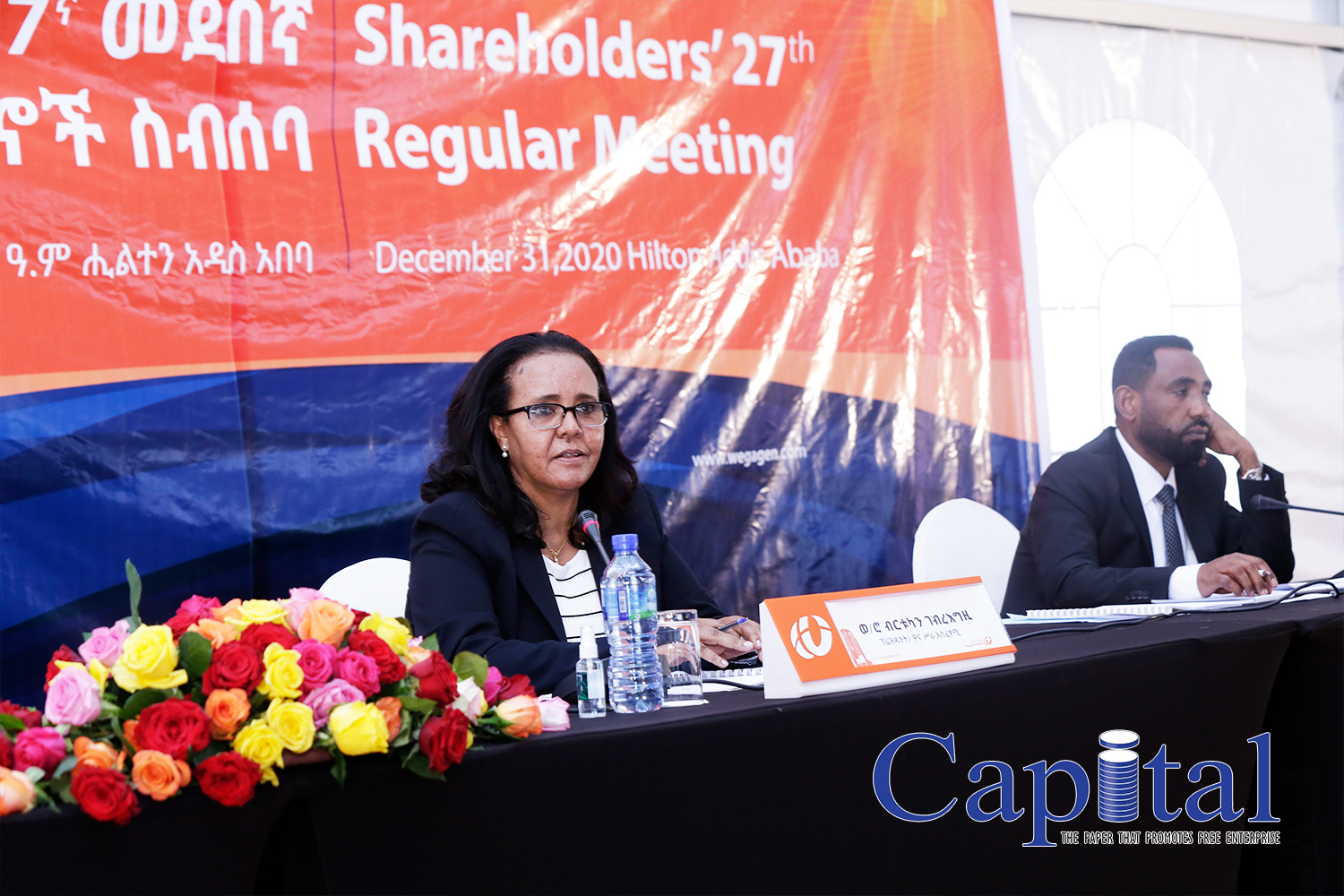
Instead, Tefera Molla, Vice Chairperson gave the message for the year.
On his message, Tefera said that despite the challenging environment at global and national level that he mainly associated with COVID 19, the bank continues to be profitable and managed to record increment in the key performance indicators.
JCC, MasterCard Foundation partner to fuel innovative business
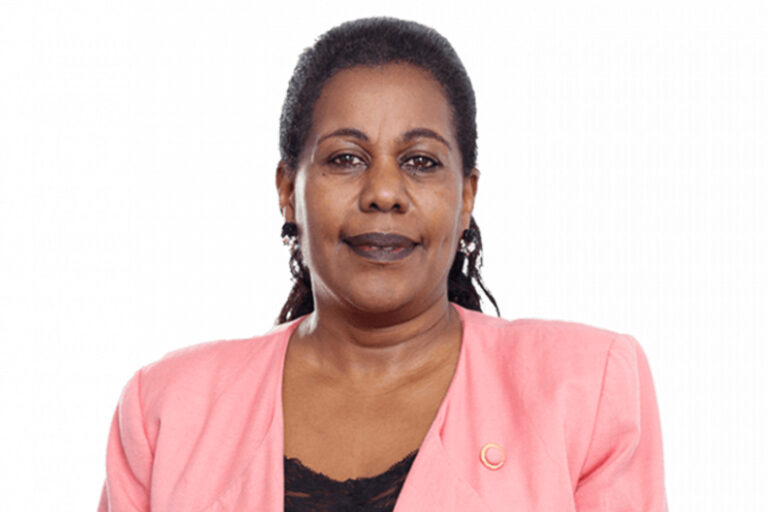
Jobs Creation Commission (JCC) in collaboration with MasterCard Foundation is set to award 200 new and innovative businesses on the program that will be held in the coming three years.
On the program launching ceremony, Alemtsehay Dersolegn, Director of Innovative Jobs and Projects of JCC explained that some of the winners will be expected to be well known enterprises globally in the coming at least ten years’ time.
The initiative will be started in the current year and for first year, 20 winners will be selected, while an additional 10 would get the award for their business idea besides the 20 winners that will get ample attention to attain their business dream to be successful.
The commission has announced that the registration for the business ideas competition that is called ‘Bruh’ commenced on January 9 and will be open for one month until February 7.
The application shall be done via online on bruh-et.com or offices in towns throughout the country. Alemtsehay said that 500 business ideas that may contain 1000 youths will be selected and those selected individuals will get extended training for one month before they appeared to juries to present their business ideas.
“On the competition process, 300 business ideas from 500 will be short listed and included on the award, while from the 300 business ideas the 200 business ideas will be selected to get business development support or business acceleration that have a six months period,” she said.
“The main objective of the Bruh initiatve is to get youths that have different innovative businesses that becomes applicable in real life,” she added.
For the first year, 50 business ideas will be selected from the total applications and they will get an intensive of one month training that includes entrepreneurshipand capacity building before it comes to juries to table their ideas.
Dawit Mulugeta, Manager of Innovative Jobs and Projects, said that the training helps those 50 selected business ideas to enable to develop feasible business proposal that may convince investors to invest on it.
On the process, 30 ideas that may contain 60 youths will be selected for the award and from the stated ideas 20 will be selected for six months incubation for business acceleration that will make them a company that shall be recognized as one of the major businesses in the country with potential job creations.
Those who may participate on the competition should have the age of 15 to 29 and mainly new businesses or those that do not extend more than 2 years on business activities, while the financial award seed money will be 200,000 birr for this year.
“The award may not be big but the major support will be the business acceleration that shall not be determined by money but it will garner major attention,” the Manager said.
Dawit said that business ideas that have innovative idea, scalability, shall create huge jobs in the coming ten year, and the business idea shall come up with solutions which are the major four pillars that focus on the competition that follows by different committee members selected from different organizations.
Dawit explained that to introduce the new program JCC has observed the experience of others.
The competition will be share on TV every week. MasterCard Foundation will provide the finance or seed money.
9 billion birr required for humanitarian aid, stresses ERCS
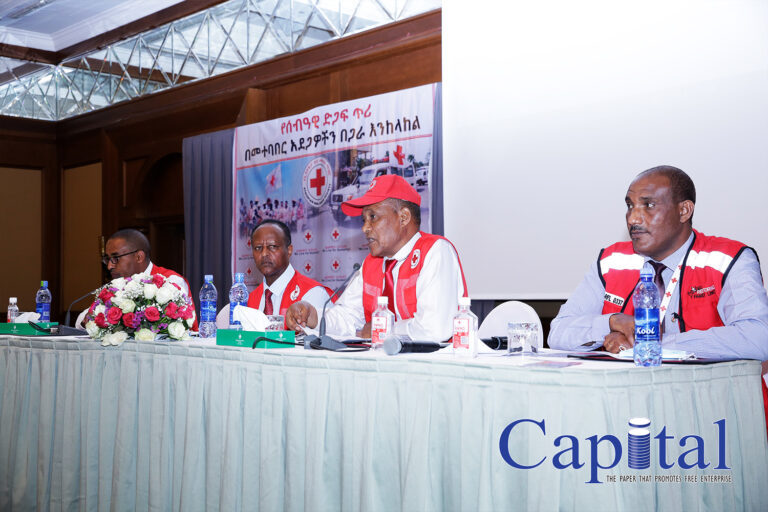
Ethiopian Red Cross Society (ERCS) demands 9 billion birr to asses’ humanitarian assistance in the 4 regions affected by conflict and violence.
According to ERCS assessment on the current conflict and violence on the ground, a total of 0.53 million people are in need of humanitarian assistance in Tigray, Amhara, SNNP and Benishangul-Gumuz regions which requires 9 Billion Ethiopian Birr to provide general and supplementary food, non-food items water and sanitation services and other essential.
Human and natural made calamities, mainly conflict, flood, locust swarm, covid-19, among others, have been alternately ravaging the country causing endless humanitarian crisis, to say the least. No sooner Ethiopia has tried to tackle the locust swarm, flooding, Covid-19 than hit by another wave of internal conflicts and violence in Tigray, Oromia, Benishangul Gumuz, Southern regions claiming the lives of hundreds of thousands. Millions of internally displaced people, vulnerable children, women, the elderly, people with disability and the wounded have left their home fleeing the conflict riven areas and other natural mishaps.
The National Disaster Risk management Commission (NDRMC) report of September 2020 indicates that flood has also affected 1,095,358 people out of which 313, 179 people were displaced across the country. Regarding Covid-19 pandemic in Ethiopia, it economic, social, health, education and political impact has continued affecting millions of peoples to say the least. Added to all these, the recent conflict and violence have complicated the humanitarian response of the National Society.
In 2019/2020 Ethiopian fiscal year, ERCS had provided: Food and nonfood items support, early recovery and rehabilitation services, Covid-19 protection and mitigation services, ambulance and first aid services, Psycho Social Support, and restoring family link services, to over 36 million individuals spending over 700 million Ethiopian Birr.
In the first quarter of the Ethiopian budget year, July – October, 2020, ERCS has reached 138,000 beneficiaries who were in need of humanitarian support with 70 million Ethiopian Birr. 300 volunteers and staff and 100 ambulances were mobilized for this humanitarian mission including the locust swarm affected areas of the country in which ERCS actively involved in saving the lives and protecting the livelihoods of the vulnerable. Since the onset of conflict and
violence over the last two months, ERCS has provided ambulance and first aid services and non-food item including medicine and essential shelter for the victims. Moreover ERCS Mekele Branch has been providing water trucking to the incidents. These services have been given to overseers of 30 million Ethiopian Birr.
Targeted to support 2,534,297 peoples affected in the four regions IRC has called its partners and volunteers to raise 233,090,712 million dollar fund. 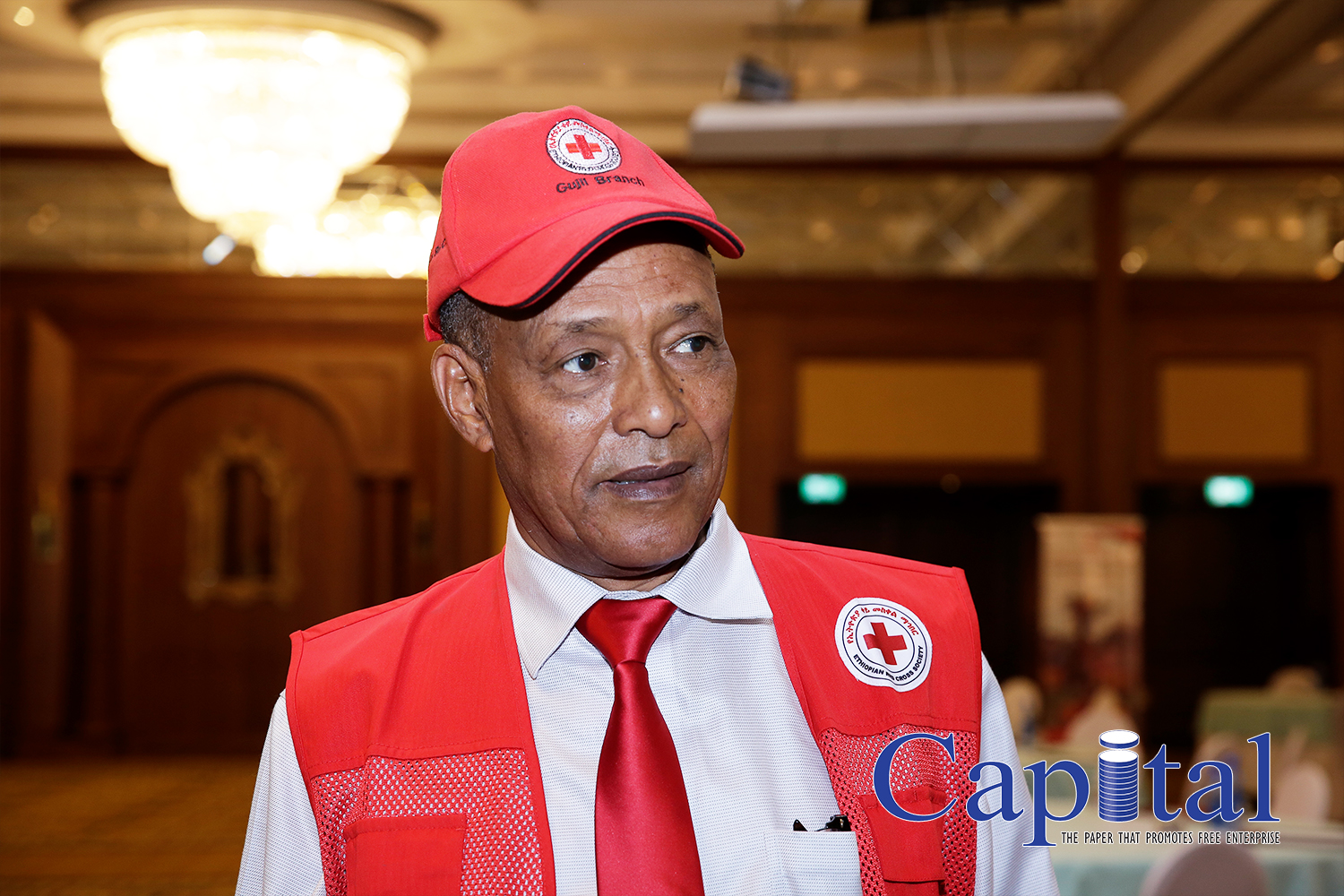
IRC suggest enhancement of the culture of nonviolence through provision of peace education to increase peaceful coexistence among people, Better coordination and collaboration among humanitarian actors to address ever increasing humanitarian actors, Strengthening ERCS’s emergency preparedness and response capacity at all level for a better living.
IRC planned to support Western Tigray and North Gondar 646,462 population, Central, S/eastern, N/western and Eastern Tigray (22% from total affected 1,280,094), Southern Tigray, North wello and zone 2 of Afar (394,645), Metekel zone (336,823), Konso, Alle, Derashe and Bench Shoko of SNNP (204,493).As per the direction of the National board, 4 teams drawn from different departments and branches including Partner National Societies and ICRC representatives made an assessment in
Western Tigray and North Gondar
Central, S/eastern, N/western and Eastern Tigray
Southern Tigray, North Wello and zone 2 of Afar
Metekle zone of Benishangul Gumuz region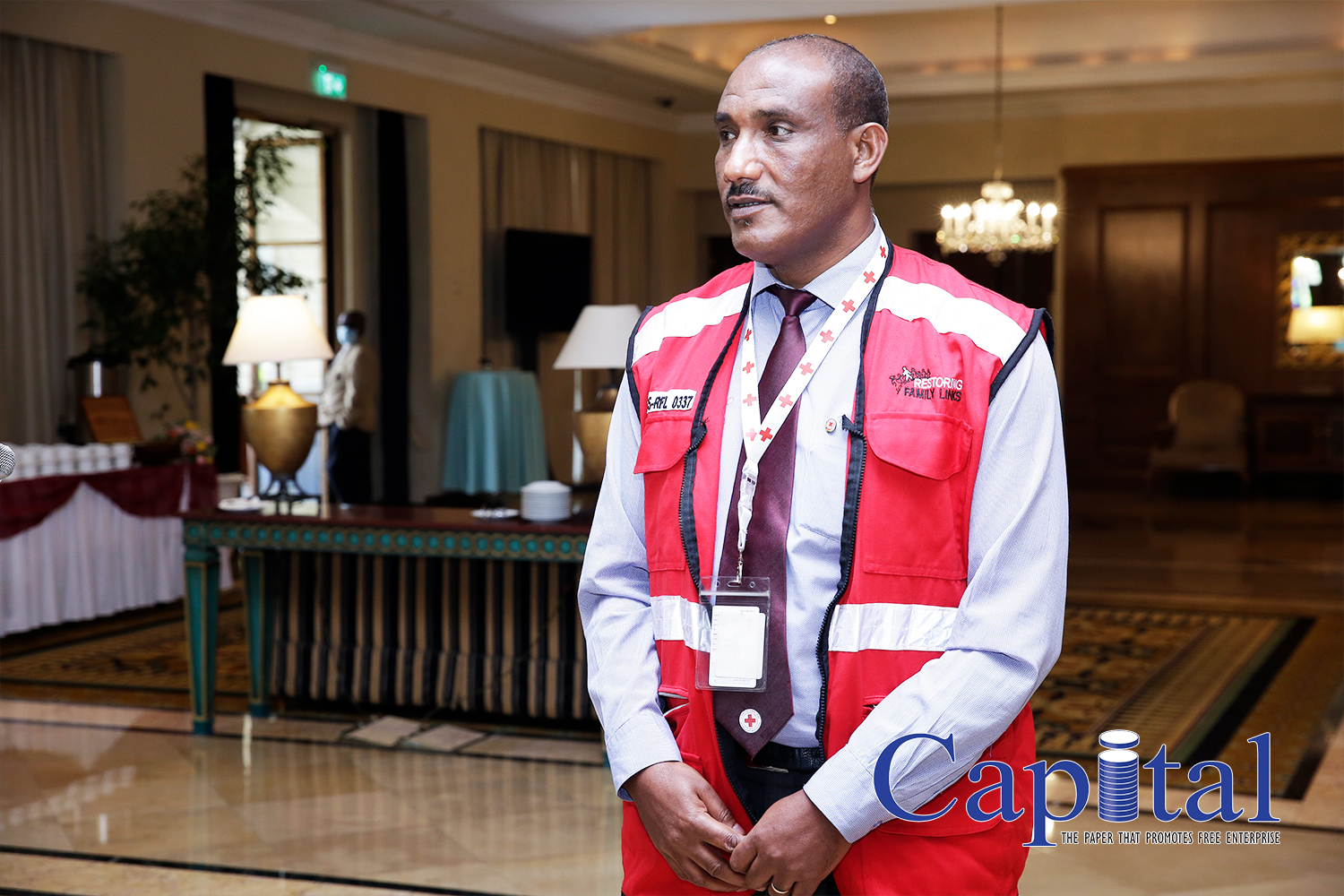
Konso, Alle, Derashe and Bench Sheko of SNNP
Assess and evaluate the impact of conflict and violence disaster affected people.
Identify the priority emergency and early recovery needs
Identify the most vulnerable people (IDPs, non-combatants, under five children, pregnant and lactating mothers, etc.)
Western Tigray and North Gondar
