Tuesday, May 26, 2026
Home Blog Page 3456

SMLH extends third and final round of support to Hizbawi Serawit School

0

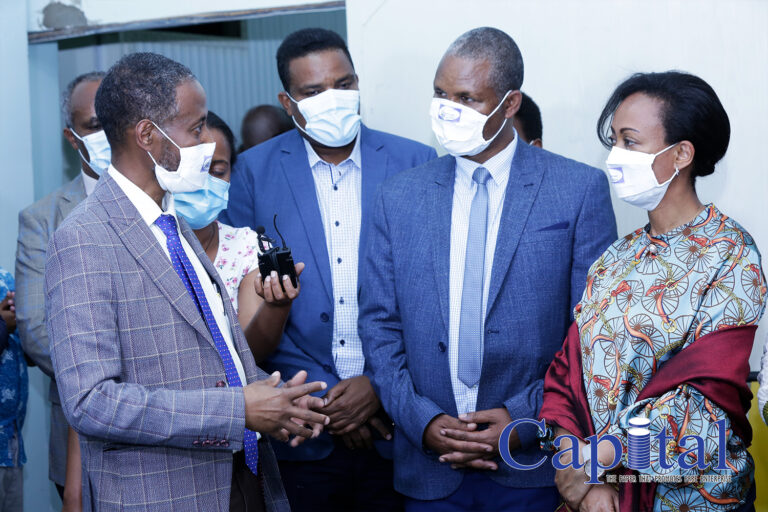
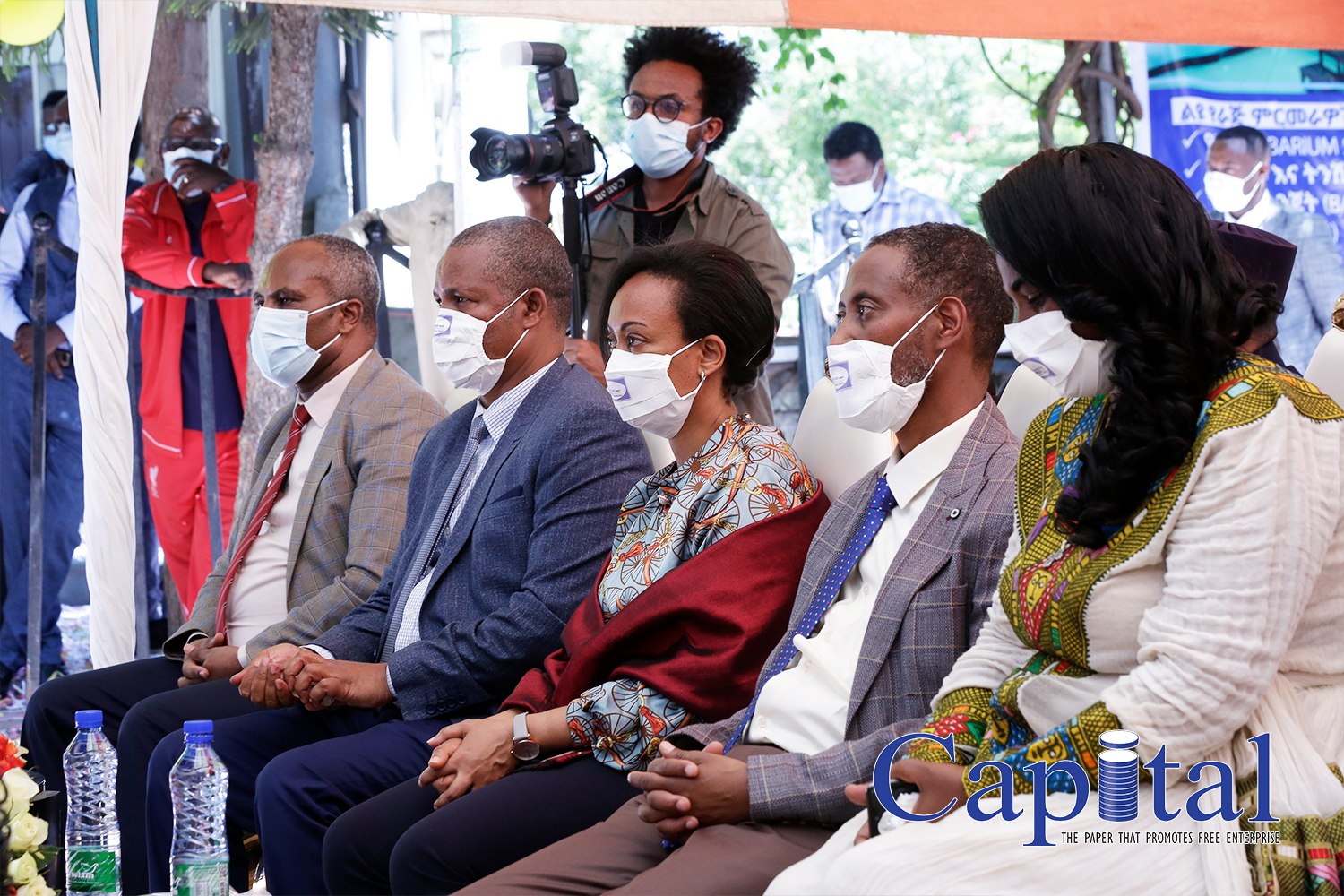
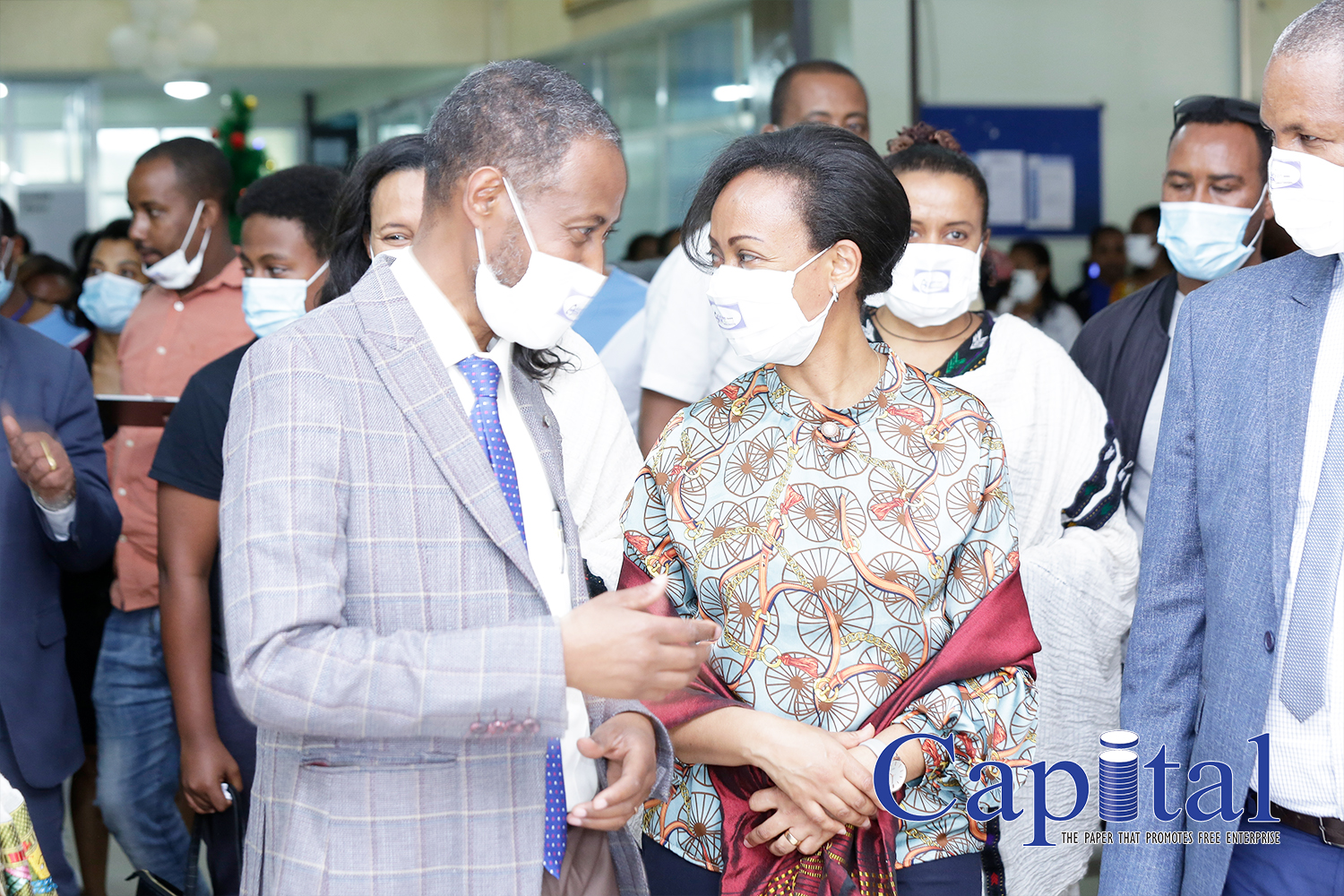
The Ethiopian section of the SMLH-ONM, Société des Membres de la Légion d’Honneur and Ordre National du Merite, as part of their three-month food support project for disadvantaged students of Hizbawi Serawit School and their families, donated the last and third round assistance on Saturday August 1.
The project that was launched on June 6th aims to benefit 100 students and their families in need of support from the school. To realize this project members of SMLH, Zemen Bank Labour Union, Icare ye Lycee LiJ, and other companies and individuals came together to contribute their part as their corporate social responsibilities.
“Our association, SMLH-ONM has provided basic need support for 100 students and their families aiming to alleviate the challenges that they face in relation to the COVID 19 pandemic for the last two months,” said Teguest Yilma, President of SMLH-ONM Ethiopia.
“Over 500 family members will be beneficiary of SMLH’s initiative,” Teguest explained saying “this is to encourage the students to focus on reading and studying as much as they can while they stay at home because of the pandemic.” She also thanked all those who supported the initiative.
Students and their families received basic food items like teff, edible oil, pasta, flour and sanitary products. This will continue for another one month, until September the end of the rainy season and hopefully school will resume, she said.
For SMLH that is formed to strengthen cooperation and friendship between French and Ethiopian communities, providing support for Hizbawi Serawit School is not the first time; the association has also inaugurated a tap water and hygiene facilities for the students.
Commander Pierre-Francois Ferri Navy- Military Advisor at the French Embassy said that France will always stand with Ethiopia. “France will assist in everything it can to support Ethiopia,” the Commander said during the event.
These students were part of the Addis Ababa City Government school feeding initiative that provides breakfast and lunch to children who go to school, but since schools have been closed due to the pandemic, the program has been halted.
Zerihun Korme, Yeka Sub City Woreda 2 Education Bureau Head also said that the community should stay vigilant about COVID 19. “The families and the students must be more careful in protecting themselves and others around them in these difficult times.”
Several actions have been carried out by the members of the SMLH for the benefit of the Hizbawi Serawit School, in particular through educational projects.
SMLH Ethiopia has supported the school in Addis Ababa which is located in a popular and historic sector north of the capital. Close to the French Embassy, this district, called “Farensaï”, was reserved in the 1960s by emperor Haile Selassié for the settlement of the families of the combatants who participated in the first peacekeeping operations in Korea and Congo.
The association of SMLH Ethiopia was formed in 2013 by the recipients of the French government’s award of the Legion of Honor and Ordre National du Merite in recognition of eminent services rendered to their country and the strengthening of Franco-Ethiopian bilateral relations. SMLH-ONM Ethiopia brings together the decorated of these two French national orders living in Ethiopia, both French and Ethiopian nationals.
Since 2017 the section was joined by those honored with French ministerial awards, mainly academic awards in arts and literatures as well as agricultural merit, and maritime merit among others.


Canal+ aims to join the pay-TV market by March next year

0

Canal + Group, a Paris based and one of the biggest global pay-TVs and that partnered with Ethiopian Bruh Entertainment is expected to be on air in March 2021 with local shows.
In connection with the visit of President Emmanuel Macron in March 2019 the French TV company that is owned by Vivendi, an integrated content, media and communications group, signed a memorandum of understanding with Bruh Entertainment for the implementation of a distribution agreement for the commercialization of a pay-TV offer.
Tewodros Abraham, owner of Bruh Entertainment, said that the pay-TV will commence operation in the beginning of the coming year.
There are two pay TVs in Ethiopia, while they are not considered as a streaming of shows based in Ethiopia or incorporate with local languages, according to Tewodros.
“We are undertaking the required preparation to commence Ethiopian shows with the pay TV channel,” he said.
Early this week Eutelsat, a French satellite operator, and Canal+ have signed a multi-year, multi-transponder contract for Ku capacity on EUTELSAT 7C to support the launch by CANAL+ of a premium DTH platform in Ethiopia.
“The deal signed this week with is very important, since they will provide dedicated platform for Ethiopia,” Tewodros said.
The pay TV is expected to commence its operation with up to 50 channels and in the future that will be expanded to 80 channels.
“We are looking at dedicated local shows with local contents,” he said adding “Ethiopian producers that might be engaged in movies, cooking channel, documentaries or talk show, should use this opportunity to use the platform.”
Shows that might be related with education system or job creation, which may include relevant government stakeholders, will have a space at the pay-TV, according to the Ethiopian partner, “because our capacity is very wide.”
“Currently we are engaged in discussion and also sign deals with local channels, movie production companies, and dubbing on foreign movies to Amharic is also going,” Tewodros said.
“Initially we are starting on Amharic but will expand with other local languages,” he added.
The price is expected to start from 300 birr per month, while the decoder will be available with a reasonable price and will be produced in bulk.
“Canal + have already partnered for the supply of the decoder that will be assembled in China,” he said.
The operation will be full high definition and Tewodros argued that there is a capacity locally to come with the standard production and it is also supposed to grow significantly.
“There are local channels who does have good capacity, while professionals are also available. When we started the operation they are encouraged to execute their skills, but still the sector should grow,” he said.
Besides local channels professionally selected relevant international channels like news and documentary channels will have a spot at the pay-TV. Obviously since the company is from France some selected French language channels that have a potential for Ethiopian audience will also have part at Canal + TV, which is exclusively dedicated to Ethiopia.
There are two pay TVs in Ethiopia, DSTV of the US and Star Times of China, but the Canal + pay TV is different because its platform is strictly focused for Ethiopia.
The company discussed with government offices like Ministry of Culture and Tourism to keep and promote Ethiopian culture than heavily promote foreign culture. “We will do our best to promote Ethiopian culture and unity,” the Ethiopian partner said.
Canal + have similar dedicated pay TV in Africa particularly in West Africa. The West African TV is different with European Canal + channels, but the language is French. “The Canal + Africa has given full attention for African programs, movies, sport and shows,” Tewodros explained. “In the meantime our strategy is the same with the west African trend, until the industry become strong and ample local content become available we may use foreign channels at the initial stage,” he said.
The local industry and TV productions, which include entertainment, educational, cultural, promoting products, history, should be growing as soon as possible, according to the owner of Bruh Entertainment.
“The industry was not growing in the past because platforms were not available, but now we have facilitated the platform,” he says “we will discuss on contents and seal a deal with professionals, who have ideas, to come up with their production as per the standard, condition and time frame,” he added.
To tap the potential the company also targets to support on development, capacity building, and resource supply.
“Canal + mainly focus on training and capacity building in West Africa that I observed in Cote d’Ivoire, which has one million subscribers of Canal +, and it will be also applied in Ethiopia,” Tewodros said.
He said that they have a plan to get up to one million subscribers in the coming four years. Meanwhile Ethiopia has wide population their pay TV and number of subscription for foreign pay TVs is very small.
Canal+ Group is the leading French audiovisual media group and a top player in the production of pay-TV. Through its subsidiary Studiocanal, the Group is also the European leader in the production and distribution of movies and TV series for international audiences.
Canal + Group is not new for Ethiopian pay TV market. With its local representative Syscom Plc, it has been transmitting the pay TV, Canal + Horizons, starting from 1997.
Teguest Yilma, Managing Director and Owner of Syscom Plc, reminded that several channels have been on Ethiopian air via Canal + Horizons.
She said that most of the channels have been French language that were mainly preferred by francophone residents in Ethiopia including the foreign community.
“Through time the group preferred to concentrate on other francophone African countries,” Teguest reminded how the pay TV left the country.
Vivendi is an integrated content, media and communications group, which also own Universal Music Group that is engaged in recording music, music publishing and merchandising. It owns more than 50 labels covering all genres.
Universal Music has also established Universal Music Africa that may help also promote Ethiopian music, according to Tewodros.
Eutelsat is already the leading carrier of Ethiopian channels through its 7/8° West video neighborhood.

Ethio telecom amassed 47.7 billion birr revenue

Subscribers increases to 46.2 million

The sole telecom service provider in the country Ethio telecom announced that its total service subscribers have reached 46.2 million showing an increase of 5.8 percent from the previous period. In the budget year of 2019/2020 Ethio telecom also amassed 47.7 billion birr revenue.
According to Frehiwot Tamru, Chief Executive Officer of the company, aiming to achieve its strategic goal the company has conduct different reforms which enhance the service provider to harvest 47.7 billion birr which is 105 percent higher than the target and 31 percent increment from the previous year.
According to Frehiwot, network expansion, project targeting to enhance customer experience and satisfaction, 4G/LTE full coverage in Addis Ababa and introduction of LTE advanced service in some parts of Addis Ababa, fixed broadband services with massive tariff reduction as well as offering 16 new and 25 revamped local and international products and services were the factors that helped it register the achievement.
The CEO revealed that 147.7 million USD was generated from international business, showing 50 percent increase from the last budget year.
She further noted that 11.3 billion birr tax, 4 billion birr dividend and 10.2 billion birr (318.4 million USD) loan payment for projects implemented under vendor-financing modality were made during the period.
She also said that five billion birr is paid as a commission to vendors that also help create employment across the nation.
Frehiwot said Ethio telecom has contributed a total of 1.15 billion birr in kind, service and cash as part of its corporate social responsibility in area such as health, agriculture, environmental protection and beautification of cities.
Infrastructure vandalism, security vulnerability, commercial power interruption, COVID-19 and telecom fraud were mentioned as the challenges in the budget year.
Ethio telecom has 95 percent population coverage, 85.4 percent geographical and 46.1 percent density coverage nationwide. The number of Ethio-telecom’s customers has reached 46.2 million, showing a 5.8% growth compared to the previous year.

Chamber tables five year policy plan

The Addis Ababa Chamber of Commerce and Sectoral Association (AACCSA) has tabled a five year policy input for the government to consider incorporating in its new development plan.
Mesenbet Shenkute, President of AACCSA, announced that the inclusive policy recommendation titled ‘Towards the Creation of a Robust Private Sector’ is prepared under the government’s strategy which is giving priority for the private sector development.
“The economic policy recommendation was done four months ago and was tabled to the Office of the Prime Minister and other relevant government offices in consideration for the private sector to get better attention under inclusive manner,” she said adding “ we hope all relevant bodies will use it, since it is considering coordinated economic policy.”
The problems and challenges on the private sector activities have been identified under the document, according to the president of AACCSA.
Getachew Regassa, Secretary of AACCSA, said that meanwhile the development of policy will be the accountability of the government, the chamber considered itself responsible to be an instrument to provide support.
“The major reason to develop this policy recommendation is that currently the country is under a transition period that needs support from non-governmental organs. Currently, the government is engaged on massive changes that the chamber needs to put its share in the upcoming strategy for the private sector, and the policy recommendation has also targeted to pressure the government for the benefit of the private sector,” Getachew said.
“Besides focusing on challenges that occur under operation and bureaucracy as we had done in the past, the policy recommendation at the initial stage will have better contribution to address challenges at the grass root level,” he added.
The policy recommendation has looked at the legal, policy and administration gaps and indicates directions and recommendations, according to the Secretary.
“Sustainable solution have got priority in our document, meanwhile we have similarities with structural problem that the government frequently stated as a major challenge for the country economic development,” he added.
The document gives priority to eight strategic matters that are pillars to get tangible changes in the poverty reduction, private sector development and economic growth for the country.
Shibeshi Bettemariam, Deputy Secretary for Advocacy and Innovation at AACCSA, adds that, the document comprised of 474 pages with two volumes will be an input for the government’s development plan.
The policy plan work was started in November 2018 and was finalized six months ago.
“Under this plan policy and institutional development recommendations that show the potential of the private sector economic development contribution for the nation are included,” Shibeshi said.
Access to finance, land, human capital, and technology; increasing trade that evaluates doing business, import and export; lowering public deficit and debt, digital economy and investment are the areas the policy plan covers.
“The document has 135 policies and institutional development recommendations under key performance indicators with 60 measurements,” he says, “for instance under the pillar of lowering public deficit and debt we raised the formation of legal framework on illicit financing and remittance, indicate recommendations on tax administration, and corporate governance.”
He said that some of the points mentioned on the chamber document have similarities with the government’s ten year prospective development plan that is currently under discussion and expected to be implemented in the coming decade with two- five year plans.