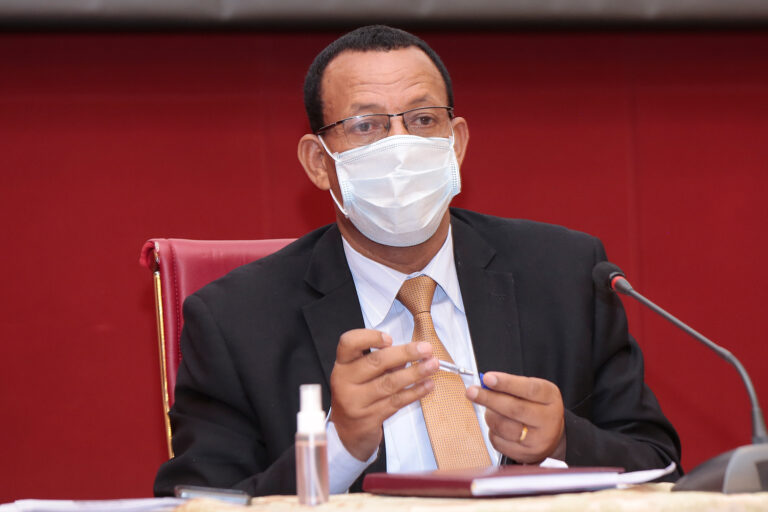
Members of the parliament, who evaluated the fifth year of the parliament period this week, expressed their disappointment on the parliament secretariat and ask for the reform to happen at their institution.
In their extraordinary session that was held on Tuesday July 14 members of the parliament said that the strength of the secretariat administration is being eroded from time to time.
Members claimed that they are responsible to control and evaluate the activity of other executive bodies but they are not getting proper service at their own institution.
“The service we are getting from the parliament secretariat is very poor,” they expressed their disappointment.
Lack of qualified or capable staff in the administration is a major problem, according to members of the parliament. Several members frequently mentioned the attitude and ethics of support staff like drivers, is very disappointing that needs immediate change.
They asked where the reform is happening at the parliament. 
Tagesse Chafo, Speaker of the House, accepted most of the claims and said that changes are undergoing. He said that there are problems regarding ethics and protocol that are supposed to be solved. “The house has also shortage of staff that was in the process to fill but later suspended by the global pandemic, COVID 19, that also restricted most of the activities at the parliament,” he said.
Tagesse said that there were activities to hiring professionals but that was delayed due to the pandemic.
Meanwhile the parliament administration mismatch issue has taken several times at the discussion following the report of Shitaye Minale, Deputy Speaker, about the one year performance of the parliament.
The members said that differently the house has become powerful and independent compared with the past periods. “The freedom at the parliament now is different,” one of the members of the parliament said. But she expressed her concern that the freedom, which should be appreciated, sometimes went against the country’s culture and norms. “We observed that there were substandard debates and unethical phrases and arguments that did not fit the norm of the parliament,” she added.
Shitaye said that the construction of the new building for the parliament has commenced in the budget year. In the year 75 million birr has been allocated for the project and it is being carried out by initial payment of over 40.4 million birr, according to the Deputy Speaker.
This year the parliament ratified 58 proclamations.
Parliamentarians demand reform at their institutions
Rift Valley wines awarded at the 2020 Monde Selection International Wine Contest
The Monde Selection International Wine Contest that took place on July 2 and 3 at the Hotel Manos Premier in Brussels awarded Castel Winery Plc for its Rift Valley Cuvee Prestige- Chardonnay 2018, Rift Valley – Chardonnay 2018, and Cuvee Prestige- Cabernet Sauvignon/Merlot 2015, a prestigious Gold medal which serves as a seal of approval in the European wine industry.
According to a statement Castel sent to Capital the international jury was thrilled with the quality of the wines submitted for this edition of the contest. “The medalwinning bottles came from 20 different countries and included 56% red wines, 22% white wines, and 22% liqueurs, sweet wines, and rosé. Some countries really stood out during the competition, as was the case with Portugal, winner of 19% of the medals, closely followed by France and Hungary sweeping 18% and 15% of the medals respectively,” reads the statement. 
Monde Selection Wines appointed an international Jury of wine professionals, all prominent experts coming from across Europe. They were selected for their acknowledged proficiency and technical competence in evaluating the quality of wine.
This year’s jury was comprised of oenologists, sommeliers, professors and lecturers as well as wine journalists. The contest is recognised for its professionalism, its precision and the technical approach of its assessments. Each wine is subject to blind tasting in conformity with quality evaluation, calculation, and medal ranking methods officially approved by the most important wine organisations (OIV-UIOE). The awards are granted in compliance with the OIV standard that sets out a 30% award limit for international wine competitions.
AFD provides assistance for the National Palace renovation
A 12 million euros financing has been provided by the French Development Agency (AFD) for the first phase of the renovation project of the National Palace Project, which will be open to the public.
This Project is part of the commitments taken by French Government during the Head of State visit in Addis Ababa in March 2019 in favour of Ethiopian Heritage program. The agreement was signed on July 16, between Ahmed Shide, Minister of Finance, Valérie Tehio, AFD Country Director and Frederic Bontems, Ambassador of France to Ethiopia and the African Union.
The National Palace was built during Emperor Haile Selassie reign and has become one of the most emblematic national buildings of Ethiopia, though it was never opened to the public and was used as an official residency that is currently used as the official quarters of the President.
The first phase of the Project will cost 20 million euros and will consist the opening of the Palace to the public along with the park in front of the Palace. A complementary grant of 8 million euros is expected to be provided by AFD in 2021 after the launch of the works.
Palace Administration will be in charge of the implementation with the support of Expertise France, a French public agency and key actor in international technical cooperation, specialized in designing and implementing technical cooperation projects especially through participation of French public institutions such as Versailles’ Palace organization which will intervene and provide assistance to this project.
In a related news AFD signed an 8 million euro grant agreement on the same day to support the Agricultural Transformation Agency (ATA) to develop agribusiness capacities and access to finance in the agriculture sector. This project is part of the Agriculture Commercialization Cluster (ACC) program, supported by other development partners, such as the Danish and Dutch Embassies and the European Union.
The objective of this financing is to develop the investment capacity of smallholder farmers and the small and medium-sized agribusinesses by providing them with inputs and capacity development services and by upgrading and adding value to the commercial chain of their production.
Within 5 years, it is expected to develop productivity and revenue generation of 1.8 million small farmers and 1,340 agri-SMEs, including them in the value chains from production to marketing, and developing their access to credit and dedicated financial services in order to increase their investment capacity.
Africa will need a lot of energy to power its COVID-19 recovery
Africa will need a lot of energy to build back better in the aftermath of the coronavirus pandemic, Executive Secretary of the Economic Commission for Africa (ECA), Vera Songwe, said.
Speaking during a Res4Africa webinar on scaling up renewable energy investments in Africa, Songwe said actions to ensure there is enough energy to power Africa’s rebuilding efforts should focus on three key aspects – infrastructure, supply and cost of energy.
She said following the outbreak of the COVID-19 pandemic, trade, education and health had moved to ICT platforms, consuming about 40 percent of the continent’s energy.
“So for us to be able to have on the continent a viable ICT sector that will allow our economies to build back better, we are going to need a lot of energy,” said Songwe, adding private investments will play a crucial role, especially with the launch of the Africa Continental Free Trade Area (AfCFTA).
The ECA Executive Secretary said the issue of the continent’s energy was not transition but energy substitution.
“We do not have the transition problem in the kind of scale that Europe has. The conversation for Africa is around substituting expensive bad fossil fuels into something that is cleaner and most certainly cheaper. We have to replace fuel-based energies with green and sustainable ones,” Songwe said.
She added partnerships and cooperation were needed in supporting African countries to deliver on their energy and development agenda.
“We need to begin to honestly and seriously look at the financing structures of Africa’s infrastructure. We are financing infrastructure at shorter time frames than it takes to build that infrastructure resulting in debt sustainability issues,” said Songwe to private sector representatives attending the webinar.
She said Africa’s power utilities need to up their game if they are to play a crucial role in helping the continent build back better post COVID-19.
Only two countries in Africa, Uganda and Seychelles, have viable electricity sectors, said Songwe, a situation she said needs to be addressed with only 19 nations operating at expenditure while the rest are operating at excessive losses.
Cost reflective tariffs are part of the problem affecting the continent’s power sector, she said, adding; “We must ensure that on the continent tariffs are cost reflective.”
Songwe said the continent needs to collectively work together to ensure regional power pools are viable.
“Not every African country can produce energy,” she said, adding with the game-changing AfCFTA, the private sector can invest in the regional power pools to the continent’s benefit. Songwe said local currency energy investments would go a long way in boosting access to affordable energy on the continent.
For his part, Francesco La Camera, Director General of the International Renewable Energy Agency (IRENA), said Africa’s energy decisions are pivotal to climate mitigation and socio-economic development. He reinforced the centrality of the energy transition to post COVID-19 recovery and the 2030 Agenda for Sustainable Development and Africa’s long-term prosperity.
“The need to electrify cities in a sustainable way must be the core of government strategies,” he said, adding there was an urgent need to ensure “the ruling class addresses the perception of risks that investors still have in some parts of Africa”.
Stefano Signore, Head of Unit for Sustainable Energy and Climate Change, Directorate-General for International Cooperation and Development in the European Commission, said; “There is a calling and need to work with Africa and for Africa. We are confident that Europe and Africa can work together to meet the climate agenda, undertake a clean energy transition and forward Africa’s renewable energy development.”
For his part, Amith Singh, Head of Energy Finance at Nedbank in South Africa, said; “If we really want to see Africa’s renewable power being developed, we need global initiatives that can leverage cooperation and investment.”
He said Europe can mitigate risks in African countries with sustainable programmes that can encourage the development of new policies, capacity building, local manufacturing and provide financial assistance.
Roberto Vigotti, Res4Africa Foundation’s Secretary General, said placing renewable energy at the heart of Africa’s COVID-19 recovery is crucial to bridging the energy access gap on the continent.
RES4Africa Foundation and Enel Foundation’s joint 3rd flagship publication Scaling up Africa’s renewable power which is dedicated to de-risking renewable energy investments in Africa, was unveiled during the webinar.
Vigotti said the publication will shed some light on the importance of effective de-risking initiatives to unlock Africa’s renewable energy potential and calls for a new impetus on possible solutions to crowd-in renewable energy investments at scale.