Wednesday, October 7, 2026
Home Blog Page 3496

Tigray’s regional officers to be replaced

0

The interim government of Tigray region has said it has started working to replace all high post officers of the federal and regional bureaus from the previous administration as part of its reorganization of the region.

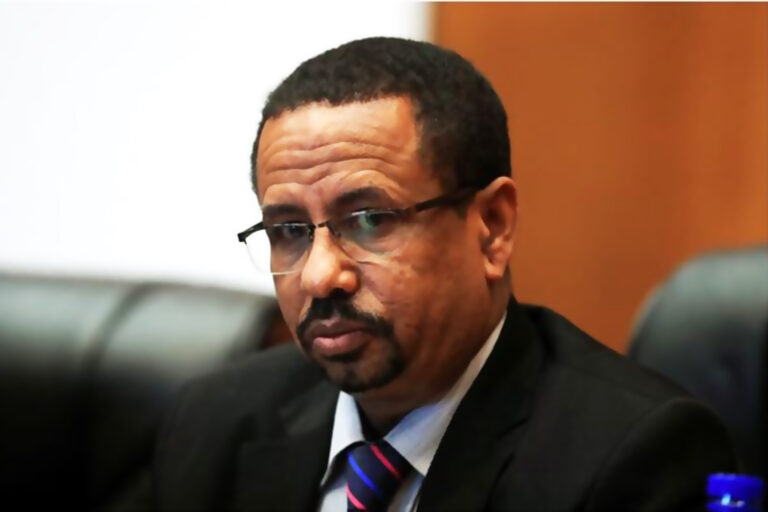
Mulu Nega, CEO of the new interim government told Capital that the new administration started replacing bureau officers working in higher positions of the government structure in the region however other civil servants will maintain their position.

Mulu added that most of the higher officers in both governmental and regional offices were appointed by the TPLF group and there is fear that they are working for the group.

It has now been well over a month since the law enforcement operation was started in Tigray and the government since November 29 announced that it has successfully completed its military offense after controlling the town of Mekele from the leaders of Tigray Peoples’ Liberation Front /TPLF/.

In light of all of these, one of the mandates of the interim government is reorganizing the government structure in the region by cooperating with independent and neutral scholars and political parties operating in the region.

Mulu told Capital that the interim regime is working on replacing older TPLF administration structures and last week the new regime had appointed a new mayor for Mekele city, the capital of Tigray.

The Interim Administration has prepared its charter to re-establish new Regional and Zone cabinet structures but Woreda councils and Kebele administration will continue.

“The establishment of the interim administration aims to ensure the benefits of the people of Tigray and sustain lasting peace by restructuring the preceding administration system,” the CEO said. Beyond restoring peace in the region the new administration is planning to facilitate credible and participatory elections to be held in Tigray Regional State.

“The acceptance of the people to the new government is overwhelming,” Mulu said. The CEO has been saying the government will work on public relation and communication in the region to separate the people from the TPLF ideology.

The immediate action of the interim government is resuming social services not properly functioning at the moment, including education, health and so forth, in collaboration with the federal government, sector ministries and other stakeholders.

“We are working to restore the social services in the region, in some places these services have been restored while in some places it’s a working progress since in some other places the infrastructure has been damaged by the TPLF,” Mulu told Capital.

Mulu explained that TPLF had damaged different infrastructures in the region which will take a long time to repair nevertheless the new government is working aggressively with the people to restore the operations of the offices including schools.

Collection of firearms is another task that the provisional administration will be undertaking – and it is something given priority in the interests of peace in the region.

Prime Minister Abiy Ahmed also visited Mekelle to meet with the new regional government leaders and commanders of the Ethiopian national Defense Forces. He reaffirmed that the government is committed to the reconstruction of the region and called on the people of Tigray to cooperate in the effort to bring what he called criminal elements to justice.

On Friday December 18, the government had announced a 10 million birr bounty for anyone who disclosed the whereabouts of members of the leaders of the TPLF group.

UNEQUAL EXCHANGE & DEBT

0

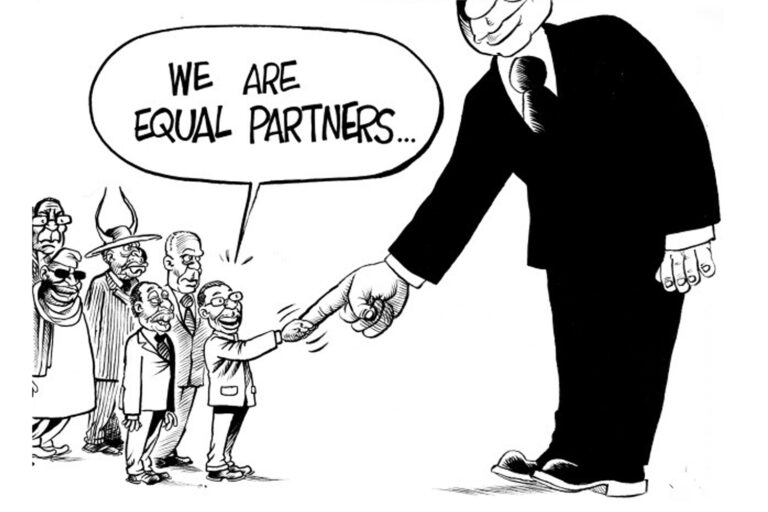
Unless we Africans bury our perennial naiveté once and for all, we are going to perish, literally! First and foremost, we should fully recognize that the reigning global order is not set by us, nor is it primarily intended to benefit our sheeple (human mass). It is time Africans understand the intricate workings of the world system that continues to polarize human existence, both at the level of the individual as well as countries.

Unequal exchange is a permanent pillar of the modern world system. The North extracts resources, financial or otherwise, by employing skewed systems of exchanges! The value of currencies in the global South rarely appreciate vis-à-vis the currencies of northern countries. The economic model that we blindly follow cannot and will not allow our currencies to hold their values against the currencies of the north through time. One can visualize ‘unequal exchange’ by just looking at economies using PPP (purchasing power parity). When goods are priced using PPP, the effect of unequal exchange becomes very clear. Same kinds of goods/services have different prices, depending on location. In the north, prices tend to be dear compared to southern countries. This difference is essentially what is extracted from southern countries on a continuous basis. Going through the analytics of this thesis is certainly beyond the scope of this column. Suffice is to say, this massive loss is 3 to 5% of OECD’s GDP, on annual basis! This is where the actual structural inequality/polarization of the global system resides!

Debt is another scheme of the world order that systemically disfranchises the gullible. In the current monetary regime of the world system, money is created out of thin air and is disbursed as interest bearing financial product in the real economy, mostly to those connected to dominant interests. This systemic extraction of the sweat and blood of labor (including that of entrepreneurs) is another pillar that upholds continuous polarization. Individuals, corporations and states are all affected by this fraudulent scheme of the global banking cabals. Even ‘developed’ economies like Greece, Ireland, Portugal, Italy, Spain, etc., have fallen through the trap and are made to suffer the consequences of phony money creation and its rampant avarice! We admit; our continent has a dearth of competence to interrogate such subtle and brutal economic arrangements of the reigning world system. Obviously, our pompous elites are not up to it. As a result, our sheeple always find itself at the short end of the stick, so to speak.

To understand and elaborate the prevailing polarizing globalization, Africa’s organic intellectuals must play the critical roles. By organic intellectuals we mean enlightened individuals with commitment, confidence, competence, courage and caliber to create social consciousness, with a view to transform collective existence from the reigning life-destroying trajectory (of the world order), to a more democratic, sustainable, equitable and resilient system! This also implies that we should be left alone (or force ourselves to go it alone) to do what must be done, whatever the sacrifice. This is what the East Asian countries did, to some extent, before achieving some semblance of economic independence. The case of China is probably the best example. Countries in Africa must encourage thoroughgoing independent analyses at all levels. It is instructive to look at the case of South Korea during its transformative years. General Park set up an ‘Economic Development Board’, to lead the whole new initiative. Members of the board were mathematicians, physicists, statisticians, engineers, etc. and it was chaired by the president himself. There were no economists, accountants, managers, lawyers or the likes, in the board. The reason: the task at hand required original thinking, thinking that start from first principles, which naturally reject phony assumptions leading to blind mimicking!

We believe Africa has no choice but to fully engage in more creative ideas. It needs innovative approaches to solve its seemingly intractable problems. It is inevitable that mistakes will be made, but these mistakes will enrich the discourse and add to the whole cumulative experience. As the saying goes, ‘what doesn’t kill you will make you strong’. The western model of accumulation at all cost, is a sick philosophy we should intentionally and forcefully abandon. In its place, life centered ideologies need to be propounded. Exposing the whole truth about the system that is destroying both life and life supports systems of our precarious planet must be agenda number one! In Africa and so far, it is our learned zombies, what we call the Ivy Idiots (‘Intellectuals but Idiots’, in the recently coined phrasing of Nassim Taleb) who have been given ample space to pontificate about the various ‘make believe’ scenarios (present & future) that have no rational basis for their realization. Our lives, increasingly based on material consumption will not bring health, wealth or wisdom. Copy catting unworkable and unsustainable nonsenses, is not only very pathetic, it is also dangerous. Our indoctrinated youth expect a future livelihood that closely mimics what is piped through the stupid box, without realizing that it is all a pipedream! As we never tire of repeating; we need to have another six earths before the rest of the South can have a livelihood similar to that of the North. This is not a matter of opinion; it is a scientific fact!

Even those who have been benefiting from the lopsided arrangement of things are no more secured in their old ways, hence are trying to change or at the very least, rearrange the world system. On the other hand, the multipolar world that is trying to emerge is considered a threat and every aspect of its manifestation is being fought tooth and nail by entrenched dominant interests. The wars in MENA, pending wars in Eastern Europe, South China Sea, South America, are all reminders of where the core values of the status quo lie.

“Ever tried. Ever failed. No matter. Try Again. Fail again. Fail better.” Samuel Beckett. Good Day!

The ten year development plan breakdown

0

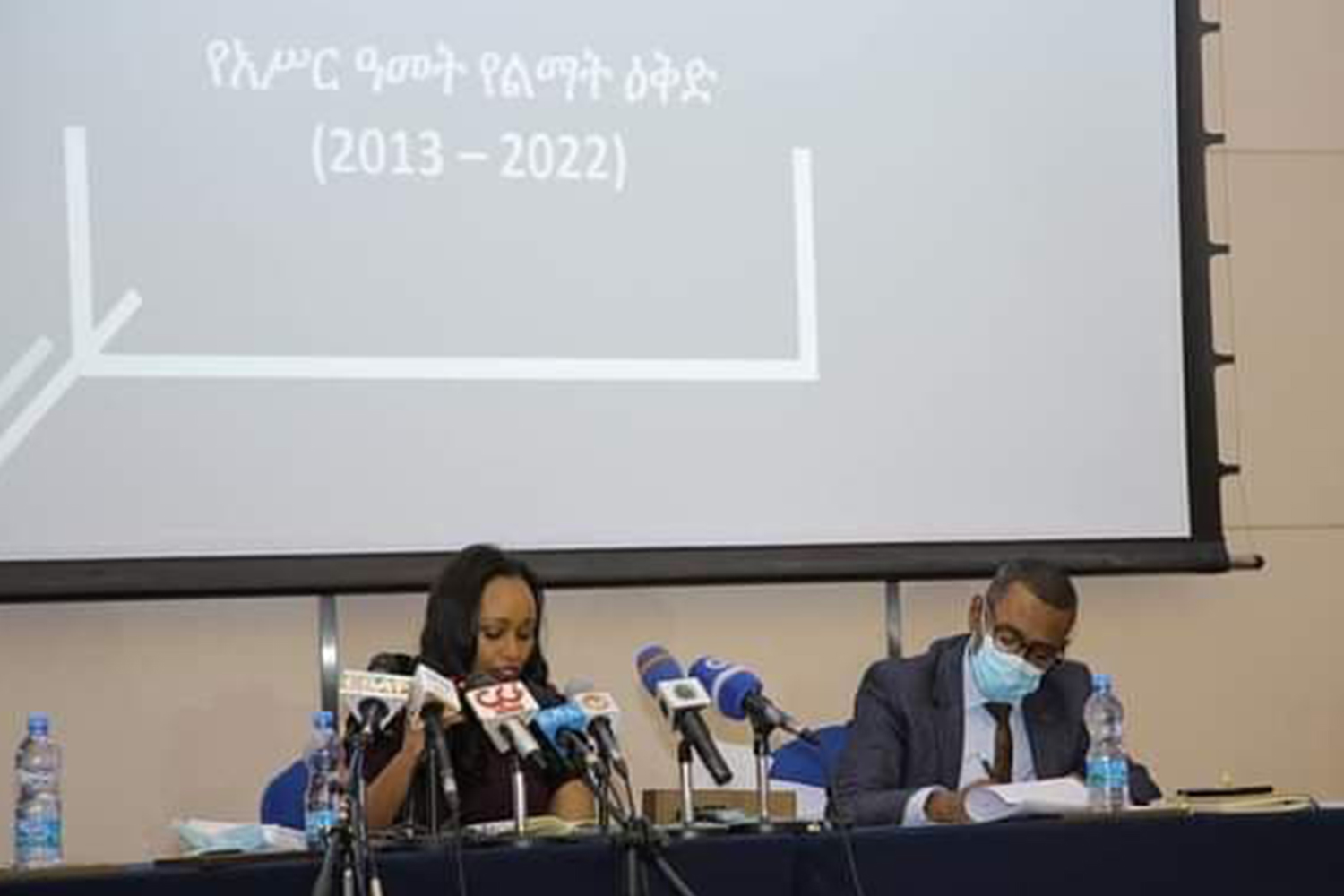
The recently endorsed ten year development plan has placed the manufacturing industry to take the lion share in terms of hard currency earnings in the coming period; while per capital income will be more than double by 2030.

The development plan that is expected to achieve real structural transformation by including different reforms in the macroeconomic policy and approach of development shows that the industry sector in general will be a major pillar to attain the demanded development in the coming decade.

The plan that was approved by the Council of Ministers a week ago and sent to Parliament for ratification to be applicable as of this budget year has projected the manufacturing subsector of the industry sector will be the major source of foreign currency.

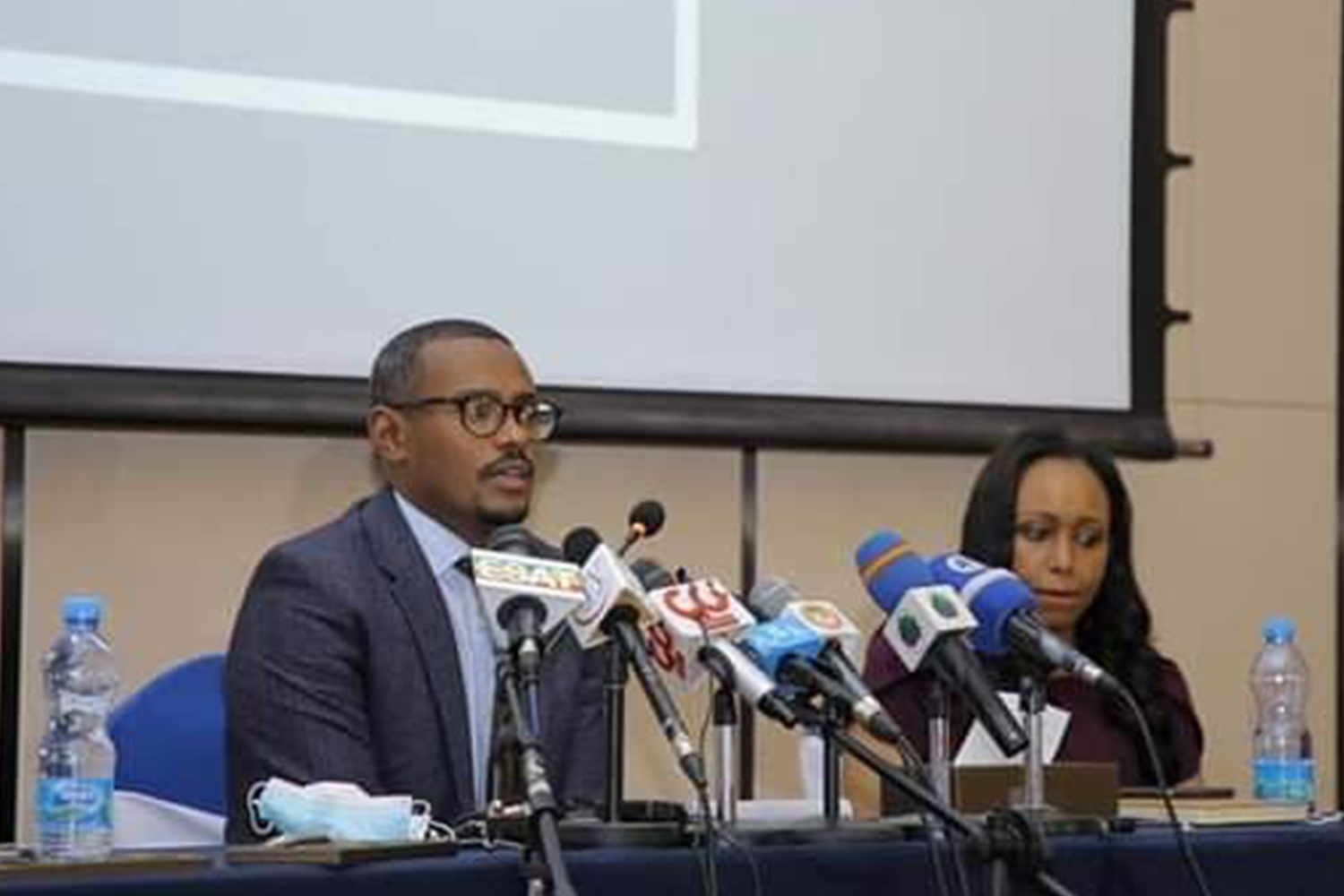
Nemera Gebeyhu, Deputy Commissioner of Planning Development Commission (PDC), said that the manufacturing sector will contribute 48.4 percent in the coming ten years from export earnings from the current 13.3 percent, while agriculture will be reduced to 36.4 percent from the current 77 percent.

The mining export earnings share is also expected to grow to 11.3 percent from 6.9 percent.

At the end of the planned year, the poverty line will drop to seven percent from the current 20 percent of the total population.

The per capital income is also expected to lift to USD 2,201 for the current lower one thousand dollar. The per capital income is projected to grow on average 8 percent every year in the coming ten year.

The agriculture sector contribution to the GDP will be significantly shrunken in this period. According to the plan, the agriculture sector that has about 33.4 percent share on the GDP now will drop to 22 percent, while other sectors; industry and service will show massive shifts.

Meanwhile the massive changes are expected on the industry sector that includes manufacturing and mining sector besides the construction industry, the service sector will continue to top similar to the current situation.

The projection indicated that the service sector will take a share of 42.1 percent of the GDP from the current 39.2 percent of position.

The industry sector in general is expected to expand to 35.9 percent of the GDP from the current about 27.4 percent.

In the industry sub sector the manufacturing sector will has massive progresses and stand at 17.9 percent from the current 6.4 percent of the GDP share.

Regarding workforce similar to the GDP share the agriculture sector labour force will diminish to 42 percent from the current about 73 percent. However, the labour force share may show significant reduction in the coming ten year, it will continue as a major player on job contribution.

The manufacturing industry is expected to grow by two fold on job creation in the period and will be standing at 15 percent. The projection indicated that the service sector will have a growth of close to 20 percentages on labour share from 19.9 percent to 39 percent by 2030.

The ten year program has 10 strategic pillar; quality economic growth, inclusive prosperity, competitiveness and productivity, technology capability and digital economy, green economy and shock resilient, sustainable growth and development finance, depart the private sector to lead the economy, institutional transformation, justice and good governance, and sustainable peace development and strong regional economic cooperation.

The key focus areas are multiply economic growth sources, financial sector development, doing business initiative, demographic dividend, quality, inclusive and economic centric infrastructure development, sustainable urbanization, and peace, justice and inclusiveness.

According to the plan the agriculture sector will grow by 5.5 percent, industry by 11.4 percent and service sector by 10.4 percent in the first five years of the ten year plan. From the industry sector the manufacturing and construction sub sectors will grow by 18.4 and 8.5 percents respectively. In the stated first five year the economic growth will be stood at 9.2 percent. In the second five year that will be ended in 2030 the agriculture sector growth has projected to be 6.2 percent, industry 14.6 percent, and service 10.7 percent.  The manufacturing and construction sector under industry sector in the second five year will have 22.9 percent and 9.2 percent growth respectively.

Meanwhile the agriculture GDP share may shrink in the coming period and the sector will be a priority on access to finance and using improved machines on the way to productivity that was not seen in the past.

Under the three years Home Grown Economic Reform Agenda, the government has already supported the agriculture sector on unseen past experience and allowed the agricultural tools to be imported under duty free scheme.

On average, in the next ten years, the country economy is targeted to have grown by 10 percent.

The unemployment rate in urban areas is expected to down to a single digit and stand at nine percent from close to 19 percent.

Monitoring and evaluation will make different the current economic plan than the previous trend. Nemera said that quarterly evaluation will be undertaken every year in the period that will help to identify the gap and supposed to be corrected or accelerate on the area that achieved.

According to Nemera, investments envelop is also the other uniqueness of the plan. “We will design the investments and source of finance every time,” he told Capital.

He said that the auxiliary documents regarding financing envelop has already been designed.

Fitsum Assefa, Commissioner of PDC, said that meanwhile the current ten year plan focused on the private sector lead development of the government will have projects that are based on deep evaluation.

“In the past there was massive public investment, while it was problematic regarding to inclusiveness. In the coming year we have to grow but the financing will be lead on sustainable financing and engaged on innovative financing source unlike the previous trend,” she said.

“The sustainable development finance source will be supported by the government revenue, financial inclusion that expands the mobilization of saving, and efficiency gain on projects. The loan that the government may receive will proceed in a prudent manner, while development assistance is also considered as part of source of development finance in the coming years,” Fitsum explained.

She said that despite the development plan crafted for ten year the implementation process has been classified in different periods.

“For instance the initial implementation period will have three years and the second phase will have one year duration,” the Commissioner elaborated.

Regarding foreign currency exchange on the CEO Forum that was held on Friday December 18, Fitsum hinted that the government will use floating change rate that is crafted in the ten year plan.

Zemen hires PwC to design its strategic ten year roadmap

0

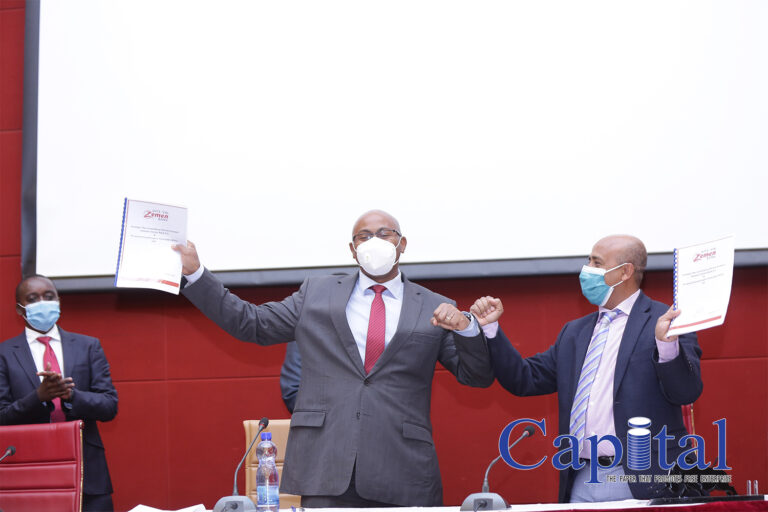
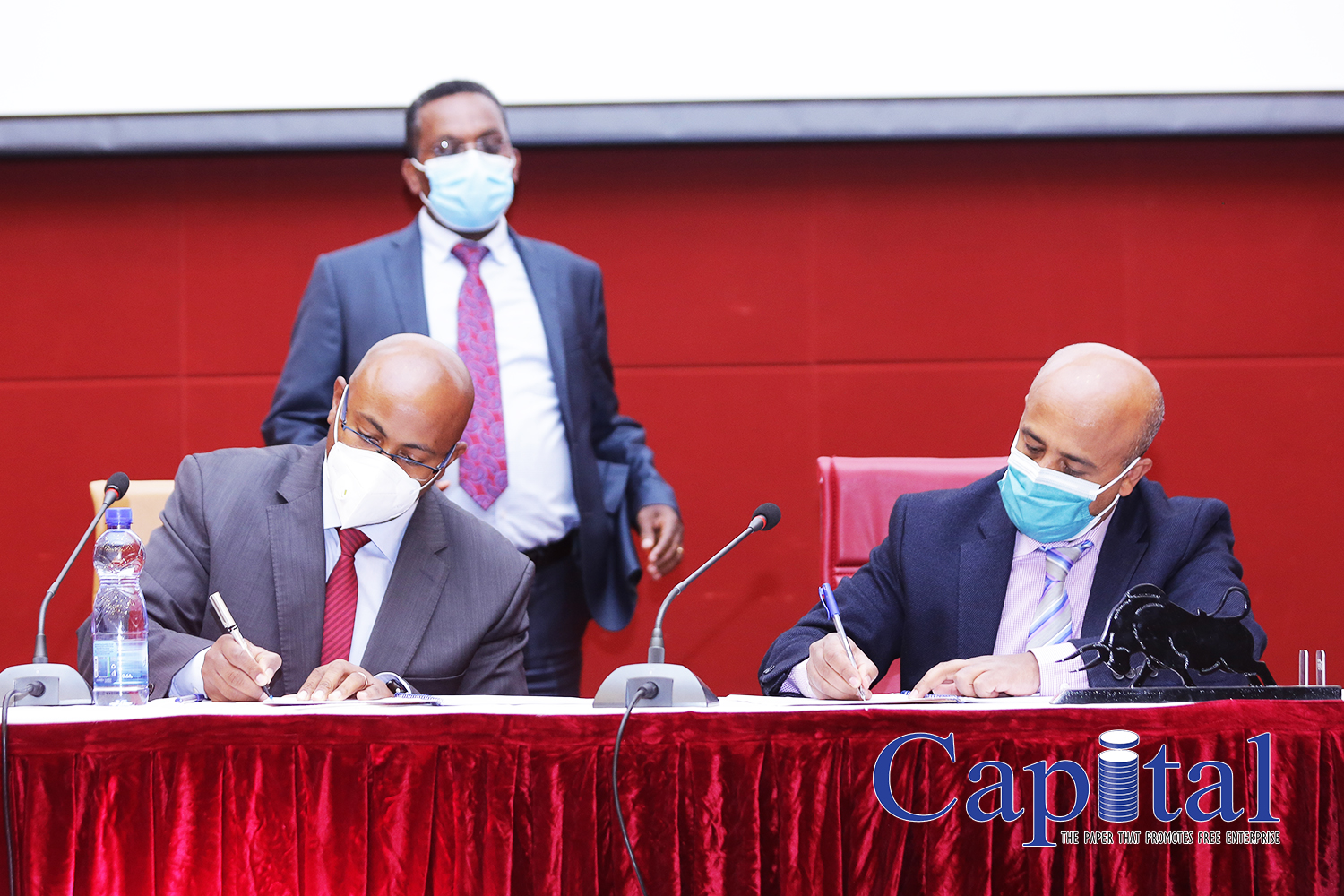
Zemen Bank, one of the top in terms of earnings per share, awards a global giant PricewaterhouseCoopers (PwC) to design a ten year road map.

At the ceremony held on Tuesday December 15, the bank and the consultancy firm has signed a five year strategic plan besides the ten year road map.

Abebe Dinku (Prof), Chairperson of Board of Directors of Zemen, said that the banking sector in Ethiopia is one of the fastest growing sector in the country and reminded that the coming years will be very tough for the sector since close to 20 new banks are under formation which double the number of currently existing banks in the market.

“We expect it to review the institutional capacity and current business model and the firm will propose practices that are innovative and workable on the corporate strategy plan that will enable the bank to shoot up in all aspects,” he said.

“The five year financial projection is also very much important,” he added.

Dereje Zebene, President of Zemen, said that the company is selected from four international companies by their technical and financial offer, “To be honest the bank focused on technical evaluation to hire the consultant,” he stated.

“We gave priority to companies that have been engaged in strategy development. We have through references seen what they have developed in other countries and the bank has also contacted the foreign banks which the consultants support,” he elaborated.

The PwC road map will show the way how Zemen will operate. The strategy also considers the financial sector development in the country and the region and it will also look into the regional integration.

In its 12 year history the financial firm has applied two different five year strategic plans. While due to the effect of COVID 19, it has been delayed in engaging or hiring of another strategic planner that is to be conducted by an independent consultant.

Dereje said that in the past over one year, his bank had operated by its own interim strategy that evaluates and fills the gap of the previous strategic plans.

“The consultant that has wide expertise in the sector and Africa in general and in the region particularly is expected to show ways on how the bank shall compete in the fast growing sector,” Dereje added.

The bank has introduced different new customer based services and as a result the first two strategic plans were very successful and a testimony to this is its soaring performance and profit.

Meanwhile the invitation was for all but only foreign consultancy firms were involved on the bid.

PwC, based in London, has offices in more than 155 countries and is one of the leading global professional service providers. It is however, its first time to offer a strategic plan in the financial sector support in Ethiopia. It has however been working with several financial firms on IFRS conversion.

The road map will be designed in three months time.

In the ended financial year Zemen has amassed over a billion birr net profit which is a sharp increment compared with the 650 million birr of profit in the preceding year.