

The year has been quite turbulent for the agricultural sector mainly because of the locust swarm. To this end, as one of the means of fighting desert locusts, the government has prepared to procure 5 helicopters through a loan financed by the World Bank.
The Ministry of Agriculture had been inquiring for finance from government so as to combat this locust menace and 10 million dollar of guaranteed loan finance from the World Bank has been availed to that effect. The helicopters are expected to be purchased from Germany and Israel. This will be a boost to the 5 planes that Ethiopia has; of which two are surveillance planes whilst the remainder are chemical spraying planes.
In the fight against the swarm, recently, the Israeli government had offered a helping hand to the Ethiopian government with the provision of 27 drons and equipment as well as offering training to combat the desert locusts. Following the request by Prime Minister Abiy Ahmed, Israel’s Minister of Foreign Affairs, Gabi Ashkenazi instructed to deploy an ad-hoc task force of locust fighters and experts to Ethiopia in order to join forces with their Ethiopian counterparts and control the spread of the swarms in the country. This collaborative assistance has been of great benefit to the country.
According to FAO, substantial and widespread breeding continues in eastern Ethiopia and central Somalia. In the past week, there have been increased reports of immature swarms in both countries, which is to be expected as later instar hopper bands fledge and form new swarms. It is likely that most of the hopper bands have now fledged and formed swarms in central Somalia while numerous hopper bands of all stages are still present in a large part of the eastern Somali region in Ethiopia, roughly about 225 km by 375 km, between the Shabelle River and the border of northern Somalia.
Elsewhere in Ethiopia, a mature swarm was reported in the southern Rift Valley between Teltele and the Kenya border, which is likely to be an earlier swarm coming from the north. An immature swarm appeared in northern Afar coming from adjacent areas in Eritrea. Intense ground and aerial control operations have continued in Somalia and Ethiopia. Nevertheless, now that immature swarms are forming in central Somalia and eastern Ethiopia, they are expected to be moving south towards southern Somalia and southeast Ethiopia where they could start arriving in northeast Kenya this weekend. This movement is anticipated to increase during the remainder of December and into January.
Intensive survey and control operations should be maintained in Ethiopia and Somalia with extreme vigilance and preparedness required in Kenya. It is to this effect that the Ministry of Agriculture is keen to purchase 5 helicopters to aid in the fight against the swarm.
Ministry of Agriculture to purchase 5 helicopters to fight locust swarm
Africa Insurance ensures top flight performance
EPS increases 16 fold
Africa Insurance Company is back on track with 16 folds of earnings per share growth and lower claim settlement in the 2019/20 financial year.
The insurance company that is one of the oldest private insurers since the market reopened early 1990s has disclosed that in the past financial year it has achieved higher performance in most of its operations.
The annual report of Africa Insurance Company, which was established in 1994, disclosed that the firm has been able to climb its earnings per share to 254 birr from 16 birr of the 2018/19 financial year. The earnings per share growth stood at close to 16 fold or 1,600 percent.
In the reported year, the claim settlement has dropped by 17 percent or 86 million birr compared with the preceding year performance which is unusual in the insurance industry.
The decrement of claim payment is not common for the sector in the country; in contrary, claim settlement is growing every year, while the performance of Africa for the stated year was different and even shows significant reduction, which is 17 percent.
In the 2018/19 financial year the company had been paid over half a billion birr and stood at 509 million, but in the 2019/20 financial year the amount has decreased to 423 million birr in the general class of business.
At the same time for the long term insurance class of business, the company paid close to 11 million birr for claim, which was close to 16 million birr a year ago.
According to the annual report, paid claims for motor, fire, engineering, liability, pecuniary and workmen’s decreased by 95.5 million birr in total, while accident and health, marine, political violence and weather index paid claims increased by 9.7 million birr.
During the financial year, a gross written premium income of 574 million birr was registered from both general and long term businesses, while the lion share that was 553 million birr was aligned with the general class of business.
Meanwhile, the general class of business premium collection has shown increment. Its growth pattern has stood at three percent or close to a 17 million birr increment compared with the preceding year. Despite the premium growth rate looking very dormant in the 2019/20 financial year, the company has been able to achieve better growth rate compared with the 2018/19 growth rate that was 2.6 percent.
From investment income, the company secured close to 111 million birr that includes 34 million birr of interest income generated from deposit held in banks, and 16 million birr and 52 million birr from investment in shares and rentals respectively.
The company expense in the year has climbed by over 12 million birr or 10 percent compared with the preceding year. In the year, the general and administrative expense stood at 129 million birr.
The paid up capital of Africa that opened two more branches in Addis Ababa and Jigjiga in the reported year to stretch its branches to 34 has reached 180.3 million birr from 165.3 million birr a year ago.
Its total asset has reached 1.4 billion birr, while the liability stood over a billion birr.
The company, which has two huge buildings around Bisrate Gabriel and Bole net fixed and intangible assets, has surpassed 315 million birr.
For the year, the company has secured 58 million birr profit before tax, while the profit for the year after tax has climbed to 45.7 million birr from a 2.8 million birr loss of the 2018/19 financial year. This is a boost for the insurer which had the worst period in terms of loss for the 2018/19 year since the insurer is known as one of the top three most profitable private insurers in the country.
Similar to earning per share boost, the profit after tax of the company has also climbed by 16.3 fold or 1,632 percent compared with the preceding year performance.
Zemen Insurance’s financial debut report

Zemen Insurance, the new comer in the insuring industry, has earned 18 million birr profit as it opened its doors in the last month of the 2019/20 financial year.
The insurer, which commenced operational activity on June 5, 2020, stated that in the 25 days until June 30, the last month of the financial year, insured over 24 million birr worth of values with the collection of gross written premium of 161,840 birr.
The premium was written for the motor and marine sector with 138 thousand and 23 thousand respectively.
The annual report of Zemen Insurance indicated that in the stated less than one month period the claim incurred was less than one thousand birr.
In the stated period, the company that got the green light from National Bank of Ethiopia, the financial supervision body, mid-January 2020 and commenced operation early June has consumed over eight million birr as expense for the reported period.
Melaku Ezezew, Chairperson of Zemen Insurance, on his address said that even though the company has planned to start its operation earlier, it started late due to the effect of COVID 19 and instabilities around the country.
According to the report from the total expense, the establishment cost was 5.1 million birr and took the lion share.
Meanwhile the company operated for less than a month in the 2019/20 financial year and wrote only 162 thousand birr premium, it has earned 18.3 million birr profit after tax.
“The achievement for the year was mainly attributed from investment return and service fee from share subscription, bringing the earnings per share on weighted average capital at 20 percent,” the report explained.
“This is almost a preoperational profit, an encouraging result that is the highest in the history of Ethiopian insurance industry,” the company first report added.
The company profit was mainly secured from investment income that it secured from interest. The report indicated that in the period that shall be stated as the first operational year the investment income and other operating income of Zemen Insurance was 20.2 and 5.7 million birr respectively.
From the investment income the major share, interest on time deposit was close to 19 million birr that is followed by interest on saving account income that was one million birr.
The report indicated that the insurers’ total assets has climbed to 122 million birr on June 30 from 111 million birr of January of the same year that depicted by almost 10 percent growth, while the paid up capital and equity reached 99 million birr and 117 million birr respectively.
At the project period, which was around January, the paid up capital was 94 million birr which boosted to almost 99 million birr on June 30.
On the general assembly that held was on Saturday, the board chair has proposed to increase the company capital to 150 million birr in the current financial year.
Shumetie Zerihun, founding CEO of Zemen Insurance, told Capital that the general assembly has accepted the proposal to up the share by close to 35.4 million birr.
“After the reported period the paid up capital of the company has reached 114.6 million birr. In order to make the capital 150 million birr, the board chair has proposed the stated additional amount to be floated for shareholders to buy in the current financial year,” Shumetie explained.
Zemen, which is so far the new comer in the insurance industry, has about 937 shareholders.
Amhara Bank organizers signal establishment of Amhara Insurance
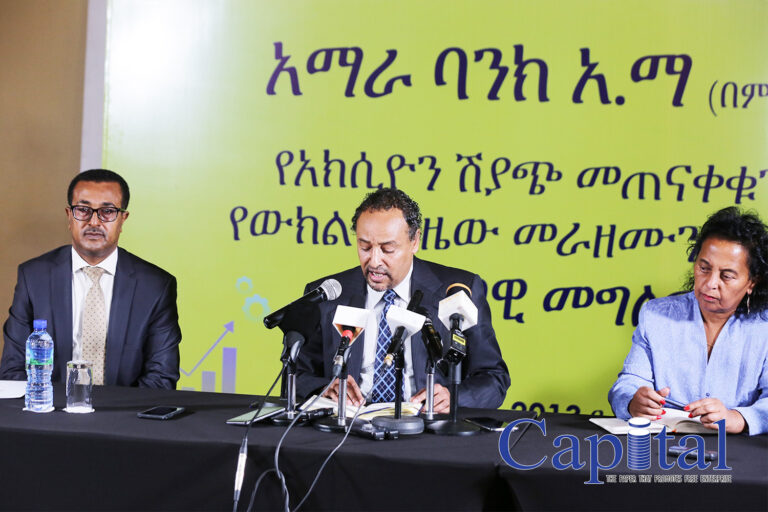
Initiated by the success of Amhara Bank, the market organizers of the bank have signaled to establish Amara insurance as Capital has learnt.
According to Melaku Fenta, Chairperson of the Organizing Committee of the Bank, the organizers of the bank are working to come up with Amhara Insurance.
“The organizers are working to fulfill the requirements of the National bank and required licenses of which is soon to be guaranteed,” Melaku stated.
After setting the record for an initial paid up capital for a new entrant bank in the Ethiopian banking industry Amhara Bank has stopped selling its shares after a year of subscription period.
The bank said it has subscribed capital of 8.1 billion birr and of these 6 billion birr were paid in full.
The bank said it had sold 1.7 billion birr worth of shares within one month period between October 29 and November 29 alone.
“This indicates that there is still a demand for shares, but the sale ended on November 29,”said Melaku on a press conference.

Apart from the record it registered in terms of the paid-up capital, the bank has a large number of shareholders. The bank says it has 185,000 shareholders, while this number of shareholders is challenging to hold the founding general assembly at one place.
Hence, the Bank is resorting to delegation attendance in which multiple shareholders can delegate their respective representatives to attend and vote on their behalf.
He said everyone could not attend the first general assembly of all shareholders due to the current situation of corona virus in Ethiopia.
According to the bank organizers, so far 75,000 shareholders have given power of attorney to be represented for the general assembly, while it is not enough to fill the quorum.
Melaku also said that to get ample delegation the power of attorney process has been extended until December 24, 2020 and called the shareholders to visit relevant documents registration offices to finalize the process.
According to Melaku, the financial institution has not been able to meet the quorum in accordance with the commercial law and the proclamation of the National Bank of Ethiopia (NBE), a supervisory body of financial institutions.
Currently, there are 19 banks in Ethiopia including two public banks. According to the information obtained from NBE about 20 new banks both conventional and interest free are on the way to join the market.
