

I don’t talk about this very much in public, because most people assume that homeschoolers are either religious zealots or antisocial freaks, and we’re definitely not the former. Maybe a bit antisocial, but I wouldn’t call it “freakish” per se. We just don’t like seeing neighbors’ houses. Or neighbors. People, really … okay, maybe a little freakish after all. But that’s not why we homeschool.
We homeschool because we want to be more active participants in our children’s education. That’s not a knock on our local public schools, which are as good as they come. That’s not a knock on private schools in the area, many of which are world-renowned. We homeschool because most of the practices and structures of the modern school, public or private, exist for the benefit of the institution, not the child. There’s nothing evil or bad about this, it’s just inherent in the logistics and organization required for any effective institution responsible for hundreds or thousands of people. But it’s not just logistics. It’s not just the bus schedule. It’s also the curriculum. It’s also the homework and the testing. It’s also the social structures and social behaviors that are embedded in the modern school.
Modern education is a perfect example of the Industrially Necessary Egg – spotlessly clean and cool to the touch, not because that makes for a better tasting egg, but because the protein factories that supply mass society with mass quantities of eggs require chemical washes and refrigeration to turn a profit. That’s fine. I get it. We live in a big world where lots of people want eggs, and the protein factories satisfy that desire pretty effectively.
But what’s not fine is that we have all been nudged into believing that the Industrially Necessary Egg is the Best Egg, that a fresh egg, which isn’t scrubbed clean and never sees a refrigerator, is an Inferior Egg. We have all been nudged into believing that of course 13-year olds should be grouped with other 13-year olds during most waking hours, that of course there should be a clear delineation between home life and school life, that of course the school day should mirror the adult work day, that of course classroom lectures are the most effective pedagogy, that of course children can only be socialized by letting them roam free in a big flock from one semi-shepherded environment to another.
I don’t begrudge the practices and structures of modern schools. Necessary is as Necessary does.
I don’t begrudge the taxes that I pay to support these schools. Don’t tell anyone, but I’d pay even more to support public education and public safety.
What I begrudge is the question that I always get when I tell someone that we homeschool our kids: “Don’t you worry about their socialization?”
My response: “Don’t you?”
My god, hospital admissions for suicidal teenagers have doubled over the past 10 years. Tell me you don’t know a family touched by this tragedy. Tell me you don’t see how our children are sexualized and objectified at a younger and younger age, not by predators lurking outside some gender-neutral bathroom, but by themselves, adrift in the vast oceans of social media. Tell me you don’t see how drug and alcohol use by our children is changing in form, where instead of getting high to party they get wasted to obliterate themselves.
None of this is the fault of the Industrially Necessary School. But it’s not unconnected, either.
So yeah, we want to be active participants in our children’s lives, and that’s why we homeschool. Not to shield them or isolate them from reality, but to be there for them as counselors and teachers as they confront reality. And not just to be there for them when mass society allows us, when it’s our turn during the work week to take responsibility for our own kids, but to embrace that responsibility all of the time. Because it is our responsibility all of the time, no matter how much mass society facilitates and nudges us into partially abdicating that responsibility so that we can work longer and longer hours in service to the Nudging State and the Nudging Oligarchy.
I know that homeschooling isn’t for everyone. I know that homeschooling is impossible for most. I know that when I say “we homeschool” it is entirely a royal we, where my wife shoulders 99% of the burden. But I also know that you don’t have to homeschool outright to be a truly active and engaged participant in your child’s education. Everyone can do that.
Engaging actively in our children’s education has given us two great gifts.
First, the stress level in our family evaporated the day we got off the industrially necessary schedule of the school and onto the organically beneficial schedule of the child. Imagine if you suddenly found three or four hours of new time every day. Imagine how that would reduce the stress in your life, and now think about giving that gift to your child. Even if you can’t escape entirely the scheduling clutches of the Industrially Necessary School, simply recognizing how much of your child’s schedule is institutionally nudged on you and them rather than educationally required of you and them will change everything.
Second, we were able to inject a program of critical thinking and critical speaking into our children’s curriculum, what a classical education would have called Rhetoric and modern education calls Debate. I dunno … I never did Debate in high school, and my prior was that this was impossibly nerdy and more than a little silly. I could not have been more wrong. Our girls can think on their feet. Our girls can stand their ground. Our girls can make a persuasive argument, and they can recognize how others try to persuade them. My favorite part of a critical thinking/writing/speaking education? Our girls have demolished hundreds of smarter-than-thou mansplaining-in-training boys in debate competitions around the country. What does a curriculum of critical thinking/writing/speaking look like? It looks like girls and boys of different ages and backgrounds, all practicing and competing on an equal footing in a battle of research and wits – now there’s a socialization we can all support!
And here’s the kicker. Our girls are now teaching these critical thinking and critical speaking skills to those who have a hard time raising their voice effectively in a Team Elite world, from middle schoolers in Bridgeport, Connecticut to high schoolers in Malelane, South Africa to prison inmates in California. What do I mean when I say we need a Movement to change the world? This.
What I’m describing is the difference between education and training.
Education – whether we’re talking about the education of a child, the education of an investor, or the education of a citizen- is always additive to the free-thinking autonomy of the child/investor/citizen. But that’s not what the Nudging State and the Nudging Oligarchy have in mind. They don’t want education. They want training. The Nudging State and the Nudging Oligarchy want to train you like Haven trained her mustang. They want to turn you into Clever Hans, an intensely other-regarding animal who welcomes the saddle. Because once you’re trained to welcome the saddle, you’re going to take the bit.
The playbook of the Nudging State and the Nudging Oligarchy is always the same – put a compelling Narrative around some Industrially Necessary System and train humans who use that system into some version of Clever Hans.
It’s clearly the playbook for our modern markets, where we are trained by the Nudging Fed and the Nudging Street. We are Clever Hans, dutifully hanging on every word and signal from Janet or Mario or Goldman or Merrill as we stomp out our investment behavior.
It’s also the playbook for our modern politics, where we are trained by the Nudging Parties and the Nudging Media Oligarchs. We are Clever Hans, dutifully hanging on every word and signal from Donald or Bernie or Fox or WaPo as we stomp out our voting behavior.
In all of these Industrially Necessary Systems – schools, markets, and politics – recognition and critical thinking is the antidote to Clever Hans Syndrome, and active engagement is how you administer the medicine. What do we DO about our Hollow Markets and our Broken Politics?
Actively engage with yourself to recognize how many of your behavioral choices in the world of investing and politics aren’t a free choice at all, but are instead derived from a clever “choice architecture” imposed by others. You probably won’t change your behavior. That’s kinda the point of these pleasantly skinned Hobson’s Choices – they’re offers you can’t refuse. But the day you recognize the choice architectures that enmesh us is the day you start making true choices. It’s the day you start thinking and reading differently. It’s the day that everything starts to change for yourself, your family, and your clients.
Actively engage with yourself to create a critical thinking curriculum that adds to your reservoir of free-thinking autonomy. Read more history. Read more biography. Read more science fiction. Every day. Watch a lot less CNBC and CNN and Fox and all the rest. I know we can’t wean ourselves from Facebook and Twitter. It’s our bottle and we’re addicted. I am, too. But take the time to listen to someone whose political or market views you emotionally dislike and force yourself to see the world through those views, not as an adversary but as another thinking, feeling human being. Every day. Educate yourself, don’t train yourself.
Actively engage with others to spread the word. To educate, not to train. We treat others as free-thinking autonomous human beings, not as manipulable objects. Never as objects, even if it means losing the client or losing the election. This is how we fix things. Bird by bird. Voice by voice. From below, not from above. As wise as serpents and as harmless as doves.
What will your verse be?
Forget about Industrially Necessary Schooling, we homeschool our children

Government proclaims it does not need a “baby-sitter”
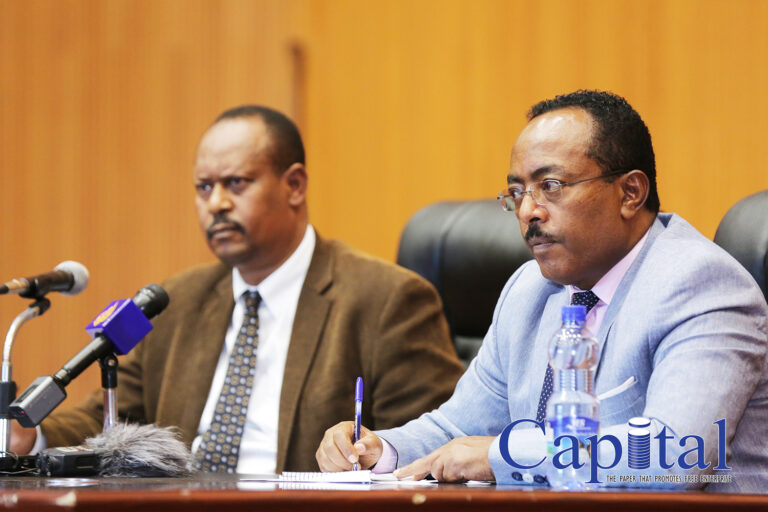
It has been well over a month since the law enforcement operation started in the Tigray region after the 4th of November 2020 attack and now the government has announced it has completed its military offence after taking the town of Mekele from the so called criminal group of Tigray People’s Liberation Front /TPLF/.
Although the government announced that the TPLF group had attacked the North National Defense, Sekoture Getachew, a veteran TPLF politician, publicly justified the November 4th military attack against the Northern Command of the Ethiopian National Defense Force (ENDF) as an anticipatory self-defense and amongst it all the international community still continues to force the Ethiopian government to accept independent investigation.
On Tuesday December 8, Redwan Hussein, spokesperson of the state of emergency told reporters that Ethiopia will invite others for assistance only if it feels that it failed to investigate.
“Ethiopia is led by a government which knows how to govern a nation. Ethiopia doesn’t need a baby sitter,” said Redwan.
Redwan confirmed that Ethiopia’s security forces shot to the air and detained United Nations staffers as they tried to reach parts of the embattled Tigray region that they were not supposed to go.
“They broke two checkpoints to drive hastily to areas where they were not supposed to go, that they were told not to go,” Ethiopian government spokesman Redwan Hussein said in a press conference.
“They were told in some areas they were not supposed to move. And when they were left alone they broke two checkpoints, and when they were about to break the third one, soliders shot to the air and detained them. Now, of course they are free,” Redwan explained.
Ethiopia’s government is making it clear it intends to manage the flow of humanitarian aid, but the U.N. has openly sought unfettered and neutral access according to international principles.
The U.N. announced deal with the Ethiopian government, saying it was signed on November 29. Crucially, the deal allows aid only in areas under Ethiopian government control. The government on Tuesday said 44 truckloads of food aid had been delivered to Shire, the main town near the refugee camps.
On Tuesday, Redwan repeated that message and added, “No entity, multilateral or unilateral, is supposed to supplant the government. We, the government, would call the shots.”
“Humanitarian assistance must be escorted by defense forces,” he said.
“The government will give allowance on where to go and where not to go. There are some forces who have not surrendered. They may not have some regular leadership and command and supply of resources but they can still keep on shooting until they run out of their arms. Thus, we are saying our humanitarian assistance has to be escorted with the military,” emphasized Redwan.
“Just because we completed the operation in three weeks it doesn’t mean we are in a picnic it was a very tough assignment it was completed successfully because the government was very much conscious about its people. Any life that dies during the operation is a lose to Ethiopia, but we are not hiding anybody killed by the government defense but because there was none there is no one to be accountable other than Ethiopians. It doesn’t matter if they were killed by government force or TIgray forces all are Ethiopians, we are not fighting with a foreign enemy it was a family feud,”Redwan stated vividly.
Regarding the humanitarian assistance, Mitiku Kassa, Commissioner of the National Risk and Disaster Management, said the commission is working to address humanitarian assistance to 1.8 million people in the region. However with the fear of the number increasing, the commission is working to do rapid assessment to capture additional number of beneficiaries, since between 22-30 percent of the urban population may need relief assistance for the short period of time.
ATA attaches the livestock sector to its new decade program

Agricultural Transformation Agency (ATA) has launched the next ten year program that includes the livestock sector and regions, which were not part of the ended program, and ensure all farmers to be commercialized by 2030.
Transformation of Ethiopia’s agriculture sector to one where farmers and pastoralists have market oriented production and productivity and sustainable natural resource development and utilization would be the next ten year strategy that ATA will engage with its partners, says Yifru Tadesse, Senior Director at ATA said.
He added that the livestock sector will be a core sector besides the crop sector and five excluded regions in the first ten year; Afar, Benshangul Gumuz, Gambella, Harari, and Somali will be also included on this coming ten year program.
According to Yifru, over the next 10 years, ATA has the ability to roll out up to 11 strategic programs in total.
For this budget year ATA’s focus will be on four strategic programs, that is; systemic interventions, crop agricultural commercialization Cluster (ACC), livestock ACC, and scale up regions ACC. Under the plan until 2025 systemic interventions, livestock ACC, and scale up regions ACC, horticulture in urban and peri-urban areas, horticulture expansion in the ACC regions, and livestock and crop in food insecure areas will be included on the strategic program, while until the end of 2030 that is the next five year starting from 2026 up to 2030, 11 strategic programs are expected to be included.
Khalid Bomba, CEO of ATA, told Capital that details of the coming ten year strategy will be fully finalized in this budget year.
Mandefro Nigussie, State Minister for Agricultural Development at Ministry of Agriculture (MoA), recalls that previously ATA had come up with high quality outcomes that needed appropriate capacity in terms of human capital and others at MoA to implement it with similar standard, while it was a gap at MoA. He said that in this current implementation period MoA and ATA have jointly taken part in the strategic design. “We have planned our ten year strategy jointly from design stage that will help to scaling up with similar level,” Mandefro told Capital.
“Since we designed jointly we shall catch-up the expertise, and capacity building in gaps will also be undertaken,” he added.
The 10 years evaluation
In the first decade of its program ATA had focused on the crop sector transformation in selected weredas of four regions, Amhara, Oromia, SNNP and Tigray. According to independent evaluation that was conducted by Food and Agriculture Organization of the United Nation (FAO) and presented by Maximo Torero-Cullen, Chief Economist and Assistant Director General of FAO, who attended the evaluation and launching of the new program on webinar, it is clear that the past ten year performance of ATA has concluded on promising and well accepted results in related with different aspect of transforming of productivity.
The independent evaluation covered the corporate impacts of the agency’s activities in the country in terms of projects executed, studies conducted, and other impactful activities implemented to drive agricultural transformation, growth, and poverty reduction.
According to the Chief Economist, the support provided by ATA was characterized by a problem-solving approach, swift action, the inclusion of gender-sensitive approaches, and enhanced coordination of stakeholders, covering an extensive amount of land and farmers through scaled-up investments.
Overall findings from the micro analysis of FAO recognized that ATA has achieved many of the outcomes it is being measured against , that is – input use, extension services, and agricultural technology, effective removal of bottlenecks in the rural agricultural economy that have improved the linkages between producers, input markets and agricultural services, and improvements in priority areas are reflected in productivity gains by smallholders for certain priority crops and in market orientation positions.
It added that the likelihood of organic fertilizer use by households producing priority crops rose by 18 percentage points, whereas for chemical fertilizer rose by 23 percent.
“ATA was found to increase the likelihood of agrochemicals use by close to 15 percent, which could be a reflection of rising demand for herbicides in lieu of crop rotation as smallholders tend to rely on less diverse production portfolios,” the evaluation added.
Regarding the economic aspect the Chief Economist uploaded that overall, the total 2012–2019 spending considered in the economy-wide analysis of ATA impacts was USD 138.9 million, with 13.4 percent spent (USD 18.6 million) on support functions and overheads.
“In every year of the period 2013-2019, the level of GDP was on average 0.30 percent (or USD 243 million) higher due to the productivity effect that is triggered by the spending associated with the ATA interventions in the priority areas and crops covered by the FAO’s evaluation,” he added.
“As a whole, the ATA has contributed USD 1.7 billion to the GDP of the 2013-2019 periods. Also, ATA’s interventions have increased private consumption by a total of USD 1.3 billion during the same period,” Torero-Cullen said.
Oumer Hussein, Minister of MoA, said that despite the promising changes we have noticed, the sector is riddled with various problems that challenge the smallholder farmers of Ethiopia and addressing such challenges and commercializing the sector could lead Ethiopia to further exploit its agriculture potential both in crops and livestock.
Khalid said that the success of the ATA is not a sole responsibility of the agency; rather, it has been a combination of collective efforts and contributions regaining from the government, MoA, agriculture bureaus, the community of partners excluding from development partners and others.
Regarding regional performance evaluation, he amplified that different performances in different sectors have been achieved, which is the uniqueness of Ethiopia that of sectors specialized in different regions.
“For instance if you see the achievement of Amhara region it is aligned with teff, wheat was good in Oromia, for fruit tree in SNNP and Oromia and sesame was very good in Tigray. This helps one region to get lessons from another region in this circumstance,” Khalid explained.
Khalid said that the independent study of FAO will boost the trust of financers and international partners to provide more support for the coming ten year program.
ATA was established on the mission to catalyze sustainable development of agriculture value chains and markets, through promoting effective practices and approaches to address systemic constraints and coordinating execution and integration of high impact interventions at the farmer level. ATA has conducted several studies beside directly implemented about 47 agricultural projects.
The ballooning inflation
Dissecting the exponential inflation rates over the years
After the 2005 election, the government was quick to set a growth path that was driven ‘partly targeting to politically impress the public.’ This path is stated as one of the major reason for spiral inflationary trends of the country until now.
The government would later be in a dilemma to choose either economic growth or neutralize inflation. A new study has revealed its recommendation for the government to focus on food investments at the cost of the other sectors to curb the food inflation.
The latest study conducted by two senior economists stated that in Ethiopia, inflation was not generally an issue before the 2005 controversial election and the violence that follows it. “The latter is important as it contributed to the change in the modality of growth financing which we believe is resulted in the macroeconomic imbalances witnessed,” the study reads.
“It was followed by the behavior of high inflation, significant parallel market premium of the currency, shortage of foreign exchange, significant trade balance and fiscal deficits and huge debt that characterized the Ethiopian macro economy today,” states the study that was carried out by Alemayehu Geda, Professor at Addis Ababa University and Kibrom Tafere, Professor at Cornell University under the title of ‘The Challenge of Inflation and Financing Development in Ethiopia: A Kaleckian Approach with Empirical Result’.
The study recalls that before 2005, the government exercised prudent fiscal and monetary policies which were institutional legacies from previous regimes, while it argued that the macroeconomic instability occurred when the government became reluctant to continue the strict trend.
“These macro challenges began to emerge following the government’s move towards laxer monetary and fiscal policy and significant state activism informed by its version of a developmental state,” the study explained.
The study explains that the government’s decision to pump huge amounts of money by borrowing from the National Bank of Ethiopia to fill the budget gap as well as foreign loan has played a major role to the skyrocketing inflation that was not higher than five percent for decades.
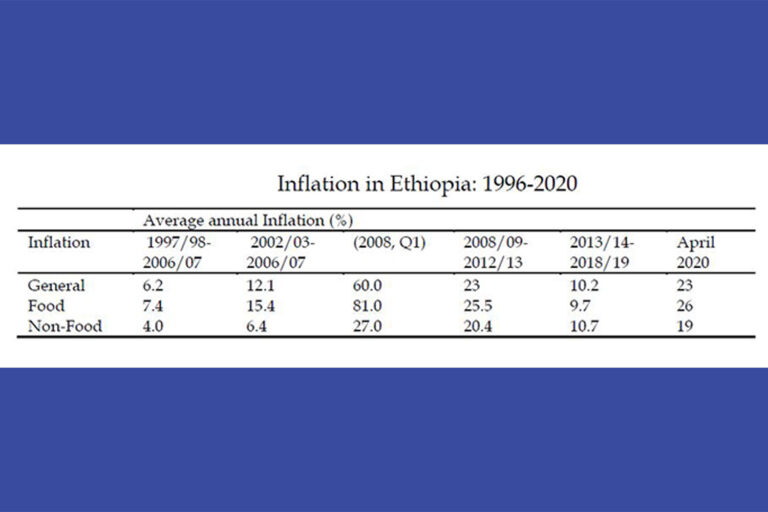
The study further recalls that, the official headline inflation for the first quarter of 2008 stood at 60 percent with food inflation being about 80 percent.
It is said that this has declined over the years, but not significantly, and the latest (April 2020) data shows a general inflation level of 23 percent and a food inflation of 26 percent.
This is a huge macroeconomic shock given the price history of the country where inflation for the last five decades before the early 2000, was below 5 percent per annum. What is more alarming is that the poor are the major victims of this inflationary phenomenon as they spend significant part of their income on food and other basic goods.
In this study an attempt to identify the forces behind the inflationary challenge in Ethiopia was looked into keenly.
The study was done using the Kaleckian approach to inflation and financing development in developing countries as an overarching theoretical framework. The study found weak domestic food supply, a rising money supply and exchange rate depreciation (devaluation) to be the three major factors behind inflation in Ethiopia.
The effect of these major determinants is also found to have different potency in the short and long run, as well as across the three versions of the inflation models estimated. In addition, imports of food items, economic growth and price of imported goods are also found to have effect on the level of inflation in Ethiopia.
“We are also able to come up with specific elasticity values of inflation with respect to each of these determinates that could inform policy aimed at abating the double-digit inflation that is disproportionally hurting the poor and fixed-income earners in the country,” the study said.
The nature of financing development since the 2005 failed election seems one of the major reasons behind the high inflation and related macroeconomic instability in the country today.
The study reminded that following this failed election and the government violence on civilians, donors protested by reducing aid as well as changing its mode of delivery from ‘budget support’ to ‘provision of basic services’ directly.
“Confronting with the latter, and yet wanting to register rapid economic growth partly to politically impress the public (especially in the disfranchised urban areas), the government has resorted to high investment and a significant monetization of the deficit. This is complemented by significant borrowing from China,” it argued.
The study recognized the economic growth in the past over a decade but said that, the financing of this growth is problematic and was the major factor behind the inflation and severe macro imbalances witnessed in the country later.
“Despite the double-digit growth noted, inflation became a double-digit figure too. This positive co-movement between the two is puzzling that led many even to suspect the credibility of the official growth data,” it explained.
The study argued that the inflation severely affects the poor since it mainly spiked the price food than non food products because of un-increased food supply in the economic development that the government claimed double digits for over a decade.
“Food expenditures constitute the lion’s share of household expenditures in Ethiopia. In 2006, for example, its share in total expenditures was 57 percent. This did not change much today, being about 54 percent in 2019,” it says, “Thus, the effect of a rise in food price on general price level and social welfare is significant. Generally, food inflation increased faster than the general inflation during the period under analysis.”
