

The 1st Ethio-Horticulture International conference that was organized by Ministry of Agriculture (MoA) and Ethiopian Horticulture Producers Exporters Association (EHPEA) and expected to gather several people from abroad and local was canceled a day before the event was supposed to be opened.
The event was scheduled to be held at Ethiopian Skylight Hotel for two days starting from Friday February 28, while the cancelation came on Thursday February 27.
On Tuesday February 5 Aynalem Nigussie, State Minister of MoA, gave a press briefing for media about the event and the expected out come from the international conference.
The event that is organized under public private partnership (PPP) model by MoA and the private sector wing EHPEA, was designed to go through challenges on the sector, evaluate the tax and insurance issues besides presentation of research papers.
At the press conference Aynalem said that at the event high government officials, guests from different countries, producers and exporters, financial institutions, researchers from higher education institutions, and potential investors will attend.
She said that it has also targeted to boost the sector by amplifying its past success in the job creation and economic support. “The country agro ecology will also be promoted on the international conference,” the State Minister said.
She added that challenges and success stories on the sector will be assessed followed by giving a direction by the government to solve problems and boost the sector.
Sector experts claimed that such a decision would give a bad image for the country since several foreign participants were already on their way and others were preparing to come.
Without further explanation MoA posted on its facebook page on Thursday February 27 that the conference is postponed for another time. The post does not give any given time when the conference will be held.
Sources indicated that the reason for canceling the event is that higher officials are in another meeting and that they would not be able to attend the conference.
In the horticulture sector particularly in the flower subsector Ethiopia has become the second biggest exporter in Africa after Kenya.
The sector passed bad period in the past three years in relation with the political instability in the country. But in the current budget year the sector has shown dramatic improvement regarding production and export earnings.
The first six months export report of the budget year indicated that the flower sector has been flourished, while the fruit and vegetable sector performance was high compared with the projection.
In the first half of the budget year the export of flower achieved 183 percent of the target.
in the period the sector was expected to get USD 123 million but the actual performance was USD 225.3 that is also 113 percent compared with the same period of last year.
The other sector that is included in the horticulture investment sector, fruit and vegetable, achieved a 122 percent of the target. The fruit and vegetable sector contributed USD 51 million, while the target was USD 41 million.
Ethio-Horticulture International conference cancelled last minute

BASF introduces new automotive refinish paint

The German chemical industry giant BASF introduces a new automotive refinish paint range for the first time in the Ethiopian market. The new paint solution named ‘Baslac’ is distributed in the market by the local firm Hamlin Trading Ltd.
The latest entrant to the market Bascal is said to offer body shops a cost effective alternative, allowing for reliable high quality finishes without compromising on profitability. According to BASF, Baslac offers an overall modern solution to all refinishing jobs on car quickly and outstanding results.
Baslac is one of the fastest growing refinish brand which has a great success globally with a wide variety of smart repair and single site body shops utilizing this new innovating technology, said Gift Mbaya, BASF General Manager and Business Lead, “BASF is constantly working on developing products that will add to the portfolio, increasing the range of finishes while keeping cost down for the body shops.”
“Baslac is a product which is lean and easy to use and has a range of high quality refinishing products at a cost effective price. The specially designed portfolio offers all the products required to complete a professional repair with outstanding results.” “The unique feature of Baslac is that it has a digital training and knowledge center with technical support available on line on how to use the product.”
Baslac offer the best possible finish for all solid, metallic and pearl colors. “They are simple to apply and are accompanied by perfect color matching support. Baslac basecoats have outstanding hiding powers,” said Mbaya, adding Baslac topcoats are designed with performance in mind, high solid, pigment system allows a good flow and covering power with a quick drying finish together with perfect hardness and polishing properties on drying. “Color matching is accurate and there is a comprehensive range of color support tools to make the process even easier.”
The long term experienced chemical company in the automotive industry, as part of its coating division, BASF provide Baslac reliable color competence product quality and modern E-orainted customer’s service and is sold over 50 countries all over the world.
The German chemical company and the largest chemical producer in the world, BASF Group runs six major business segments. These divisions includes chemicals, performance products, functional materials & solutions, agricultural solutions, nutrition, and oil & gas. Positioned across 80 countries with its subsidiaries and joint ventures, it has 390 production sites in Europe, Asia, Australia, the US, and Africa.
In Ethiopia BASF is working on various industry segments specially on agriculture solutions business. BASF has been developing its plant on seed agriculture in Arerti, in Amhara region, according to Mbaya.
“A friend in need is a friend indeed”
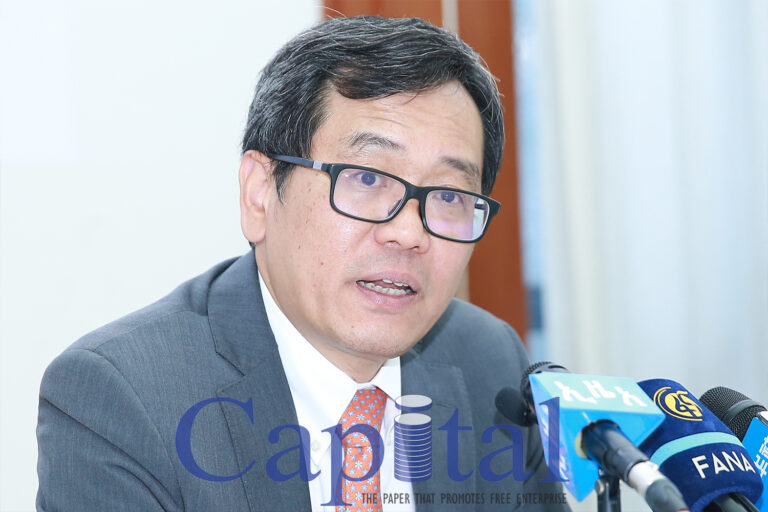
Chinese ambassador hails Ethiopia’s solidarity in combating COVID-19
Chinese Ambassador to Ethiopia, Tan Jian commended Ethiopia’s support and solidarity in the efforts to contain the outbreak of coronavirus (COVID-19).
In his press briefing on Friday February 28, Ambassador Jian said China has taken comprehensive, rigorous and thorough measures to prevent and contain COVID-19 especially at the hardest-hit Hubei Province.
“The Chinese government attaches great importance to international cooperation,” said the ambassador.
He appreciated support and solidarity of the people and government of Ethiopia as “unforgettable”.
The ambassador said Ethiopian Airlines has not interrupted flights to China and continued its 35 flights per week. “The people and Government of China highly appreciated it and will never forget that,” he said.
He said the Chinese government is treating the students the way it cares for its own children.
Since December 2019 when the first case was reported in Wuhan city, fighting the spread of COVID-19, the Chinese government has taken the most comprehensive, rigorous and thorough measures. China has established an all-around and multi-level epidemic prevention and control system, centering on Wuhan city and Hubei Province, with a highly responsible attitude towards the lives and health of the Chinese people and people around the world.
The ambassador further stated that there are 311 Ethiopian students living and studying in Hubei Province, including Wuhan city and up until now there is no case of infection reported.
The Provincial Department of Education has set up a special working Group to take care of the foreign students.
All universities in the province have taken measures, including: disclosing the epidemic-related information in a timely manner; providing students with virus prevention stuff like face masks, disinfection rubber gloves, disinfectant, hand sanitizer; regularly disinfecting the residence; assigning staff to provide free food delivery and buy stuff for students staying in dorms; setting up 41 special hot-lines to provide 24/7 counseling for international students; created Wechat groups consisting of faculty members, volunteers and international students to learn their needs and situations.
Prime Minister Abiy also discussed this issue with President Xi of China in a phone conversation. President Xi promised that China will take care of Ethiopian students the way it cares for its own children.
This time round, African countries and people have provided China with various forms of support in the COVID-19 battle, which has “vividly illustrated the brotherly friendship of sharing weal and woe and helping each other between China and Africa”. Recent reports show that Djibouti also helps china one million dollar.
WHO team who visited China recently estimated that the measures taken in China have averted a significant number of cases.
Until February 27, 2020, the National Health Commission had received reports of 78,824 confirmed cases and 2,788 deaths in 31 provincial-level regions on the Chinese mainland and the Xinjiang Production and Construction Corps, and in all 36,117 patients had been cured and discharged from hospital. 78,824 is the accumulated figure of the confirmed cases, now the existing confirmed cases is 36,117.
On February 28, the first case in sub-Saharan Africa was announced in Nigeria. The World Health Organization (WHO) said in a report that much of the global community is not yet ready to implement the types of measures that have contained the fast-moving coronavirus outbreak in China.
Ethiopians protest against US involvement in GERD
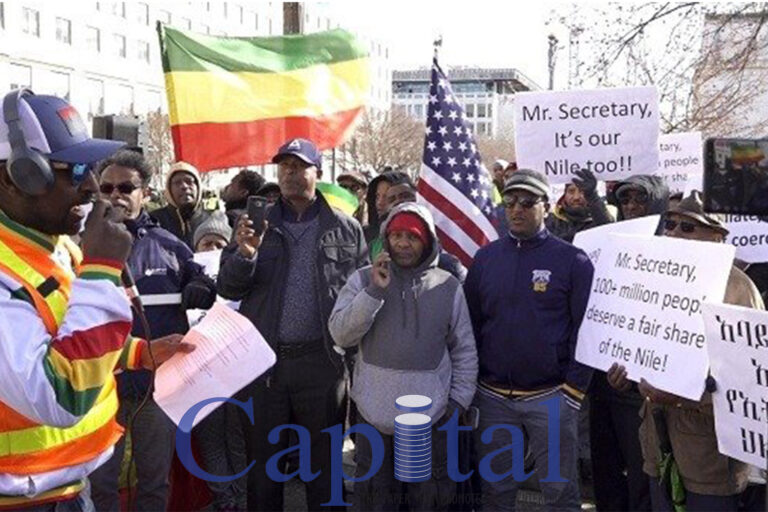
Hundreds of Ethiopians staged a protest rally on Thursday February 27, in front of the United States State Department in Washington D.C.
They opposed President Donald Trump’s government pressure on Ethiopia in the negotiation on the operation and filling of the Grand Ethiopian Renaissance dam (GERD).
“Stop pressuring Ethiopia,” Ethiopians chanted in front of the U.S. State Department.
“Mr. Secretary, 100+ million people deserve a fair share of the Nile,” reads another placard that Ethiopians carried during the demonstration.
These Ethiopians say the Trump administration is putting unfair pressure on Ethiopia to make Egypt get away with Ethiopia’s right to generate electric power from the mega-dam project on the Nile River.
Protesters also demanded the Ethiopian government to make public all details regarding problems in the negotiation.
Those advocating for that position argue that the Trump administration is primarily interested in helping Egyptian leader Sisi to get unfair deals at the expense of Ethiopia.
Ethiopia, Egypt, and Sudan have been negotiating the Dam since November 2019. The United States and the World Bank were present in the negotiation since then as “observers.”
Reports from media outlets who claim to have insider information about the negotiation process indicated that the “observers” are putting unfair pressure on Ethiopia to defend to promote Egypt’s position, which is informed by the Colonial-era agreement to which Ethiopia was not a signatory.
In related development, Ethiopia has asked the United States to postpone what was expected to be the final round of talks on the hydropower dam, it said on Wednesday, delaying the potential resolution of a dispute that sparked a years-long diplomatic crisis.
“We have asked that we need more time for consultation,” Bizuneh Tolcha, spokesman for Ethiopia’s ministry of water, irrigation and energy said, without providing details.
The final round of talks were scheduled for Thursday and Friday in Washington. The U.S. has hosted several rounds of talks in Washington with ministers from the three regional powers and the World Bank after years of trilateral negotiations failed.
Egypt, Ethiopia and Sudan said on Jan.31 they would sign an agreement by the end of this month to end their differences over the filling and operation of the $4 billion Grand Ethiopian Renaissance Dam (GERD).
Ethiopia is building the dam near its border with Sudan on the Blue Nile, which flows into the Nile river – the main water source for Egypt’s 100 million strong population. The dam is the centrepiece in Ethiopia’s bid to become Africa’s biggest power exporter.
There was no immediate comment from Egypt and Sudan.
