Friday, October 9, 2026
Home Blog Page 3563

How to use customer data insights for more effective marketing strategy

0

The crucial evolution in marketing and advertising, in general, is the ability to understand what kind of data you have, how to organise it and how to activate it.

A decade ago, many marketing experts were right when they predicted that data would become an integral part of any marketing strategy. More than 70% of marketers are confident in their data-driven approach and expect to increase their marketing budget in the upcoming years, focusing on targeted messaging, AI and tailored product development.

However, structuring and managing data is a challenge. On average, marketers use nine different channels and platforms to market to prospects. As companies expand or reduce their tech landscape, they are often left with incoherent accounts that keep disorganised data.

Customer data can sprout from anywhere, as sales transactions and customer interactions are trapped in a company’s CRM and EPR systems. Then, some external data providers offer customer information to help marketers in lifecycle journeys and managing customer purchase lifecycle.

If businesses want to succeed, they need to structure, organise and analyse data to drive their marketing strategy and use it effectively to engage customers. These are the steps that will tell you how organised data can help in improving your marketing strategy.

Simplify and streamline customer data

It has no purpose to own large amounts of data if you can’t interpret it and make it work for your benefit. Departments have to create a blueprint of their marketing technology stack so that they know what is being monitored, what data is being produced and what information they can analyse from relevant tech solutions. The online gaming industry, especially the online casino market has set an example on how a structured customer data pipeline can help in improving gameplay, offers and overall experience. The operations and platforms of online casino services are quite different from the days when we’ve associated casino games only with land-based venues. Make sure to check out SlotsWise.com to read more about various gaming providers and how they tailor their offers with the help of data.

Streamlining your advertising and sales processes will help you to figure out the tools you need to derive insights from your data and form the analytics foundation. Ensure that your data is of high quality and from a reliable source. Think about it – there’s nothing worse than sending personalised, tailored content containing the wrong information about the campaign. Your customer data must be sorted into multiple segments, depending on your leads and who you’re targeting for the ultimate level of personalisation.

Align company goals and KPI’s with data and marketing

There has to be transparency around business goals so that different departments can collaborate and align with the management team to build a quality pipeline. Ultimately, the end goal will be to drive revenue but with building strong, nurturing relationships with clients.

To convert and nurture leads into loyal customers, experts should agree on which factors define a good lead and how to categorise and tier prospects.

When you’ve created the lead structure to capture and convert customer data, it’s time to define KPI’s. KPI’s can be strategic (insights about revenue and profit) and tactical (answering “how” questions on email open rates, clicks, conversions, SEO, etc.).

The primary principle is how you tie tactical analytics to create data journeys, or precisely, how will you improve the effectiveness of your channel. Customer engagement is the largest and most meaningful data segment of a company. Each user has a different number of engagement rate across other channels. The primary purpose is to build, present and drive such engagements to increase the probability of customer conversions. Data-driven marketing has become an important strategy to consider as part of the campaign thanks to the advancements in technology and analytics, allowing to interpret data in detail.



Airtel Zambia and Ericsson partner to drive responsible e-waste disposal and recycling in Zambia

0
  • Airtel and Ericsson to champion e-waste awareness and collection initiative leveraging Ericsson’s global Product Take-Back Program
  • Ericsson’s program covers the collection, decommissioning, transport, storage and environmentally sound recycling of obsolete technology

Airtel Networks Zambia Plc has partnered with Ericsson (NASDAQ:ERIC) on a ‘Product Take-Back’ program to minimize the potential environmental impact associated with the disposal of decommissioned electrical equipment.

The Product Take-Back program is part of Ericsson’s Sustainability efforts geared towards taking accountability for environmental impacts of all products and services during their lifecycle. The program ensures that end-of-life material is treated and recycled in an environmentally responsible manner.

Airtel continues to be committed to ensuring that the beauty of Zambia is sustainably conserved and understands that environmental impact starts with its own operations.

Airtel’s CEO and Managing Director, Apoorva Mehrotra says: “Airtel is committed to being socially responsible. We believe that the adoption of responsible e-waste disposal techniques will help to manage the impact on the environment. We are collaborating with Ericsson in e-waste management to not only evacuate the waste but also educate the general public and all key stakeholders about the importance of the proper disposal of e-waste in the country.”

Ericsson provides free product retrieval and safe disposal services for equipment that has reached its shelf life, as part the company’s extended producer responsibility. Ericsson offers the program to all customers globally, which guarantees that e-waste does not end up in trade-restricted areas or landfills.

Todd Ashton, Vice President and Head of Ericsson East and South Africa says: “Ericsson aims to minimize the negative environmental impact of our own activities and products in operation, while delivering solutions to enable the low-carbon economy. Our partnership with Airtel in Zambia extends the scope of our Product Take-Back program to include creating awareness about e-waste and helping to ensure that end-of-life material is waste-treated in an environmentally responsible manner.”

E-waste, not recycled properly, is an under acknowledged environmental hazard around the world. Airtel Zambia’s initiative is geared towards creating awareness and minimizing the potential environmental impact associated with the disposal of decommissioned electrical and electronic equipment in the country.

56 years since Abebe Bikila won Tokyo gold 40 days after appendicitis surgery

0

In October 1964, Tokyo hosted their first Olympic Games. To celebrate, Tokyo 2020 will bring you some of the most incredible and historic moments that took place 56 years ago. In the latest part of the series, we take a look at Abebe Bikila, the Ethiopian marathon runner who glided through the streets to claim gold.
The background
Nobody outside of Ethiopia had heard of Abebe Bikila when he arrived at the Rome 1960 Olympic Games. He hadn’t even been the first choice entrant for his country, who until that point had never won an Olympic gold medal.
In fact, in 1960 no athlete from an East African nation had won gold – and it seemed unlikely that Bikila, a soldier in the Ethiopian army and last-minute replacement for an injured teammate, would be the person to buck that trend.
“Who’s this Ethiopian?” questioned one commentator.
He would soon have his answer.
Bikila had purchased new running shoes for the marathon in Rome that year, but having found they gave him blisters, decided to run – as he had many times in the plains of his home country – barefoot over the 26.2 mile course that wound around the streets of the Italian capital. But the marathon course was nothing like the softer ground of an athletics track or even the cushioned earth of a cross country race. Many of the streets the marathon runners would pass through that year were cobbled and uneven, and the race took place at night – lit only by members of the Italian armed forces holding torches at the side of the roads.
“It wasn’t a marathon it was ‘Aida’,” Italy’s Corriere della Sera reported. “With the Romans roadside making up the chorus.”
But to the shock of the world, Bikila triumphed that evening in Rome, finishing the race in 2:15:16 and breaking the world record by a full eight seconds.
Four years later in Tokyo, would he be able to do the unthinkable and become the first athlete to win back-to-back marathon golds?
The moment
By the time Tokyo 1964 was about to begin, everybody in the running world now knew who Bikila was. He was now among the favourites for gold, but Tokyo would prove to be a completely different prospect for the Ethiopian long-distance king.
For one, the weather in Tokyo was intimidating, with 90 per cent humidity causing an almost misty haze to descend over the stadium where the starters lined up to begin their quest for marathon glory.
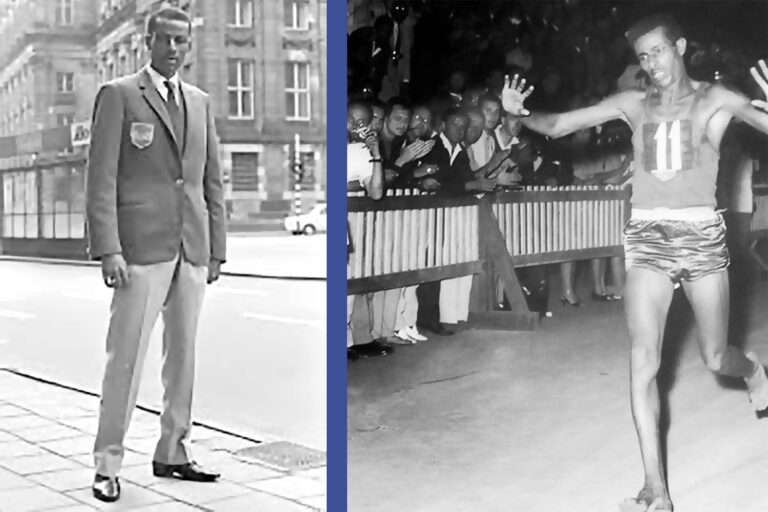
Something else that would have been noticed by anyone who had watched his race in Rome was that Bikila was wearing shoes – white, flat-soled running shoes that look decidedly different to the ultra-cushioned gear worn by long-distance elite runners today.
But perhaps the most important difference for Bikila was the build-up to the event. Just 40 days prior to the marathon competition, he had been diagnosed with acute appendicitis, spending a week in hospital following an emergency appendectomy.
But nothing would stop Bikila from making history that year in Tokyo.
In gruelling race that took a devastating toll on many of the runners competing in it (of the 68 starters, 10 didn’t make it to the finish line), Bikila was composure personified.
Utilising his relaxed, highly efficient running style, the Ethiopian glided through the streets of Tokyo.
In truth, he was in a league of his own that day, coming home over four minutes sooner than his nearest rival, Basil Heatley of Great Britain.
When he passed through the tape at the end of the race in a new Olympic record of 2:12:11.2, he looked like he had barely broken a sweat. In a race where many of the competition collapsed across the finish line, Bikila celebrated by doing gymnastic exercises on his back at the edge of the track.
For the second time in as many Games, Bikila received Ethiopia’s only gold medal – and with it became the only athlete to win two marathon gold medals.
What happened next?
Of the 13 marathons he ever competed in, Abebe Bikila won 12.
Until he first graced the Olympic stage, East African athletes had never won Olympic gold. Now runners from the region are the dominant force in long-distance running, with Ethiopia on its own having won a total of 22 gold medals.
Bikila returned home a hero, but in 1969 tragedy struck. The Volkswagen Beetle he was driving was involved in a traffic accident that left the legendary athlete paralysed. He would never walk again.
But being bound to a wheelchair did not stop Bikila from continuing to compete. A year later, while still receiving treatment for his accident, he took part in the 1970 Stoke Mandeville Games in London – the forerunner to today’s Paralympic Games.
Bikila died at age 41 in 1973, following a cerebral haemorrhage related to his accident. It was less than 10 years after his incredible victory in Tokyo.
But the legend – and legacy – of East Africa’s first Olympic gold medallist continues to live on today.

German Coach Middendorp to take over St George

0

Record 14 times Ethiopian Premier League champion St George once again turned out the only side to employ a foreign Coach handing a three years contract to German Ernest Middendorp. According to the club’s Board member and marketing Head Dawit Wubeshet propelling the team back in to championship title, overseeing the Youth scheme and steer St George to Confederation Cup last eight are few of the responsibilities bestowed to Middendorp.
Ten years as a player with 198 goals in 235 appearances, the economics graduate Ernest Johannes Middendorp turned out Coach since 1985 and travelled to more than two dozen clubs in nearly four decades. Though championship titles and trophies are not mentioned in his profile, his travel took him to Asia and Africa where he managed the likes of big time clubs Hearts of Oak and Ashante Kotoko of Ghana.
Quitting his second spell with South African giants Kaizer Chiefs just days before putting his signature to St George , the 61 year Coach is expected to arrive to Addis Ababa to his first ever encounter with the team that had been laid off for the past seven months due to Covid19 Epidemic.
In addition to building the side almost from a scratch and steer them to back to the glory day, Middendorp has additional duties involving in the overall structure of the 80-plus years St George that never has its own stadium and dependant of one of Ethiopia’s leading investor Abnet G/Meskel.
Twenty three teams in 35 years with an average of 1.7 years in a single club, it appears that Middendorp has little patience or no long term plan to commit himself to one club.
According to FarPost publication, Middendorp had also been linked for the Head Coach position with Tanzanian giant Yanga and Ajax Cape town thus his arrival to Addis Ababa is not yet confirmed.
