


To Silence the Guns, Restore Nature
Hailemariam Desalegn
In the span of a human life, Mozambique’s majestic Gorongosa National Park has flipped: from wildlife haven to killing ground to sacred ground of peacemaking and recovery. This past week, as African Heads of State gathered in Addis Ababa to evaluate progress toward “silencing the guns” and creating an environment conducive to development, Gorongosa stands as both a warning sign and a symbol of hope.
Battles waged in Gorongosa during Mozambique’s 1977-1992 civil war left millions of people dead or wounded. It also ruined the ecosystem and killed 90 percent of elephants, buffalo, zebra, and wildebeest as soldiers poached them for money or slaughtered them for meat. At the war’s end, just 15 buffalo and 100 hippo survived. Few lions remained.
But with peace came opportunities to rebuild communities for 100,000 local people and to restore the environment. By 2018, grasslands, shrublands and forests were recovering. Some 1,000 buffalo roamed the area and the hippo population had increased five-fold. When Cyclone Idai struck last year, healthy ecosystems absorbed tens of millions of gallons of water, saving nearby villages from floods. Meanwhile, through programs of the Gorongosa Restoration Project, families have improved their agriculture and health, and the education of their children. Today, ecotourism adds local jobs, as the area reclaims an essential balance between nature and human development.
As in Gorongosa, the protection of nature everywhere is central to sustainable development, to the mitigation of climate change, and to secure and peaceful societies. Yet nature is being lost is being lost at a frightening rate.
Habitat conversion, the unsustainable use of natural resources, urbanization, and climate change all undermine the foundations of the natural world. The earth has lost 60% of terrestrial wildlife and 90% of the big ocean fish. One million plant and animal species are threatened with extinction. We are clear cutting rainforests at a rate of four football fields per minute.
The impacts of land and ecosystem degradation on biodiversity, land productivity, and human well-being in Africa has affected over 485 million people and costs an estimated US$9.3 billion annually.
That which has been destroyed in centuries, we must act to restore in the next decade in order to avert even greater natural, climate and human catastrophes.
Roadmap to Action
There is a roadmap to action. The Campaign for Nature offers a science-driven, ambitious new deal for nature that calls on world leaders to protect at least 30 percent of the planet—its land and water—by 2030. This rallying cry of “30X30” fuels the Campaign, which is a partnership of the Wyss Campaign for Nature, National Geographic Society, and a growing coalition of more than 100 conservation and indigenous peoples’ organizations around the world. The Campaign has also launched a High Ambition Coalition (HAC) for Nature and People composed of government leaders to drive high-level action on 30X30.
The Campaign calls on world leaders help mobilize financial resources to properly manage protected areas, and to fully integrate and respect indigenous leadership and rights in the work of conservation. We know from experience that local communities have to own the protected areas as their own and benefit from their protection. Only in this way will conservation succeed and promote inclusive economic and social development.
The Campaign’s main measures are crucial to Africa’s peaceful development. Africa generates 62 percent of its GDP through industries that are highly or moderately dependent on nature, most especially agriculture. One of the major risks business faces from the loss of nature is increased conflict. The protection of nature is paramount.
Africa can and should take the lead in driving action toward 30X30. A crucial opportunity to do so will be at the meeting of the 15th Conference of the Parties to the Convention on Biological Diversity in Kunming, China, later this year. There, Convention targets will be updated to reflect the full extent of our planetary crisis.
Many African countries have already committed to conserving their natural heritage as integral to sustainable development. The governments of both Rwanda and Uganda have resolved to protect 30 percent of their natural lands by 2030. Ethiopia has written environmental protection into its Constitution so that every political party that comes into power must act accordingly. Namibia has designated its entire coastline as a national park.
Gorongosa National Park has shown us that nature recovers if given a chance. And like streams across a watershed, the benefits flow from there.
By investing in national parks, natural reserves, sustainable tourism, and community-led conservation areas, and by partnering with indigenous and local people, by building a global consensus for 30X30, we can not only save biodiversity but also generate jobs and income, significantly mitigate climate change, and silence the guns.
Hailemariam Desalegn is the former Prime Minister of Ethiopia.
Investment FREEFALL
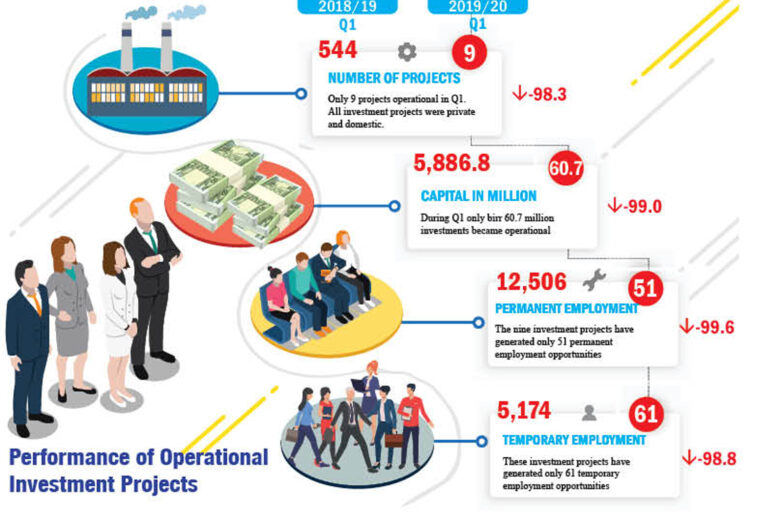
The latest quarterly bulletin of the National Bank of Ethiopia (NBE) indicates that fresh investment projects and investment capital was almost nil in the first quarter of the current fiscal year that runs from July to September. The bulletin that shows the overall economic condition of the country states that in the first quarter of 2019/20 fiscal year that ended on September 30, only 9 investment projects with investment capital of 60.7 million birr became operational throughout the country. It added that both the number of investment projects and investment capital showed 98.3 and 99 percent decline compared to the same period last year. At the same period of last year the number of projects operational were 554 with 5.88 billion birr investment capital. 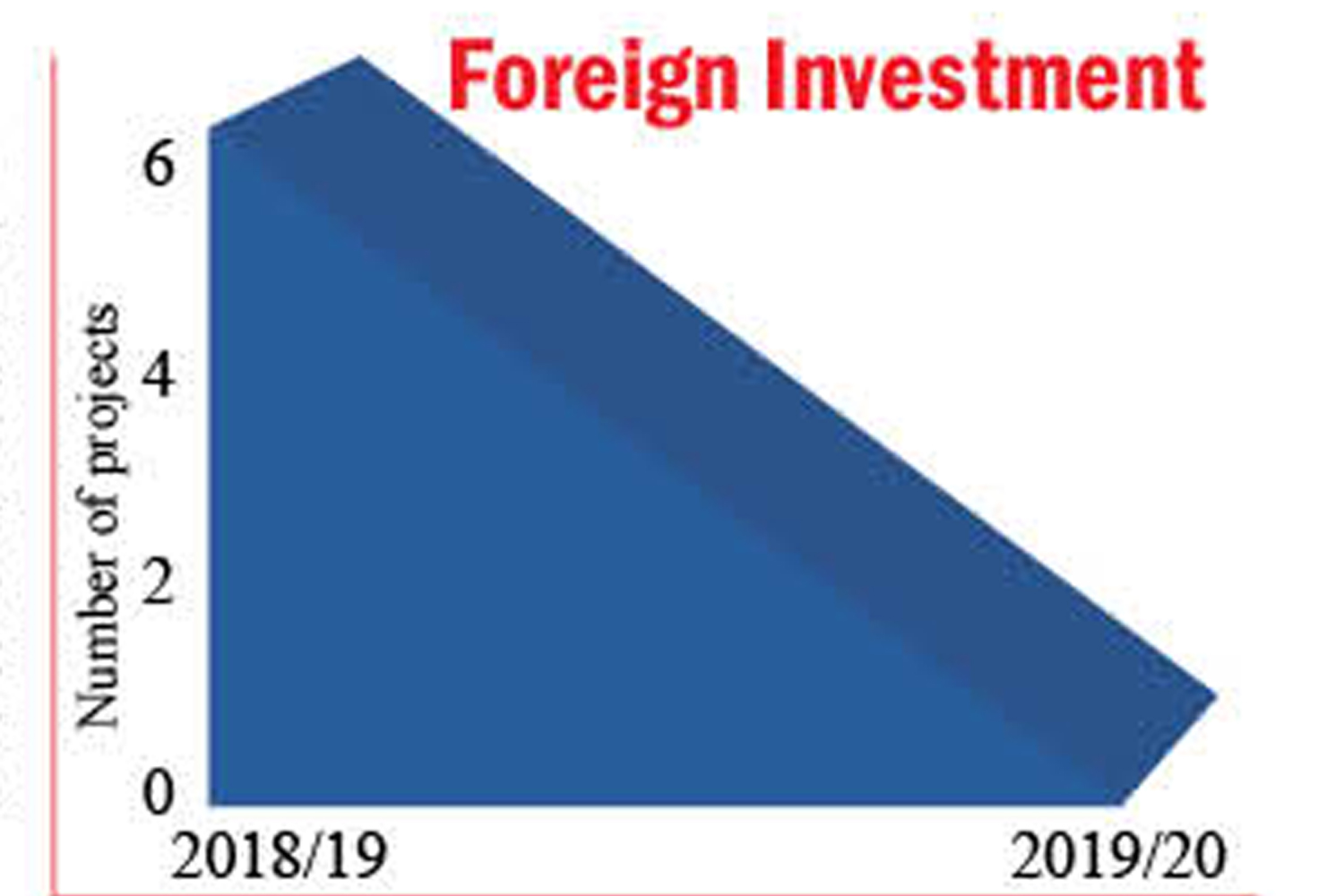
Operational investment projects dropped by 99%
The latest quarterly bulletin of the National Bank of Ethiopia (NBE) indicates that fresh investment projects and investment capital was almost nil in the first quarter of the fiscal year.
The bulletin that shows the overall economic condition of the country states that in the first quarter of 2019/20 fiscal year that ended on September 30, only 9 investment projects with investment capital of 60.7 million Birr became operational. It added that both the number of investment projects and investment capital showed 98.3 and 99 percent decline compared to the same period last year.
At the same period of last year the number of projects operational were 554 with 5.88 billion birr investment capital. The number of operational investment in the fourth quarter of the past fiscal year has been 112 with 898 million birr capital.
According to the quarter review document, from the stated number of investments and capital there was no foreign investments. “All investment projects were private and domestic,” it explained.
However Abebe Abebayehu Ethiopian Investment Commission Commissioner strongly disagrees with the report. “In the first quarter of the budget year there was 700 million dollar inflow of foreign direct Investment. Moreover 33 businesses become operational during the stated period,” Abebe told Capital.
A year ago six foreign investment projects with investment capital of 199.2 million birr were operational, while the public investment were nil during the whole year of last year.
According to NBE’s report, the nine investment projects in the first quarter of this budget year have generated employment opportunities for 112 people of which 45.5 percent (51 jobs) was permanent and 54.5 percent (61 jobs) temporary. Compared with the same period of last year the employment generation has dropped by 99.6 and 98.8 percent respectively for permanent and temporary employment.
These figures were 12, 506 permanent and 5,174 temporary jobs at the same period of last year.
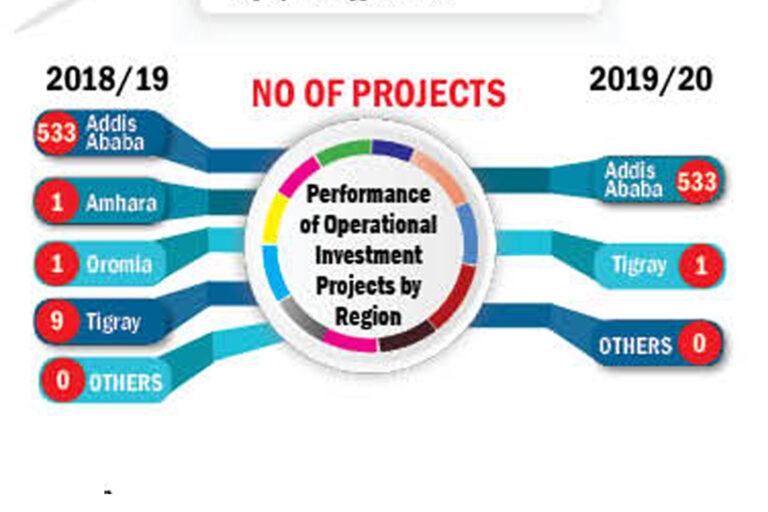
Regarding regional distribution from the nine new operational investments, except one investment in Tigrai all are in Addis Ababa.
“In terms of regional distribution, 88.9 percent of the total projects with 75.3 percent of total investment capital were in Addis Ababa and 11.1 percent of total projects with 24.7 percent of capital are in Tigray,” the report states.
While in terms of job creation Addis Ababa received 80.4 percent of the permanent employment and 67.2 percent temporary employment while that of Tigray region was 19.6 and 32.8 percent respectively.
As for sectoral distribution, manufacturing constituted 55.6 percent of the total investment project while construction and real estate, renting and business activities took 22.2 percent share each. Of the 60.7 million birr capital invested, the share of manufacturing sector was 66.4 percent, and that of real estate, renting and business activities 26.3 percent and construction 7.2 percent.
About 76.5 percent of the permanent employment was created by manufacturing sector while real estate, renting and business activities created 23.5 percent, according to the quarterly bulletin of the central bank.
Likewise, manufacturing sector was the leading sector by employing 67.2 percent of temporary labor force followed by real estate, renting and business activities which constituted 32.8 percent.
The registered operational investment in Tigray region in the stated period was consumed almost one fourth of the total investment for the period, while it has only created 10 permanent and 20 temporary jobs.
The bulletin indicated that operational investment in other regions in the stated period was zero. However in the first quarter of 2018/19 each one investment with capital of 40 million birr and 123 million birr were operational in Amhara and Oromia regions respectively. But it was zero for all regions in the fourth quarter except Tigray and Addis Ababa.
However regional investments slow downed the situation in Tigray region is different for instance in the first quarter of the 2018/19 9 projects with capital of 34.3 million birr were operational that improved to 12 projects and 103 million birr capital at the fourth quarter.
Otherwise all of the 533 projects are based in Addis Ababa.
Hailu Jelde, Commissioner of Oromia Investment Commission, which is the biggest region regarding investment potential, capacity and strategic location, told Capital that the region is focusing in enhancing previous investments to undertake their businesses on full capacity.
A couple weeks ago Investment Trend Monitor, the United Nations Conference on Trade and Development (UNCTAD) report, stated that the foreign direct investment slowed down to USD 2.5 billion in 2019 from USD 3.2 billion a year ago.
