

Nearly 15 million children have been vaccinated against measles in Ethiopia in an effort by the health authorities to maintain essential health services, even as they battle to contain the COVID-19 pandemic.
The nationwide campaign which wrapped up this weekend was conducted under the leadership of the Ethiopian Ministry of Health with support from World Health Organization (WHO), UNICEF, Gavi, the Vaccine Alliance and the United States Centers for Disease Control and Prevention. The vaccination campaign was initially scheduled for April but was suspended due to the pandemic and resumed in July.
The campaign ran for 10 days, which is longer than similar past campaigns to limit crowding and risks of COVID-19 infections. Health workers wearing face masks delivered the measles vaccine in open and well-ventilated areas. Other measures such as physical distancing, handwashing and temperature checks were also implemented in compliance with COVID-19 prevention guidelines.
The campaign’s target was 15 million children and it attained 96% coverage (14.4 million), showing that even with an ongoing COVID-19 pandemic, countries can continue to carry out life-saving mass vaccinations.
Ethiopia vaccinates 15 mln children against measles
RAKEZ re-opens its doors for business set-up consultations
Ras Al Khaimah Economic Zone (RAKEZ) will be opening its sales offices in Ras Al Khaimah, Dubai and Abu Dhabi on Monday 3 August 2020, welcoming investors seeking consultations on business set-up in the UAE.
As RAKEZ carefully re-opens its doors to new investors, it has taken a series of precautionary measures to ensure the health and safety of its visitors, employees and the whole community. Investors visiting RAKEZ for consultation will meet their business set-up consultants in designated open spaces while maintaining safe physical distancing. In addition, the authority has made several enhancements in the business set-up processes by eliminating the requirement of passing on original and printed documents. Investors can walk in to any of RAKEZ sales offices in Ras Al Khaimah, Dubai and Abu Dhabi, to consult with the RAKEZ team before proceeding to RAKEZ Portal 360 to submit all requirements, sign their documents, and completing the payment transactions in a safe and secure platform.
IATA urging African governments to unblock bottlenecks
As a consequence of the pandemic and associated restrictions, African airlines are forecast to lose USD 2 billion in 2020. Without urgent financial relief, the industry is at risk of collapse, putting about 3.3 million jobs and USD 33 billion in African GPD in jeopardy.
To date, the governments of Sub-Saharan Africa Rwanda, Senegal, Côte D’Ivoire and Burkina Faso have pledged a total of USD 311 million in direct financial support to air transport. A further USD 30 billion has been promised by some governments, international finance bodies and other institutions including the African Development Bank, African Export Import Bank, African Union and the International Monetary Fund (IMF) for air transport and tourism. However, much of the relief is yet to reach those in need due to institutional bureaucracy, complex application and creditworthiness processes, as well as cumbersome conditions to secure finance.
“Over USD 30 billion in financial support has been pledged to aviation and tourism in Africa. Some of this money has been allocated by governments, but far too little of it has reached its intended recipients. Governments and lenders need to urgently unchoke the bottlenecks so that the money can flow quickly, otherwise it will be too late to prevent closures and job losses. There will be no point re-opening the borders and skies if there is no industry left to speak of that is capable of supporting trade and tourism, which are the key components of any thriving economy,” said Muhammad Albakri, IATA’s Regional Vice President for Africa and the Middle East.
Ethiopia starts using Port of Tadjourah
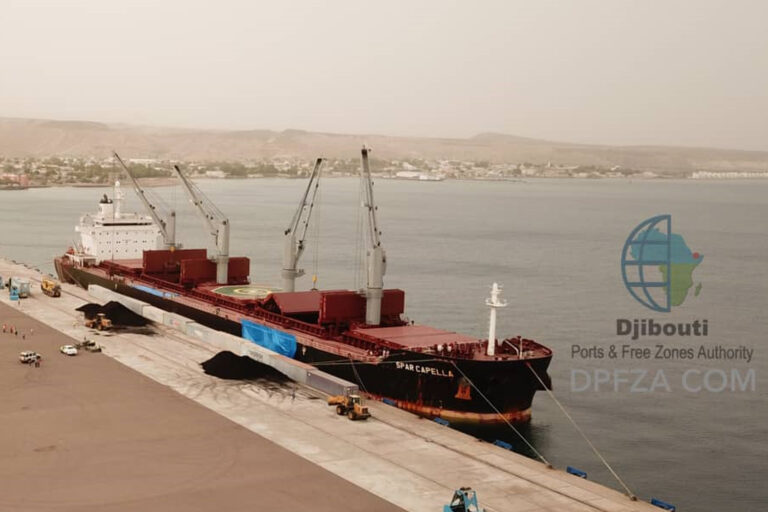
Ethiopian Shipping and Logistics Services Enterprise (ESLSE) announced that it started using Djibouti’s Port of Tadjourah, which received the first vessel on July 17 with Ethiopian cargo.
Roba Megersa, CEO of ESLSE, told Capital that the port, which was idle for years, has now started giving service for Ethiopian cargo.
He said that the vessel with cargo of coal arrived on July 17 and is transported to Ethiopia.
Initially the port has been developed in the aim to transport mainly potash from Ethiopia’s Afar region, while the mining is not yet developed. Besides that the port has a potential to provide for northern Ethiopia.
Roba said that the road from Tadjoura to Balho, a border town, is high standard that is also preferred by drivers. The road that is 120 km and consumed USD 156 million was inaugurated late last year.
The coal imported for cement factories is 50,000 metric tons and is transported by Spar Capella vessel, which is sailing under the flag of Norway, from South Africa.
Compared with the traditional route from ports in Djibouti via Galaffi, the current road from Tadjoura to Balho is high quality and shortens the driving hour significantly, according to the CEO.
“The major share of the 120km road from Djibouti to Galafi is damaged, which forced drivers to drive up to 8 hours to cross the border, while this side may take only two hours,” he added.
Trucks that crossed the border will come at the center via Dechato town of Afar region.
He said that other vessels will also use the port in the coming period as an alternative. “It is a good alternative when ports surrounded Djibouti as the main town is crowded,” he said.
“Ethiopian vessels will use Tadjoura Port since they are equipped with gear, which is a support to unload cargos from vessels, and don’t need crane at the port,” he explained.
Roba said that on a daily basis up to 4,000 tons of cargo can be unloaded, which is very big for the new port and even high compared with the performance in other Djibouti ports.
“For instance on Friday July 24, 2,000 tons of cargo was unloaded and transported by 50 trucks, while in the past days 100 trucks that carried 4,000 tons of coal has been transported,” he said.
Spar Capella is a bulk carrier that was built in 2011 and is sailing under the flag of Norway. Its carrying capacity is 58,000 tones DWT.
The Tadjoura Port, which consumed USD 90 million, has been built to mainly focus on general cargo, such as potash and has a depth of 12 meters with 2 berths of 435m length. This facility is well positioned to serve hinterland and could accommodate vessel of up to 80,000 DWT.
The Tadjourah-Balho road financed by the Kuwait Fund for Arab Economic Development is the third road corridor besides Djibouti-Galafi-Dicheto and Djibouti-Dewalle-Dire Dawa connecting Ethiopia.
In related development Djibouti Shipping Company, formed under Djibouti Ports and Free Zones Authority (DPFZA), has received its first vessel a week ago.
Djibouti Shipping Company’s first ship (African Sun) arrived at Djibouti on 19 July and is set to target to reduce transit time for merchandise travelling from different route.
The ship that targets to bolster regional trade arrived from the Port of Mersin, Turkey and will make regular journeys to Mogadishu, via Djibouti, Berbera and Bossaso. Africa Sun has a capacity of 1,108 twenty foot equivalent units (TEUs).
According to the statement from DPFZA, in addition to import-export traffic, Djibouti Shipping Company will also offer redistribution services for transshipment containers in Djibouti, by major shipping lines and intended for ports in the region.
“Africa Sun is the first step in a major national project to become a key player in the shipping industry,” DPFZA said in its statment.
