

The government targets to double the current fiscal year domestic indirect tax collection from the performance registered in the just ended fiscal year.
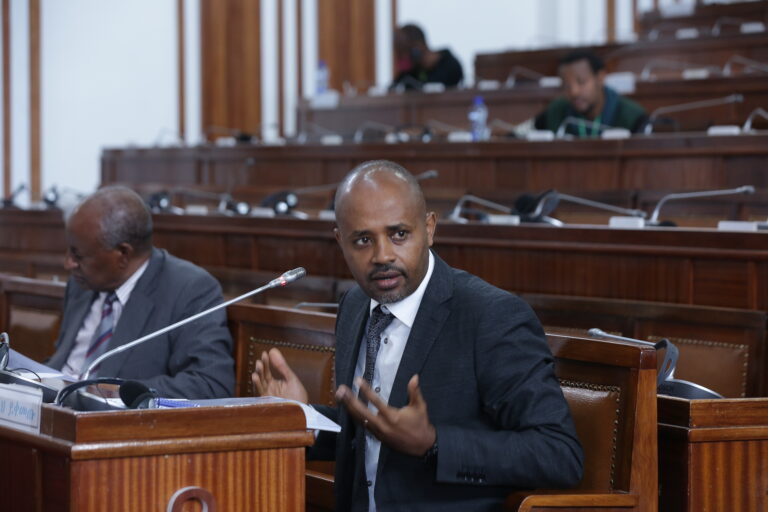
Recently Eyob Tekalign, State Minister of Finance (MoF) told Revenue, Budget and Finance Standing Committee that for the year the government targeted to expand its revenue from indirect taxes that are mainly value added tax (vat), excise tax and others.
Members of the standing committee raised their concern that due to the COVID 19 pandemic the economy will be affected, which also influences the tax collection operation.
In his response Eyob explained that the government has considered the effect of the pandemic but it has mainly focused on indirect taxes than direct tax, which is mainly corporate or income tax.
“We will work strongly to expand the tax collection from indirect sources and reforms in the area are being done,” he explained.
For the last few years the country was working to expand the tax base and on regulatory and enforcement areas to boost the tax collection, which is very low even compared with peers in Sub Sahara countries.
In the last budget year MoF has also revised the excise tax proclamation that is expected to enlarge the revenue from this tax sector. The amended proclamation also gives a right for the government to revise the percentage every two years, which is a usual trend in other countries like neighboring Kenya.
From domestic indirect tax the collection will be about 85 billion birr that is ambitious compared with the performance for the 2019/20 fiscal year. In the last fiscal year the revenue from indirect tax the government estimated it was close to 41 billion birr, while the projection was to get almost 71 billion birr.
From local domestic commodity VAT, the government has targeted to earn 30.5 billion birr that is 27 percent higher than last fiscal year projection. Domestic commodity VAT expected revenue for the year is also 61 percent higher than the actual performance for the 2019/20 fiscal year, which was 19 billion birr.
The expected service VAT for the year is 39 billion birr with 10 percent increment compared with 2019/20 fiscal year and 118.6 percent compared with real achievement. In the last fiscal year the government projected to earn 35.5 billion birr from service VAT but the performance was close to 18 billion birr.
The import commodity VAT for the year was set to be 37.7 billion birr and the actual performance was 34 billion birr.
For the year the government has targeted to earn 107 billion birr from all VAT sources. In the past year 96.7 billion birr was expected, while the actual performance is estimated to be about 71 billion birr.
According to last year projection from domestic commodities excise tax collection, the government was expected to secure 10.4 billion birr, while the real performance was 3.3 billion birr.
For this year the commodity excise tax collection is expected to be 13.7 billion birr that is 31 percent higher than the past year and 313.4 percent compared with the performance that was 3.3 billion birr.
The import commodity excise tax revenue has also set to be 14 billion birr with 30.4 percent increment from the expected earnings for the 2019/20 budget year. In the 2019/20 fiscal year the project from import commodities excise tax was 11.4 billion birr, while the earning was close to 11 billion birr.
For the current fiscal year the government has targeted to collect close to 28 billion birr from all excise tax sources.
In the past year close to 22 billion birr was expected from excise tax, while the result was 14 billion birr.
According to the budget document of MoF, the revenue from customs duty collection is expected to increase significantly. According to the projection for the year the government targeted to get 45 billion birr.
From the direct tax the government has expected to earn close to 66 billion birr, which has reduced by 9 percent compared with the 2019/20 fiscal year target.
Gov’t to double indirect tax collection
S&P Global Platts to analyze global wheat market

Global market price will be the reference for financial opening of the latest procurement process of 400,000 metric tons of wheat after the Public Procurement and Property Disposal Service (PPPDS) hired a global company, S&P Global Platts, to analyze the global market for wheat procurement.
On Friday July 24, the PPPDS has opened the bid for 400,000 metric tons of wheat that was initially floated in October 2019, after being cancelled in different occasions.
Abeba Alemayehu, Procurement and Contract Administration Sector Deputy Director at PPPDS told Capital that the current bid evaluation process will be different since it considered the international price besides the participants offer.
She said that the new scheme will make the government more beneficiary since the measurement will not only consider the lowest offer at the bid.
“Previously procurement was not assessed based on the global market price, but it was supposed to be because global market price indicator will identify the offer if it was exaggerated or not compared with international rate,” Abeba said.
She added that when the financial offer of the bid participant for the latest bid process opened it will be evaluated with the global market rate, which is analyzed by S&P Global Platts, a London based company. S&P Global Platts is a provider of energy and commodities information and a source of benchmark price assessments in the physical commodity markets for the last 110 years.
“In the past it was difficult to compare the price but this scheme will help us to compare whether it is close with the global market or not,” the Deputy Director said.
At the bid announcement PPPDS indicated that the finance will be evaluated under international price.
PPPDS announced the rebid on June 16 and the bid opening was expected to be done on July 10, which was rescheduled because of internet shutdown.
The wheat global price indicators were not subscribed in the past, while oil and other commodities are subscribed by Ministry of Trade and Industry and National Bank of Ethiopia.
“The new scheme will give more benefit for the wheat procurement, which is one of the strategic commodity for the government,” she added. “Besides that it will increase the quality of the biding process.”
“If we know the fob price at the Black Sea we will expect the bidders’ rate, who may supply from the stated location, to come up with close amount of the rate that we have,” she added.
At the opening only five companies submitted their bid document, while 53 companies bought the bid document.
The Swiss company Aston SA, A Plus Importer, Huyton Inc of London, Latudo General Trading from UAE and Mush Candle Factory Limited of Kenya are the companies that submitted their bid document.
According to their offer most of the companies indicated that they will supply the product from different ports in Russia.
Worku Gezahegn, procurement expert at PPPDS, said that the financial evaluation will be opened when the technical evaluation that opened on July 24 is finalized. He told Capital that the financial evaluation will be opened in the coming ten days.
We cannot pretend as if nothing happened

Who in Ethiopia is happy today? The Afars, the Amharas, the Oromos, the Tigrays’. Who? As a matter of fact our history hardly finds moments where people enjoyed happiness, liberty, or even wild abandon. Ours is a history of ethnic violence, nationalities, battle, blood and territory.
Ethiopia in the era of Jawar and Bekele (now in detention) appears to be re-inventing a new religion of ethnicity. In accordance with our culture’s declining intellectual prowess, our new creed in the year 2020 is a very simple faith, with one Oromo-and-Amhara dogma: Oromos are great, Amhara’s are dull. Everything else follows inevitably. For example, Amharas are wrongdoers and must be disciplined, while Oromos are saints and must be pampered.
Last weeks’ destruction in Oromia region is what interests us today.
The rampant destruction directed towards Amharas in few Oromia towns following the murder of Hachalu Hundessa is what jolted Ethiopia in early July. All day the so called ‘Keros’ intimidated and attacked Amharas and non-Oromos causing massive devastation to towns, the like of which has never been seen in Ethiopia’s recent history. As one Shashemene resident supposedly said “All the people could do was pray.” These gangsters were organized, incited, and committed by extreme political party operatives. For reasons that are obscure, the state security forces acted like they were either on the side of or afraid of the destroyers. [Notice, not one top official from the regional or the federal government was terminated, no one resigned, and no one took responsibility for failing to prevent or stop these crimes against humanity … No one!… Yes, some mid level bureaucrats and officials suspected to have ties with the attackers seem to have been arrested. But nothing else!]
We only bring these issues because we hear a lot of words, but we don’t see much happening
For background… killings, looting, or taking of goods by force and causing destruction to businesses owned by Amharas have been increasing in Oromia since the latter years of Hailemariam’s administration. In most, if not all instances these incidents have been tolerated. While this reality left many citizens bone-weary with the shock and frustration that no decisive action is taken, and that political leaders calling for “hate the man or woman who’s not Oromo” persist, the country will remain in danger of lapsing into a state of civil unrest. These extremists always ignore or belittle the enormous success of millions of Oromo people over the generations in enriching economic, political, intellectual, social, and cultural life in Ethiopia. They want their followers to riot, set fires, and attack and even kill innocent people. For what? To grab power and prosper while everyone else struggles, suffers, and dies.
In the wider context of the political transformation of Ethiopia, a more fundamental debate should have taken place following the rise of Prime Minister Abye Ahmed to power. In particular, discussions on inequality, justice, failure of institutions, predation of wealth, should have been contemplated… there was none. Instead, the same old politics continued. The state, this time again, became nothing more than a vehicle for Oromo polity domination.
Today, maintaining political balance and diffusing ethnic tensions is the only way the country can survive. If the Federal government fails to maintain these essential functions, the destruction and mindless mayhem can turn the still controllable risk into uncontrollable. Add to it Covid-19 in a country where poverty, growing inequality and disregard for human life are thriving, and in which legal and economic policies are increasingly designed to create and sustain wealth for the powerful, but not end poverty, any fool can see that we’re all heading for disaster.
Interestingly enough, the past weeks’ destructions provoked the first embryonic unity of citizens in Addis Ababa. Most of the city residents stood firm and prevented an actual fight and the possibility of general damage that could easily have brought havoc to the city. This time over AA residents did not let the thugs take over. Still, plenty of damage has been done to businesses, personal lives, undefended buildings, and the public interest.
I think and I hope, more and more citizens of AA, with increasing understanding and courage, will develop a much greater and more systematic level of organizational control in defending their city from hooligans. Even better, why not organize to seek political representation in kebele or zone-level decision-making conversations about how to best strengthen communities and increase shared economic prosperity? Organized communities act as stewards by building community wealth, empowering community voice, increasing resident participation and enhancing community conditions through neighborhood organizing. More specifically, many such communities galvanize residents and together push for transformative neighborhood changes including security, job creation, housing unit production and small business support.
Dear readers, thuggery never brings prosperity to a nation, but benefits only a few shameless opportunists, while to the country as a whole it heralds countless deaths, widespread impoverishment, and, in the gravest cases, a long-lasting degeneration of the people. It’s therefore critical for this government to face reality and launch a deeper political, social and economic transformation to restore normalcy, rebuild the unity of Ethiopia and put in place an economy designed to serve the people.
MAGICAL THINKING
Magical thinking is becoming quite broad and frighteningly popular. When magical thinking pervades a society, widespread disconnect, followed by actively erupting disillusionment, is the inevitable result. By and large, we believe the imports of these make believe phenomenon/magical thinking, in all spheres of socio-economic existence, is essentially due to the strategy of globally entrenched interests. All the major institutions of humanity are systemically geared to numbing the masses. It is not for no reason we affectionately call the ‘human mass’ of each and every society the ‘sheeple’ (sheep + people). Without the project of zombifying the sheeple (sorry for the redundancy) the world’s dominant interests cannot always get away with their ritualized murdering, so to speak!
Here is a benign general definition. ‘Magical thinking is a type of thought process based on questionable cause and effect relationships. This can lead a person to hold false ideas and make poor decisions. In some cases, magical thinking plays some type of positive role that improves creativity or quality of life’. For us, a more nuanced and biting explication of the phrase is preferred, subsequently; ‘Magical Thinking’ is nothing more than a type of thinking fixated almost always on the magical, i.e., on the irredeemably irrational. In other words, it is thinking ‘outside of reality’! If magical thinking is widespread in a society, the possibility of rational thinking usurping power, hence responsibilities, is going to be remote. Such a situation is now prevalent in the majority of human collectives/societies. Why is the world having more and more individuals, people, corporations, states, etc., immersed in magical thinking? Our answer is simple; it is because late modernity is incapable of surviving actually existing reality! See the articles next column, on pages 30.
Let’s use current and somewhat familiar examples to illustrate the point. In Ethiopia, private banks profess to pay a dividend of 50% per annum. Obviously, this is not a prudent business model, by any stretch of imagination. Elsewhere, such Ponzi utterances can easily start a bank run, but not here. It seems there is no room for rational reflection on such critical matters in our country. Be that as it may, it is obvious that banks play significant role in late modernity. Therefore, if banks are getting such basic fundamentals wrong, then one can imagine what kind of blunders other gullible economic actors are liable to make, invariably at the expense of the sheeple’s livelihood. Between our mighty industrialists, who are bravely assailing the formidable manufacturing challenge of bottling God given water in plastics, and the highly depraved tenderpreneurs/rentiers corrupting all state apparatus, the country’s hope of creating a capable modern sector is bound to remain only a pipe dream. But don’t sweat it too much; what we lack in creativity can be amply compensated with our unfailing magical thinking!
Less than half a decade ago, the Ethiopian government was going around boasting that it had managed to raise a couple of billions of USD from the international capital market without a glitch. If memory serves us right, the underwriter/handler was Goldman Sachs. To critical analysts the whole theatrics seemed embarrassingly amateurish, if not out rightly imbecilic. As usual, we opined against such magical thinking, but to no avail. The magical thinking, backing the government’s decision was the unfounded belief in the country’s capacity to service the debt as well as pay the principal without sweat, i.e., without rescheduling or (anticipated) debt forgiveness. With plenty of useful idiots around (from the lenders’ point of view), our voices were drowned swiftly. Nonetheless, we fruitlessly continued to holler; these useless idiots (our sentiment) have no clue as to the real workings of transnational capital, financial, industrial, etc. Highly educated all the way up to complete daftness and subjugation, these cretins/useless idiots and their preaching were accepted as the epitome of erudition. Beware of false Prophets in late modernity, says the Good book!
Trusting the Goldman Sachs of this world, on its own, is an example of unadulterated magical thinking. These so-called investment banks (before they collapsed in 2008 and changed their status to ordinary banks) have proved, time and again, their unreliability the world over. Greece was taken to the cleaners, never to recuperate, on the account of Goldman Sachs’ expensive ‘guidance’. During the last decade Africa was ordered to sing the tune; ‘it is time for Africa’ or in the parlance of the propagandists; ‘Africa Rising’, all on the back of another cyclical commodity boom, which was known to be short lived. Today, we are not singing but crying. Don’t expect our good for nothing elites/leadership (not only political) to self-flagellate for their gross mistakes. If anything, these states and their leaders are now working, yet again, on other unworkable projects (New Green Development, Sustainable, blah, blah.), mostly to collect pittance from the pushers of these initiatives (OECD countries)!
Truth is; when the sheeple starts thinking magically, it tends to feel good.
Achieving all our dreams through sheer desire is what one of the modern day philosophers from Hollywood’s ivory tower is advocating. “I operate from a place of delusion – that’s what the Fame is all about….I want people to walk around delusional about how great they can be-and then to fight so hard for it everyday that the lie becomes the truth.” Good Day!
