

As soon as the first case of coronavirus was reported in Ethiopia the price of some goods showed a significant increase. The goods include medical kits, sanitizers, disinfectants, masks and other consumable goods such as oil, rice and teff.
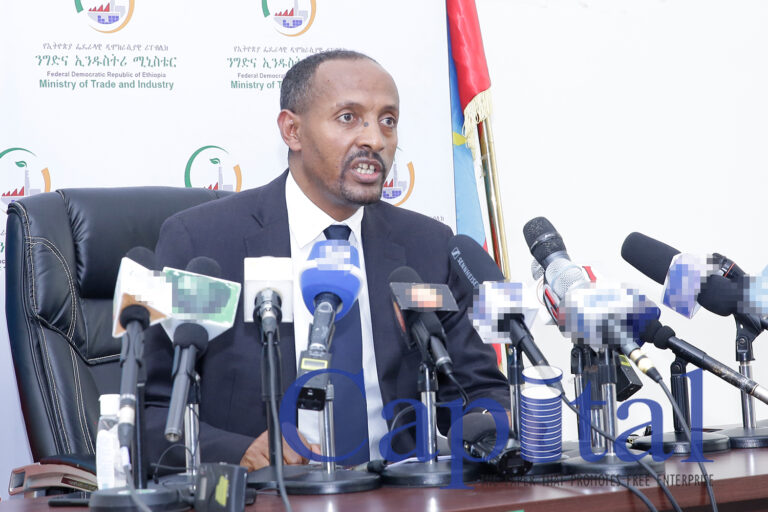
The Ministry of Trade and Industry (MoTI) said that it has observed a price hike and shortage of teff in the market. “Although the problem is on the supply and distribution the government is trying to solve the problem by giving financial support to unions and cooperatives. Currently unions are distributing 1.5 million quintals of teff to the market,” said Melaku Alebel Minister of Trade and Industry.
A report by the MoTI shows the government has found 25,068 traders who were unjustifiably increasing the price of goods all over the country.
Starting from March 10, 2020 up to now MoTI took measure on 25,068 traders who were accused of manipulating prices of goods. 10,000 were released by warning; 13,350 were fined; 424 arrested and waiting trial; 404 banned from doing business and 890 licenses were revoked.
According to the ministry, the government is working to develop the production of such goods locally to increase the supply.
Currently 81 factories are selected to produce 5.1 million masks per day and seven of them has already started the production. The minister also said that the country has a capacity to cover the local demand of detergents, as 43 factories are producing 2,258,200 kg of soap and 357,951 liter of liquid soap per day.
To control the price hike on food commodities the ministry is distributing the commodities through unions, including sugar, wheat, maize, rice, oil and teff.
The Minister also said that the country is also working to increase the oil deposited capacity of the country.
“The international crude oil price drop is an opportunity for Ethiopia, we are working to increase our capacity on oil depot and increase the import rate of oil,” said Melaku.
According to the minister the country imports 399 million liters of crude oil per month; the country spends more than 3 billion dollars annually.
The Ministry has reported that the eight months export performance of the country fetched USD 1.8 billion, half a billion lower than its target. However as the ministry stated the country does not face much challenges on the export of items as it was expected since most of the items are related with food commodities.
Ministry targeting those who hike prices of commodities
As famines of ‘biblical proportion’ loom, UN urged to ‘act fast’
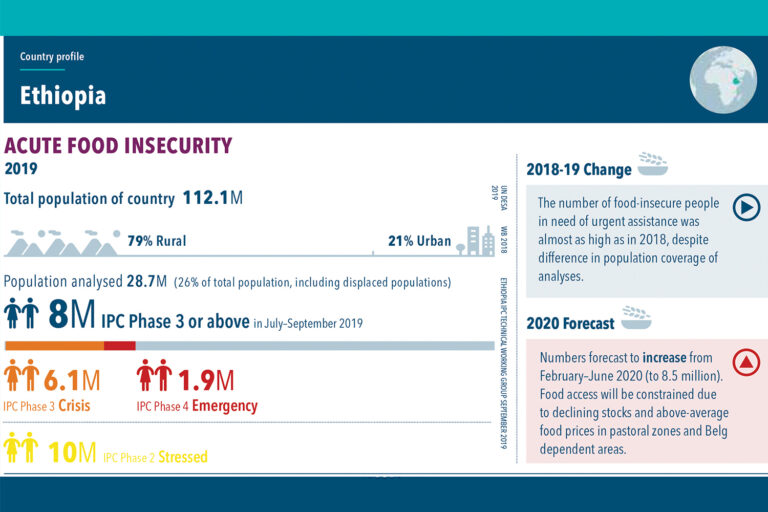
A Global Report on Food Crises released by United Nations has stated that more people face acute food insecurity and malnutrition in the wake of the COVID-19.
The report indicated that at the close of 2019, 135 million people across 55 countries and territories experienced acute food insecurity, noting that additionally, in the 55 food-crisis countries, 75 million children were stunted.
This, according to the report was the highest level of acute food insecurity and malnutrition documented by the network since the first edition of the report in 2017.
The report by the Global Network Against Food Crises, an international alliance of United Nation, governmental, and non-governmental agencies working to address the root causes of extreme hunger.
The 2020 annual Global Report on Food Crises, showed also that in 2019, 183 million people were classified to be in stressed condition – at the cusp of acute hunger and at risk of slipping into crisis or worse if faced with a shock or stressor, such as the COVID-19 pandemic.
It added also that about 73 million of the 135 million people covered by the report live in Africa; 43 million live in the Middle East and Asia; 18.5 million live in Latin America and the Caribbean.
The key drivers behind the trends analysed were: conflict – the key factor that pushed 77 million people into acute food insecurity; weather extreme – affecting 34 million people; and economic turbulence which accounted for 24 million.
Ethiopia
For Ethiopia the report states that while Ethiopia has made development gains over the last two decades, 27 percent of the population, or 30.2 million people, were still living below the poverty line (USD 1.90 a day).
The report also states that over 70 percent of rural Ethiopians are severely poor according to the Multidimensional Poverty Index. “Frequent and severe droughts have eroded resilience for rural households that have lost productive assets and have had little time for recovery between drought events,” reads the report.
The report also states that about 8 million people were in Crisis or worse across Afar, Amhara, Oromiya, Southern Nations, Nationalities and Peoples’ region (SNNPR), Somali and Tigray regions from July–September 2019, despite receiving humanitarian food assistance. This includes about 1.9 million in Emergency of whom over 1 million were in Oromiya. Around a third of the population in Somali and Oromiya faced Crisis or worse. An additional 10 million people were classified in Stressed level.
The population in Crisis or worse was similar to that of 2018, when estimated that 8.1 million people were food insecure and in need of assistance. At the start of Meher harvests in October 2019, food security improved, but about 6.7 million people remained in Crisis or worse.
Ethiopia is also the second largest host of refugees in Africa. The result of the annual report indicated that monthly food assistance for refugees lasted from 14–25 days, creating food gaps for up to 17 days a month.
Stating the factors driving acute food insecurity the report pointed out that extreme weather and crop pests contributed to the low yield.
The February-May Belg rainy season was characterized by late onset, erratic distribution and below-average rains. A below-average secondary Belg season harvest in eastern Amhara, eastern Oromiya and north-eastern SNNP regions was expected. In East and West Harerghe zones, where no significant rains were received until April and seasonal cumulative precipitations were up to 60 percent below average, the cereal output was very poor, with crop failures reported in some areas. In western key-producing areas, the June–September Kiremt rains were up to 30 percent above average and aggregate cereal production is estimated at above-average levels. However, unseasonal heavy rains during the October/November harvest resulted in localized crop production shortfalls. Crops were attacked by desert locusts at the end of the year in northern and south-eastern Tigray, north-eastern Amhara and Eastern Oromiya regions. While coordinated control measures implemented by farmers, local communities and the Government have contained crop losses, substantial localized losses were reported in parts of Oromiya zone.
WHO urges countries not to let COVID-19 eclipse other health issues
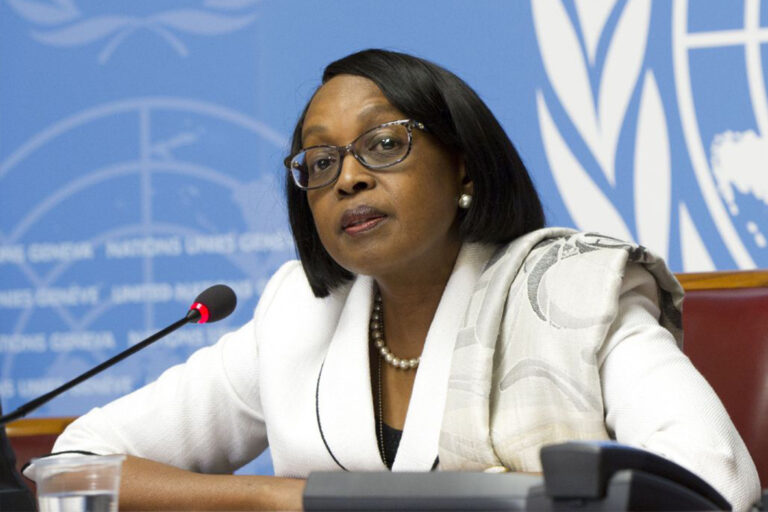
Public health systems in Africa are coming under severe strain as the unprecedented COVID-19 pandemic persists. But as countries battle to bring the outbreak under control, efforts must also be maintained on other health emergencies and progress made against diseases such as malaria or polio preserved, the World Health Organization (WHO) urged.
Prior to the arrival of the novel coronavirus in Africa, WHO was stressing the need for countries to ensure the continuity of routine essential health services. “An overburdened health system not only undermines the effectiveness of the response to COVID-19 but may also undermine the response to a whole host of preventable threats to human health. Even brief interruptions of vaccination make outbreaks more likely to occur, putting children and other vulnerable groups more at risk of life-threatening diseases” WHO said in a statement.
“I urge all countries to not lose focus on their gains made in health as they adapt to tackle this new threat,” said Dr Matshidiso Moeti, WHO Regional Director for Africa. “We saw with the Ebola Virus Disease outbreak in West Africa that we lost more people to malaria, for instance than, we lost to the Ebola outbreak. Let us not repeat that with COVID-19.”
Confirmed COVID-19 cases in Africa continue to rise, now exceeding 28,000. WHO is supporting countries in all aspects of the COVID-19 response and has recently published guidelines for ensuring the continuation of critical health services, including immunization and anti-malaria campaigns. The guidelines stress the need for countries to take a dynamic approach that mitigates any unavoidable pause in vaccination campaigns.
The consequences of disrupting efforts to control malaria in Africa could be particularly grave. Current estimates suggest that sub-Saharan Africa accounted for approximately 93% of all malaria cases and 94% of deaths, mainly among children under five. A new analysis by WHO and partners suggests that in a worst case scenario if malaria prevention and treatment services were severely disrupted as a result of COVID-19, the number of malaria deaths in 2020 in sub-Saharan Africa could rise to double the number in 2018.
“Africa has made significant progress over the past 20 years in stopping malaria from claiming lives. While COVID-19 is a major health threat, it’s critical to maintain malaria prevention and treatment programmes. The new modelling shows deaths could exceed 700 000 this year alone. We haven’t seen mortality levels like that in 20 years. We must not turn back the clock,” said Dr Moeti.
There are countries like Benin, the Democratic Republic of the Congo, Sierra Leone, Chad, Central African Republic, Uganda and Tanzania which are continuing with their insecticide treated bed net campaigns and other important malaria prevention activities. Countries are adapting their malaria strategies to the current complex situation.
Another essential health service is immunization. The response to COVID-19 has already disrupted vaccination efforts on the continent. Despite considerable progress on immunization, one in four African children remain under-immunized. Measles vaccination campaigns in Chad, Ethiopia, Nigeria and South Sudan have already been suspended because of COVID-19, leaving approximately 21 million children who would have otherwise been vaccinated unprotected.
Poll reveals African businesses expect their revenues to decrease sharply by next month
In a live poll conducted by Africa.com on April 22 as part of its webinar series, Crisis Management for African Business Leaders, which Capital is the official media partner, nearly 70% of webinar participants predicted that their business revenue will decrease by more than 10% next month. 47% indicated that they expect their revenue to decrease by more than 25% next month, and 24% indicated that they expect revenues to decrease by more than 50% next month. Only 20% indicated that they expect revenue to remain the same or increase.
Approximately 1,500 business leaders participated in the poll. Participants came from 41 countries across the African continent, with the largest representation coming from Nigeria, followed by South Africa, Kenya, Ghana and Ethiopia. 60% of the participants have one of the following titles: CEO, managing director, president, principal, partner, CFO, chair, chief, director, executive director, group head, general manager, or manager. Of the remaining 40%, the leading titles are analyst and consultant.
The largest sectors represented are financial services and professional services, followed by energy and manufacturing. A smaller tier consisted of real estate, health care, agriculture, health care, and media, arts & entertainment.
The live poll preceded a panel discussion on Liquidity – Managing Cash Flow When Sources of Revenue and Funding Dry Up moderated by Kunle Elebute, Chair, KPMG, with the following panelists: Welela Dawit, CFO, GE; Admassu Tadesse, President and Chief Executive of the Eastern and Southern African Trade and Development Bank (TDB); and Sim Tshabalala, Chief Executive, Standard Bank Group.
Africa.com Chair and CEO Teresa Clarke commented “the poll results are supported by the qualitative data we collected from the 10,000 registrants for the webinar series. We asked registrants what their greatest concern is with respect to COVID-19. Responses were open ended, and we received 10,000 responses ranging from 10-100 words. By far, the greatest concern expressed was reduction in revenue. But interestingly, many commented that while they were concerned about revenues, it was because they were concerned about being able to pay their employees. One respondent commented, ‘In Africa, we care more about people than profits.’”
The panel discussion is part of a four part series on crisis management developed by Africa.com and three faculty members from Harvard Business School. The next webinar discussion will take place on Wednesday, April 29, and is moderated by Hakeem Belo-Osagie, Chair of FSDH Merchant Bank and Harvard Business School Senior Lecturer of Business Administration. That webinar is entitled “This isn’t the West – How Africa’s Informal Sector Reacts to COVID-19.”
