

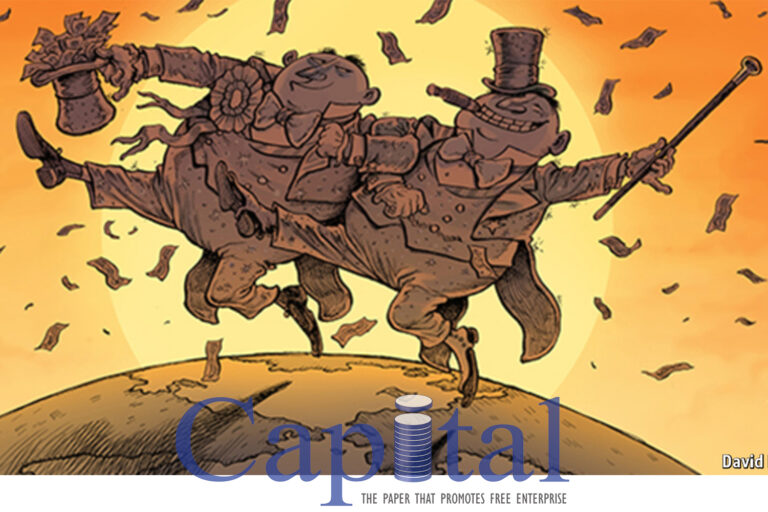
‘Cronyism’ has become one of the major operating principles of late modernity. We believe it is informative to reflect on the very origin of the word. Like many philosophical ideas, the word ‘crony’ can be traced back to ancient Greece. In the language of the ancient Greeks, ‘Khronios’ meant long lasting, perennial. In the mid 1600s the word became an English slang, compliment of Cambridge University. Deriving its essence from the Greek word, the connotation of the slang became quite clear and popular as well. In the modern world system cronyism is can be described as a substantive involvement with partners in crime!
The more potent and dangerous forms of cronyism involve two areas of modern societies. One is ‘crony capitalism’. The other, we would like to call ‘political cronyism’! The latter might sound a tad too redundant, as politics by its very nature, is ‘partnership in crime’. When the two spheres merge, i.e., the political and the economic, the result is the frightening phenomenon that goes by the name fascism! In the twilight of the modern world system, crony capitalism has managed to undermine the old capitalist virtues of resourcefulness, tenacity, creativity, frugality, probity, efficiency, honesty, perseverance, etc. Cronyism has replaced the above by suspicion, skepticism and outright disharmony amongst people. Unfortunately, institutionalized cronyism is now the norm in almost all nation states of the world system. It seems, without cronyism, modern capitalism will come to a screeching halt!
Crony politics or political cronyism is also one of the main features of modern societies. For instance, what we are currently witnessing in the US electioneering is a good example of political cronyism. In today’s democracy, it really doesn’t matter as to whom the sheeple (human mass) wants to elect. Without the blessing of the deep state, the people’s candidates will not see the light of day! See Hudson’s article next column. There are built-in processes in the system that will allow cronies to thwart off the desires of the masses! In the case of the US, for example, the honchos of the Democratic Party can easily reject the peoples’ favorite candidate and award the nomination to their desired crony! The same applies to the other major party. When such blatant cronyism prevails, one cannot in all honestly talk about a democratic system.
Lighter version of cronyism is also quite common in modern bureaucracies. ‘Favoritism to friends without regard for their qualifications, especially by appointing them to political positions’, is how one dictionary defines this anti-social value of our decaying civilization. Since ‘cronyism’ has become a widely practiced phenomenon in all activities of human engagements, specialized names are now assigned to its various manifestations. For example, the above is ‘nepotism’. It is a word mostly assigned to bureaucratic cronyism, which leverages kinship, etc.
Cronyism and the deep state go hand in hand. Without the protection of the deep state, cronyism can hardly survive. Cronyism can flourish in a society only when the rules of law/justice, etc. are systemically undermined, and for that to happen the input of the deep state is crucial. Granted, we humans are not angels, but that doesn’t necessarily mean our collective existence must be based on our worst dispositions. In fact, in the olden days of hunting/gathering or when intense co-operation was the norm (before industrialization) all those who pushed disruptive agendas, in one form or another, would have been eliminated from society. This was necessary to secure peace and harmony within a society. Today, instead of putting these disruptive psychopaths in jail or in a lunatic asylum, societies at large have decided to reward them with the highest offices/responsibilities!
Nonetheless, this widespread malaise is increasingly facing all sorts of resistance. Some of these grass root resistances have started to take political forms. In both the countries of the North as well as global south, old narratives are giving way to new emerging ones, and situations on the ground are changing fast. On the other hand, the parasitic elites, the beneficiaries of cronyism, have been numbed by their own criminal manipulations and trickery. In fact, they have become oblivious to the simmering mayhems that are now turning all over the world. Here is how the old French economist characterized ‘cronyism’.
“When plunder becomes a way of life for a group of men in a society, over the course of time they create for themselves a legal system that authorizes it and a moral code that glorifies it.” Frédéric Bastiat (1801-1850). Good Day!
CRONYISM
DBE investigating employees involved in NPL’s

The Development Bank of Ethiopia started inspecting individuals and its employees related with Non-Performing Loan /NPL/ of the bank.
Highly Corrupted government officials and employees of the bank contributed for the nonperforming loan of the bank to reach 16 billion birr according to Haileyesus Bekele President of the Bank.
The president further said that one of the main reasons for the increasing of the NPL is because of the less assessment on debtors, weak pre condition to get loan, giving false information to get loan by sabotaging with the employees of the bank.
Hence, the bank has taken measures on five employees, according to Teshome Almayehu, Vice President Lease Financing of the bank. Currently five employees are behind bars and the bank is investigating 71 projects which are not paying back there debt.
The bank’s NPL stood at 34 percent in the first half of the current fiscal year. In last fiscal year 2017/18, nonperforming loan ratio was at 40 percent.
Shortage of foreign currency, termination of agricultural loan and political unrest around the country were point out as reasons of the rising ratio of NPL in the last fiscal years.
Rain fed agriculture investment and failure of rain fed commercial farms in some regions of the country is also one big player for the rapidly growing non-performing loan. As one of these reasons the bank has banned to give loan for rain fed agriculture starting from 2017.
“Some of the companies have thousands of workers and has been generating foreign exchange to the country,” argues Haileyesus, but currently most of the companies failed to operate competitively even as proper as they should be; they are facing marketing problems.
To resolve these in the current fiscal year the state owned bank established one branch and ratify 10 million birr annual budget to administer and manage some companies failed to attract buyers including the Turkish company, Ayka Addis.
According to Teshome, most of the companies failed to attract buyers because of their high price.
The state owned development financial institution is supervised by the Public Financial Enterprises Agency and supports developmental projects on mainly agricultural, industrial, manufacturing and foster the investment of private capital for productive purpose. One of the mandates of the bank is the provision of development credit to viable priority projects along with technical support through mobilizing resources from domestic and foreign sources.
Priority area projects financed by the Bank include commercial agriculture, agro-processing, manufacturing and extractive industries. DBE also extends a special line of credit for borrowers that operate in the textile, garment and leather and leather product industries. As an additional special line, the Bank offers credit for the procurement of raw materials in the pharmaceutical industry and to companies that supply products to corporate government entities.
ESLSE to expand Modjo dry port
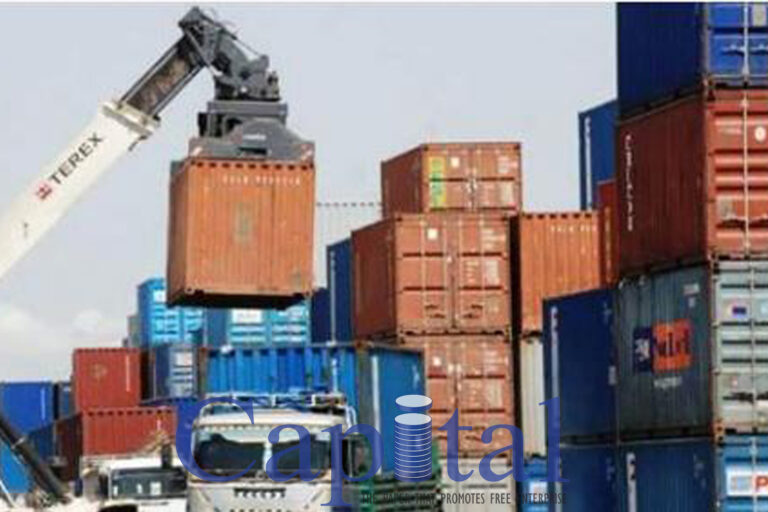
Ethiopian Shipping and Logistic Service Enterprise /ESLSE/ issued a bid to the construction the fourth phase of the Modjo dry port expansion.
As stated on the bid document, the enterprise invited all international construction companies that are equivalent to grade two contractors and above for the construction of the Modjo phase four project.
The phase four project includes, construction of terminal pavement on 2.2 hectare of plot of land, three main gates, access road, container washing and Modjo garage workshop port and terminal construction.
The bid issued on February 12, 2020 is expected to be opened on March 19, 2020.
The dry port in Modjo was established in 2009, located approximately 70Km from the capital. Due to the increased number of multi modal containers arriving in Ethiopia, the dry port was forced to begin operations without construction being completed.
The expansion to the port was started in 2010, the first phase of the expansion was done by the Ethiopian Water Works Corporation which was completed in 2012. The expansion includes increasing the holding capacity to 5000 more containers as well as developing infrastructure like access roads, electricity and drainage systems with 254 million birr finance. Following the completion of the first phase, the second and the third phase of the project were followed that include the construction of a containers’ terminal, the digging of two deep water wells, construction of additional stores, a heavy truck terminal, an alley, and gas stations, as well as other structures.
According to Ashebr Nota, Communication Director at the enterprise, for the previous three phases of the expansion the enterprise has financed 1.5 billion birr.
Modjo Dry Port is one of Ethiopia’s eight operational inland dry ports along with Qality, Semera, Meqelle, Dire Dawa, Gelan and Kombolcha and Woreta dry port the recent joined port. These ports have an installed handling capacity of 22,000 containers.
Modjo Dry Port works with two systems known as unimodal transport and multimodal transport, and it is the only multimodal service provider in the country. As it is the principal port in the country, the government and development partners are working to expand the facility. The World Bank has pledged a 150-million-dollar loan to expand Modjo Dry Port.
The port has a railway system with a capacity to move 3,500tn of cargo on a single trip. The train can make two trips a day to Djibouti, while truck transport takes more than four days for a two-way trip. As the largest port in the country, Modjo Dry Port handles more than 70pc of the nation’s imports.
Ethio-Horticulture International conference cancelled last minute

The 1st Ethio-Horticulture International conference that was organized by Ministry of Agriculture (MoA) and Ethiopian Horticulture Producers Exporters Association (EHPEA) and expected to gather several people from abroad and local was canceled a day before the event was supposed to be opened.
The event was scheduled to be held at Ethiopian Skylight Hotel for two days starting from Friday February 28, while the cancelation came on Thursday February 27.
On Tuesday February 5 Aynalem Nigussie, State Minister of MoA, gave a press briefing for media about the event and the expected out come from the international conference.
The event that is organized under public private partnership (PPP) model by MoA and the private sector wing EHPEA, was designed to go through challenges on the sector, evaluate the tax and insurance issues besides presentation of research papers.
At the press conference Aynalem said that at the event high government officials, guests from different countries, producers and exporters, financial institutions, researchers from higher education institutions, and potential investors will attend.
She said that it has also targeted to boost the sector by amplifying its past success in the job creation and economic support. “The country agro ecology will also be promoted on the international conference,” the State Minister said.
She added that challenges and success stories on the sector will be assessed followed by giving a direction by the government to solve problems and boost the sector.
Sector experts claimed that such a decision would give a bad image for the country since several foreign participants were already on their way and others were preparing to come.
Without further explanation MoA posted on its facebook page on Thursday February 27 that the conference is postponed for another time. The post does not give any given time when the conference will be held.
Sources indicated that the reason for canceling the event is that higher officials are in another meeting and that they would not be able to attend the conference.
In the horticulture sector particularly in the flower subsector Ethiopia has become the second biggest exporter in Africa after Kenya.
The sector passed bad period in the past three years in relation with the political instability in the country. But in the current budget year the sector has shown dramatic improvement regarding production and export earnings.
The first six months export report of the budget year indicated that the flower sector has been flourished, while the fruit and vegetable sector performance was high compared with the projection.
In the first half of the budget year the export of flower achieved 183 percent of the target.
in the period the sector was expected to get USD 123 million but the actual performance was USD 225.3 that is also 113 percent compared with the same period of last year.
The other sector that is included in the horticulture investment sector, fruit and vegetable, achieved a 122 percent of the target. The fruit and vegetable sector contributed USD 51 million, while the target was USD 41 million.
