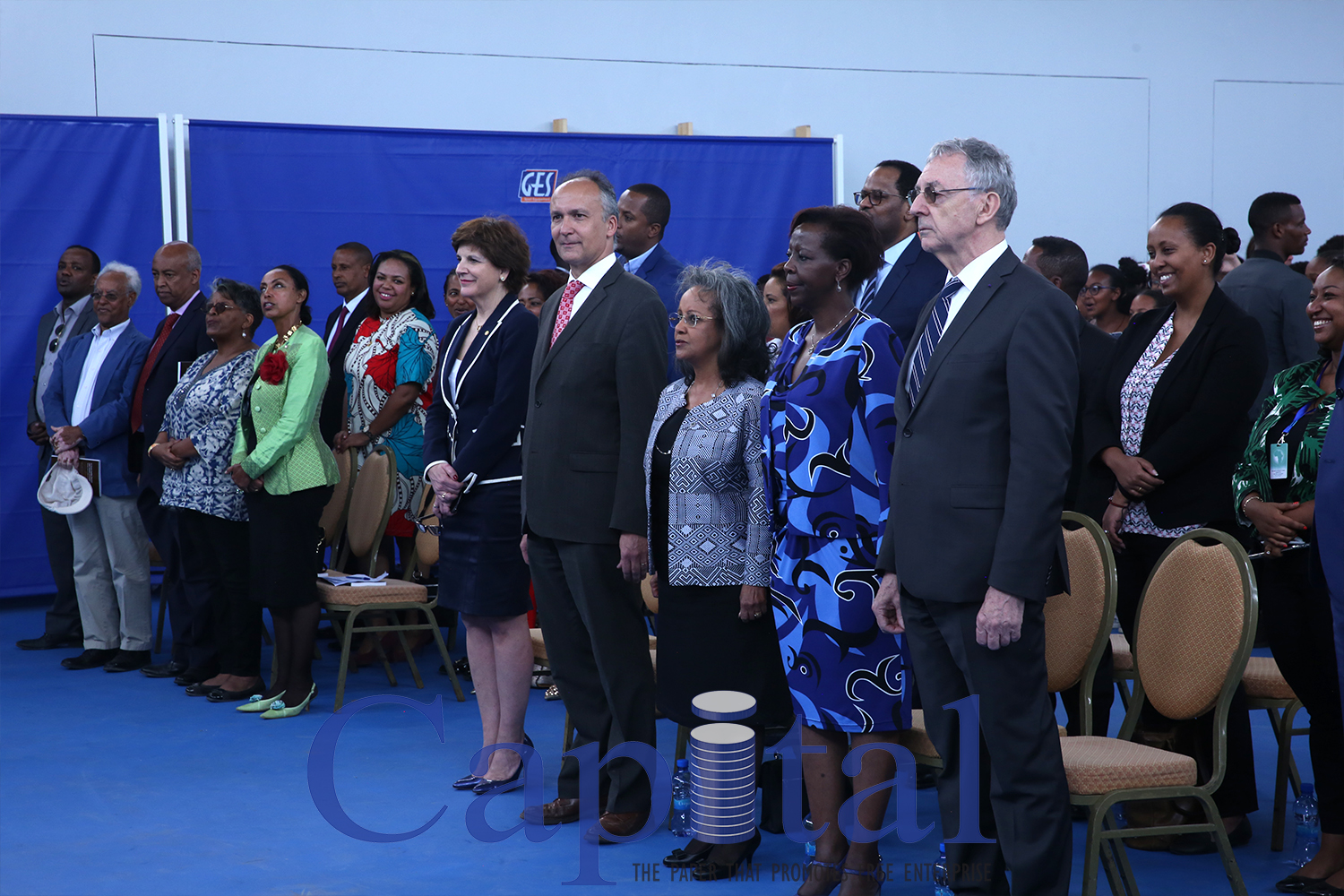
Odda Integrated Transport Services S.C. will start providing long distance public transportation services, by next week.
The company, which was established, last year with close to 10,000 shareholders in order to provide multiple business entities including public transportation services, has already purchased 50 modern buses from the Volvo Group, a Swedish multinational manufacturing company headquartered in Gothenburg. They are being assembled in Brazil by a company called Marco Polo.
The overall costs of the bus are a little bit more than 400 million birr, according to Eshetu Zeleke CEO of Odda.
Efficiency, operational excellence, and comfort is world class and all the buses meet the standard of the new transport directives.
Volvo, the Swedish car manufacturer has already delivered four buses two months ago for trial and the board chairman and the CEO traveled to Brazil to check the quality of the assembled busses recently.
European giant car manufacturers such as Man, Iveco, Mercedes, were among the competitors.
There are 46 buses are already at Djibouti port and they have cleared custom issues, they are expected to arrive in Addis this week.
For Eshetu Zeleke, the buses are new and the first for the Ethiopian road as they are made in Europe
The company already recruited and trained nearly 120 drivers and helpers. The company is expected to create more than 250 direct job opportunities and many more indirect jobs.
ODDA buses are expected to provide transportation services to 40 destinations, in all directions.
The ticket will be done though modern technologies to avoid a paper-based ticketing system and Odda is connecting the application. The buses have the capacity of 55 passengers, are expected to deliver transportation services throughout the country and beyond.
“Our plan is also integrating east Africa, by having our brand that will deliver long distance transportation from Addis to Mombasa, Juba, Djibouti, Khartoum, Nairobi, and Asmara,” Eshetu told Capital.
Alliance plans to construct modern parking lots in different parts of Addis Ababa, as part of its strategic plan. The buses will have a GPS online tracking system to increase efficiency.
According to the CEO, all buses, which have CCTV cameras, speed controllers, GPS, and air conditioning systems.
The company has a well-equipped maintenance center with the aim of being the center of excellence. Odda has also opened two petrol stations on the outskirts of Addis to supply petroleum beside a plan to add more buses in the near future.
New long distance transport service features e-ticketing
Fake job recruiters exploit, abuse nation’s most vulnerable
According to the Addis Ababa City Administration Bureau of Labour and Social Affairs around half of the Capital’s 317 employment agencies are exploiting people through illegal practices.
The Bureau’s assessment found 117 agencies posting fake jobs, demanding money from the potential employees, manipulating people into doing excessive work, not paying taxes, and sexually harassing women.
The Bureau pointed out that 39,800 jobs posted by the agencies demanded payment from those seeking work, which is illegal. Then they would turn around and ask employers to pay the worker’s salary directly to them claiming the pay was commission.
Many jobs were fake but still the agencies would take money from those desperately looking for work. The Bureau said 20 agencies had their licenses revoked for posting fake jobs.
“Fake recruiters are catfishing desperate job-seekers, seducing them with the promise of a high-paying job before stealing their money,” Bureau Head Alemtshay Paulos told Capital.
According to her many agencies are exploiting people looking for domestic or service industry work.
“Fake recruiters are impersonating legitimate people at real companies. When the person contacts you, everything appears real-a real company with a real person’s name and photo that appears in that company’s directory of employees. The agencies charge you hefty fees but later you are informed that the job offer is fake.”
She added that some agencies have been bringing many girls from rural areas, keeping them in small rooms in Addis promising that eventually they will send them to Arab countries for domestic work.
“We have not started yet to send people abroad for domestic work, we are in the preparation stage but some agencies bring girls and take money from them. They promise that they will soon send them abroad. Often they are sexually assaulted or face other abuse.
She urged all stakeholders to stop these crimes by working together and asked that people tell them if they are aware of such illegal agencies.
“Workers will be subjected to a mandatory pre-departure training and verification of their contracts of employment before leaving Ethiopia. Those wishing to engage in recruitment must become familiar with the new requirements and regulations,” she added .
Thousands of Ethiopian migrant workers are in the Middle East as domestic workers, cleaners, drivers, chefs ect. Some say recruiting agencies are part of the problem.
Eliminating phosphates from detergent for a clean environment
BASF a German multinational chemical company operating in Ethiopia since the early 1960s, organized a workshop in collaboration with the Ethiopian Standard Agency (ESA). The goal is to replace phosphate with other ingredients to make soap and detergents. Sector professionals attending the daylong workshop including, ESA, academicians, environmental experts, regulatory bodies from the Ministry of Trade and Industry and experts from the Chemical Institute as well as managers from soap and detergent manufacturers, came together to talk about standardization and possible ways to replace phosphate as an ingredient in soap and detergent production in an effort to produce environmentally friendly products.
In Ethiopia, it is compulsory for manufacturers of soap and detergent to use less than 10pct phosphate.
Research indicates that the use of phosphates has come under increasing pressure from environmentalists and politicians because of their contribution to the eutrophication of water, which promotes excessive plant growth and decay, severely reducing water quality when it is discharged into the environment. This is now causing demands for a reduction or even banning the use of phosphates in detergents.
“BASF prioritises the need to contribute to the U.N. SDGs through products and solutions along the value chain to create a sustainable future. This is embedded in our corporate strategy as a company,” said Gift Mbaya Business Lead and General Manager at BASF TRO, Ethiopia.
Eutrophication is caused by either the addition of fertilizers to a water source (typically the run-off from agriculture), or from the mass use of phosphates from detergents and cleaning products that are improperly disposed off.
European countries banned the use of phosphates in dishwashing detergents because of the chemical compounds that pollute lakes and streams. They create algae bloom and starve fish of oxygen.
While some regions have installed reduction agreements to avoid the use of phosphates in cleaning products, a variety of products can be used in addition to BASF solutions.
Even in Africa, countries are considering the ban on the use of phosphates in detergents. Countries like Tanzania already banned it some years ago.
BASF, headquartered in Ludwigshafen Germany, runs five major business divisions, chemicals, performance products, functional materials & solutions, agricultural solutions, and oil & gas. Across these segments, the multinational was able to sell at a value of EUR 62.7 billion in 2018. Present in more than 80 countries with its subsidiaries and joint ventures, it has 390 production sites in Europe, Asia, Australia, the US, and Africa.
“Business success tomorrow means creating value for the environment, society and for business. We do this in collaboration with our customers by developing highly innovative products and solutions aligned to consumer needs. This in turn enables our customers to grow and effectively contribute to the development of the country,” Mbaya adds.
BASF spends more than two million euro for research and development with around 11,000 employees worldwide. Effective and efficient research is a key cornerstone for the company’s development.
UK Prime Minister Boris Johnson and Africa
Boris Johnson, the former Mayor of London an avid advocate of Brexit has been elected the new leader of Conservative Party (a.k.a Tory Party) in a ballot of party members and became the new Prime Minister of United Kingdom. Speaking at the Queen Elizabeth II Centre in London, he said: “We are going to energise the country. We are going to get Brexit done on 31 October and take advantage of all the opportunities it will bring with a new spirit of can do. We are once again going to believe in ourselves, and like some slumbering giant we are going to rise and ping off the guy ropes of self doubt and negativity.”
On Page 26 of his biography of Winston Churchill, the then Britain’s Foreign Secretary, Boris Johnson, writes of a “Gestapo-controlled Nazi EU.” This kind of hyperbole about Europe has been a Johnson stock-in-trade since his time as a legendary untruth-telling correspondent for the Daily Telegraph in Brussels three decades ago.
James Landale, now the BBC’s diplomatic correspondent, a young reporter in Brussels at the time wrote this ditty as “Boris tells such dreadful lies. It makes you gasp and stretch your eyes”. True to form, Boris Johnson accuses the European Union founding fathers of having a teleological vision of Europe which is an end game in which all Europe’s nation states folded into one political union.
Unlike Boris Johnson’s accusations, the founding fathers of European Union had political ambition to bring Europe together to prevent another war or, for that matter, the return of the Gestapo. Their method was to break down economic barriers. The EU’s French spiritus rector, Jean Monnet, after all had been a trader and a salesman, which coincidentally is why de Gaulle disliked him. For the French president, Monnet’s idea of Europe was one about the economic bottom line, not about more gloire to France.
To be sure, European cooperation was a political project and involved, and involves, sharing some sovereignty. Churchill told the House of Commons after 1945 that “national sovereignty maybe resolutely diminished.” Accordingly, Churchill was instrumental in setting up the non-EU European Court of Human Rights. As it happens, that body interferes far more in British ministers’ and judicial decisions than the European Court of Justice, which is an EU institution.
In 1950, Europe was about ending the economic nationalism around the machinery of war. That was why control over steel and coal was removed from national governments and handed over to a common authority, complete with a court, a parliamentary assembly and a rule that prevented discrimination in hiring on the grounds of nationality which is the origins of today’s freedom of movement.
Prime Minister Boris Johnson now rules the world’s fifth-largest economy. In his first speech to Parliament as Prime Minister, Boris Johnson told his fellow lawmakers that his biggest mission would be to deliver Brexit for the purpose of uniting and re-energizing the UK and, in a highly transparent case of copycatting President Donald Trump of the United States, supposedly making the country the greatest place on earth.
Sechaba Nkosi, a noted South African correspondent, stated that despite his pronouncements, it is clear that Prime Minister Boris Johnson, very much like President Trump, is a divider, not a uniter. Sechaba Nkosi strongly argued that from an African perspective, it was interesting to observe that Prime Minister Boris Johnson displayed a colonial master’s hauteur via-a-vis the European Union. According to Sechaba Nkosi he set out to show the EU who the new sheriff in town is and threatened that, if the bloc refused to let him have his way, he would leave without a deal come October 31.
Holger Schmieding, Chief economist at Berenberg Bank in London, stated that the developing world should even be more scared. As with his role model in the White House, protectionism is likely to be the new hallmark of Prime Minister Boris Johnson’s trade regime. If his short stint as UK Foreign Minister is anything to go by, there will be very scant regard for existing relations with other countries. Sechaba Nkosi noted that the Commonwealth, a group of former British colonies, hardly features in his policies. All they are bound to get is the same alluring, but false rhetoric about great trade deals that President Donald Trump has been issuing.
Denis MacShane, the former UK’s Minister for Europe and is the author of “Brexit No Exit: Why Britain Won’t Leave Europe” asserted that all the ideals that have governed the Commonwealth group of nations since its formation, the promotion of human rights, democracy, the rule of law and free trade, will be things that Prime Minister Johnson will ultimately hardly bother himself about. He will likely become a nightmare to all those who ever thought that an august body such as the Commonwealth deserves someone to uphold some elements of human decency as its face.
Given that, in his own words, his biggest priority will be to make Britons wealthier, healthier and more secure, he will not give constructive direction to hundreds of deals that his predecessors left unfinished. It comes as a leaked Whitehall document laid bare widespread fears of consumer panic, rising crime and economic chaos in the aftermath a no-deal Brexit. Given the feebleness of the UK economy, Prime Minister Johnson will need trade partners who will simply roll over when he presents the UK’s demands. The only form of global justice is that very few nations on earth will be tempted by those “deals.”
Dealing the issue of Prime Minister Boris Johnson and Africa, Sechaba Nkosi further argued that Prime Minister Johnson will be to the world what Herman Mashaba is to South Africa, passionately asserting his determination to make Johannesburg better, but making no attempt to hide his dislike for immigrants. To Prime Minister Johnson, Africa is a continent that can benefit from adopting more British values. Given his lack of intellectual openness and refinement, he simply wants the continent to be a carbon copy of its former colonial masters.
It seemed quite unthinkable in the past for Britain and the United States, the erstwhile key drivers of globalization over the past two-and-a-half centuries, to be at the front of such an onslaught against international openness and progress.But Prime Minister Boris Johnson, like President Donald Trump, has shown us that it is not impossible for Eton’s and Oxford’s finest to try and reverse all the gains that have been made in more than 70 years.