

DHL Express announced its minority stake acquisition in Link Commerce, the UK-based e-commerce firm that helped the logistics company develop its hugely successful DHL Africa eShop platform.
Hennie Heymans, CEO of DHL Express sub-Saharan Africa, says that the acquisition demonstrates the company’s commitment to growing e-commerce on the continent. “Acquiring a stake in Link Commerce – the company behind the MallforAfrica.com platform – shows our tremendous support of e-commerce in Africa. It also positions us to realize our ambitions of growing the eShop offering globally, and work on the scalability of the platform when the opportunity arises.”
“DHL’s investment in Link Commerce is a perfect fit. With the DHL investment we are now able to grow faster by leveraging the amazing shipping network DHL has built globally. This will help us expand our white-label turnkey B2B eCommerce platform and provide online shoppers with the ability to shop more and get more at great shipping rates fast,” said Chris Folayan Founder and CEO of Link Commerce and Mall for Africa.
Just over one year on from its initial launch, the DHL Africa eShop continues to see massive growth in sub-Saharan Africa. Heymans notes that the DHL Africa eShop has consistently outperformed expectations since its launch. “The platform was developed in partnership with Link Commerce and initially launched in 11 African countries in April 2019. It was an immediate success, gaining around 5,000 subscribers within the first six weeks. Today, DHL Africa eShop is live in 34 countries across Sub-Saharan Africa with tens of thousands of users across the continent.”
DHL Express cements commitment to growing African e-commerce with strategic investment in Link Commerce
Retool annual budgets toward agriculture production and expand food reserves, urges ADI seminar
African countries need to urgently expand food reserves, keep food supply flowing and boost their agriculture budgets to avert a possible hunger pandemic, partly caused by the COVID-19 pandemic, delegates at a two-day webinar hosted by the African Development Institute (ADI) urged.
Africa must now, more than ever, develop and implement policies to enhance capacity to compete in the agriculture sector, processing, trade and industry, the speakers said in a clarion call for action.
Noting that COVID-19 has fast-tracked the transition to the 4th Industrial Revolution era, participants also called on African governments to scale up technology for agriculture production, including private sector-led initiatives, to build resilience and grow the sector to self-sufficiency.
The webinar, titled, Building Resilience in Food Systems and Agricultural Value Chains: Agricultural Policy Responses to COVID-19 in Africa, examined the pandemic’s impacts on Africa’s agri-food systems and offered policy recommendations to make them more resilient and efficient.
The dialogue, which drew 770 experts from 57 countries, was the second in a series ADI organised under its Global Community of Practice (G-CoP) to provide evidence-based policy guidance to African Development Bank Group member countries.
DEAR MAMA ETHIOPIA AFRICA, “I CAN’T BREATHE”!
“There is no power or authority without responsibility, and he who accepts the one cannot escape or evade the other.” H.I.M. Emperor Haile Selassie I
As we close out the month of May, commemorating Victory Day, African Liberation Day and the Downfall of the Derg, we also honored the birth of Malcolm X and passing of Berhane Selassie aka Bob Marley. The month of celebrations and reflections would end in rage, however, as the world watched 46 year old African America, George Floyd, take his last breath while pleading for his life, finally crying out, “Mama…I can’t breath.” This is not new. Sadly this is status quo in America yet every time I think I have built up an immunity or “anti-body” that will allow for my non-visceral reaction, I am proven wrong. It cuts like a hot knife piercing the flesh, soul and dignity of every person of African descent; a wound so fresh and deep that even our ancestors weep. Marley wailed in the song Slave Driver, “Every time I hear the crack of a whip, my blood runs cold… .” The whip or weapon this time was a knee on the neck of an unarmed black man in Minneapolis, Minnesota in the good ole US of A.
Approximately 81,000 Blacks reside in Minneapolis, almost 19.5% of the population. Ethiopians are an estimated 22,000 in numbers of the north central US state which Prime Minister, H.E. Dr. Abiy Ahmed, found it fit to visit in 2018 in what I like to call, his ‘Come Back Home US Tour’. The state is also residence to others born South of the Sahara according to Michou Kokodoko, Project Director of Federal Reserve Bank of Minneapolis. “Since 2000, the number of African immigrants in Minnesota has increased from almost 35,000 to more than 90,000, according to…the U.S. Census Bureau. During this time, African immigrants in Minneapolis-St. Paul and… outside the metro area have actively engaged in civic and economic life. For example, Ilhan Omar was recently elected to represent the state’s fifth Congressional district, the first Somali American elected to Congress. In terms of economic life, African immigrants work in a number of industries, with a notable presence in health care.”
When juxtaposed to the historic relationship between Blacks in America and the continent, specifically Ethiopia, we do find connectivity. Dating back to 1892’s Victory of Adowa which propelled Pan Africanism, signaling the forward ever spirit for Black freedom fighters, Africans at home and abroad fought with and for each other, over land and sea and “…by any means necessary” to quote Malcolm X. By the 1930’s, Italian occupation of Ethiopia would rally African American support, though Blacks faced after church Sunday lynchings in the south, inspiring Nina Simone’s song, Strange Fruit. “Southern trees bearing strange fruit. Blood on the leaves and blood at the roots. Black bodies swinging in the southern breeze. Strange fruit hanging from the poplar trees.” Same period, Tuskegee Airman, Colonel John C. “Brown Condor” Robinson served the Imperial Ethiopian Air Force; Ethiopian World Federation forged the successful Pro-Ethiopia campaign; and Dr.’s Nnamdi Azikiwe, Nigeria’s first president and Kwame Nkrumah, Ghana’s first president graduated, respectively, 1930 and 1939 from Historically Black University, Lincoln State before heading home to take the anti-colonial helm. Nkrumah wrote after his experience in America, “Slavery was not born of racism, rather racism was the consequence of slavery.’ With this racial twist was invented the myth of color inferiority. This myth supported the subsequent rape of our continent with its despoliation and continuing exploitation under the advanced forms of colonialism and imperialism.”
By 1954, US school segregation was deemed discriminatory and according to research, the 1954 inaugural USA visit of His Imperial Majesty, Emperor Haile Selassie I, may have influenced the landmark Supreme Court decision, Brown Vs. Board of Education. A May 1954 Chicago Defender Newspaper article states, “It was obvious that the state department realized that his visit on the heels of the Supreme Court decision offered a good opportunity to counter Communist racial propaganda which has plagued this nation in world forums.” While May 22, 1954 editorial in the Ethiopian Herald stated, “So intermeshed are the interests of our present day world that whatever happens in one part may have repercussions in wide areas elsewhere. The United States Supreme Court’s decision last Monday on segregated state schools in that country takes its place in this category of events.” Buttressing the impact of the Monarch’s visit was the USA’s Amicus Curiae brief to the US Supreme Court arguing, “It is in the context of the present world struggle between freedom and tyranny that the problem of racial discrimination must be viewed . . . For discrimination against minority groups in the US has an adverse effect upon our relations with other countries. Racial discrimination …raises doubts even among friendly nations as to the integrity of our devotion to the democratic faith.”
H.I.M. Emperor Haile Selassie I stated, “There is no power or authority without responsibility, and he who accepts the one cannot escape or evade the other.” The AU made a powerful move in recognizing the African Diaspora hence taking on a major responsibility. Will they respond to the voices of the 6th Region, desperately in need of a proverbial ventilator to literally save lives, as they cry out, Mama Africa “I can’t breathe…”?
Dr. Desta Meghoo is a Jamaican born
Creative Consultant, Curator and cultural promoter based in Ethiopia since 2005. She also serves as Liaison to the AU for the Ghana based, Diaspora African Forum.
Habtamu Weldeamanuel
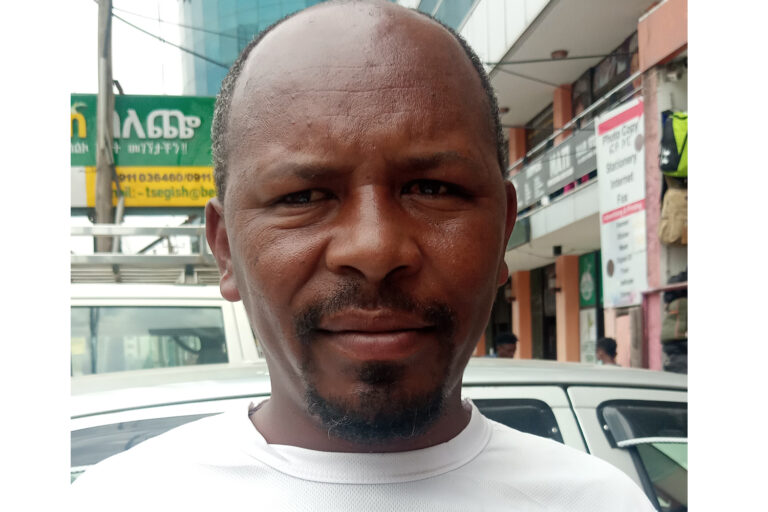
Name: Habtamu Weldeamanuel
Education: 10+
Company name: Habtamu Coffee
Title: Owner
Founded in: September 2012
What it does: Deliver coffee
HQ: Addis Ababa
Number of employees: 1
Startup Capital: Zero
Current capital: Growing
Reasons for starting the business: To generate income and support my family
Biggest perk of ownership: Create opportunities for other
Biggest strength: Committed to do any job
Biggest challenging: Behavior of the society
Plan: To expand my business with other services
First career: Been doing lots of small business
Most interested in meeting: Prime Minister Abiy Ahmed
Most admired person: My father
Stress reducer: Eating
Favorite past time: To spend time with my family
Favorite book: ‘Yemechereshawa Kitel’
Favorite destination: Country sides
Favorite automobile: Toyota Mini van
