

As per the recommendation of the National Bank of Ethiopia (NBE) to respond for the effect of COVID 19 banks are submitting their proposal for the central bank, Capital learned.
NBE proposed for banks to come up with their own initiative to mitigate the effect on their clients mainly for those who are highly affected because of the outbreak of the coronavirus.
The effect of the virus in the country is growing in the past few days after the country expands its laboratory test capacity. However the economic effect of the virus is started to be observed in Ethiopia since the outbreak was reported on March 13.
According to sources early this week NBE requested banks to come up with their responses until Friday May 8.
Based on that banks have submitted their proposal on how to contribute to the mitigation strategy for their clients.
Currently banks have rescheduled and rearranged their loan portfolio. Few weeks ago the central bank has waived its strong rules, mainly for loans, to support banks actions to solve challenges in the economy.
Since then almost all banks rescheduled the loan settlement and postpone periods. A bank president that Capital asked about the situation stated that banks rescheduled loans almost for every customer who demands that since NBE supported the idea.
Based on the new initiative that banks taking as per the recommendation of NBE they are also freezing interests for businesses that are mainly affected by the global pandemic.
One of the private banks’ president, who demands anonymity told Capital that his bank has decided to cut interest rates for sectors like hospitality and tourism for three months.
He said that relatively his bank is young and has limited capacity compared with oldest private banks, to freeze interest for months will cost his bank millions of birr.
It shows that how much economically affected companies get relief on the lift of interests.
At the same time Dereje Zebene, President of Zemen Bank, disclosed of Friday that his bank has lifted interest rates from 0.5 percent to 3 percent for sectors in the hotel, tourism and manufacturing.
The interest cut for the stated industries will remain for two months until June 30.
He reminded that his bank freeze interest rates for horticulture industry for three months until the end of the financial year that will be closed June 30.
Capital learned that other banks has also taken similar measures and disclosed for NBE.
Recently the Addis Ababa Hotel Owners Association disclosed that because of the pandemic the hospitality industry is losing USD 35 million every month and majority of them are linked with bank loans.
Recently Capital reported that the private sector is looking for banks to cut the interest rate on some percentage besides rescheduling the loan settlement period.
This move is appreciated by the private sector particularly by the manufacturing industry actors. They said that the situation has indirectly forced their activity besides direct effects related with the importation of raw material since some of the resource centers globally are closed.
“Our business is not as usual because of shifting of consumers to basic commodities and suspension of some economic activities,” one of the manufacturing industry operators told Capital.
“We were looking some measures besides loan reschedule the current measures shall support us to continue to cover at least wages” other industrialist engaged on heavy industry said.
Currently the central bank has established a vehicle for banks to access temporarily liquidity with 13 percent payment.
Banker stated that the interest rate by any measurement is very high.
Banks submit proposal for NBE to freeze interest rates
IMF insists on birr depreciation
The International Monetary Fund (IMF) urge Ethiopia to accelerate the birr depreciation; while the government said it will do that with caution. It has also urged the authorities to closely monitor the impact of COVID-19 on financial stability.
In its recently published COVID 19 related document, IMF provided further support to stabilize the balance of payment and push the debt service and said that the government needs to increase the pace of depreciation.
“Increasing the pace of depreciation would help reduce real overvaluation and act as a shock absorber during the crisis (COVID 19),” the IMF document said. It added that the authorities underscored continued commitment to closing the gap with the parallel rate to eventually move to a market-clearing exchange rate but signaled a need to continue moving with caution.
The document of IMF also stated that the government remains committed to the objectives of the Extended Credit Facility (ECF) and Extended Financing Facility (EFF) arrangements that have been supporting Ethiopia’s economic reform program since December 2019.
It added that while much of the focus in the near term will be on responding to the fallout of the crisis, the authorities underscored that they will continue to further the reform agenda.
“The government officials has highlighted their commitment to gradually ending financial repression by increasing T-bill issuances, ceasing new National Bank of Ethiopia (NBE) financing to the Development Bank of Ethiopia (DBE) in June, and gradually reducing direct NBE advances to the government,” it said.
“They also remain committed to implementing the FX roadmap to be finalized by end-April, which is last month, to lay the groundwork for an eventual move to a market-clearing exchange rate,” it added.
Ethiopia disclosed that it will arrange the exchange rate policy and indicated that the possibility of market based exchange rate might be introduced.
The fund has also recommended the government to closely follow the financial conditions at banks that they are getting some support from the central bank to stabilize their liquidity in related with the case of corona virus.
The central bank provided 15 billion birr (0.45 percent of GDP) for private banks few weeks ago and allowed them to access finance with 13 percent interest rate to solve their liquidity challenge. “The measure (providing the 15 billion birr) aimed at addressing tight liquidity conditions that had arisen prior to COVID-19 and aids banks in repaying some of the 1 month loans previously provided through the Individual Bank Lending Facility-introduced in February-for the same purpose,” IMF said.
The document said that NBE is also planning to extend 16 billion birr (0.5 percent of GDP) in liquidity to the Commercial Bank of Ethiopia (CBE), the stated owned financial enterprise. It said IMF supported the decision to build adequate liquidity buffers but emphasized the need to ensure that NBE lending to the CBE reflects the terms available to private banks and avoids implicit solvency support.
“NBE has appropriately provided liquidity to banks to maintain financial stability. Once the crisis abates, monetary policy will need to be tightened significantly to achieve the single-digit inflation objective. Strong efforts are needed to address the real overvaluation of the exchange rate, allowing the exchange rate to act as a shock absorber,” IMF said.
It said that the government is encouraging banks to reschedule loan repayments, currently on a case by- case basis, but have not changed loan classification rules and recommended close monitoring of liquidity positions, loan-to-deposit ratios, and asset quality. “In particular, there is an urgent need to step up monitoring of deposits and bank liquidity, as well as frequent supervisory review and reassessment of banks’ loan portfolios during the crisis,” it said.
It also emphasized the need to consider policy options to deal with potential further bank liquidity shortages, such as strengthening the framework for emergency lending and adjusting reserve requirements.
Regarding debt condition the fund elaborated that the joint World Bank–IMF Debt Sustainability Analysis (DSA) shows that debt is sustainable. “However, liquidity pressures to service external debt have increased, the room to absorb shocks is now smaller than at program approval due to lower export projections, and a large or more persistent impact of the COVID-19 shock than presently assumed could further worsen the outlook,” it said.
On the domestic front, public debt remains vulnerable to contingent liability shocks, including those stemming from public banks, it says “Despite severe losses due to COVID-19, Ethiopian Airlines intends to continue servicing its debt and does not have plans to seek government support.”
A week ago the IMF Executive Board has approved USD 411 million emergency assistance for Ethiopia under the Rapid Financing Instrument to support the country on the way to fight COVID 19.
The Board has also approved Ethiopia’s request for relief under the CCRT on debt service falling due to the IMF until October 13, 2020 of about USD 12 million. This relief could be extended up to April 13, 2022, subject to the availability of resources under the Catastrophe Containment and Relief Trust (CCRT).
Local oil pressers want more gov’t attention
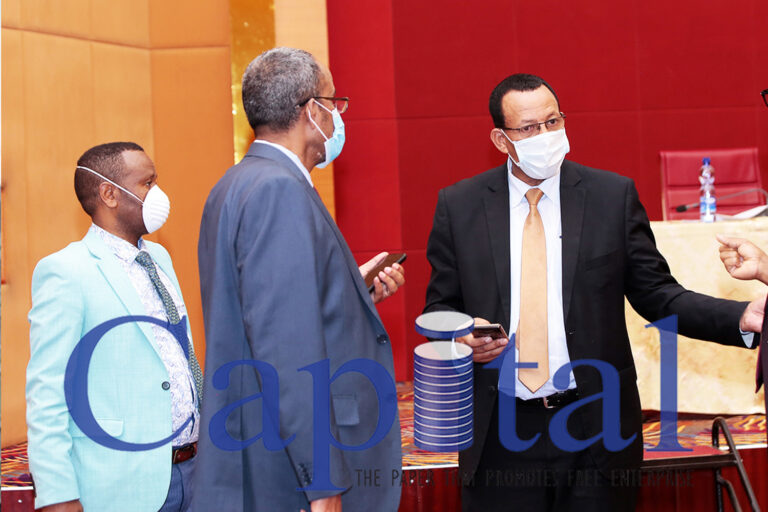
The Ministry of Trade and Industry (MoTI) criticized some basic commodity producers for abusing the situation, meanwhile it has promised to provide adequate support for those lacking input to continue their operation in full scale.
On the discussion that was held with local edible oil pressers, millers and related product producers, Abdulfetah Yusuf, head of the Addis Ababa Trade Bureau, stated that there are companies that played their role to mitigate the challenge and supply their products on fair price with adequate quality.
But there are producers that are abusing the system and trying to use the opportunity to amass significant profit, according to Abdulfetah.
“We have evaluated producers engaged in mega hoarding, fixing price with wholesalers, production of substandard products like hand sanitizers,” he said.
On his presentation on the discussion that was held on Thursday April 7 at Intercontinental Hotel the bureau head said that some producers offered highly volatile price and are not interested to supply products like consumers association, and some of them force consumers to buy one product to sell another.
“Producers are providing their products for limited wholesalers on the aim to escalate the price and the price is determined by very few actors that distribute the product for responsible retailers like consumers associations,” he added.
He has mentioned companies like oil pressers, millers, pasta and macaroni producers that are engaged on illegal activity.
He said that the price of some basic commodities increased in relation with the outbreak of COVID 19, meanwhile the revenue of significant part of the society declined because of the situation.
During the discussion local companies also claimed that even though they have the capacity to produce in bulk that stabilize the market they do not get support from the government to access foreign currency for raw materials.
Tewodros Tadesse, Communication Head of Shemu Group, said that despite his company’s huge capacity to press edible oil at the plant at Dire Dawa it is not getting adequate attention from the government.
He said that Shemu has 850 employees with the capacity of 220 tones production per month but now it is running with the production of ten tones per month.
He told Capital that currently the company is undertaking expansion which they so far accomplished 90 percent and expand the production to 870 tons per month but the company is continuing under its capacity that he said is almost nothing compared to its capacity. Currently Shemu is producing only 10 tons of oil per month because of lack of input.
“We are not getting foreign currency to import crude oil for the production of edible oil, while finished products importers are supported by the government,” he said.
Representative of East Africa Holding that also has oil presser at Harar claimed that his company is facing similar challenge to produce the basic commodity.
Some pressers have also called the government to subsidize companies to get raw material from local market on reasonable price that would lead for lower price for end products.
At the meeting Eshete Asfaw, State Minister of MoTI, said that the local supply on edible oil for instance is very high than the demand but the price went up significantly.
“Some supermarkets observed this week are selling 5 liter oil with 500 birr but the total cost for imported oil is less than 300 birr,” he said.
“We have also evaluated the local pressers trend; it is similar regarding price hike without any proper reason,” Eshete said.
Eshete appreciated the effort of companies like Shemu and East Africa and promised to give adequate attention.
Tewodros said that they are delightedly and expect a quick response from the government.
DISTORTING ECONOMIES

Price distortion is one of the major pillars of late capitalism or cronyism for short. When there is no agreed upon standard to measure something, it is relativity and arbitrariness that take over the whole task. For the obvious reasons, these two cannot serve as the foundation of a system of rational measurement/metrology. In our current capitalist global economy price is supposed to measure almost everything that is in play. However, since 1971, incoherent relativeness and ineffective arbitrariness were systemically introduced into the global economy by way of measurement. This situation came into being when the Bretton Woods Agreement collapsed, i.e., when the US government officially abandoned the Dollar’s convertibility to gold. At the time all other currencies were pegged to the US Dollar, hence, by extension to gold. After 1971, prices of goods/services became prone to the built-in-inflation of state’s policies!
Price is the most crucial signal that facilitates production, services and trade in a capitalist world economy. When prices are distorted, including the pricing of money itself (because of various manipulations) the system loses its most celebrated function, namely the efficient allocation of capital! 1971 ushered, explicitly/implicitly, economic policies based on unearned phony money. This economic lunacy, implemented and operating at the global level, started to create fictitious prices worldwide and ended up dictating the allocation of resources, including the non-renewables! Useless and unproductive projects proliferated the globe as a result of this intentional mispricing, fully anchored on phony money. The world is now paying the price for such shortsighted policies. The abandonment of the gold standard, amongst many other things, encouraged nation states to indulge in the excessive manipulation of the market. The result; inflation became the foundation of all economic policies in each and every country of the world. Deficit financing, which has become a currency in the nation states budgets, owes its modern existence to the fiat/phony money system. At times, states conviction of ‘inflate or die’ can get pretty much out of hand (Argentina, Zimbabwe, etc.) forcing the intervention of multilateral institutions likes the IMF, ECB, Etc.
Ironically, it was the socialist states that undermined, rather intentionally, the logic of price discovery in their planned economies. The political orientation of the ‘socialists’, i.e., USSR, China and others, was primarily ethical and was not obsessively concerned about efficiency, which of course the market mechanism excelled at. Ultimately, it was the incapacity of the socialist economies to appreciate the centrality of the price mechanism in the world economy that did them in, so to speak! The current systemic distortion of prices that took over the West’s imagination after 1971 will also have the same effect, sooner than later. By comparison, the depth of intentional price distortion in the West is more cynical and malicious than the socialisms of the bygone era. When a country allows its banks, under the auspices of the central banks, to print/digitize money with abandon, inflation is bound to be the outcome. The systemic inflation created all over the world is paid by the sheeple (human mass). The continuous pauperization of the sheeple (human mass) and its general livelihood is one way of paying for the excessive money printing. This is exactly what happened in the West, in late 1970s and early 1980s. To thwart off the dangerous adventure, the then FED (the late Volcker) raised interest rate to about 20% and directed the world capital into savings, thereby creating havoc in the periphery/third world. Don’t forget, at the time the US dollar was the sole global reserve currency!
In 1985, the Plaza Accord was signed by the major core countries of the system to depreciate the US dollar, particularly against the then emerging giants of production, namely Japan and Germany. The Japanese bubble thus created (compliment of the yen’s appreciation) gave rise to an immense misallocation of capital. For example, just before the burst of the Japanese bubble, the Tokyo Palace of the emperor was valued more than the whole state of California! In 1989 the Japanese economy collapsed and it has not regained its mojo since then. In 1989 the Nikkei index constituting the top 225 companies in Japan, was about 40,000, today it is below 20,000! Germany was probably saved because of the two unions, East Germany & European Union. The Deutsch Mark became the currency of united Germany, while the DM became the template and the anchoring currency behind the euro. The Euro was supposed to benefit from the Bundesbank’s traditional emphasis on guarding against excessive inflation. Today the Mediterranean countries of Spain, Portugal, Greece and Italy as well as the smaller nations like Ireland, are facing the brunt of this Euro policy. Since these countries cannot print their own fiat currencies, but are nonetheless forced to live and compete in a fiat world, they faced economic dislocation. For instance, Italy has lost over 25% of its industrial capacity since joining the Euro currency. Even in these days of pandemic, the monetary conservatives, (Germans, Dutch, etc.) are not willing to accept the issuances of certain bonds (by the EU) to help countries like Italy and Spain. In fact, only few days ago, the German Supreme Court lent its support by upholding German/Dutch position, against the protestation of Brussels’ bureaucrats. More and more, the project of the European Union is becoming untenable!
The fiat currency regime impacted the African economies in ways that was not easy to reverse. Unsustainable mode of development, based on the export of non-renewable resources, was taunted as a solid foundation for resilient and sustainable progress that will bring decent livelihood to Africa’s sheeple. However, the reality was and still remains very different, notwithstanding the idiotic rhetoric of the global establishment and its local lackeys. Extreme dependence on external institutions of economic governance, (like the BW institutions, EU, etc.) both for policies and finance, has left the nation-states of Africa without reliable bearing. Africa’s youth must start interrogating our lopsided integration into the world system, which is based on perennial unequal exchanges. Without rectifying this centuries old regime of exchange (unequal exchanges), there will be no meaningful and equitable development in Africa. See our Covid-19 update next column and other articles on page 30.
“In the absence of the gold standard, there is no way to protect savings from confiscation through inflation. Deficit spending is simply a scheme for the ‘hidden’ confiscation of wealth. Gold stands in the way of this insidious process. It stands as a protector of property rights.” Alan Greenspan. Good Day!
