For decades, the night-time economy has been treated as a cultural add-on: something colourful, occasionally unruly, and largely peripheral to “serious” economic planning. Bars, clubs, theatres, late-night restaurants, music venues, transport, security, cleaning, and healthcare services have been seen as by-products of urban life rather than strategic assets. That view is no longer tenable. In an era of post-pandemic recovery, changing work patterns, and intense competition between cities, the night-time economy is not a luxury. It is an economic system in its own right, and one that requires intentional governance.
At its core, the night-time economy is about more than leisure. It encompasses employment, tourism, cultural production, public safety, logistics, and urban identity. In many cities, it employs between 5 and 10 percent of the workforce, disproportionately young people, migrants, artists, and those without access to traditional nine-to-five roles. These are not marginal jobs; they are entry points into the labour market and, for many, long-term careers. When the night-time economy falters, the social consequences are immediate: unemployment rises, informal activity increases, and city centres hollow out after dark.
The pandemic exposed just how fragile this ecosystem is. Overnight, venues were shuttered, supply chains collapsed, and skilled workers exited the sector en masse. While many businesses have since reopened, the underlying vulnerabilities remain. Rising rents, energy costs, staffing shortages, and restrictive licensing regimes continue to undermine viability. Yet policy responses are often fragmented, reactive, and moralistic focused on noise complaints, antisocial behaviour, or alcohol consumption rather than on economic resilience and urban planning.
This moral framing is a persistent problem. Night-time activity is too often discussed in terms of risk rather than value. Disorder, public intoxication, and safety are legitimate concerns, but they are management challenges, not reasons for neglect. Daytime economies also generate crime, congestion, and environmental impact; we address those through infrastructure, regulation, and design, not through curfews or disinvestment. The same logic should apply after dark.
Cities that understand this are already moving ahead. The introduction of night mayors, night-time commissions, and dedicated policy units in places such as London, Amsterdam, New York, and Sydney reflects a growing recognition that the night requires its own governance framework. These roles are not symbolic. When empowered, they coordinate between businesses, residents, transport authorities, police, and cultural institutions, aligning economic objectives with social outcomes. Crucially, they shift the conversation from “how do we control the night?” to “how do we make the night work?”
A functional night-time economy depends on infrastructure that many cities still lack. Reliable late-night public transport is not a luxury; it is a prerequisite for safety, accessibility, and workforce participation. Poor lighting, limited sanitation, and inadequate wayfinding make urban centres hostile after dark, particularly for women and older residents. These deficiencies are often cited as reasons to restrict night-time activity, when in reality they are reasons to invest in it.
There is also a cultural dimension that policymakers underestimate. Night-time venues are incubators of creativity. Music scenes, comedy, fashion, and culinary innovation rarely emerge from office parks operating between nine and five. They grow in clubs, basements, and informal spaces that allow experimentation and risk. When cities lose these spaces, priced out by development or regulated out of existence, they lose more than entertainment. They lose the soft power and distinctiveness that attract talent and visitors in the first place.
At the same time, the night-time economy must evolve. It cannot rely indefinitely on alcohol-centric models that exclude families, older residents, and those who do not drink. A more diverse night means museums open late, libraries hosting evening programmes, cafés replacing some bars, and public spaces designed for low-cost, low-risk socialising. This diversification is not only socially inclusive; it is economically prudent, spreading demand across different demographics and time slots.
Ultimately, the question is not whether cities can afford to invest in the night-time economy, but whether they can afford not to. An underdeveloped night leads to deserted streets, reduced footfall, higher policing costs, and a diminished sense of safety. A well-managed night generates jobs, tax revenue, cultural vibrancy, and global competitiveness.
Treating the night-time economy as an afterthought is a policy failure rooted in outdated assumptions about work, leisure, and urban life. As cities grapple with remote working, declining high streets, and the need to reimagine public space, the hours after dark offer both a challenge and an opportunity. The choice is clear: continue to regulate the night as a problem to be contained or recognise it as an economic and cultural engine worth designing, supporting, and protecting.
A new soil “medicine” is helping farmers in Bule district and beyond defeat crippling soil acidity, boosting yields from a few quintals to harvests that can finally feed families and fuel Ethiopia’s growth.
Tesfaye Malei was once a man who had lost hope. A farmer in Bule district of the Gedeo Zone, he would rise before dawn to work a one‑hectare plot, only to harvest less than two quintals—about 200 kilograms—of grain. “All that labor for two quintals!” he recalls, his voice still marked by the frustration of those years. His soil, eaten away by acidity, made his effort almost meaningless.
Today, Tesfaye stands in the middle of the same field and tells a very different story. “This land that used to give only two quintals per hectare now produces 50 or 60,” he says, smiling broadly as he looks over thick stands of barley. For him, this is not just a better harvest; it is a return of dignity and security—a resurrection powered by a new fertilizer technology called OC‑MASSA.
This is more than the story of one farmer. It is the story of a wider awakening in Bule, where farmers have begun to “bury” soil acidity and move into a new phase of prosperity. Their journey shows what can happen when science, policy reform, and farmers’ own determination finally pull in the same direction.
A Paradise with a Silent Killer
Located in Southern Ethiopia’s Gedeo Zone, Bule district looks like a green paradise from a distance. Sitting at an altitude of around 2,810 meters above sea level, it enjoys a cool highland climate and receives roughly 1,400 millimeters of rainfall per year—conditions that, on paper, seem ideal for barley, wheat, maize, and other highland crops.
Yet behind this apparent abundance lurked a silent killer: soil acidity. For years, farmers sowed seeds, applied fertilizers, and labored from dawn to dusk, only to harvest yields that were nowhere near commensurate with their effort. Many describe a sense of shame and helplessness as their land failed them season after season.
Research has since confirmed the scale of the problem. Nationwide, more than 40 percent of actively cultivated land is now considered acidic, with some regions—such as parts of Sidama, Southwest and South Ethiopia—reporting acidity on well over 60 percent of farmland. In total, around seven million hectares of Ethiopia’s arable land are affected by acidification, with about 3.2 million hectares severely damaged. In Bule district alone, 3,813 hectares are claimed by this “silent killer.”
Farmers Find a New Ally
For years, the main solution promoted to combat soil acidity was lime. Scientifically, lime works: it raises pH and helps unlock nutrients for plants. But practically, it has been a heavy burden on smallholder farmers. Correcting soil acidity using conventional lime can require 20 to 30 quintals per hectare, meaning huge transport and labor costs in rugged highland terrain.
“Transporting lime to solve soil acidity requires a lot of money and effort,” explains Dr. Selamyihun Kidanu, Director of Agronomy and Business Development at OCP Ethiopia. “For many farmers, moving up to 30 quintals of lime per hectare on steep, fragmented plots is simply not realistic. That is why OC‑MASSA was developed—to solve this bottleneck.”
OC‑MASSA is a customized fertilizer that combines phosphorus with calcium and granulated limestone in a single granular product. The idea is simple but powerful: instead of hauling many bags of bulk lime plus separate fertilizer, farmers apply a much smaller quantity of one product that both neutralizes acidity in the root zone and supplies missing nutrients—especially phosphorus, which is a key limiting factor in many Ethiopian soils.
The logistical advantage is striking. To treat acidic soil, OC‑MASSA requires only about three quintals per hectare—roughly one‑tenth of the lime requirement for similar effect. That alone can cut transport burdens and associated costs dramatically, especially in remote and hilly districts like Bule.
Worku’s Barley and the Power of Practice Change
When you meet Worku Kurse in his barley field, the brightness on his face rivals the lush green of his crop. Worku supports nine family members. For him, farming is not a side activity; it is the source of his children’s schoolbooks, the fund for a new roof, and the guarantee of daily bread.
“It used to be a big victory if we managed to get six quintals from one hectare,” he recalls of the days before OC‑MASSA. “We sowed in the old way, scattering seed by hand, and we just accepted whatever came.” That changed when extension workers and OCP agronomists introduced a package of practices: treating acidic soils with lime and OC‑MASSA, sowing in rows instead of broadcasting, and applying the right fertilizer at the right time.
“Now we start preparing our fields in May,” Worku explains. “We first treat the soil acidity and then sow in line. When we added OC‑MASSA, the result shocked us.” On land that once produced six quintals per hectare, Worku is now expecting around 30 quintals, enough to comfortably support his family of ten and invest back into his farm.
Farmers like Worku emphasize that OC‑MASSA alone is not a magic wand; it works best when combined with improved agronomic practices. But they are equally clear that without a practical way to tackle acidity, no amount of seed or technique could unlock their land’s potential. For them, OC‑MASSA is the missing piece that makes other improvements truly pay off.
Tesfaye’s Journey from Despair to Confidence
Few stories illustrate the emotional arc of this transformation better than Tesfaye’s. A few years ago, his yields had fallen so low that he considered abandoning farming altogether. “In the past, we used to get only two quintals from a hectare,” he recalls. “Imagine! Working an entire season for such a small harvest—it breaks your spirit.”
Everything changed when he joined demonstration plots managed with OCP Ethiopia and local experts. Over two seasons of applying OC‑MASSA and following improved practices, his fields were transformed. “Now the result is between 50 and 60 quintals,” he says, still sounding almost incredulous. “My hope has returned. I have decided to stay in agriculture. This new technology has given me confidence.”
Tesfaye’s experience is echoed by other farmers in cluster groups across Bule. Shege Shifera, who works with more than 20 farmers on a 10‑hectare barley block, points to the thick, uniform crop covering the hills. “This barley is not just sprouted; it is fed and grown with OC‑MASSA,” he says. “We have seen the benefits with our own eyes. From now on, even if there is no support, we will buy and use it ourselves.”
Science, Standards, and Policy Reform
Behind the visible “miracle” in farmers’ fields lies years of research, trials, and policy shifts. OCP Ethiopia and its partners spent around six years in laboratories and on experimental plots, collecting data across multiple regions and crops. By some estimates, OC‑MASSA delivers yield advantages of 20–30 percent over conventional blends on average, and up to 50 percent in particularly sensitive acidic zones.
Dr. Wondale Habtamu, Deputy Director General of the Ethiopian Agriculture Authority, underlines that OC‑MASSA is the product of a deliberate move toward science‑driven, private‑sector‑enabled agriculture. For decades, Ethiopia’s fertilizer system was tightly controlled by the state, with limited room for customized products or private investment. Now, that is changing.
“In the past, agriculture was constrained not only by law but by the way the sector was controlled,” he notes. “Today, we are opening space for private investors and encouraging innovation, but without compromising on quality and safety.” According to him, OC‑MASSA went through rigorous testing and meets standards set by the Ethiopian Standards Institute before being approved for wider use.
Wondale describes OC‑MASSA as more than a simple fertilizer—he calls it a “soil medicine.” Unlike standard products like urea or DAP, which mainly address nutrient deficiencies, this blend targets the underlying pH problem while delivering key nutrients. Farmers who used to haul 30 quintals of lime and other inputs per hectare can now achieve better results with around 3 quintals of this balanced fertilizer, reducing cost and labor while improving profitability.
A Broader Transformation Takes Shape
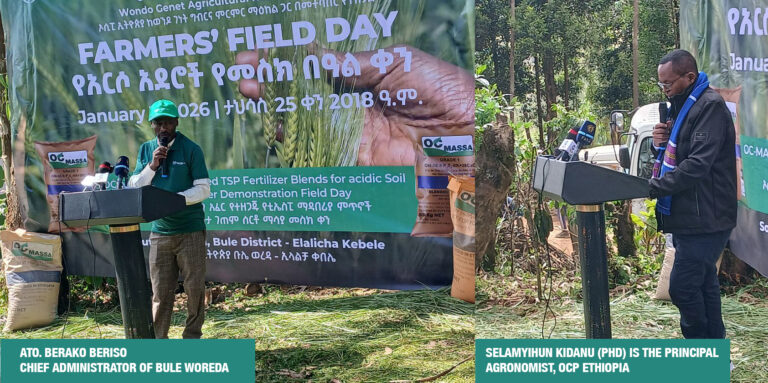
For local leaders, the change is visible in both fields and attitudes. Barako Beriso, Chief Administrator of Bule woreda, notes that while the district’s land is naturally fertile, acidity long blocked its potential. “Over the past 10 years, we have worked with Wondo Genet Agricultural Research Center and other partners to bring technology to our farmers,” he says. “Now we are seeing large demonstration fields—barley clusters spanning more than 13 hectares, involving dozens of households. Our farming practices are shifting from traditional to modern.”
OC‑MASSA’s impact is not confined to Bule. In recent seasons, clusters of wheat in Oromia, maize and teff in Amhara, and wheat and barley in Sidama and South Ethiopia have also used the product, with thousands of farmers reporting improved yields on previously acidic land. One report notes that thousands of metric tons of OC‑MASSA have already been distributed to tens of thousands of farmers, as part of efforts to scale up treatment of acidic soils nationwide.
Another important dimension is local production. About 30 percent of OC‑MASSA’s raw materials are now sourced within Ethiopia, giving hope that, as blending plants expand and investments mature, the country could move toward fully domestic production. That would not only improve supply security but also save significant foreign exchange.
OCP Group, the Moroccan phosphate giant behind OCP Ethiopia, has been a strategic partner in this process. Through agreements with the Ethiopian government, including a multi‑billion‑dollar fertilizer complex planned in Dire Dawa, OCP aims to combine Ethiopian potash and gas resources with imported phosphates to make more of the fertilizers the country needs—tailored to its diverse soils.
The Stakes: Food Security and Livelihoods
The stakes could hardly be higher. Agriculture remains the backbone of Ethiopia’s economy, employing around 80 percent of the workforce and contributing more than a third of GDP. Yet an estimated 43 percent of cultivated land is acidic, and in some highland regions the proportion is even higher. Soil acidity directly affects the livelihoods of millions of smallholders and, when family members are counted, may touch the lives of nearly 40 million people.
“When soil pH drops below about 5.5, the soil effectively ‘locks up’ nutrients,” agronomists explain. Even if fertilizers or organic matter are added, plants cannot fully access the nutrients they need, and yield can be cut by half or more. In such a context, tackling acidity is not a luxury—it is a prerequisite for food security.
That is why, in addition to private actors like OCP, development partners such as USAID have also joined efforts to demonstrate and expand the use of locally blended fertilizers for acidic soils, particularly in regions like Sidama. These collaborations aim to boost yields, raise rural incomes, and make Ethiopia’s food system more resilient.
A New Foundation for Hope
Back in Bule, the most powerful evidence of change is not found in policy documents or laboratory reports but in the fields themselves. Stretches of land that once produced sparse, yellowing stands now hold dense, green barley and wheat. Farmers who once spoke of giving up now talk about buying more seed, sending children further in school, and investing in better homes.
“The biggest thing this new technology has given us is confidence,” says Tesfaye. “We are no longer afraid of our own soil.” Worku agrees, adding that OC‑MASSA and the new practices have given him a reason to see farming as a business, not just survival.
The OC‑MASSA story is still in its early chapters. With seven million hectares of acidic land still to be reclaimed, officials like Wondale caution that much work remains. They call for coordinated, “back‑breaking” effort from government, private sector, researchers, and farmers to spread this technology and related practices across the country, making Ethiopia’s highlands lush and green again.
For now, in the hills of Bule, the sight of lush barley swaying in the wind is more than a pretty scene. It is a promise—proof that with the right tools and partnerships, even “dead” soil can be brought back to life, and with it, the hopes of millions of Ethiopian farmers.
In January 2025, the air transport industry was facing significant headwinds and none more so than the threat of tariffs and the potential retaliation they might provoke.
In this challenging context, airlines nevertheless earned a record net profit of $39.5 billion. It must be pointed out though that in one year a single oil company can make as much profit as our whole airline industry does. Looking at net margins, the picture appears even more fragile. At an expected 3.9% in 2026, the airline industry remains one of the lowest-margin industries, having never seen a net profit margin above 5%. In per-passenger and US dollar terms, the industry’s anticipated net profit equates to $7.90 — below what Apple earns from selling one iPhone cover.
Risk Landscape
In 2026, risks abound. Having a view of what these might entail is important for planning and decision-making and the impact they may have on airlines. Five areas loom particularly large in the year ahead.
1. Policy Fragmentation
The post-World War II multilateral system is weakened, with perhaps the most visible fragmentation occurring in international trade. “Me-first” policies are being enacted with little concern for their impact on global networks, whether it is supply chains or single industries such as air transport.
International institutions are also being sidestepped, threatening to undo the International Civil Aviation Organization’s 80 years of global harmonization. Different frameworks now compete to determine how to address CO₂ emissions from air transport. Fragmented tax policies introduce severe competitive distortions that ripple across the global network even though the policy may appear locally focused. Such policies raise little money for governments, have little or no impact on emissions, and make air transport more expensive.
2. Supply Chain Disruptions
There is a persistent and record-high backlog of aircraft orders. While things have started to improve, the mismatch between airline requirements and production is not expected to unwind before 2031-2034. This negatively caps growth in the industry yet protects yields as aircraft load factors reach the highest level in aviation history. More dramatically, the situation has halted progress in improving fuel efficiency across the global fleet and slows the industry’s decarbonization.
3. Climate Change-Related Disruptions
Disruptions such as extreme weather and commodity price swings can affect agriculture, infrastructure, global trade, and investment flows. A successful energy transition for airlines pursuing net zero carbon emissions by 2050 requires stable policies and reliable financing. The reduced commitment to addressing climate issues in a coordinated manner across the world will undoubtedly slow progress on all these fronts.
Associated risks include greater food and water insecurity, and therefore increased migration. Yet the world has turned more hostile towards immigration. The decision by nations to welcome, or not welcome, migrants will put pressure on borders and support systems, impacting international air passengers.
4. Cyber Threats and Artificial Intelligence
Cyber threats are growing in both frequency and importance. We also see a convergence of risks and vulnerabilities with artificial intelligence (AI) enhancing attackers’ capabilities, geopolitical instability providing fertile breeding ground, and digital dependence exposing supply chains and organizations to greater risks.
The airline industry’s reliance on critical infrastructure makes the global air transport network particularly exposed, along with all other network industries. AI adds risks related to misinformation, loss of privacy, and erosion of trust, on top of those that might generate economic disruption, job displacement, and greater inequality. Proof of AI generating substantial profits and increased productivity are scarce and may take years to materialize.
5. Macro-Economic Outlook
The external value of the US dollar is important to the global economy because of its dominant share in cross-border payments. Over the very long term, the US dollar is a trend-depreciating currency. Currently, the Federal Reserve is in rate-cutting mode, and global uncertainty has rather uniquely favored other safe havens, such as gold and the Swiss franc. Adding the lack of fizz in the US economy, persistent budget and current account deficits, and potentially greater reservations about US stock market valuations, the US dollar appears most likely to pursue its depreciation in 2026.
A weaker US dollar tends to benefit all non-USD-based countries who will pay less in local currency for their USD-denominated debt and trade. This is of course important for air transport where over 50% of the cost base is invoiced in US dollars.
At the same time, the oil market is undergoing major structural change as demand is shifting in response to electrification and to greater use of liquefied natural gas (LNG) in road transport. Geopolitical changes will also play a role. Supply is expanding even as demand slows, leading to inventory build-up and putting downward pressure on prices—again good news for airlines.
The risk of a severe economic slowdown in 2026 seems limited unless we have underestimated the potential combined effect of the above converging risks and vulnerabilities, or because of unforeseen events. Nevertheless, this is not a particularly growth-friendly environment and global GDP growth is unlikely to accelerate. Moreover, given this risk convergence, the margin to maneuver is reduced, which makes policy mistakes more likely.
Championing the Value of Aviation
In the context of limited policy flexibility, good growth and welfare-increasing strategies are hard to come by. Yet it so happens that the energy transition and air transport combine to deliver a uniquely promising growth strategy that can enhance agriculture, restore natural habitats, build energy independence, strengthen local communities, broaden the tax base, promote international trade, connect people, support innovation, and lift productivity. All of these benefits have a dynamic and positive impact on each other. This is way more than what traditional economic policy can muster through policy, interest rate cuts, or tax reductions.
Even without quantifying all those dynamic effects, the airline industry supports 87 million jobs and 4% of global GDP. Air transport is not just about flying—it’s about driving progress. Let it lead the way.
Marie Owens Thomsen is IATA’s Senior Vice President, Sustainability & Chief Economist
Globalization and great power rivalries have diminished the scope of sovereignty through interconnected economies and crises, placing control in the hands of superpowers. Consequently, it is challenging for the UN to maintain an upright position to enforce its principles fairly among all member states, as the influence of power often dictates actions beyond its established mandate.
The UN Charter’s Article 2(1) enshrines the principle of sovereign equality, asserting that every state—regardless of size—should have equal standing. However, when the UN was founded in 1945, its architects understood that the organization would falter without the involvement of major powers, as had occurred with the League of Nations.
At the San Francisco Conference in 1945, the founders of the UN believed that granting the U.S., USSR, UK, France, and later China, permanent seats with veto power would enable these nations to engage in the UN Security Council and help maintain balance whenever international peace was threatened, thus preventing the collapse that had beset the League of Nations.
Today, however, great powers frequently violate UNSC peace mandates, transforming the Security Council into a battleground for power politics rather than a guardian of collective security. The Council often serves as a stage for geopolitical maneuvers, masked by the rhetoric of security threats.
Recent vetoes by Russia have obstructed accountability for its invasion of Ukraine. Simultaneously, the U.S. military actions against Venezuela have attracted substantial international criticism, particularly from Russia, China, Iran, Cuba, and the UN Secretary-General, who have labeled these actions a potential violation of international law and a dangerous precedent.
The U.S. has defended its military intervention in Venezuela as lawful and necessary, despite widespread condemnation from various member states, including those with veto power like China and Russia. Washington has emphasized that Nicolás Maduro and his wife will face trial in U.S. courts under a narcoterrorism indictment first issued in 2020, framing the intervention as law enforcement rather than aggression.
Critics contend that the U.S. operation violates UN Charter Article 2(4), which prohibits the use of force against another state’s territorial integrity without consent, self-defense, or Security Council approval. The UN Secretary-General has expressed deep concern over the escalation and disregard for international law. Some experts and allies, such as Spain, have labeled the actions unlawful, while others focus on holding Maduro accountable.
The U.S. claims this approach leverages its right to prosecute alleged international crimes through domestic courts, arguing that the charges target individuals rather than resolving state-to-state disputes that require mutual consent. This perspective dismisses the matter as lacking substance that necessitates Security Council approval, despite widespread discontent among some UN member states who view such unilateral actions as breaches of sovereignty and the principles of the Charter.
The U.S. intention to prosecute Nicolás Maduro and his wife under its domestic legal framework does not violate international law, as prosecutors assert their jurisdiction is justified by the impact of drug trafficking on American territory and national security, consistent with statutes such as 21 U.S.C. § 960a regarding narco-terrorism.
The prosecution of Nicolás Maduro and Cilia Flores under U.S. domestic laws does not constitute a violation of UN Charter Article 2(7) or Article 92, as these provisions do not apply to unilateral national judicial actions against individuals.
However, there remains significant criticism regarding the frequent breaches of UNSC peace mandates by great powers, which have transformed the Council from a multilateral guardian into a theater of veto-driven power politics, where “security threats” obscure national agendas. This power asymmetry undermines universal principles, prioritizing might over equity, particularly against weaker states.
This exposes the flaws in UN enforcement due to veto-driven selectivity. Today, power asymmetry has established a new norm that limits autonomy and sovereignty, surpassing established UN rules. Weaker nations, particularly in Africa, Latin America, and poorer regions of Asia, face compounded erosion through sanctions, debt diplomacy, and sometimes even full-fledged wars that violate national sovereignty under the pretext of addressing potential threats.
The UN’s architecture was designed to prevent unilateral domination, but concessions to great powers have entrenched precisely that dynamic. Structural power imbalances distort the UN’s promise of sovereign equality. This compromise reveals a paradox: the very mechanism intended to preserve peace is often undermined by superpowers, making collective enforcement difficult. The true rules of the game are not those connected to the UN but rather those dictated by the structural power dynamics among superpowers, who define conditions on their own terms through subtle interests.
In contemporary global politics, the actual rules appear to be dictated by structural power asymmetries rather than the boldly stated principles in the UN Charter. Sovereignty has increasingly become less a principle and more a bargaining chip within global economic and military hierarchies.
Although the UN Charter envisioned sovereign equality under Article 2(1), the veto concessions made by the P5 in 1945 have entrenched unilateral domination and distorted collective enforcement. While the Charter’s ideals of equality and collective enforcement remain aspirational, practice is heavily influenced by superpower rivalry and self-interest.
There is a pressing need to revisit the veto concessions made in 1945 in light of today’s global realities, aiming to create a fairer playing field for all, given the significant changes that have occurred since then. The fundamental flaws in the international system necessitate a core conversation about contemporary global governance.
Negotiations at the 1945 San Francisco Conference enshrined the veto despite opposition from smaller states, who viewed it as “victors’ justice” that undermined sovereign equality. P5 leaders like Roosevelt and Stalin insisted on it to secure support for the UN Charter, allowing any permanent member to block substantive resolutions, even those concerning themselves.
Global shifts since 1945 have underscored the limitations of the UN Security Council veto in a multipolar world. Decolonization empowered nations such as India and Brazil, while emerging threats like cyber warfare and climate crises demand agile collective action that is often hindered by vetoes. Since 1946, over 290 vetoes have been cast, primarily by Russia (approximately 150, including Soviet uses), the US (over 80, many related to Israel), and, to a lesser extent, China, the UK, and France, paralyzing responses to conflicts like those in Ukraine and Gaza.
The Russia/Soviet Union has the highest tally of vetoes, frequently using it during the Cold War to counter Western initiatives and more recently in Syria and Ukraine. The US has extensively vetoed resolutions to protect allies, notably Israel, while China has increased its veto use since the 1990s on issues such as Myanmar. This concentration of veto power entrenches the power structures of 1945, despite the P5’s outdated representation.
Ultimately, reforming the UN Security Council veto must address the paradox of a mechanism designed to safeguard great-power consensus that now routinely allows narrow national interests to undermine collective security. This tension erodes the UN’s credibility and the Charter’s principles of sovereign equality and peaceful dispute resolution.
Expanding membership to reflect multipolarity—by adding India, Brazil, Germany, Japan, and African representation—would dilute the dominance of the veto without abolishing it outright. Such changes would preserve the UN’s viability while enforcing the primacy of the Charter over national vetoes, enhancing the collective enforcement of the principles outlined in the UN Charter.
You can reach the writer via gzachewwolde@gmail.com