Wednesday, May 13, 2026
Home Blog Page 621

Ethiopia blossoms as key player in global air-transported flower trade

0

A new report from the International Air Transport Association (IATA) highlights Ethiopia’s growing prominence in the global air-transported flower trade. The report, released on February 14, 2025, reveals a significant shift in the dynamics of the industry over the past two decades, with Ethiopia emerging as a key exporter alongside traditional powerhouses like Colombia and Ecuador.

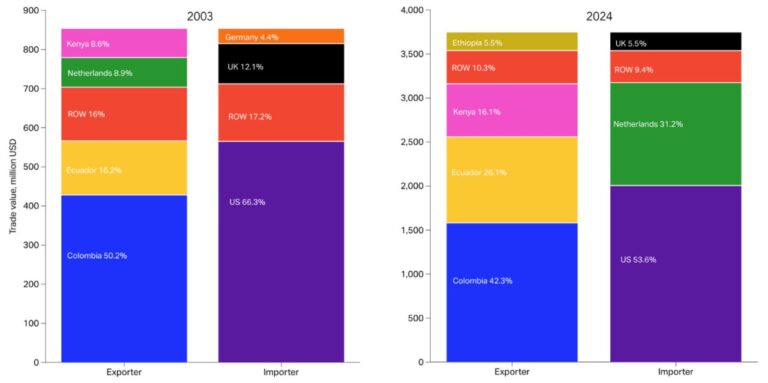
According to IATA’s analysis of data from Global Trade Tracker, the value of the global air-transported flower trade has surged from USD 852 million in 2003 to USD 3.7 billion in 2024—a remarkable four-fold increase. This growth has been accompanied by a notable concentration of market share among a select group of exporting nations.

While Colombia remains a dominant exporter with a 42.3% market share in 2024, Ethiopia has made significant strides in the industry, becoming a notable newcomer that has pushed the Netherlands off the list of top exporters. This expansion is attributed to two primary factors: the reduction of tariffs and trade barriers through trade agreements, and advancements in air cargo capabilities.

“Trade agreements have reduced tariffs and barriers, increasing exports and opening markets for developing nations,” the IATA report stated. “Developments in air cargo, including improved refrigeration and logistics, ensured that flowers remained fresh and enabled seamless global distribution of large volumes on time.”

These advancements in air transportation have greatly facilitated the trade in perishable goods, including flowers, creating opportunities for emerging economies like Ethiopia to capitalize on their comparative advantages. The improved refrigeration and logistics networks are vital. It ensures that delicate flowers reach global markets in peak condition, preserving their quality and extending their shelf life.

On the import side, the United States continues to dominate, accounting for 53.6% of total imports in 2024. However, the Netherlands has risen to become the second-largest importer at 31.2%, serving as a main distribution center for flower re-exports.

As Ethiopia solidifies its position in the global flower trade, it is crucial for the country to continue investing in infrastructure, technology, and sustainable practices to ensure long-term competitiveness and growth. As the IATA report suggests, the increasing concentration of market share among a few key players underscores the importance of specialization and efficiency in this rapidly evolving industry.

The report concludes by playfully pondering which countries might have a comparative advantage in romance. While this question remains open for debate, there’s no doubt that Ethiopia has blossomed into a significant force in the global air-transported flower trade, showcasing its potential as a key player in the international market.

Ethiopia’s Tamrit Expo Poised to Generate Billions in Trade, Boost Manufacturing Sector

0

The third edition of the Ethiopia Tamrit Expo, a national movement aimed at revitalizing the country’s manufacturing sector, is projected to generate over five billion birr in trade transactions, according to Industry Minister Melaku Alebel. The expo’s launch event, held recently in Addis Ababa, highlighted the initiative’s significant potential impact on Ethiopia’s economy.

Melaku emphasized that while Ethiopia boasts a rich history of ancient civilization, its manufacturing productivity has been slower to develop. Recognizing the crucial role of a strong manufacturing industry in Ethiopia’s journey towards prosperity, the Ethiopian Tamer initiative was launched in 2022.

The minister noted that the initiative has already achieved considerable success in addressing challenges within the sector over the past two years. Notably, the increased availability of domestically produced goods through reduced foreign exchange costs and import substitution has been a key achievement. In the first six months of fiscal year 2025 alone, Ethiopia successfully produced two billion birr worth of such products.

“Prioritizing the manufacturing industry is critical for building a sustainable and inclusive economy,” Melaku stated. He noted that the world is moving towards the fifth industrial revolution, characterized by production processes in which people and machines work closely together. Advances in robotics, artificial intelligence, and global internet connectivity are transforming industries, leading to more efficient, faster, and cost-effective production methods.

While acknowledging Ethiopia’s historic contributions to civilization in areas such as agriculture, architecture, science, and social systems, the minister stressed the need to modernize production systems to keep pace with global advancements. He reiterated the government’s commitment to making Ethiopia a model of prosperity in Africa by adopting modern technology and increasing domestic production.

The Ethiopian Tamer initiative aims to address key challenges facing the manufacturing sector, including market access, raw materials, reliable energy sources, and skilled labor. The initiative is working to improve the overall business environment through economic reforms, support for the manufacturing sector, streamlining government services, and efforts to enhance competitiveness.

The 2025 Ethiopian Tamer Expo, scheduled to run for seven days starting on May 7, 2025, is expected to attract a diverse array of businesses and generate substantial commercial activity. Minister Melaku called on all stakeholders to contribute to the success of the Expo, highlighting its potential to drive growth and innovation within Ethiopia’s manufacturing sector.

Advancing local pharmaceutical and medical equipment production

0

Ethiopia is making notable strides in expanding its domestic production of pharmaceuticals and medical equipment, according to Dr. Abdulkadir Gelgelo, Director General of the Pharmaceutical Supply Service of Ethiopia (EPSS).

Speaking at the 4th International Pharmaceutical Suppliers Conference in Addis Ababa, Dr. Gelgelo highlighted the conducive environment fostered to support this growth within Ethiopia. The conference, themed “Building Strong Local and International Alliances for a Common Vision,” convened international pharmaceutical suppliers, industry representatives, and experts to discuss creating a transparent and efficient pharmaceutical supply chain.

Dr. Abdulkadir emphasized the tangible progress made since the Third International Drug Supply Conference, citing significant achievements in domestic production. “Ethiopia has now commenced production of medical gloves and syringes,” he announced.

He further highlighted the local assembly of ultrasound machines as a significant milestone in the production of domestic medical devices. “This success demonstrates the growing potential of Ethiopia’s medical technology sector,” Dr. Abdulkadir added.

Daniel Waktole, President of the Ethiopian Pharmaceutical and Medical Supplies Manufacturers Association (EPMSMA), echoed Dr. Abdulkadir’s assessment, emphasizing the positive impact of the government’s attention to the medical sector and recent policy and operational reforms. He underscored the favorable conditions for pharmaceutical manufacturing in Ethiopia, as well as the critical infrastructure provided by the Kilinto Industrial Park. Daniel also shared his vision of positioning Ethiopia as a hub for pharmaceutical suppliers in Africa.

Dr. Abdulkadir stressed the need to create additional investment opportunities to address the country’s current medicine supply needs. He reaffirmed EPSS’s commitment to forging strong partnerships, both domestically and internationally, emphasizing that the conference itself serves as a platform to facilitate such collaborations.

The conference, which drew participation from over 100 international pharmaceutical suppliers both in person and online, reflects Ethiopia’s dedication to strengthening its healthcare sector through local production and strategic partnerships.

New survey reveals concerns among Ethiopian school leavers about job opportunities

0

A recent survey conducted by the African Leadership University (ALU) has revealed that nearly two-thirds (65%) of school leavers in Ethiopia are worried about limited job opportunities following their education. The 2025 Africa Workforce Readiness Survey, the first pan-African survey of its kind, provides critical insights into the perspectives of young graduates and employers regarding higher education, career prospects, and the economy.

The survey, which gathered responses from nearly 8,000 participants across nine African countries, found that Ethiopian school leavers’ primary concerns about entering the job market include a lack of available jobs (65%), an unfavorable economic climate (37%), and insufficient work experience (29%). Additionally, 24% of respondents expressed a lack of confidence in their ability to secure employment after graduation.

Despite these concerns, Ethiopian school leavers remain optimistic about the future of the broader African economy. An impressive 85% expressed hope for economic growth, the highest percentage among all countries surveyed. In contrast, only 67% of Ethiopian employers shared this optimism, ranking fourth lowest among participating nations.

Veda Sunassee, CEO of ALU, emphasized the importance of addressing these challenges. “This survey clearly shows that to unlock the immense potential of young Africans, higher education must focus on leadership, problem-solving, and building strong links with the business world,” Sunassee stated. “By bridging the gap between education and workforce demands, we can empower Africa’s next generation of leaders to drive meaningful change.”

The survey also highlighted the need for improved skills and experience among graduates. While 74% of Ethiopian school leavers are considering pursuing higher education in the future, this figure ranks third lowest among surveyed countries. Of those planning to continue their studies, 50% cited job acquisition as their primary motivation. However, only 63% of employers believe that higher education adequately prepares graduates for the job market—the second lowest percentage recorded.

Employers identified several skills they find lacking in recent graduates. Digital skills topped the list at 36%, followed by innovation and creativity at 33%, and entrepreneurial skills at 24%. Furthermore, around half (51%) of employers believe that higher education institutions should prioritize developing leadership skills to better prepare students for employment.

When it comes to choosing a college or university, Ethiopian school leavers indicated that practical work experience is their top priority (49%). The survey revealed that banking and financial services, as well as social affairs and healthcare sectors, are among the most popular career paths for these students, each chosen by 15%. Additionally, 72% expressed a desire to work for organizations focused on addressing global challenges.

The impact of artificial intelligence (AI) on future job prospects was also a significant concern among respondents. While 70% of Ethiopian school leavers view AI as an opportunity for their careers—the highest level of optimism among all surveyed countries—70% also fear it could negatively affect their job prospects. This dual perspective reflects a nuanced understanding of AI’s potential challenges and benefits.

Employers echoed this cautious optimism regarding AI’s role in business. While 30% acknowledged AI as a risk to their operations—the second highest percentage after Zimbabwe—61% recognized it as an opportunity for growth.

In light of these findings, ALU has outlined several recommendations for higher education institutions to better align with employer needs and enhance workforce readiness:

  1. Respond to Employer Needs: Universities should prioritize teaching both soft skills and technical abilities.
  2. Align Curriculum with Career Aspirations: Institutions should expand academic offerings that reflect career-focused experiences.
  3. Enhance Work-Based Learning Opportunities: Partnerships between employers and educational institutions should be strengthened to provide hands-on work experience.
  4. Foster Public-Private Collaboration: Universities should collaborate with public and private sectors to fund new programs and infrastructure.
  5. Assess Progress: Institutions must monitor their effectiveness in closing the skills gap within higher education.

As Ethiopia navigates its educational landscape amidst concerns regarding job readiness and economic stability, these insights from the ALU survey underscore the need for strategic reforms in higher education to empower young graduates and foster a thriving workforce capable of meeting future challenges.