Monday, November 23, 2026
Home Blog Page 948

Carbon finance a promising tool for climate mitigation and agricultural transformation in Africa

0

Carbon finance is emerging as a key mechanism to mitigate climate change and drive sustainable agricultural development across Africa, according to Abraham Belay, Ethiopia’s Minister of Irrigation and Lowlands. Speaking at the International Conference on Irrigation and Climate Resilient Production 2025, held at the Adwa Memorial Museum, the minister emphasized the potential of transitioning from diesel-powered irrigation systems to those powered by renewable energy, and African leaders exchanged experiences.

This transition, he noted, could unlock significant investments in agricultural transformation and enhance resilience to the impacts of climate change. Switching from diesel to renewable energy-powered irrigation not only reduces emissions but also modernizes African agriculture, increases food security, and offers a promising path to sustainable agricultural development[8].

Abraham called on policymakers, investors, researchers, and farmers to commit to alternative strategies for transforming African agriculture through sustainable irrigation. He underscored the importance of environmentally sound policies that prioritize land and water rights, farmer-led irrigation, and the adoption of climate-smart technologies.

While the minister acknowledged that funding remains a key challenge, he suggested innovative models such as public-private partnerships, blended finance mechanisms, and climate-specific funds as solutions to mobilize resources for promoting irrigation expansion and improved resilience. These mechanisms could create opportunities for African countries to supplement their investment programs in agricultural and forestry landscapes, with carbon finance.

Carbon finance could provide the funds to ensure the production of agriculture can be done in a low carbon and resilient way. African countries are interested in the opportunity to preserve their natural resources, while benefiting of financial flows from global carbon trading schemes, including Ethiopia and Zambia.

President Taye Atske-selassie also spoke at a national conference on irrigation, emphasizing the strategic importance of irrigation for food self-sufficiency and cited successful examples from other countries. He highlighted how irrigation projects at the national level are enhancing pastoralists’ livelihoods, revitalizing agricultural production, promoting agricultural industry development, and creating employment opportunities for women and youth across Ethiopia. He also emphasized the importance of joint leadership, cooperation, consultation, and strong knowledge exchange within Africa, emphasizing the critical role of high-quality data in irrigation development.

For African countries, trading of carbon credits represents an opportunity for economic development, job creations, access to climate finance and a driver for change that can contribute to the global fight against climate change, the realization of the Aspirations of Agenda 2063, and the sustainable development goals.

As African countries seek to enhance their climate resilience and achieve food security, carbon finance presents a viable pathway for attracting green investments and promoting sustainable agricultural practices. However, tensions between market-driven approaches and the need for sustainable, equitable land use remain. Concerns around transparency, integrity, and benefit-sharing raise questions about how well Voluntary Carbon Markets align with Africa’s sustainable development priorities.

To unlock the potential of voluntary carbon markets to finance agrifood system transition, data integrity, harmonized methodologies, and precise and cost-effective Monitoring, Reporting and Verification (MRV) are crucial. Governments have a role in supporting carbon credit markets through regulation, farmer incentives, and ensuring equitable benefit-sharing. Leveraging Voluntary Carbon Market finance alongside other climate finance mechanisms can enhance long-term impacts, while technological innovations and scalable business models can drive cost reductions and greater participation.
Political decisions impacting irrigation projects, president warns

0

A recent discussion has highlighted the critical importance of informed decision-making in Ethiopia’s irrigation sector, revealing how political agendas can adversely affect development projects. President Taye Atske-selassie emphasized the need for data-driven approaches during the 2025 Global Irrigation and Climate Resilient Production Conference, where African leaders gathered to exchange experiences and strategies.

The president pointed out that while some irrigation projects have thrived, others have faced catastrophic failures due to decisions made without proper data collection. “Significant funds have been invested in irrigation projects without adequate data collection,” he stated, referencing conversations with the Minister of Irrigation and Lowland.

During the conference, Taye underscored the role of leadership initiatives and informed decision-making in overcoming challenges within the irrigation sector. He noted that when projects are embraced and supported by local communities, they can lead to meaningful improvements. The success of a dry season farming initiative was cited as an example, demonstrating that despite having sufficient land, water, and manpower, the region has struggled with food self-sufficiency for years.

The president lamented that many irrigation projects have been marred by political considerations rather than relying on empirical data. “We spent a lot of money on those irrigation projects without proper data collection,” he explained. “This is the hardest lesson we have learned from this plan.”

Taye highlighted the devastating consequences of prioritizing political expediency over informed planning, stressing that such decisions have resulted in failures that serve as cautionary tales for future initiatives. He called for a shift towards prioritizing data and expert analysis to ensure successful development and prevent wasteful expenditure of resources.

The current situation reflects a delicate balance between supply and demand in Ethiopia’s irrigation sector. Leaders from various African nations shared their experiences navigating policy hurdles, emphasizing how internal political dynamics and global influences can complicate efforts to achieve food security.

In light of these challenges, Taye Atske-selassie urged for a more strategic approach to irrigation development that focuses on community involvement and data-driven decision-making. He expressed hope that Ethiopia’s experiences could serve as a model for other African countries striving for food security amidst similar challenges.

NBE reports surge in t-bill rates, exceeding policy rate

0

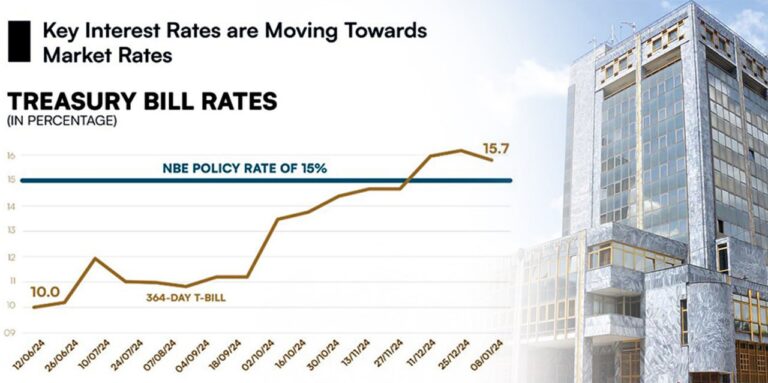
The National Bank of Ethiopia (NBE) has reported a significant increase in the interest rate for Treasury bills (T-bills), which has now exceeded the policy rate for the first time, marking a positive rate.

This change occurs as the NBE’s Monetary Policy Committee is set to revise the policy rate, which was established at 15% at the beginning of the fiscal year.

According to the NBE’s Monetary and External Sector Developments overview published on February 13, the interest rate for one-year T-bills has risen by 57% compared to the beginning of the budget year.

In July, the rate was 10%, but it has surged to 15.7% in just six months, representing the highest rate relative to the current inflation rate of 15.5% and the policy rate of 15%.

The recent spike in T-bill rates follows recommendations from the International Monetary Fund (IMF), which urged the central bank to adjust interest rates in order to attract more bidders and mobilize resources. The IMF emphasized the importance of maintaining positive real T-bill rates aligned with the policy rate.

In its latest report, the IMF noted that the transmission of monetary policy to T-bill rates has been limited, as weighted average issuance yields have remained at or below 10-11%, despite attempts to adjust rates to market-clearing levels.

The IMF attributed this limitation to factors such as demand from pension funds at negative real interest rates, the inclusion of T-bills in reserve requirement calculations, and historical practices of rejecting bids above 10%.

However, following the IMF’s recommendations, T-bill rates have shown consistent growth. In the latest auction held last week, the average interest rate for one-year T-bills reached 17.69%, reflecting a positive trend in light of the declining inflation rate, which fell to 15.5% in January from 17% the previous month.

The NBE’s transition to an interest-rate-based monetary policy framework marks a significant step toward aligning with global best practices. This new framework replaces the previous credit ceiling approach, aiming to enhance communication of the central bank’s policy stance and influence the broader monetary and credit landscape.

The IMF’s first review under the Extended Credit Facility (ECF) program, published in November, underscored the authorities’ commitment to achieving positive real interest rates by the first quarter of 2025 while moving away from quantitative lending constraints.

In addition to these monetary policy developments, the NBE reported a notable increase in foreign exchange (forex) trading among banks. Between October 2024 and January 2025, banks traded a total of USD 428 million in forex, with daily average sales increasing to USD 43 million in January, up from USD 22 million in August 2023.

As the NBE prepares to revise its policy rate, the recent adjustments in T-bill rates and the decline in inflation indicate progress toward stabilizing the economy and enhancing market functioning, according to experts.

Ethiopia to permit foreign banks from friendly countries

0

Ethiopia has announced plans to permit foreign banks from friendly nations to invest in its financial sector, representing a significant shift in the country’s banking policy. However, the highly anticipated bill, revised two months ago, has yet to be officially published.

Under the newly adopted banking business proclamation, international banks will be allowed to re-enter the Ethiopian market through various operating schemes.

This proclamation, ratified by parliament in mid-December 2023, includes key provisions aimed at enhancing the financial sector.

The law will only take effect once it is published in the Negarit Gazeta, the official decree gazette, and detailed directives are issued.

According to Mamo Esmelealem Mihretu, Governor of the National Bank of Ethiopia (NBE), this process could take anywhere from three months to a year.

In an interview with Zemen Economy, a state-owned media outlet, Governor Mamo emphasized the importance of international banking investors having a solid reputation.

He also highlighted that the countries of origin must maintain positive diplomatic relations and cooperate with Ethiopia. “The countries’ authorities should have readiness to collaborate with the NBE,” he added.

The 2022 policy framework outlines specific requirements for foreign banks wishing to establish a presence in Ethiopia. For example, a foreign bank seeking to set up a subsidiary must obtain formal approval from its home country’s regulatory authority for supervisory cooperation. Similarly, a foreign bank planning to open a branch must secure written authorization from its home country’s supervisor.

The amended proclamation, dated December 17, 2023, also emphasizes cross-border cooperation. It allows the NBE to enter into agreements with domestic or international regulatory bodies to coordinate supervision, share information, and manage financial crises.

Additionally, the proclamation stipulates that the NBE must maintain confidentiality regarding information received from foreign authorities unless disclosure is legally required or necessary to protect the NBE’s interests in legal proceedings.

This policy shift marks a key milestone in Ethiopia’s strategy to integrate its banking sector into the global financial system. The government has announced its intention to grant up to five banking licenses to foreign investors over the next five years.

Foreign banks will have four modes of entry: establishing a subsidiary, opening a branch, setting up a representative office, or acquiring shares in new or existing domestic banks.

As Ethiopia awaits the final directive, this move is expected to attract significant interest from international investors.

According to Mamo, several international banks are expressing interest in investing in the Ethiopian banking industry.

This shift comes nearly five decades after foreign banks were last permitted to operate in the country, prior to the rise of a communist-led government in 1974.