The central bank has raised the Treasury bill (Tbill) yield to align with the newly implemented policy rate. This move aims to ensure market functionality and enhance participation from the banking sector in auctions, following recommendations from international partners.
The government relaunched the Treasury bill auction in December 2019, adopting a market-oriented scheme that encourages involvement from entities beyond pension funds in the biweekly market.
Although financing costs for the government have significantly increased, Tbill auctions were successfully introduced to replace the existing mandatory NBE Bills with a market-based system for domestic borrowing.
However, the government has faced pressure from foreign partners to increase yields, as the weighted average yields are currently negative in real terms.
According to a recent review by the International Monetary Fund (IMF), the transmission of monetary policy to Treasury bill rates has been limited. Weighted average issuance yields have remained at or below 10–11 percent, despite authorities’ commitment to adjusting Tbill rates to market-clearing interest rates.
The IMF report indicates that, against a projected issuance of 137.5 billion birr, only 64.1 billion birr in Treasury bills were issued between July and September 2024, revealing “little involvement from the banking industry.”
The report further notes that additional measures are necessary to enhance market functioning, improve price discovery, and address ongoing undersubscription in Tbill auctions, as discussed in monetary policy meetings with authorities in September.
“While Treasury bill rates are now theoretically allowed to adjust freely to market-clearing interest rates, continued demand from pension funds at deeply negative real interest rates, the Central Bank of Ethiopia’s (CBE) practice of including Treasury bills in reserve requirement calculations, and the historical precedent of the NBE rejecting auction bids above 10 percent have limited participation from the banking sector,” the IMF stated in its reports.
Authorities have acknowledged the need for improvements in the auction process and have agreed to accept rates up to the policy rate introduced by the National Bank of Ethiopia at the beginning of the current fiscal year.
The IMF has emphasized that authorities recognize the necessity of increased banking sector participation and are committed to ensuring that market participants understand the new rules governing the Treasury bill market.
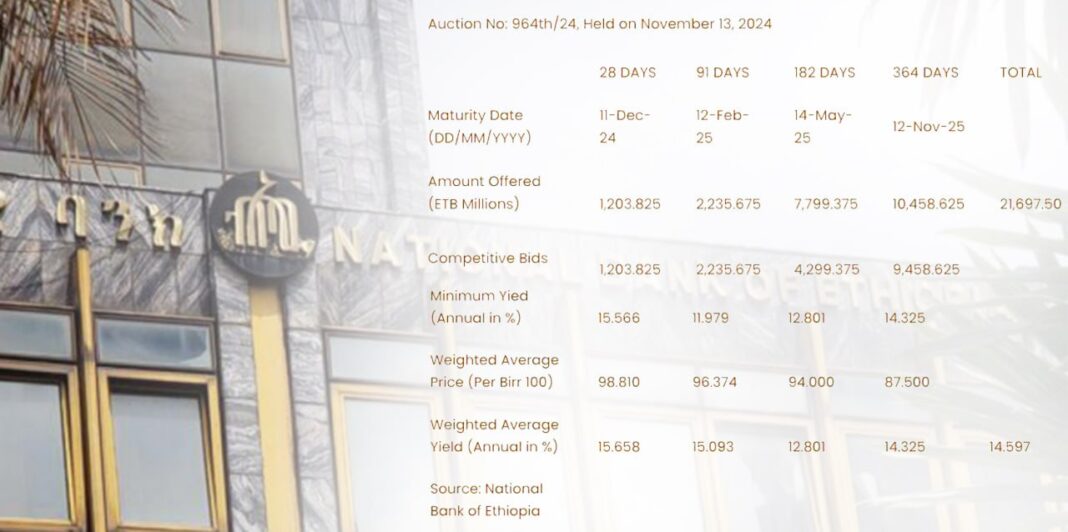
The average yield has improved in the last two notable Tbill auctions compared to previous ones. The most recent auction, held on November 13, yielded an average return of over 14.5%. The lowest yield was 12.8 percent for a six-month maturity, while the maximum allowed by the NBE was 15.6 percent for a 28-day maturity, exceeding the policy rate of 15 percent.
Between July and September 2024, two pension funds—the Public Employees Social Security Administration and the Private Organization Employees’ Social Security Administration—along with the CBE, acquired over 80% of Tbill issues; however, several smaller banks have begun to expand their holdings.
The IMF stated in its evaluation report, published about two weeks ago, that “a rise in Treasury bill rates to yields at least in line with the monetary policy rate is needed to ensure the continued development of the transmission mechanism and government debt markets.”
In contrast to directive advances, which are a primary financing scheme driving inflation, Tbill auctions serve as a tool to regulate money flow in the market and facilitate government funding.