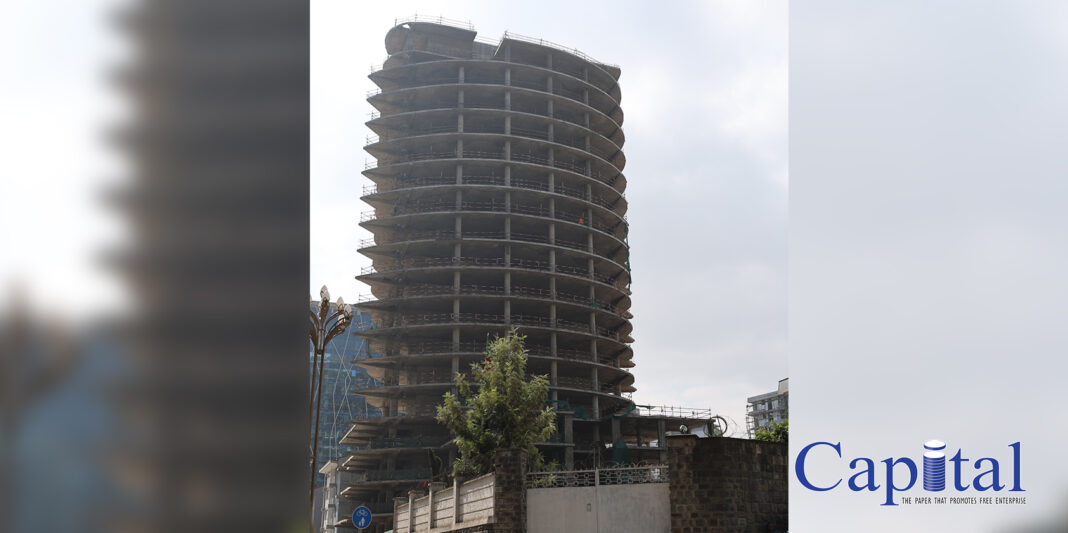
What was once envisioned as a landmark of corporate strength for Nib Insurance S.C. has turned into one of its greatest financial challenges. The insurer’s ambitious headquarters project in Bole, Addis Ababa, remains an unfinished concrete shell, following the company’s decision to terminate its contract with China Communications Construction Corporation (CCCC).
The termination, finalized in May 2025, marked the end of a turbulent partnership and pushed the project into an uncertain transition period. Initially celebrated as a symbol of confidence within Ethiopia’s insurance industry, the building has now become an example of mounting construction inflation and complex leadership hurdles.
Nib’s struggle to erect its headquarters dates back nearly a decade. The initial tender for excavation works, launched in May 2016, was suspended by the Federal Ethics and Anti-Corruption Commission due to “irregularities” in the bidding process. Although the commission later allowed the project to proceed, the delay sowed early doubts among shareholders.
Construction officially began in October 2018 with an estimated budget of 812 million birr, considered reasonable at the time. The contract, covering a 1,435-square-meter plot in central Bole, was awarded to the Chinese firm CCCC. However, by May 2021, work came to a halt when the building reached the ninth floor.
While the official explanation cited a “dispute over concrete quality,” insiders say financial disagreements were the real cause. CCCC reportedly requested a price adjustment following a sharp increase in global material costs during the COVID-19 period, claiming the 2018 contract had become “non-viable.”
Negotiations between Nib Insurance and CCCC resumed in 2022/23, but the contractor’s revised price raised the total project cost from 812 million birr to 2.4 billion birr. Subsequent estimates reached nearly 4 billion birr, a fivefold increase that Nib’s management dismissed as unrealistic.
Economist Dr. Kaleb Asfaw said the escalation reflected both global inflation and local macroeconomic pressures. “With the birr’s declining value and rising import costs, an increase of this scale was almost inevitable,” he told Capital. “But such long delays test the company’s liquidity and investment resilience.”
Ultimately, both sides signed a Contract Termination Agreement in May 2025, allowing the Chinese contractor to withdraw without litigation. Yet, the departure left Nib Insurance with logistical complications and a half-finished building.
To salvage the project, the Nib Insurance board, chaired by Siraj Abdella and led by CEO Zufan Abebe, adopted a phased construction strategy. Early in 2024, shareholders were asked to reinvest 50 percent of their 2022/23 dividends into the building fund. The decision drew complaints but enabled work to resume, bringing the structure to its current 18 floors.
That progress, however, proved short-lived. As finishing works began, disagreements resurfaced. Internal advisers estimated the cost at 1.7 billion birr, but CCCC’s proposal reached 3.08 billion birr, a 55 percent jump rejected by Nib leadership. The termination soon followed.
According to senior project management consultant Yohannes Gessese, the phased approach has helped Nib manage cash flow but increased the project’s exposure to inflation. “The longer construction stretches on, the higher the costs for imported materials like elevators, electrical systems, and cooling equipment,” he said.
Nib has since approved a phased procurement model, dubbed Option Two, which divides construction into separate packages rather than relying on a single contractor.
– Phase I will focus on completing basements—including parking and electric vehicle charging bays—the podium floors up to the 5th level, and exterior aluminum cladding.
– Phase II will cover interior works and final finishes for upper floors.
Phase I alone is budgeted at 1.1 billion birr, with 54 percent to be financed from company capital and 46 percent through bank loans. The projected timeline for completion is 540 days once a new contractor is signed, tentatively targeting completion of lower commercial levels by late 2027.
For Nib Insurance, the prolonged delay represents more than a construction setback. The company currently pays over 15 million birr annually in rent for its offices in Dembel City Center — funds that could otherwise return to shareholders as dividends once the new headquarters is operational.
Industry observers say completing the tower and leasing its commercial floors could help offset the financial burden. “If Nib moves quickly, the building can still serve as a revenue-generating asset,” one insurance consultant noted. “But if delays persist, it risks becoming a liability rather than a symbol of stability.”
Adding to the pressure, Nib Insurance is also entangled in an ongoing 144.5 million birr legal dispute with the Ministry of Revenue. The case involves alleged tax arrears related to refinanced dividends and disputed value-added tax (VAT) claims.
Sources indicate that two separate suits have been filed over capital gains tax for the years 2010 to 2015, with some aspects now under review by the High Court and Court of Cassation. Additionally, a VAT demand of 68 million birr, which Nib argues was imposed retroactively before the relevant proclamation appeared in the Negarit Gazeta, is also being contested.
Despite these legal and economic headwinds, Nib’s board insists the company remains committed to completing its long-awaited headquarters. The project, once meant to symbolize progress, has instead become a cautionary tale on inflation, corporate governance, and project management in Ethiopia’s volatile construction sector.