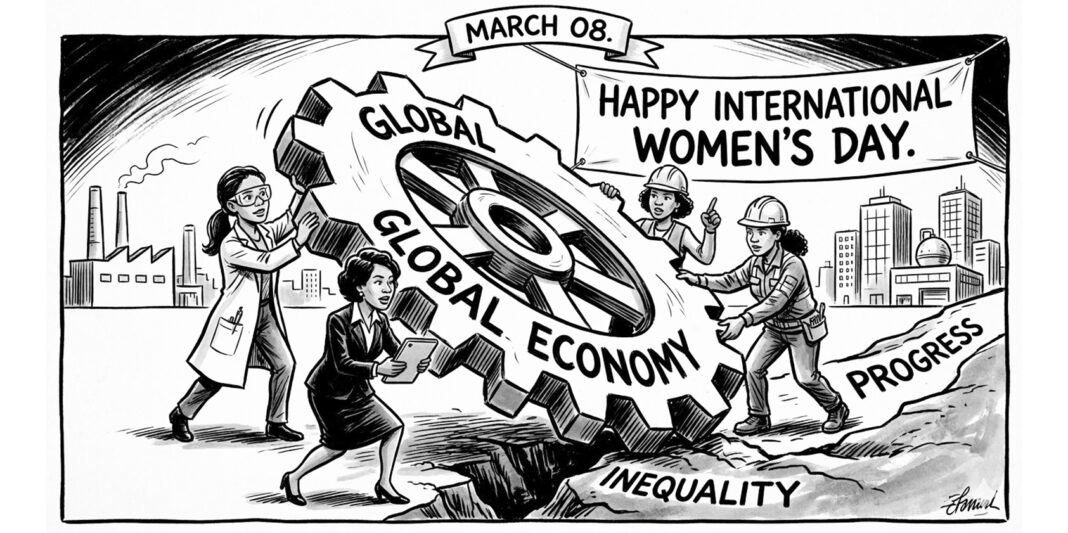
Every year on March 8, the world performs a familiar ritual. Governments issue statements, corporations launch social media campaigns, and conferences convene to celebrate the achievements of women. The language is predictable: empowerment, equality, inclusion. Yet behind this choreography lies a question rarely asked aloud—if the commitment is so universal, why does so little change?
International Women’s Day has gradually evolved into one of the most widely observed symbolic events on the global calendar. But symbolism is not policy, and celebration is not economic transformation. In a year defined by geopolitical shocks, fractured supply chains and tightening global growth, the real test of women’s empowerment is not rhetorical enthusiasm but economic integration.
The world marking March 8 today is far from stable. The war between Russia and Ukraine continues to distort energy and food markets. The Israel–Hamas conflict has injected fresh uncertainty into an already fragile Middle East. Meanwhile, the growing cycle of military strikes and proxy confrontations stretching from Gaza to the Red Sea—and involving Israel, Iran, the United States and allied forces—has heightened fears of a broader regional escalation. Across Asia, the uneasy balance surrounding China and Taiwan continues to cast a long shadow over global trade routes and semiconductor supply chains. Closer to Africa, tensions involving Ethiopia, Eritrea and Egypt remind us how regional rivalries can unsettle entire economic corridors.
For economists and investors, these are not abstract geopolitical dramas. They are forces that shape inflation, commodity prices, investment flows and business confidence. Conflict does not merely destroy infrastructure; it disrupts markets.
And when markets contract, it is often women who absorb the first economic shock. Women dominate the informal sector across much of the developing world—the very segment most exposed to volatility. Women-run micro and small enterprises frequently operate with thinner capital buffers, weaker access to credit and fewer institutional protections. When supply chains fracture, these businesses are often the first to collapse.
Yet this is where the International Women’s Day narrative becomes strangely selective. The same institutions that celebrate women’s empowerment each year continue to operate economic systems in which women remain structurally underrepresented in the arenas where capital and investment decisions are made.
Consider corporate leadership. Women remain a minority in global boardrooms and executive suites. Venture capital continues to flow overwhelmingly to male-led startups. Even development finance institutions that speak loudly about gender inclusion often struggle to translate these commitments into measurable shifts in investment patterns.
In other words, the challenge may not be a lack of awareness. It may be the persistence of symbolic politics in place of structural reform.
This matters because the case for women’s economic inclusion is not primarily moral—it is economic. Diverse leadership tends to produce stronger governance, more disciplined risk management and broader innovation. Firms that draw from a wider talent pool consistently outperform those that do not.
Yet the argument is often framed as a social justice campaign rather than what it truly is: a question of economic efficiency.
Emerging economies illustrate the contradiction most clearly. Across Africa, women are among the most active entrepreneurs, operating businesses in agriculture, retail, manufacturing and services. They are also central actors in informal cross-border trade networks that sustain regional markets. Yet the transition from survival entrepreneurship to scalable enterprise remains difficult because financial systems rarely meet them halfway.
Celebrating women entrepreneurs while denying them access to capital is not empowerment. It is theater.
If March 8 is to carry real meaning in an economically fragile world, it must move beyond ceremonial recognition. The question facing governments, investors and corporations is not whether women deserve applause. It is whether economic institutions are willing to adjust the rules that currently limit women’s participation in capital markets, leadership structures and investment networks.
Because the truth is uncomfortable: economies do not become inclusive through declarations.
They become inclusive when credit flows change, when boardrooms diversify, when investment committees broaden their criteria for opportunity, and when policy stops treating half the population as an afterthought.
Until then, International Women’s Day risks remaining what it too often becomes—an annual celebration of potential rather than a demonstration of progress.
In a world of tightening markets and rising uncertainty, that may be a luxury the global economy can no longer afford.