As Ethiopia races to close widening gaps in water, sanitation, and hygiene infrastructure, the international organization Aqua for All is calling on the government to establish a clear, strong policy framework that can unlock private‑sector participation in the WASH sector.
The Netherlands‑based nonprofit argues that traditional funding models, which rely heavily on government budgets and foreign aid, are no longer enough to meet Ethiopia’s 2030 development goals. To reach universal access to safe drinking water and basic sanitation, Aqua for All says the government must treat the private sector not as a side partner but as a central pillar of the WASH ecosystem.
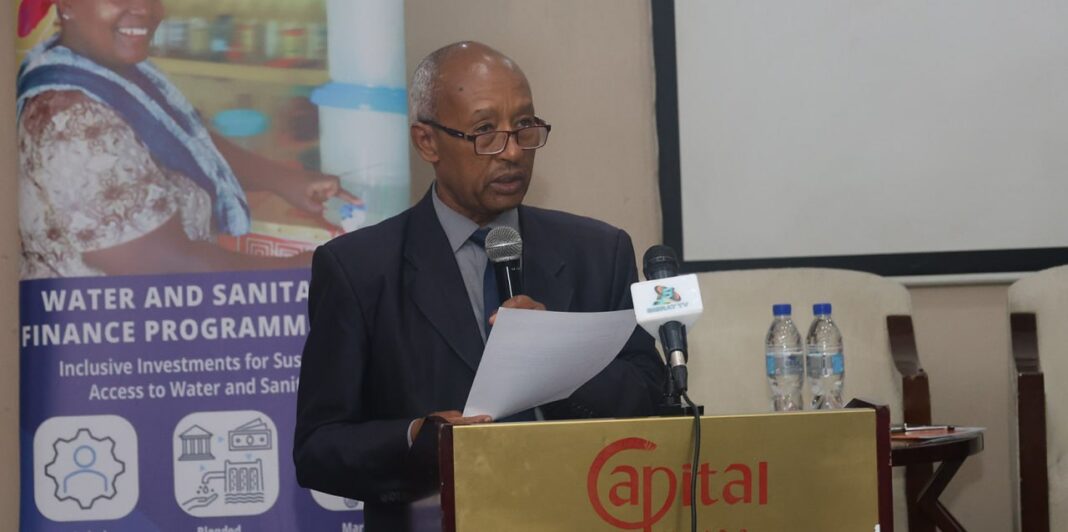
Hzekiel Aynalem, Aqua for All’s WASH Finance Program Manager and Country Representative for Ethiopia, told reporters that while the country has made progress in expanding water coverage, current efforts move too slowly to achieve the ultimate target of 100 percent public access. “If we want to reach 100 percent community benefit at the required speed, the private sector must play its role,” he said.
Ethiopia, he noted, has seen rapid transformation in sectors such as telecoms, finance, and renewable energy, but the WASH sector has remained largely stagnant by comparison. He described it as an “untapped market” whose profitability is still under‑recognized due to the absence of clear incentives, coherent regulation, and visible success stories for investors.
“There have been gaps in showing the private sector what can be gained from this market,” Hzekiel said. “Our goal now is to bridge that gap and show that the water and sanitation sector can be a profitable and sustainable business environment.”
The financing challenge is substantial. Data indicate that Ethiopia faces an annual funding gap of about 1.14 billion US dollars to achieve Sustainable Development Goal 6 (SDG 6). Relying only on the traditional “3Ts” model—taxes, tariffs, and transfers—is widely seen as insufficient to keep pace with population growth and urbanization.
Aqua for All is pushing for “market‑led” solutions that can move away from the 40‑year legacy of donor‑driven, grant‑heavy projects where communities contribute little and sustainability is often in doubt. The organization argues that the government cannot fill the gap alone with its limited fiscal space.
Financial institutions, however, have long regarded WASH investments as high‑risk, in part because they are dealing with public services where revenues are unpredictable and governance standards vary. To counter that perception, Aqua for All is working to build investor confidence through innovative financing and risk‑sharing structures.
“We don’t just provide direction; we share the risk,” Hzekiel said. By combining grant capital, technical support, and innovative financial instruments, the organization aims to make the sector more attractive to commercial banks and microfinance institutions.
A flagship example is a 400 million birr loan facility established in partnership with Bunna Bank, which has become the first private bank in Ethiopia to launch a dedicated credit line for water and sanitation projects. Aqua for All contributed grant capital to cover part of the risk, allowing the bank to lend to microfinance institutions and WASH‑focused businesses. Those institutions, in turn, on‑lend to households and small entrepreneurs for water connections, sanitation upgrades, and small‑scale service delivery.
The facility, which is scheduled to operate until 2030, is expected to reach at least 134,000 people in its second phase alone, helping to expand access to clean water and basic sanitation in underserved urban and peri‑urban areas.
Despite such local successes, Aqua for All stresses that broader, systemic change will require a national policy mandate. The organization has worked with the Ministry of Finance and the Ministry of Water and Energy to develop a WASH Financing Strategy, but it says turning that strategy into enforceable policy and detailed implementation guidelines is now essential.
The upcoming One WASH National Program (Phase 3) is expected to place greater emphasis on private‑sector participation, including opportunities for public‑private partnerships and blended financing. Yet Aqua for All believes the government must go a step further by sending a clear, high‑level signal that the private sector is not only welcome but is central to the future of the WASH sector.
“We believe there needs to be a stronger and more specific direction from the government regarding the private sector,” Hzekiel urged. “When policies and strategies are supportive, the confidence of financial institutions to invest increases.”