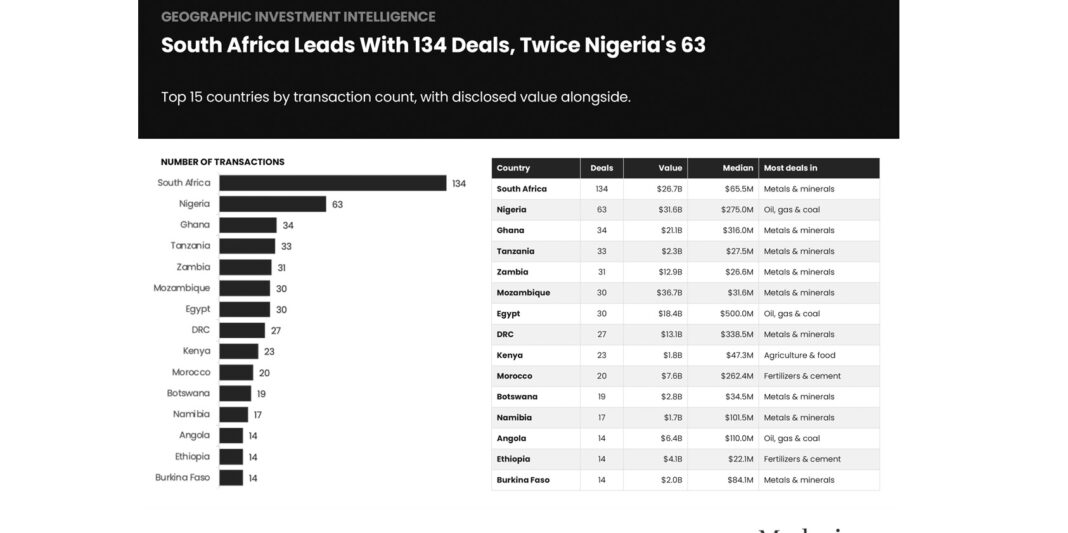
Ethiopia recorded 14 commodity-sector investment transactions worth 4.1 billion dollars between 1991 and October 2026, according to a new Africa Commodities Investment Report by Medarion.
The report, which tracks 789 transactions across 40 African countries and 709 named investors, places Ethiopia among the continent’s major fertiliser and cement investment markets. It says the country’s disclosed transaction value reached 4.1 billion dollars, with a median deal size of 22.1 million dollars.
Ethiopia’s commodity investment profile is dominated by fertilisers and cement rather than mining, oil and gas. The report records 21 fertiliser and cement deals across East Africa, where agriculture and food and power and renewables also account for significant activity.
The largest Ethiopian transaction identified in the report is the 2021 joint venture between Morocco’s OCP Group and the Government of Ethiopia to develop a fertiliser complex in Dire Dawa.
The project was valued at 3.7 billion dollars, with a stated annual capacity of 3.8 million tonnes. It is listed among the report’s selected major African commodity transactions.
The Dire Dawa project alone accounts for the overwhelming majority of Ethiopia’s disclosed commodity investment value in the report. The remaining Ethiopian deals have a combined disclosed value of about 400 million dollars, based on the report’s country total.
Across East Africa, the report records 106 transactions worth 22.2 billion dollars. The region has a relatively balanced commodity investment mix, with 35 metals and minerals deals, 28 agriculture and food deals, 21 fertiliser and cement deals and 17 power and renewables deals.
Southern Africa leads the continent by transaction count, with 266 deals, or 34 percent of the total, followed by West Africa with 156 deals, or 20 percent. East Africa accounts for 13 percent of transactions.
Pan-African transactions, involving assets or companies across multiple countries, account for 134 deals and 220.7 billion dollars in disclosed value. These are excluded from country-level value rankings.
The report finds that Africa’s commodity investment landscape is changing. While metals and minerals lead by transaction count, oil, gas and coal lead by disclosed value, accounting for 210 billion dollars, or 46 percent of the total.
It also shows that debt financing and project finance have become more prominent. Mergers and acquisitions fell from 67 percent of deals before 2010 to 44 percent in 2021-26, while debt and project finance rose from 15 percent to 34 percent.
Development finance institutions are playing a growing role. The International Finance Corporation is the most active investor, participating in 48 deals across 16 countries, while the African Development Bank participates in 24 deals across 15 countries.
Power and renewables are a major focus for development financiers. The report records 98 power and renewables transactions worth 28.6 billion dollars, with 60 involving at least one development finance institution.
The report also highlights a growing Chinese presence in Africa’s critical minerals sector. Chinese-led metals deals rose from three before 2010 to 17 in 2021-26.
In lithium, Chinese groups made 13 of 24 deals since 2019 and accounted for 94 percent of disclosed lithium deal value.
Ethiopia does not appear among the report’s leading lithium markets. Instead, its recorded commodity investment activity is concentrated in fertiliser and cement, reflecting the country’s agricultural input needs and construction sector.
For Ethiopia, the findings suggest that large-scale industrial and agricultural-input projects, rather than mining or oil and gas, have so far shaped its commodity investment profile.
The report’s figures are based on disclosed transactions and should not be read as a complete measure of all investment in Ethiopia’s commodity sectors. It records announced or disclosed deals, with 90 percent of transactions carrying disclosed value.
The Dire Dawa fertiliser complex remains the country’s standout commodity investment in the dataset, underscoring the importance of fertiliser production to Ethiopia’s agricultural economy and industrial ambitions.