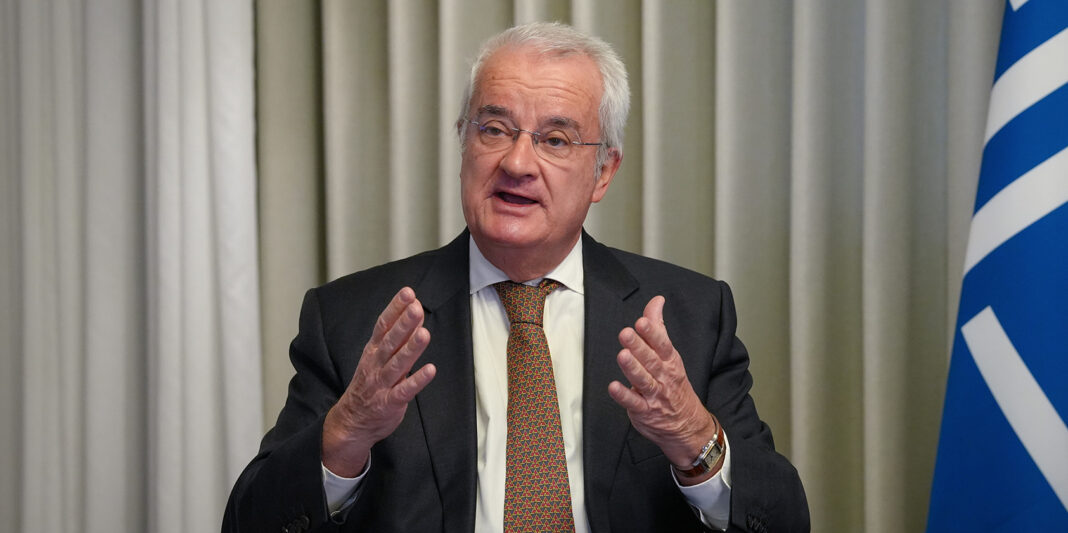
In this interview with Capital, Ambassador António de Almeida Ribeiro, Acting Secretary General of the KAICIID International Dialogue Centre, reflects on the role of interreligious dialogue in peacebuilding, conflict prevention and social cohesion. He discusses KAICIID’s partnership with the African Union, the importance of engaging religious leaders, women and young people, and the organisation’s work in conflict-affected settings across Africa. He also speaks about the need for dialogue to bridge divisions, address climate-related tensions and support Agenda 2063’s vision for a peaceful and secure continent. Excerpts;
Capital: How do you see the current bilateral relationship between Portugal and Ethiopia?
António de Almeida Ribeiro: Our bilateral relations are excellent. During this visit, we had the opportunity to meet with two senior officials from the Ministry of Peace and Reconciliation, it was a very productive exchange. We also have Ethiopian Fellows within our KAICIID cohort, two, in fact, one based in Addis Ababa and another abroad, both of whom have been valuable interlocutors for KAICIID here in Ethiopia. Overall, the visit was extremely fruitful, both in terms of our meetings with Ethiopian authorities and our engagements at the African Union, which is headquartered here in Addis Ababa, the capital of Africa.
Capital: KAICIID holds that dialogue is not a debate. In a professional context, what distinguishes interreligious dialogue from theological discussion?
António de Almeida Ribeiro: They are fundamentally different. We are not here to debate or scrutinise each other’s religion. What we affirm is that dialogue is essential; it is indispensable to building peace and fostering mutual understanding in society. I may belong to one faith and you to another, but that is not the point of our conversation. What I say is this: all religions share something in common, a commitment to peace and the promotion of human dignity. That common ground is what brings us to the same table, across very different traditions. Promoting peace and upholding human dignity must be shared goals for all of us.
Capital: You have stated that the AU–KAICIID partnership is aligned with Agenda 2063. How can interreligious dialogue contribute to building a peaceful and secure Africa?
António de Almeida Ribeiro: We have witnessed the growth of radical extremism, not only in Africa, but in many parts of the world. The only sustainable response is to bring religious leaders and policymakers together in pursuit of a common understanding. The voice of religious leaders matters enormously to their communities. When we consider that approximately 80 percent of the world’s population, more than six billion people, has some connection to a religion, it becomes clear that religious leaders hold extraordinary influence. Their messages of peace, tolerance, and respect reach not only their immediate communities but often far beyond. In Africa, this is especially significant. Our Memorandum of Understanding with the African Union is firmly anchored in Agenda 2063, a transformative framework for the continent and it is within that spirit that we are working.
Capital: Under the Memorandum of Understanding signed in Addis Ababa, how will you engage religious leaders to address communal tensions or displacement caused by climate change in Ethiopia?
António de Almeida Ribeiro: Religious leaders have a vital role in preventing the escalation of conflict. They are often deeply embedded in their communities; they hear, feel, and understand what is happening on the ground before a crisis fully emerges. A timely message from a trusted religious voice can make an enormous difference. Climate change is generating new tensions and hardship across societies, and here too, religious leaders can serve as a critical bridge between communities and governments, helping to de-escalate crises before they spiral.
Capital: Can you describe a time when you facilitated dialogue between two deeply polarised groups? What did you do to ensure the conversation was a safe and productive space?
António de Almeida Ribeiro: The first and most important message we always bring to the table is this: peace is the highest priority. For everyone in Africa, in Europe, in the Middle East, everywhere. And to achieve peace, we must be willing to engage, to listen, and to respect one another.
One of our most meaningful initiatives is the Muslim-Jewish Leadership Council (MJLC), which brings together prominent Rabbis and Imams from across Europe. Despite their profound theological differences, they find common ground and sustain genuine dialogue on a regular basis. It is a powerful example of what is possible. Beyond that, KAICIID is actively supporting dialogue platforms in the Central African Republic, Nigeria, and northern Mozambique, all areas marked by intercommunal and interreligious tension. In each of these contexts, we work to bring different factions together, foster mutual respect, and build toward a shared commitment to peace. This is work we do every day.
Capital: The work of AU–KAICIID involves connecting policymakers and religious leaders. How do you coordinate these relationships across different levels?
António de Almeida Ribeiro: Through this Memorandum of Understanding with the African Union, we hope to create the conditions for policymakers, religious leaders, and civil society to work together toward peace, respect, and tolerance. I want to be honest: this is ongoing work — it is not something that is completed in a day or a week. It is a long process, and it requires persistence and unwavering commitment. But it is vitally important, and we will continue to advance it with determination.
Capital: What is your approach to ensuring the meaningful participation of women and youth in religious dialogues, particularly within traditional or conservative societies?
António de Almeida Ribeiro: Women and youth represent the future of our world of humanity itself. Engaging them from the very beginning is not optional; it is essential. They will be the decision-makers of tomorrow, in governments, in religious institutions, and across all sectors of society. This is a conviction that is deeply aligned with the vision of Agenda 2063. Investing in young people is one of our core priorities, and we take it seriously.
Capital: KAICIID works in areas such as Cabo Delgado and Nigeria. What are the particular challenges of implementing dialogue programmes in regions affected by violent extremism?
António de Almeida Ribeiro: These are deeply complex environments, where tensions are acute and the stakes are very high. Our challenge is to bring people of vastly different backgrounds, beliefs, and histories to the same table and to convince them that peace is achievable and worth pursuing together. We must create a space in which people can speak openly, find common ground, and commit to shared objectives. The question is simple but profound: who truly wants war? No one. And that is the foundation on which dialogue can be built. We believe in this work deeply, and we remain committed to it.
Capital: How do you measure the success of dialogue programmes? Is peace a measurable outcome, or do you rely on different indicators?
António de Almeida Ribeiro: We receive feedback from many of the individuals and institutions we have worked with, and in a significant number of cases, we can see that situations are genuinely improving. But perhaps one of the most telling indicators of success is the volume of requests we receive from institutions, governments, and communities around the world asking us to partner with them. If our work were not making a difference, no one would be coming to us. That, in itself, is meaningful. And it motivates us to continue doing our very best to contribute to a more peaceful, respectful world for everyone.