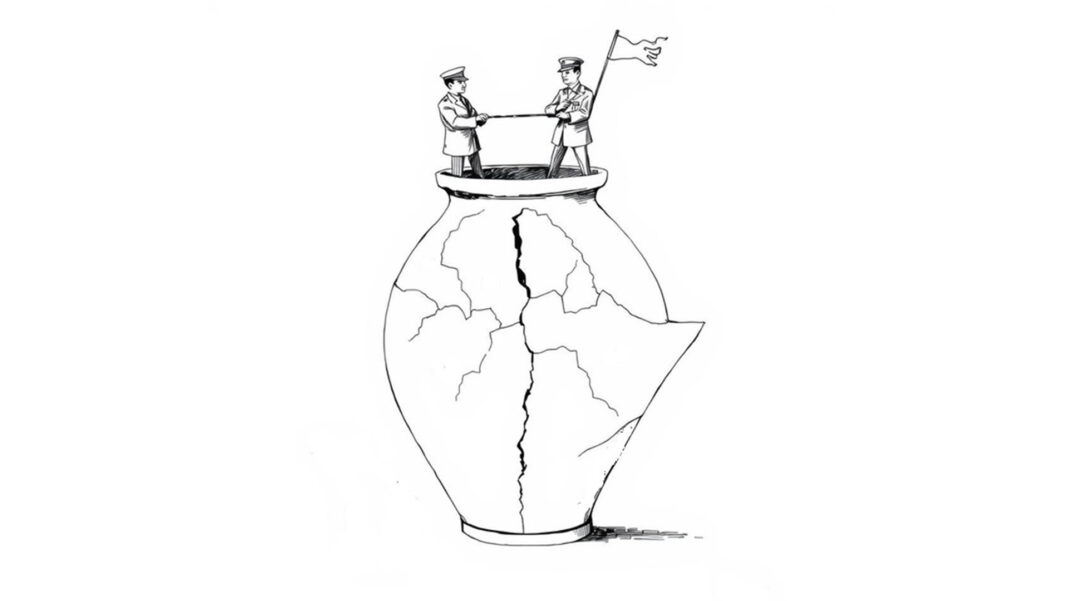
The renewed fighting in northern Ethiopia is more than another security emergency. It is a warning that the country may be approaching a far more dangerous political threshold: a conflict that could weaken the state, deepen ethnic separation and turn a fragile federation into a collection of armed, distrustful territories.
Reports from Tigray, Amhara and Afar indicate that a new round of hostilities has spread beyond a local confrontation. Tigrayan forces have reportedly moved against federal positions and taken control of airports in Mekelle, Axum and Shire, while fighting has been reported in neighbouring Amhara and Afar. Federal authorities and Tigrayan leaders accuse each other of initiating the escalation, and casualty claims from both sides remain difficult to independently verify. What is clear, however, is that the peace that ended the 2020–2022 war has been placed in grave danger.
It is tempting to frame the current crisis as a battle between two political-military establishments: the federal government and the Tigray People’s Liberation Front. That would be a serious mistake. The victims of a renewed war will not be the leaders who issue statements from protected offices. They will be civilians in Tigray, Amhara and Afar: farmers whose planting seasons are disrupted, traders whose routes are closed, children whose schools become shelters or military posts, patients cut off from medicine, and families once again forced from their homes.
Ethiopia has already paid an unbearable price for the previous northern war. Its social fabric was damaged; its economy was strained; humanitarian needs expanded; and relations between communities were poisoned by fear, grief and narratives of collective blame. A return to large-scale war would not simply repeat that devastation. It would compound it.
The immediate danger is military escalation. Fighting has reportedly widened beyond Tigray, with clashes and artillery fire affecting areas in Amhara and Afar. The reported involvement or alignment of armed groups across regional boundaries raises the prospect of a conflict that no longer fits the narrow label of a federal-Tigray dispute.
But the deeper danger is political fragmentation. Ethiopia’s constitutional order already faces intense pressure from unresolved territorial claims, contested regional authority, the proliferation of armed actors and mutual suspicion between federal and regional institutions. When political disputes are repeatedly settled through force, every region learns the same destructive lesson: security comes from armed mobilisation, not constitutional compromise.
That lesson creates a vicious cycle. Communities grow fearful; fear produces militarisation; militarisation creates new abuses and retaliatory demands; and every new round of violence makes peaceful coexistence appear less credible. In time, national institutions lose legitimacy not because Ethiopians reject the idea of living together, but because the state seems unable to guarantee rights, resolve disputes fairly or protect people from collective punishment.
Separation is not inevitable. Ethiopia’s diversity is not a weakness, and its federal system need not lead to disintegration. But a country cannot remain united by force alone. Nor can it remain stable if citizens believe their identity, security and economic future depend on the military power of their region.
Unity must be rebuilt through consent: credible institutions, fair representation, accountable security forces, lawful dispute resolution and an economy that gives people a stake in peace.
The November 2022 Cessation of Hostilities Agreement offered Ethiopia an opportunity to stop a catastrophic war and begin the difficult work of recovery. It was never a complete solution. It left difficult questions about disarmament, political recognition, contested territories, humanitarian access, accountability and reconstruction. Yet its incompleteness was a reason to implement it more seriously—not a justification to abandon it when political tensions returned.
A peace agreement is not a ceremonial document to be praised in international meetings and ignored when it becomes inconvenient. It is a framework meant to prevent the next generation from inheriting the violence of the last.
The parties must therefore agree immediately to halt offensive operations, protect civilians, restore communications and allow unhindered humanitarian access. An emergency ceasefire should not wait for either side to achieve an imagined military advantage. In Ethiopia’s recent history, battlefield victories have repeatedly produced only temporary silence before the next eruption.
Regional and international actors—including the African Union, the United Nations, the Intergovernmental Authority on Development and Ethiopia’s neighbours—should support de-escalation, monitoring and dialogue. But outside involvement cannot substitute for Ethiopian political responsibility. The essential decision must come from Ethiopian leaders: whether they will treat the country as a shared political home or as territory to be captured and controlled.
The renewed conflict also exposes the failure of elite bargaining that excludes ordinary people. Peace cannot be sustained through agreements negotiated only among armed and political leaders. Farmers, women, youth, displaced people, religious leaders, civic groups, traders and local administrators must have a meaningful role in shaping the political settlement.
This requires difficult conversations. It requires acknowledging the suffering of all communities without ranking victims by ethnicity or political affiliation. It requires rejecting language that turns entire peoples into enemies. It requires credible accountability for abuses, regardless of the perpetrators. And it requires a national commitment that no Ethiopian should lose rights, safety or dignity because of the language they speak, the region they come from or the political group that claims to represent them.
The economy also matters. War thrives where unemployment, displacement, inflation and hopelessness make armed mobilisation seem like one of the few available paths to status or survival. Ethiopia cannot separate peacebuilding from recovery. Reopening roads, restoring trade, rebuilding schools and health facilities, supporting farmers and creating jobs for young people are not secondary development tasks. They are core security policies.
The alarming events in the north should not be treated as distant news for people elsewhere in the country. A war in Tigray, Amhara and Afar will affect every Ethiopian: through higher prices, disrupted transport, lost investment, insecurity, displacement and deepened mistrust.
The country now faces a stark choice. One path is familiar: escalation, collective blame, military pride and another cycle of retaliation. It may promise decisive victory, but it can only produce a weaker, poorer and more divided Ethiopia.
The other path is harder but necessary: an immediate ceasefire, restoration of the Pretoria process, inclusive political dialogue, protection of civilians and a serious national effort to repair the institutions that have failed communities across the country.
Ethiopia is in danger not because its peoples are incapable of living together, but because political leaders have too often allowed disagreement to become warfare. The country’s future will depend on refusing that pattern—before another northern conflict becomes a national rupture.