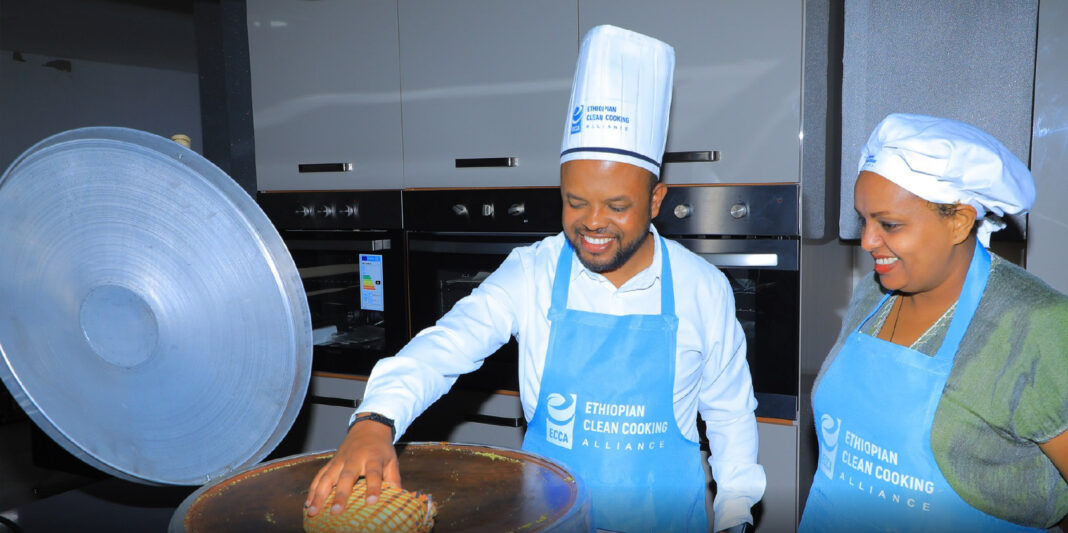
Expanding access to cleaner cooking technologies in Ethiopia could prevent thousands of premature deaths and reduce household fuel costs, but high appliance prices, unreliable electricity and financing constraints continue to slow adoption, according to a new study.
The Clean Cooking Cost Benefit Analysis – Ethiopia, prepared by Sustainable Energy for All (SEforALL) and commissioned by the Netherlands Enterprise Agency under the Energising Development programme, finds that most transitions away from traditional cooking methods deliver benefits exceeding their costs. Electric cooking produces some of the strongest results.
The report draws on Ethiopia’s National Clean Cooking Energy Sector Investment Plan, which estimates that approximately US$3.38 billion is needed to implement its preferred transition pathway through 2035. The investment would support cooking technologies, household financing, supply chains and institutional development.
Households purchasing firewood could save between US$110 and US$150 annually in fuel expenditure by switching to electricity, solar cooking, biogas or pellets, according to the analysis.
For electric, solar and pellet stoves, those savings could typically recover the appliance cost within a year. Biogas systems generally require a larger initial investment and a longer recovery period.
However, the economics differ for households that collect firewood rather than buy it. Switching to electricity introduces a cash expense for energy, even while delivering wider benefits through reduced smoke exposure, less fuel collection and lower environmental damage.
The report therefore distinguishes between savings households can immediately realise and broader social benefits, such as the estimated economic value of improved health and time saved.
The study cites national estimates linking household air pollution to approximately 63,000 premature deaths annually.
Its modelling suggests that replacing the primary cooking stoves of all households relying on collected firewood with electric, solar, biogas or liquefied petroleum gas options could prevent roughly 11,000–12,000 premature deaths a year. These estimates assume households continue using traditional wood-fired mitads for baking injera.
Continued use of polluting appliances substantially reduces potential health gains. The report warns that “stove stacking”—combining cleaner technologies with traditional stoves—can leave households exposed to harmful smoke even after acquiring a modern appliance.
It recommends measuring sustained use and actual outcomes rather than simply counting the number of stoves distributed.
Women and girls could also benefit from reduced fuel-collection and cooking demands. For households switching from collected firewood to options that eliminate collection, the model estimates time savings of about three hours daily, potentially freeing time for education, paid work and other activities.
Despite the strong economic case for electric cooking, the report cautions that a connection does not necessarily provide the capacity or reliability required to operate cooking appliances.
Power outages, voltage fluctuations, inadequate supply capacity and appliance costs remain barriers. Cooking practices also matter, particularly the energy requirements of injera baking and the preparation of slow-cooked stews.
Planned electricity tariff increases could further affect affordability. Although electric cooking remains attractive in the study’s higher-tariff scenarios, the authors warn that households unable to purchase efficient appliances may return to biomass fuels.
The report recommends targeted subsidies, appliance financing and pay-as-you-go arrangements, alongside stronger electricity infrastructure and technologies suited to local cooking needs.
It also stresses that no single solution will suit every community. Biogas, solar and appropriate biomass technologies have roles alongside electricity, depending on local resources, infrastructure and household circumstances.
The national investment plan envisages a financing mix comprising grants, carbon finance, concessional loans, government funding and private investment. The report highlights opportunities to strengthen domestic manufacturing, distribution, installation and repair services.
However, it warns that reducing charcoal consumption could disrupt livelihoods in a sector estimated to employ 1.3 million people, many informally. Reskilling and transition support should therefore accompany clean-cooking programmes.
The authors also acknowledge that their cost-benefit calculations exclude the costs of interventions needed to drive adoption, such as financing support and awareness campaigns. The estimated net social benefits should consequently not be interpreted as guaranteed household cash returns or fully funded implementation plans.