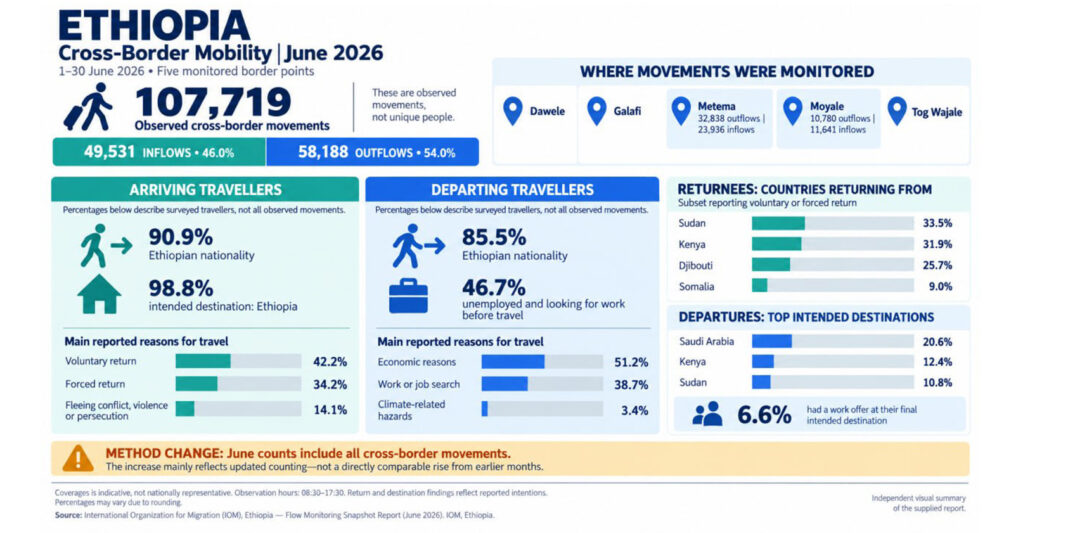
Nearly nine in ten surveyed outgoing travellers cite economic hardship or work; few have confirmed job offers
Economic hardship and the search for employment were the leading reasons reported by travellers leaving Ethiopia through monitored land crossings in June 2026, according to the International Organization for Migration (IOM).
The agency recorded 107,719 cross-border movements at five monitoring points during the month, comprising 58,188 outgoing movements and 49,531 incoming movements. Outflows accounted for 54 per cent of the total.
Among surveyed outgoing travellers, 51.2 per cent cited economic difficulties—including poverty, debt and a lack of livelihoods—as their primary reason for travelling. A further 38.7 per cent said they were travelling to work or seek employment.
The findings, published in IOM’s Ethiopia — Flow Monitoring Snapshot Report (June 2026), provide an indication of mobility along selected routes rather than a comprehensive measure of migration across Ethiopia’s borders.
IOM cautioned that a sharp increase in recorded movements in June mainly reflected methodological changes, including the expanded counting of cross-border movements, rather than necessarily indicating a comparable increase in migration.
Nearly half of surveyed outgoing travellers—46.7 per cent—said they had been unemployed and looking for work before their journey. Another 17.7 per cent had been self-employed, while 14.8 per cent had been employed.
Only 6.6 per cent reported having received a job offer in their intended final destination, highlighting the uncertainty facing many people travelling in search of employment.
Climate-related hazards, including drought and flooding, were the primary reason for travel for 3.4 per cent of outgoing respondents. Another 1.5 per cent reported fleeing conflict, violence or persecution. These figures describe the surveyed travellers and should not be interpreted as the overall causes of displacement or migration in Ethiopia.
Saudi Arabia was the most frequently reported intended destination, cited by 20.6 per cent of outgoing respondents, followed by Kenya at 12.4 per cent and Sudan at 10.8 per cent. European destinations included the United Kingdom, Norway, Sweden and Germany. The figures record intentions, not confirmed arrivals.
Metema, on the Sudan border, accounted for the largest number of observed movements among the five monitoring points, with 32,838 outgoing and 23,936 incoming movements.
At Moyale, on the Kenyan border, incoming movements slightly exceeded departures, with 11,641 entries and 10,780 exits.
The other monitoring points—Dawele, Galafi and Tog Wajale—collectively recorded 14,570 outgoing movements and 13,954 incoming movements.
According to IOM, these crossings serve travellers using routes within the Horn of Africa and towards the Gulf and Middle East. Metema also lies along routes towards Sudan and onward to Europe.
Among surveyed incoming travellers, 42.2 per cent identified voluntary return as their primary reason for travelling, while 34.2 per cent cited forced return. A further 14.1 per cent said they had been forced to flee conflict, violence or persecution.
All respondents classified in the report’s returnee analysis said they were returning to Ethiopia. Of this group, 33.5 per cent reported returning from Sudan, 31.9 per cent from Kenya, 25.7 per cent from Djibouti and nine per cent from Somalia.
IOM stressed that return was recorded as an intention: the monitoring did not establish whether respondents subsequently reached their communities of origin.
The monitoring was conducted at Dawele, Galafi, Metema, Moyale and Tog Wajale between June 1 and 30. Data collection at Kurmuk had been suspended since February 3 because of insecurity in the border area.