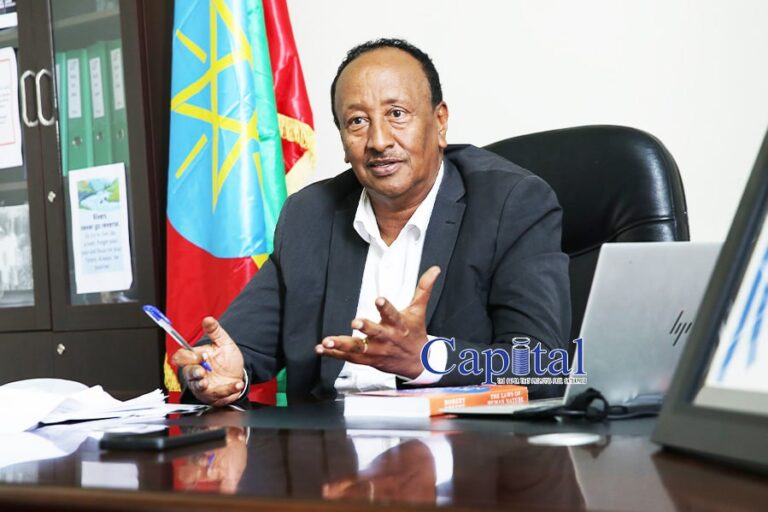
In a recent development, the management contract of Addis Chamber at the Exhibition Center was terminated by the city administration, sparking concerns and questions about the future collaboration between the two entities. This termination marks the end of a longstanding partnership that has spanned over 27 years, raising inquiries about the implications and the way forward. In an exclusive interview with Capital, Shibeshi Bettemariam, Secretary-General Addis Ababa Chamber of Commerce and Sectoral Associations, sheds light on various aspects surrounding this termination, the ensuing legal actions, and the Chamber’s strategies to navigate this transition period. Excerpts;
Capital: The management contract of Addis Chamber at the Exhibition Center was terminated by the city administration. What is the issue of working together after this contract is terminated?
Shibeshi: Yes, the management contract that was in operation, with some hiccups now and then, has officially been terminated by the City Administration as of Tikimt 1, 2016 EC. Nonetheless, we have maintained a smooth and cordial relationship with the Exhibition Center over the past 27 or more years, first as clients organizing fairs and exhibitions, and later as partners. In my opinion, our relationship with the Exhibition Center was good, healthy, and mutually beneficial. It withstood the test of time, both in good and hard times. I don’t think profit-making and financial aspects are the sole objectives of the Addis Ababa Exhibition Center. There are far-reaching societal objectives, like stabilizing food and related prices by availing essential commodities to consumers and enhancing the city’s image by organizing non-pecuniary events.
That said, it should be emphasized that our chamber has consistently generated a financial surplus for the center. We have also implemented systems that institutionalized the center, from policies, procedures, and guidelines to staffing with skilled personnel, and developing infrastructure (vehicles, ICT, etc.), including cleaning, maintenance, and service quality, even during the harshest period of the COVID-19 pandemic when the center was closed for more than a year. Therefore, focusing solely on financial revenue generation would not accurately represent our decades-long relationship. It would be unfair to reduce everything we did as partners to financial metrics alone. I believe the City Administration, especially at the higher echelons, will understand this. What matters is doing the right things ethically, and in that regard, Addis Chamber has no parallels, both before my tenure and during it. In summary, the claim that the contract is terminated due to a lack of financial inflows is not supported by the hard facts on the ground.

Capital: What are your charges against the city administration? Why did you go to court?
Shibeshi: We are not the judiciary, and we don’t have any charges; we just have claims of unpaid dividends that should have been paid back to us by the Exhibition Center. As I mentioned before, it has only been a year since the city administration appointed its own board, canceling our management contract. This action unequivocally established a new supervisory board, but it is a basic principle in management and governance that two boards cannot coexist within the same institution. This means, for example, that we cannot simply stand by when the budget our board approved for the Exhibition Center during FY 2015 EC is managed by another entity, as it creates a serious accountability issue. You cannot have one system deciding on the strategic direction and approving a budget while another entity manages and executes it.
So, what took us to court was a claim over unpaid dividends from the net profit, which is now undergoing legal processes. We wrote letters to the center reminding them to pay the dividends, and after almost a year of delay, we took legal action, even after notifying them that this would be an option.
The next logical issue following the termination of the management contract is the liquidation process. This involves appointing an independent financial audit/accounting firm to close the books, conduct a proper audit, and then equitably distribute the fixed and other liquid assets according to the applicable financial policy. To this end, both parties have established a technical team consisting of professionals from our institutions, and work has begun. We are now waiting for their recommendations to reach a mutually agreed and beneficial solution for both our institutions.

Capital: What will the Chamber of Commerce lose after the Addis Chamber’s authority to manage the Exhibition Center is terminated, and what are you doing to increase your income?
Shibeshi: It is no doubt that the management contract was one of our clear sources of revenue, revenue that we generated through our sweat, professional management, and stewardship. Losing that revenue will undoubtedly lower the chamber’s income. But will it compromise Addis Chamber’s financial position? That is not true. It does not create an “existential threat” to our chamber. Addis Chamber is one of the few institutions in the country with a long track record, around 17 years, of strategic management. We are always guided by five-year mid-term strategic plans and even developed one for the Exhibition Center while it was under our supervision.
To shed light on this, the revenue streams for Addis Chamber have significantly grown over the last two years. Almost all our overhead costs, including salaries and vehicle operations, are now fully covered by the income we generate from our membership development and services. We have strong institutions like the Arbitration Institute, the Training Institute, and the Institute of Directors, which, in combination, generate substantial income that has tripled in just two years since my appointment as Secretary General. We have put in place completely new and modern infrastructure, including a fleet of transport vehicles to manage all our operations, and implemented a state-of-the-art Enterprise Resource Planning (ERP) system, replacing the old and obsolete ICT infrastructure. We have managed to attract above-average talents, remunerate adequately, and retain professional staff who are exceptional in their fields.
To illustrate, the largest revenue the Chamber collected from its members per year was 8 million birr just three years ago. This has risen to more than 24 million birr for two consecutive years. Our training institute reached more than 4,000 trainees and generated over 16 million birr in just the past 9 months. In addition to establishing a director’s institute, we also provide 13 types of legal services to our members. Another achievement, which we have not boasted about, is our Business Innovation Center (AACCSA-BIC), which is playing its role in the entrepreneurship and start-up milieu.
We achieved this because we are guided by a realistic strategic plan that includes sustainability as one of its core objectives. How did we manage this? Because we have committed staff who are driven by a unity of purpose and guided by servant leadership, focused on our members’ needs.
Capital: How do organizers who won the bid to organize various events at the Addis Ababa Exhibition Center view the fees they charge to rent the space to businessmen?
Shibeshi: Before I address this, let me give you an example. Addis Chamber organizes no less than three exhibitions per year, some at the very Exhibition Center we mentioned and some at other convenient fairgrounds, including the Millennium Hall. In November, we organized one of our trade fairs at the Exhibition Center with a payment of close to 1.2 million birr. Many uninformed people think that Addis Chamber organizes trade fairs at the Exhibition Center for free. We have never done that throughout our recorded history or partnership; we pay like any other third-party event organizer.
Under normal circumstances, the Exhibition Center’s business model is to rent a hall to an event organizer and earn its revenue, while the organizer adds its own margin, just like any other business model. In our case, when we organize trade fairs, our overriding objective is not to maximize profits. We organize events primarily to promote our business members’ products and services, create market linkages, and recoup our costs with minimal net proceeds.
Capital: The price differences seen at exhibition centers are often exaggerated relative to the standard market. In this case, what should be done to control the price difference?
Shibeshi: Event organizers, as I mentioned earlier, rent the halls from the center, design their business plans, incur promotional and marketing expenses, add their own margins, and then rent the spaces to businesses at a higher price, generating their own profit. This can indeed create price hikes. There are times when the prices at the Exhibition Center are far higher than what you would pay for the same product in Merkato. I haven’t conducted a survey, but this is what people are telling us.
I don’t think there is a convention and exhibition center capable of controlling this entirely, because without these dynamics, the space would be empty without tenants. The challenge is how the Exhibition Center can balance its seemingly contradictory objectives of financial revenue and societal goals. I think, with serious attention, a solution can be found. If the Exhibition Center is to continue as a convention center, it must find a way to balance consumer capabilities and fulfill its social mission.
Capital: What is the current status of the Addis-African Convention Center? What’s your role now?
Shibeshi: Addis Chamber is the pioneer of the Addis Africa International Exhibition and Convention Center. Addis Chamber has been at the heart of the entire strategic conception until the establishment of the existing company along with its share company organization in its current form. The demand for huge financial outlay has been the reason for Addis Chamber to relinquish its total ownership claim of the center in favor of the share company model. We are extremely proud of that. We generated a huge idea that could rally a nation, invited others—public and private alike—to share in this significant business opportunity, and paved the way for other leaders to take charge of this notable mega project and transform our city. This is Addis Chamber’s unique and unparalleled legacy.
Today, compared to many other shareholders, our share is small in financial terms, but it was the founding share, the golden egg that gave birth to this giant edifice that stretches over 100,000 square meters. In summary, Addis Chamber is not just about talking machines; we are the brains and working hands behind this monumental project!