The World Press Freedom Day celebration took place on Friday, May 10, under the theme “Journalism in the Face of the Environmental Crisis,” organized by the Ethiopian Media Council (EMC).
Teguest Yilma, Chairperson of the EMC General Assembly, highlighted the importance of media and journalists in addressing global environmental concerns during this year’s Press Freedom Day.
Teguest emphasized that the environmental crisis is a global issue that affects people’s lives worldwide, not confined to a single location. Ethiopia, as a country impacted by this crisis, is determined to combat it by utilizing various strategies, and the media plays a crucial role in amplifying and strengthening the country’s efforts.
In her statement, Teguest called upon relevant government agencies to ensure the protection of journalists, allowing them to carry out their work without fear of harm.
Henok Seyoum highlights the difficulties faced by journalists while covering environmental concerns during a panel discussion.
He said that one of the causes of the nation’s social, economic, and political instability is environmental issues.
Participants in the meeting, including an Environment Protection Authority representative, urged the media to increase their efforts in covering environmental and climate-related stories.
Although the EMC leadership expressed concern, they also noted that one of the main obstacles to increasing Ethiopian media coverage of the problem is lack of funding.
Invited guests and dignitaries including the French ambassador, Rémi Maréchaux, attended the event.
Rita Bissoonauth, who heads UNESCO’s delegation in Ethiopia, emphasized the importance of protecting the environment.
Safeguarding journalists is vital for maintaining press freedom and enabling them to fulfill their responsibilities effectively.
The World Press Freedom Day celebration focused on acknowledging the role of journalism in addressing the environmental crisis and emphasized the need for collaboration between media and government agencies to tackle this global challenge.
Ethiopian Investment Holdings (EIH), a recently established sovereign wealth fund (SWF) that has teamed up with a dominant global security printing firm, is making its first greenfield investment. By 2026, the initiative aims to transform the security printing industry.
The facility called Toppan Gravity Ethiopia (TGE), established by Toppan Gravity, EIH, Berhanena Selam Printing Enterprise, and Education Materials Production and Distribution Enterprise, both of which are under EIH, will be equipped with cutting-edge technology and stringent security measures to produce high-quality passports, ID cards, and banking cards, setting new standards for security and integrity.
Kalkidan Arega, CEO of TGE, amplifies the strategic partnership between Toppan Gravity and Ethiopian companies as a collective commitment to revolutionize the security printing sector, not only within Ethiopia but across the African continent.
Ahmed Shide, Minister of Finance and Board Member of EIH, underscores the transformative potential of the security printing facility.
Abdurehman Eid Tahir, CEO of EIH, highlights the project as a successful Public-Private Partnership (PPP), demonstrating EIH’s commitment to collaborative ventures that address critical gaps in the economy. “The project’s contribution to knowledge transfer and skills development empowers future generations of Ethiopians,” he emphasized. Abdurehman acknowledges the project as EIH’s inaugural greenfield investment, symbolizing the SWF’s commitment to innovation and strategic growth.
Selamawit Dawit, Director General of Immigration and Citizenship Services, emphasizes the critical role passports play in national security and international relations. She highlights ongoing efforts to enhance services and underscores the significance of the groundbreaking ceremony and factory project in advancing Ethiopia’s capacity to produce passports domestically.
The facility, to be constructed as part of this venture, will specialize in manufacturing security printings. Equipped with advanced technology and stringent quality control measures, the facility is poised to exceed industry standards and cater to the evolving needs of the market, according to the statement of TGE.
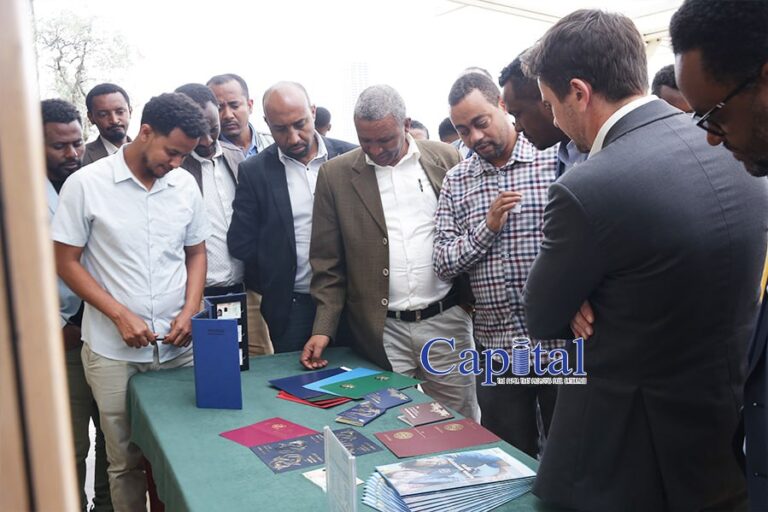
The groundbreaking ceremony included the unveiling of the new Ethiopian E-Passport, showcasing its security features, cover page, and distinctive characteristics setting it apart from its predecessor.
With the launch of the manufacturing plant that will consume USD 55 million in Bole Lemi Industry Park, the Toppan Group plans to harness its technologies and solutions to establish capabilities for the provision of a full range of government ID solutions in the African market, with a view to producing IDs and passports for neighboring countries in the future. The government of Ethiopia, meanwhile, will ensure operational design aligned with local needs by establishing rules and regulations for passports and IDs.
Toppan Gravity is a subsidiary of Toppan Next, serving as the international development arm of the Toppan Group in the security domain. Being part of the most prestigious conglomerate in the industry with decades of experience and multiple well-known references, Toppan Gravity benefits from the Toppan Group’s strong market position and extensive expertise.
As a global solutions provider primarily focused on the payment and identity industries, Toppan Gravity aims to develop the next generation of virtual and physical security solutions.
The Toppan Group’s security business traces its roots back to the security printing that was core to its operations at the time of its founding in 1900. Backed by this extensive track record, the Toppan Group has provided government IDs for more than 40 countries.
Regarding the Ethiopian investment, the Toppan Group holds a 51 percent stake in the company via Toppan Gravity’s UAE-based subsidiary Gravity Group Ind. L.L.C and one other company, while the Ethiopian government holds a 49% stake through the national printing press and the two other enterprises.
In a recent survey conducted by the International Air Transport Association (IATA), it has been revealed that significant progress has been made in the global aviation industry to reduce baggage mishandling.
The survey, which focused on the implementation of baggage tracking according to IATA Resolution 753, provides valuable insights into the current state of baggage handling practices among airlines and airports worldwide.
Out of the 155 airlines and 94 airports surveyed, the results indicate that 44% of airlines have fully implemented Resolution 753, while an additional 41% are in the process of doing so.
However, there are notable regional variations in the adoption rates of this resolution. China and North Asia lead the pack with an impressive 88% of airlines having fully implemented the tracking requirements.
In the Americas, the adoption rate stands at 60%, followed by Europe and Asia-Pacific at 40%, and Africa at 27%.
Moreover, the survey found that 75% of the airports surveyed have the necessary capability for Resolution 753 baggage tracking.
When considering airport size, the findings reveal that mega airports are leading the way, with 75% of them already capable of implementing the tracking requirements. Major airports follow closely at 85%, while large airports stand at 82%.
Medium airports, on the other hand, show a slightly lower readiness, with 61% having the capability for Resolution 753.
In terms of tracking technology, the survey indicates that the majority of airports (73%) rely on optical barcode scanning as the dominant method of tracking baggage. However, a more efficient technology, Radio-Frequency Identification (RFID), is being implemented in 27% of the surveyed airports. Notably, mega airports demonstrate higher adoption rates of RFID technology, with 54% of them already employing this advanced tracking system.
Monika Mejstrikova, the IATA Director of Ground Operations, highlighted the progress made in baggage mishandling reduction from 2007 to 2022, which amounted to nearly 60%. While this is good news, Mejstrikova emphasized that the industry aims to make further improvements to meet traveler expectations.
The implementation of Resolution 753, which enables baggage tracking at acceptance, loading, transfer, and delivery, plays a crucial role in achieving this goal.
Mejstrikova stated, “Tracking bags throughout the journey reduces mishandlings and enables airlines to reunite mishandled bags with their owners more efficiently.
With 44% of airlines fully implementing Resolution 753 and 41% in progress, travelers can have increased confidence in the timely delivery of their baggage.”
According to SITA, the global rate of mishandled bags in 2022 was 7.6 per 1,000 passengers, with the majority of bags being returned within 48 hours.
The implementation of Resolution 753 and the improved tracking measures are expected to further reduce these numbers, ensuring a better travel experience for passengers worldwide.
To accelerate the adoption of modern baggage messaging, IATA is leading the industry’s transition from legacy technologies to XML standards.
The current baggage messaging infrastructure relies on costly Type B messaging, which hampers the implementation of Resolution 753 and contributes to message quality issues and baggage mishandling.
IATA plans to launch the first pilot for testing modern baggage messaging between airports and airlines in 2024.
This transition to modern messaging will enable effective communication about passenger luggage, reduce mishandled bags, and pave the way for ongoing innovations in baggage management systems.
As the industry continues to make progress in reducing baggage mishandling, the results of this survey demonstrate a concerted effort to enhance the passenger experience and ensure the smooth and reliable delivery of baggage at the final destination.
With the implementation of Resolution 753 and the adoption of advanced tracking technologies, airlines and airports are working together to minimize the inconvenience caused by mishandled bags and provide a more seamless travel experience for passengers worldwide.
The Addis Ababa Chamber of Commerce and Sectoral Associations (AACCSA) conducted a design study seven years ago to reconstruct the Addis Ababa Exhibition Center, a facility with a history of over 40 years. However, due to a lack of attention from the government, the project has not yet commenced. The AACCSA has recently announced that none of the proposed projects for the exhibition center have been included by the government, despite its many years of service.
The Chamber of Commerce attributes the delay and bureaucratic issues to government fluctuations and problems. They have called for attention to be given to this matter and have expressed frustration with the system. Addis Chamber told capital that the reason for taking the previous debatable case to court trials.
Furthermore, the AACCSA has announced the termination of the exhibition center’s contract, which had been in effect for the past 18 years. The city administration has revoked the Addis Chamber’s control over the center, which they had been managing since 2008. The Chamber had sent multiple letters during the fiscal year regarding delayed dividend payments, but received no response. Consequently, they decided to take the matter to court.
Shibeshi Bettemariam, the Secretary-General of the Chamber, stated in an interview with Capital that the council was responsible for elevating the exhibition center to its current status. However, one year ago, the city administration appointed its own board, allowing for the existence of two boards for a single exhibition center, which is an illegal practice.
Bettemariam explained that the delay in dividend payment was the primary reason for taking the case to court. They had been requesting a response in writing for the past eight months, but had not received any. The contract between the Addis Ababa City Administration and the Addis Ababa Chamber had been renewed for either five or ten years, but the city administration terminated it through a letter.
Although the current administration had previously expressed verbal agreement to develop the exhibition center, no concrete action has been taken. Despite its long history of over 40 years, the Addis Ababa Exhibition Center has not undergone renovation and is considered inadequate to meet international standards for visitors.
Meanwhile, the government is undertaking a major project to construct the New Africa Trade and Fair Convention Center, which is estimated to cost over 4 billion birr. This center aims to provide comprehensive trade fair and related services in Ethiopia. The initial phase involves the construction of two multipurpose trade fair halls, each spanning an area of six thousand square meters, to accommodate various activities.