It has long been known that diasporas – people who have dispersed from their homelands, often times spanning generations – come into existence because people leave their countries of origin in search of mainly better economic opportunities.
Whether through remittance payments or the new economic linkages they create to their original home country, they make a vital contribution to the geopolitical strength of their countries of origin. In 2022, remittances amounted to close to $800 billion dollars, with India, Mexico and China leading the way. As these groups constitute an important piece of the global equation, it comes as no surprise that the governments of several of these home countries are increasingly trying to make more active use of them for their own economic development and geopolitical weight.
Branko Milanovic, Professor at City University of New York, stated that generally speaking, trying to reattract such people to their home country, where there is a lack of talent in sufficient number and quality to advance its economic and technological development, is a very legitimate cause. But that is not the main aim.
Taking India as a case, there have always been Indians outside India, especially in Asia and Africa, where they established important commercial and economic networks. It is worth remembering that Mahatma Gandhi, the founder of independent India, worked for several years as a lawyer in South Africa at the turn of the 19th and 20th centuries. He defended the rights of the tens of thousands of Indians or people of Indian origin who lived there.
At present, about 2.5 million Indians migrate abroad every year, the largest number in the world. The diaspora contributes about $80 billion directly and considerably more indirectly to the Indian economy. The Indian state differentiates between Overseas Indians, officially Non-Resident Indians (NRIs) and Persons of Indian Origin (PIOs) who reside in or originate from outside India. According to a report by the Indian Ministry of External Affairs, there are 32 million Non-Resident Indians and Persons of Indian Origin outside India. Overseas Indians constitute the largest diaspora in the world.
Andres Ortega, a noted Economic Analyst elaborated that, the Indian diaspora contributes consistently to reemerging India’s national movement and to India’s independence. These days, it is a factor in the transformation of the country via its civilizational reach into a global power. Not only is India the most populous country on earth as of this year, according to the UN, but just looking at the level of global notoriety, important Silicon Valley executives are of Indian origin. They include Sundar Pichai of Alphabet, Satya Nadella of Microsoft, Arvind Krishnade IBM and Sanjay Mehrotra of Micron Technology. Not to mention the current British Conservative Prime Minister, Rishi Sunak.
India’s Prime Minister Narendra Modi sees it as his personal mission to be the chief salesman in convincing Indian-origin people living around the world to re-connect much more actively with their ancestral land. The Indian government is behind the Organization for Diaspora Initiatives (ODI), which has its headquarters in New Delhi, and antennae and offices in various countries. ODI seeks to understand the various diasporas by comparing and contrasting their experiences, and promotes ideas such as the role of the diaspora in the rise of “Global India.”
Discussing the Chinese diaspora, there are also governments that are aiming to control their diaspora with an increasingly hard hand. The paradigmatic case here is China. It is estimated that there are some 50 to 60 million people of Chinese nationality (10.7 million) or origin (including Taiwanese) outside the country, whose origins date back to the ancient Silk Road. Today, the United States, Canada, Malaysia, Thailand, Indonesia, Singapore and Australia are destinations with a large presence of Chinese communities.
Arthur Appleton, Professor at John Hopkins University stated that, in some countries, their strong and economically powerful presence is not without problems. Consider Malaysia, for example. As in other countries in the region, ethnic Chinese control a large part of the economy. The fact that this population follows customs and habits that are different from those of the Muslim majorities creates further stresses. In 1969, there were anti-Chinese revolts in Malaysia that have not yet been forgotten, with important resurgences later on.
According to Arthur Appleton, the Chinese government is trying to control more and more of its diaspora. A few weeks ago, two men were arrested on charges of having helped set up a secret police post in New York on behalf of the Chinese government. In addition, three dozen Chinese national police officers were accused of using social media to harass dissidents inside the United States.
Arthur Appleton further noted that China is also trying to control the many Chinese students who travel abroad, especially to the United States, to further their studies. The Chinese ambassador in Washington, Xie Feng, has written a letter to Chinese students in the United States., asking them to support the Chinese Communist Party and “tell China’s story well”, that is, the official one.
According to some reports, tens of thousands of Chinese students pledge allegiance to the regime before traveling abroad. Almost all of them return, there is noticeable loyalty to a regime that has helped them study abroad. However, the level of trepidation among the students is rising. They fear that the authorities will examine the contents of their cell phones and computers upon their return.
Diasporas also contribute to the intimate knowledge of countries and their cultures or the comparative lack thereof. Significantly, in 2021-2022 there were some 290,000 Chinese international students in the United States. In contrast, there were fewer than 2,500 American students in China in 2020, compared to nearly 15,000 ten years earlier. Such disproportions obviously generate an imbalance in mutual knowledge.
Almost all overseas Chinese communicate with their family and friends in China, and with each other, through the WeChat app (similar to, but more powerful than, Whatsapp). After the restrictions imposed on TikTok in the United States, it is now considering banning WeChat as well. While not decided just yet, this would deprive the Chinese side of a powerful advanced communication system and much more.
Here one of the crucial issues to discuss is the issue of Diasporas and xenophobia. Two decades ago, Yale University professor Amy Chua, in her book The World in Flames (2002), argued that, along with the importance of the diasporas that had grown in tandem with globalization, the hatred and rejection they generated among the host populations had also increased.
Those tensions are certainly not limited to the case of the Chinese in Southeast Asia. There are various cases in the West, and especially in Europe. This notably includes the presumably liberal United Kingdom with Brexit, where the level of rejection is increasing not only of European immigration, but also of immigration from the former territories of the British Empire.
To conclude, looking ahead, while diasporas are not a new factor of global politics, how nations deal with them is becoming a relevant part of the struggle for global power shares. Indeed, their respective diasporas are a factor in the growing competition between China and India, which may well mark the world order in the second half of this century.
Addis Ababa came alive with the vibrant beats and moves of the Mboka Mboka Dance Performance, held at the Alliance Ethio-Française on Saturday, March 30th. The event marked the culmination of a two-week celebration of Francophonie Day, showcasing the rich cultural tapestry of French-speaking nations.
The evening was a spectacle of energy and rhythm, as talented Congolese performers took to the stage, captivating the audience with their intense and moving dance routines. From the moment the music started, the crowd was transported on a journey through the streets of Brazzaville, experiencing the fervent spirit of Congolese youth expressed through dance.
The Mboka Mboka Dance Performance was not just a show—it was a celebration of culture, creativity, and community. As the performers danced with passion and precision, they conveyed the vibrant essence of Congolese heritage, leaving a lasting impression on all who witnessed their artistry.
The event was part of a broader celebration of Francophonie Day, which had been ongoing from March 16th to March 30th in Addis Ababa. Throughout the two weeks, a series of events had been held across the city, including the launch of French language corners, beat-making workshops, dance workshops, and literary discussions, and the French language dictation led by renowned French author Rachid Santaki who travelled to Ethiopia especially for this event.
One of the highlights of the celebration was the Guiss Guiss Bou Bess Concert held at the Alliance Ethio-Française, featuring the Franco-Senegalese music group blending traditional sabar drums with deep electronic beats. These events not only entertained but also fostered cultural exchange and appreciation among attendees.
The Alliance Ethio-Française of Addis Ababa has been at the forefront of promoting cultural and linguistic exchanges between France and Ethiopia since 1907. As a non-profit organization, it is dedicated to teaching the French language and supporting arts and culture in Ethiopia.
Through its rich program of annual activities, the Alliance Ethio-Française provides a platform for local and international artists to showcase their talents and engage with diverse audiences. By fostering creativity and dialogue, the institution plays a vital role in enriching the cultural landscape of Addis Ababa and beyond.
The Mboka Mboka Dance Performance was not just a conclusion to Francophonie Day celebrations—it was a testament to the power of art to transcend boundaries, unite communities, and celebrate the richness of cultural diversity. As the audience left the venue, they carried with them memories of an unforgettable evening filled with music, dance, and the spirit of Congolese culture.
The Embassy of Italy and the Italian Cultural Institute brings to the vibrant community of theater enthusiasts to indulge in an extraordinary theatrical experience. The upcoming non-verbal comedy, “Family Album,” promises an evening filled with laughter, cultural fusion, and heartwarming narratives.
Directed by Matteo Spiazzi, “Family Album” is a unique Italian-Ethiopian collaborative project that brings together the creative talents of both nations. Set against the backdrop of an Ethiopian family’s unconventional journey, this theatrical endeavor captures the essence of familial bonds, cultural diversity, and the universal language of humor.
The performance, scheduled to run on April 4th, 11th, 18th, and 25th, commencing at 6:00 pm, will unfold at the esteemed Italian Cultural Institute in Addis Ababa. Audience members can anticipate an immersive experience as they witness the comedic genius of young Ethiopian actors seamlessly blending with Italian theatrical traditions.
“We are thrilled to present ‘Family Album,’ an embodiment of the enduring friendship and cultural exchange between Italy and Ethiopia,” remarked the organizers. “Through this collaborative endeavor, we aim to celebrate diversity, foster mutual understanding, and ignite joy within our community.”
This theatrical spectacle serves as a testament to the power of art in transcending linguistic barriers and fostering cross-cultural dialogue. Attendees are encouraged to immerse themselves in the enchanting narrative, where laughter knows no bounds, and the shared human experience takes center stage.
As Addis Ababa prepares to welcome this captivating performance, anticipation mounts among theater enthusiasts and cultural aficionados alike. “Family Album” promises to be an evening of laughter, cultural enrichment, and unforgettable memories, inviting audiences to embark on a journey of discovery and delight.
For those eager to partake in this cultural extravaganza, mark your calendars and prepare for an unforgettable theatrical experience at the Italian Cultural Institute in Addis Ababa. Come, be a part of the laughter, as “Family Album” brings to life the charming tale of an extraordinary Ethiopian family.
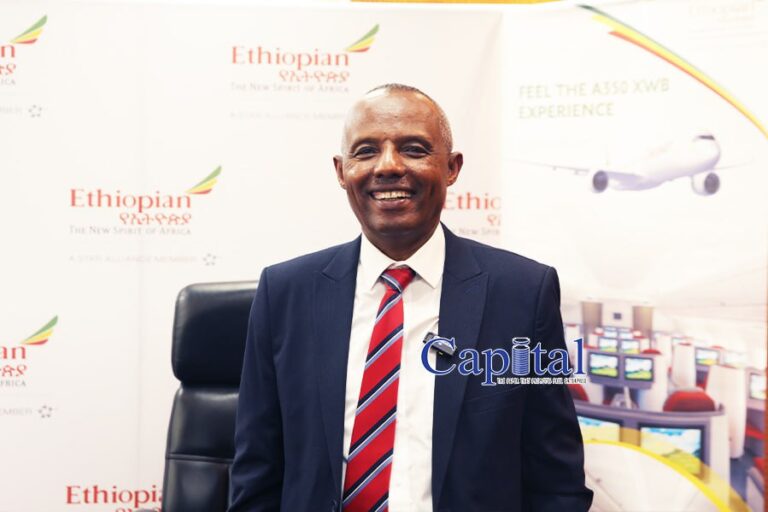
With over 38 years of extensive experience in airline management and operations, Mesfin Tasew, the Chief Executive Officer of Ethiopian Airlines Group, brings a wealth of knowledge to the table. His expertise spans various sectors, including aircraft maintenance and engineering, procurement, information technology, flight operations, and corporate leadership. Holding a Master’s in Business Administration from the Open University in the UK, an MSc degree in Electrical Engineering specializing in Communications Engineering, and a BSc degree in Electrical Engineering from Addis Ababa University, Mesfin Tasew is well-equipped to navigate the complexities of the aviation industry.
In this exclusive interview with Capital’s Groum Abate, Mesfin Tasew discusses Ethiopian Airlines’ strategies to navigate the global aviation challenges, particularly during the COVID-19 pandemic, and outlines the company’s future in African aviation, investments, sustainability, technology, and the Vision 2035 goals. His insights illuminate the company’s path and dedication to advancing aviation in Africa and globally.
Capital: What strategic initiatives is Ethiopian Airlines Group undertaking to navigate the challenges posed by the global aviation industry, particularly in light of the COVID-19 pandemic?
Mesfin Tasew: During the COVID period, the entire air transport industry, in fact, the whole industry was badly affected. Airlines had to stop flying and shut down their operations. However, Ethiopian Airlines continued operating through the COVID period, focusing primarily on cargo. Through that cargo, we were able to generate enough revenue to support our critical expenses. In fact, during the COVID period, even though Ethiopian Airlines’ revenue went down in terms of the bottom line, it didn’t state profiteers. The primary reason for that was we focused on cargo operations to transport essential goods like COVID test kits, vaccines, protective equipment, and so on. So we were very successful in navigating through the COVID period. However, now that we are in the post-COVID period, the transport industry is still affected by the aftermath of COVID. At least there are two critical issues still impacting the industry. The first one is a shortage of aircraft spare parts.
During COVID, several companies that manufacture aircraft spare parts closed their factories and lay off their personnel. Now when we come out of COVID, they are finding it very difficult to recall their professionals and they cannot produce and supply the industry with the required spare parts. This is still a problem for the entire industry. In this area, we are trying to manage it using several techniques, making special arrangements with the suppliers to get preferential treatment. But even after doing this, some of our aircraft are grounded because of the shortage. However, the rest we have managed to continue with our operations.
The second issue is a shortage of aviation professionals. During the COVID period, aircraft manufacturers laid off their factory personnel, as did airlines. Now, when they want to re-launch full operations, they cannot find enough aviation professionals like pilots, technicians, and ground handling staff at the airport. The industry is still constrained because of this human capital shortage. Luckily, Ethiopian Airlines never lay off any of its staff. It retained all its staff and that helped us to quickly recover from COVID. Now that’s not a constraint for us, whereas other airlines are affected by this. Now the whole air transport industry has fully recovered in terms of global passenger and cargo operations, but the industry is affected by these two major factors.
Capital: With the growth of African aviation, what opportunities does Ethiopian Airlines see?
Mesfin Tasew: African air transport is underdeveloped. The statistics show that the population of the African continent comprises about 18% of the global population. However, the demand for air transport in Africa, or African passengers, accounts for only 2% of global air travelers. This demonstrates that both the demand and services are underdeveloped in Africa. This in itself presents an opportunity for growth in Africa, as it is the next frontier for the development of air transport.
Other opportunities in Africa include a growing middle class and a significant number of young, middle-income businessmen who can afford to travel and are interested in creating businesses. Therefore, the demand for air transport in Africa is expected to grow rapidly. In fact, some forecasters predict that it will grow at an average rate of 4.6% per year for the next 20 years. This indicates a growing market for air transport in Africa.
Furthermore, initiatives such as the African Union’s Single African Air Transport Market (SATM) encourage African governments to liberalize their air transport market, allowing airlines to freely operate in any country or city in Africa. This eliminates the need for bilateral air service agreements and grants more freedom to African airlines. Additionally, the African Continental Free Trade Area Initiative promotes business within Africa, encourages the exchange of commodities, and facilitates easier visa processes for Africans. These initiatives provide market opportunities for airlines to carry more passengers and goods within Africa.
Capital: When the open skies agreement becomes a reality, other non-African airlines will also come. How will you manage that competition?
Mesfin Tasew: Today, non-African major carriers have entered the African market. However, their operations are based on bilateral air service agreements, which grant them limited permits to operate in each country. However, once SATM is fully implemented, only African airlines will have unlimited access to operate within Africa. This will give preferential treatment to African airlines over non-African airlines.
Capital: Continuing with connectivity, flying to Europe is much cheaper than flying within Africa. Why is that?
Mesfin Tasew: It is true that flying in Africa or traveling by air in Africa is more expensive than flying in Europe in general. There are several reasons for this. The number one reason is that operating in Africa is more expensive than operating in Europe or North America. In Africa, airlines face substantial taxes that do not exist in other non-African countries.
The taxation in Africa is not only high, but the types of taxes imposed make air travel more expensive. Secondly, fuel costs more in Africa than in the Middle East or Europe, resulting in airlines having to spend more money on fuel.
Third, ground services, such as airport services for handling passengers, baggage, and cargo, are much more expensive compared to other continents. When all of these factors are taken into account, the cost of flying becomes very expensive for African airlines. This is why airfare in Africa is generally more expensive than what others pay for travel outside of Africa.
Capital: How are the regional airlines in which ET has invested performing? And what’s the situation with Nigeria Air?
Mesfin Tasew: Ethiopian Airlines, as part of its long-term strategy, is partnering with other African airlines. We are doing this for two reasons:
Number one, to expand our reach to all the different parts of Africa, including the small cities in each country. Today, we conduct our major operations using Addis Ababa as a hub, which means we bring passengers to Addis Ababa from any city in Africa and connect them through to their final destination. However, we cannot do this for every smaller city in Africa. So establishing smaller regional airlines helps us reach all Africans, even those in remote areas and smaller cities.
Secondly, we see it as our responsibility to expand air transport in Africa, where African airlines are a source of pride and represent the new spirit of Africa, which means growth through cooperation. This is how we interpret the new spirit of Africa. African countries are trying to grow faster through cooperation among them. So based on this premise, we have established partner airlines. The first one is in Togo, a regional airline known as ASKY. It was established under a joint venture between Ethiopian Airlines and institutional investors, mostly banks in Togo. It has been in operation for the last 14 years. Now it has grown so much that it has become the largest airline in West Africa. Using Lomé, Togo as its hub, it connects 28 cities within West and Central Africa. Using Lomé, they connect two cities in West and Central Africa within a day, which was not possible before the establishment of ASKY. It is providing a critical air service in West Africa. And it has grown to a level that today it operates 14 aircrafts. And it is growing fast, as it has been profitable during the last three years. So it is a role model of South-South cooperation.
The other one is Malawi Airlines, established in Lilongwe. It has been profitable for the last two years. The CEO was here and we are happy to partner with the government of Malawi. We take a 49% share and the Malawi government takes a 51% share. But Ethiopian Airlines manages it; it’s a growing airline.
The third one is in Zambia, Airlines. It was established two years ago. It is still in the early stages, so it’s not yet as profitable as expected.
When it comes to Nigeria, we were invited by the Nigerian government to partner with them and other investors in Nigeria to set up their national carrier. After making significant progress in the establishment, there was a change of government in Nigeria, and the new government has suspended the project, stating that they wanted to reassess and reevaluate the project. When we were working with the previous Nigerian government, there were smaller airlines in Nigeria who opposed the establishment of the new national flag carrier. As you know, Ethiopian Airlines is regarded as a very strong and reputable airline in Africa and other parts of the world. The Nigerian aviation industry has not yet developed and is not as efficient, and they fear that if Ethiopian Airlines enters the Nigerian air transport market, it will overshadow them. So they oppose this partnership. They even sued the Nigerian government and so on… Therefore, the new government wanted to reassess the situation and suspended the project since, I think, July or August.
We have another initiative in DRC to set up a national carrier under a joint venture between the government and Ethiopian Airlines. After signing all the agreements, they couldn’t give us the go-ahead. We are hopeful that the government will give us the green light to set up the national carrier there. DRC is a very strong economy with abundant natural resources and a large population with a high demand for air transport services. We hope that this project will be approved.
Capital: When it comes to sustainability, SAF is the new word. What are you planning to do about it? Mesfin Tasew: Sustainability is the latest major global agenda for every government, every company, and every citizen of this globe, and the transport industry is expected to contribute its share in protecting the planet. Various decisions have been taken by all concerned stakeholders. ICO, the International Civilization Organization, in which all states are represented, has set a target to make their transport industry net zero carbon emissions by the end of 2050. Airlines around the world have to respect this and have taken it as a responsibility.
As a member of IATA, the International Air Transport Association, Ethiopian Airlines is also committed to playing its share toward protecting the air transport industry. This means the airlines are planning to address this in three ways. The first one is to use sustainable aviation fuel, SAF. The industry hopes that this will contribute to 67 percent of saving the carbon dioxide that it emits today. The remaining 33 percent is split into two parts: using new technology airplanes and improving operational efficiency. SAF is regarded as a renewable source of energy. We are ready to use SAF, and most airlines are willing to use it, but there are two problems hindering them. One is the availability of SAF. The technology is not yet well developed to enable companies in every part of the country to produce SAF in good mass to support the current and growing level of demand.
In fact, in Africa, SAF is not produced except in some experimental cases. In Europe and North America, it is produced but in small quantities. So, availability of SAF is a major driving factor to enable airlines to progressively use SAF in smaller lengths and reach 100% SAF by 2050. Therefore, we are working with the national committee in Ethiopia, who is working on this project, to expedite the production of SAF in Ethiopia. Additionally, policies need to be set up, operating regulations must be released, and these regulations must attract and motivate companies to invest their money in the production of SAF in good quantities. However, Ethiopia alone is not enough for us. We fly to more than 63 cities in Africa. Therefore, several of these countries, if not all, have to start producing SAF.
The second hindrance is the price. Today, the price of SAF is between 2 to 6 times the price of ordinary jet fuel. Considering that our fuel cost is around 45% of our total cost, if we were to buy SAF and use it fully today, our costs would go beyond control and survival. As technology progresses, we believe that the price of SAF will come down, enabling us to use more SAF blended fuel along the timeline. So we are waiting for production of SAF. That’s one. The second area is aircraft technology. We are modernizing our fleet with the latest technology aircraft, airplanes that use the most fuel-efficient engines and aerodynamic characteristics, like the 777-9 we ordered recently, the 737 MAX, the 787, the S350. Our fleet is composed of the latest technology airplanes, and we believe that this will help us reduce fuel consumption.
The third area is what we call an environmental management system, approved by ISO. In terms of properly managing waste, or reducing waste, it saves the environment by saving energy. In terms of generally reducing aircraft fuel consumption and ground transport fuel consumption, we have started the journey. Recently, we started buying electric cars, which is part of this project. On the other side, we have been using diesel fuel, and we are switching everything to electric. So, we are using some important techniques that reduce the consumption of jet fuel on the airplanes. In summary, protecting the environment is a mission that every airline has to respect.
Capital: Do you plan to invest in SAF production?
Mesfin: We have not yet decided on SAF production. SAF production is a fuel production industry in which we have never been and we don’t have any expertise. But it is an industry for general investing companies and oil-producing companies. Depending on the situation, we may partner with credible SAF producing companies based on study.
Capital: Recently, you launched your e-commerce business. Tell us a bit about that? How are you planning to do that?
Mesfin Tasew: It’s new to Africa, but it is a fast-growing business in North America and Europe. In e-commerce, there will be an online marketplace where the supplier displays all its products using specifications, graphics, and pricing, similar to a supermarket experience but online. Customers can navigate through the store and select products to purchase, much like reaching the cashier in a physical store. They can then pay online using a credit card or debit card, and the purchased goods will be delivered to their address. This concept is typically known as e-commerce, similar to Amazon, where you can buy books and other items. In Ethiopia, e-commerce doesn’t exist yet. Ethiopian Airlines has built the infrastructure for e-commerce, but currently, we don’t have plans to create an electronic marketplace. However, we want to be part of the logistics of e-commerce by partnering with e-commerce companies.
Our role will be handling the transportation of goods purchased online to buyers in Africa and other parts of the world. The facility we recently inaugurated has the capability to sort consolidated goods so that individual packages, like a mobile phone, can be delivered to the final buyer. We will specifically bridge the air transport gap in the e-commerce process. After that, we will partner with an e-commerce company and last-mile delivery campaigns. Our new facility allows us to receive large volumes of e-commerce products and automatically sort them. If there are e-commerce goods being shipped from Ethiopia, the facility can also automatically consolidate and prepare them for air transport. This is the type of facility we have, and how we plan to implement e-commerce services.
Capital: Do you have a logistics company that will distribute these goods here in Ethiopia?
Mesfin Tasew: Yes, we have signed agreements with a few companies, including Ethio Post. We will further develop this aspect.
Capital: How does the company approach innovation and technology adoption to stay competitive in the aviation sector?
Mesfin Tasew: Technology and innovation are inseparable parts of the transport industry. We have no choice if we want to succeed in our business operation. We have to continuously adapt with emerging technologies. We have to incorporate innovation continuously in our operation. One area where we implement technology is the aircraft itself. As I said earlier, we are at the forefront of using the latest technology. The second one is on how we maintain aircraft. Traditionally, we used to use traditional meters, paper-based maintenance control, but now the technology has evolved with that. We don’t plan to fix problems on airplanes when they fail, but we want to proactively address them.
There are emerging technologies that enable us to continuously monitor the health of the aircraft systems as they fly in real-time. Today, we already do that when the 787 is flying between here and, for example, Beijing. It takes 11-12 hours. From the moment the aircraft starts the engine here until it reaches Beijing, we continuously monitor the health of the aircraft. There’s a continuous stream of data from the aircraft systems. If something goes wrong, we know it. That is an interesting technology that we have adopted.
The third and very important area is digital customer service. The trend now is to empower passengers. They can go to the internet and search for their preferred airlines, preferred flights, and buy their ticket online. They can just check-in from home, come to the airport, and board the aircraft. And while they are flying, they can remain connected. We have introduced what we call internet connectivity on most of our airplanes. So as you fly, you can see your emails, send messages, and so on. This is what we call digital customer service. The customer will be served digitally from the beginning to the end. There are several other technologies that we are implementing at the airport. We have to work closely with other stakeholders like immigration. Now, immigration, you have to go to the immigration office, show your passport, your visa. There are some new technologies emerging that use single identity.
Your identity will be in the database and when you appear there, the camera will scan your face and recognize who you are, and you can just pass. These are emerging technologies that we have not yet implemented. In summary, Ethiopian Airlines will have to continuously adopt technologies to remain competitive in its operation.
Capital: Do you still plan to move your hub from here to Bishoftu? Is the plan still active?
Mesfin Tasew: Yes, that plan is still active. The Bole Airport has served this airline so far. With the recent expansions, it can carry up to 25 million passengers per year, estimated capacity. Last year, we carried 13.9 million passengers, and this year, we aim to reach 18 million passengers. If we continue with this growth in two years’ time, we will be at 20 million passengers or more. So, it will be congested. Moving away or building a new airport hub is a necessity.
We are in discussion with Oromia Regional State to secure the land. There are several farmers on the land, and they have to be resettled. We have to create their livelihood in their new settlement. That has been studied, and we have the report. We are going to discuss how and when to proceed with the resettlement of the farmers and the construction of the new mega-airport hub, which will have four times the capacity of the current one. This means it will probably be the largest airport in Africa.
Capital: What are the key priorities and goals for Ethiopian Airlines in the coming years, and how does the company plan to achieve this?
Mesfin Tasew: Ethiopian Airlines has a 15-year strategic roadmap called Vision 2035. This document outlines our objectives and what we aim to achieve by 2035. It also specifies yearly targets leading up to 2035. So we have a clear vision and strategy in place. By 2035, we aspire to become one of the top 20 global airlines and generate $25 billion in revenue annually. This year, we plan to achieve $7 billion, aiming for tripled growth in the next 11 years. We also aim to expand our fleet from the current 140+ aircraft to 270. Furthermore, we plan to increase the number of our international destinations from 136-137 to 209.
Additionally, we have set a goal to quadruple our cargo capacity from 740,000 tons to 3 million tons per year. Our growth plan is ambitious, and we have key milestones to achieve every year to reach our objectives. To accomplish our goals, our strategies are based on five pillars: fleet, infrastructure investment, human capital, systems, and sustainability. We will continue to expand and enhance our fleet, invest in infrastructure such as cargo and maintenance facilities, airport facilities, and even hospitality services like hotels. Furthermore, we are focused on developing our human capital by doubling our current staff of 17,000 employees by 2037. This entails hiring, training, and integrating professionals into our team. We are expanding our aviation academy to provide training for more pilots, technicians, and sales force personnel. In terms of systems, we will prioritize information technology and innovation to achieve operational excellence. And finally, we will invest in sustainability efforts to ensure the long-term success of our strategy and reach our key milestones.