Saturday, May 9, 2026
Home Blog Page 2203

Ovid Betoch Bank emerges as a promising financial institution

0

By our staff reporter

After nearly three years since the minimum paid-up capital requirement for banking businesses was increased tenfold, Ovid Betoch Bank has emerged as a promising financial organization in the making. Initially, there were about 18 banks in the process of formation when the National Bank of Ethiopia (NBE) issued Directive No. SBB/78/2021, the fourth revision to the minimum capital requirement for banks, in April 2021. However, most of these banks abandoned their plans to establish a financial institution.

Since then, there have been no new attempts to meet the central bank’s requirement of a minimum paid-up capital of five billion birr for banks, as outlined in the 2021 directive. However, a new bank is now seeking to address the significant demand in the mortgage market and aims to raise five billion birr within six months from a total proposed subscribed capital of twenty billion birr.

Ovid Betoch Bank has recently started selling shares to raise the necessary funds for its operations. The bank intends to transition into a housing finance company. In its prospectus, the bank announced the offering of 20 million shares at a price of 1,000 birr per share. Shareholders are required to acquire a minimum of 200 shares, amounting to 200,000 birr. The maximum limit for an individual’s share purchase is one million shares valued at one billion birr, which represents five percent of the total shares offered.

Investors are expected to pay a minimum of 25 percent of their total investment upfront, with the remaining amount to be settled over a two-year period following the establishment assembly. The bank aims to mobilize the necessary investment within six months to commence its operations.

The prospectus acknowledges the growth of Ethiopia’s financial industry and economy and emphasizes the need for greater focus on the housing and construction sectors. Ovid Betoch Bank explicitly states that the construction sector, particularly the development of residential homes and industries, has not received the required attention from banks. The document expresses hope that the government’s direction will modernize the industry and effectively facilitate the structural transformation of the economy to prevent a shortage of residential housing.

It was discovered that the existing banking services were insufficient to meet the government’s demands. Recognizing this gap, the organizers believed that additional banking institutions were needed to support the government’s efforts. Reports indicate that more work is required to acquire and provide financial resources for investment purposes and to make home finance services inclusive and accessible.

The government has expressed its intention to double the number of residential homes from the current four million within the next ten years. A study conducted by the Ministry of Urban Development and Infrastructure (MoUDI) in the 2020/2021 budget year revealed the need for one million residential homes in the capital alone. As part of the ten-year economic growth plan, it is projected that 471,000 new homes will be built annually in both urban and rural areas during the first five years, followed by 486,000 new homes annually in the second half of the plan.

The MoUDI aims to double the current number of residences in the country, which stands at 4.4 million, through various housing development schemes over the next decade. However, data from the MoUDI indicates that over 30 percent of existing homes are subpar, and 74 percent require significant renovations.

Ovid Betoch Bank, in line with its strategy, aims to contribute to the government’s efforts in addressing the severe housing shortage in the country. The bank, closely affiliated with Ovid Group, a prominent construction company that has successfully completed several large-scale housing projects in the capital, intends to provide potential shareholders with the opportunity to secure their own homes. The prospectus states that, in addition to pursuing profits, the bank will take steps to help potential shareholders become homeowners, provided they meet the necessary requirements when the bank begins operations in the future.

Currently, Goh Betoch Bank is the only mortgage company in the nation. However, industry participants seek further policy support from the government to achieve success in the industry. It is worth noting that Ethiopia is the fifth least urbanized and the second most populated country in Africa. According to the government’s definition, only 21 percent of the country’s 120 million inhabitants reside in urban areas, which is significantly lower than the Sub-Saharan average of 40.4 percent. Ethiopia is home to over 950 towns and cities.
PurposeBlack Ethiopia launches six innovative digital technology products

0

By our staff reporter

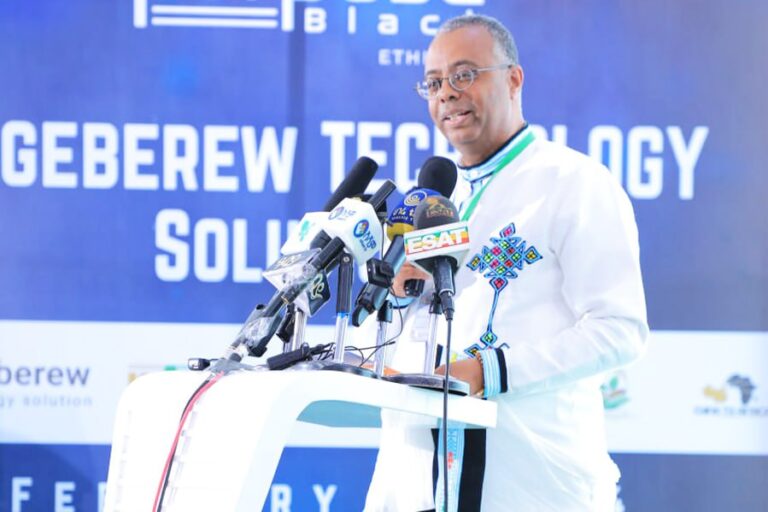
PurposeBlack Ethiopia has officially launched six digital technology products developed by Kegeberew Technology Solutions Enterprise. These products offer various solutions and services across different sectors.

One of the products, Kegeberew Agricultural Products Sourcing (KAPS), is an application that enables farmers to sell their agricultural products directly to potential buyers.

Another product, Kegeberew Consumer Credit Management (KCCM), is a website that provides credit services to both government and private service providers.

Kegeberew Learning Management System (KLMS) is a website that offers more than 77 skill enhancement training courses in various fields of education. It allows individuals to access and improve their skills through online learning, as well as provides a platform for knowledge-sharing among professionals in different fields.

Kegeberew Television Streaming is an application that allows users to access video and audio content from Kegeberew Television on their mobile phones, providing quick and convenient information.

Kegeberew Order and Delivery Tracking (KOT) is a system designed to ensure the proper delivery of orders placed through the farmer’s internet marketing platform. It tracks the movement of products from the warehouse to the customer, ensuring accurate and timely delivery.

Lastly, PurposeBlack has introduced a large-scale internet marketing option called China to Africa. This platform offers farmers the opportunity to market their products to the entire African market through the e-commerce capabilities of the internet marketing platform.

It is worth noting that PurposeBlack is actively working on a total of 24 digital technology products, with six of them already launched and operational.

25 million birr support to boost soybean production announced

0

The Ethiopian Pulses, Oilseeds, and Spices Processors Exporters Association (EPOSPEA) has revealed a project aimed at expanding the productivity and market chain of soybeans. The project, which will span one year, has received a financial support of 25 million birr from GIZ.

The primary objective of the project is to enhance the production volume and market chain by building the capacity of soybean producers and exporters. Sisay Asmare, Chairman of the Association’s Board, emphasized that GIZ’s financial assistance is directed towards promoting the export of onion, avocado, and soybean products, as well as stabilizing the domestic market. He further highlighted the association’s commitment to working on soybean production for the benefit of Ethiopia.

It is worth noting that soybeans play a significant role in the global production of cooking oil, accounting for approximately 60 percent of the total output. The implementation of this project aims to strengthen the capacity of the association and facilitate the utilization of the support provided to traders and farmers in the sector.

Ethiopia implements “Ground Station as a Service” Project, expanding satellite data reception capabilities

0

By our staff reporter

Ethiopia has recently announced the launch of its “Ground Station as a Service” project, leveraging the multi-satellite data receiving station it established three years ago. The ground station, located at the Entoto Observatory Research Center, has begun offering data reception services to organizations and countries in need of satellite data based on their usage requirements.

The station, operated by the Space Science and Geo-spatial Institute (SSGI), has configured 11 satellites to receive and process information, providing the desired cloud services. By converting the received satellite data into different formats, the station offers data processing capabilities and facilitates access to cloud services.

Abdisa Yilma, the Director General of the institute, expressed that the Ethiopian Space Science and Geospatial Institute has been diligently working on this project for over a year. The multi-satellite data reception station at Entoto has completed configuration works to receive mission data from 11 satellites, enabling data collection and uplink to the designated cloud service address. Consequently, the station is now fully operational and ready to provide data reception services.

This innovative “Ground Station as a Service” project brings significant benefits, particularly for organizations with limited budgets, small satellite operators, and research institutions. Instead of investing in their own data center infrastructure, these entities can access cost-effective data center services by paying only for the time slots they utilize. This approach allows them to access global satellite data coverage without incurring high capital costs.

Overall, the project is expected to foster substantial growth in the data reception sector, generating significant foreign exchange income. The addition of more satellites to the data reception station and various data analysis operations are anticipated to further enhance the service’s scalability and economic potential.