

The country’s external debt is continuing to lower in the second quarter of the fiscal year, similar to the first quarter. During the last two quarters, the net external debt resource flow recorded negatives.
According to the public sector debt statistical bulletin published by the Debt Management Directorate (DMD) at the Ministry of Finance, the strength of the dollar and out-performing of principal settlement against fresh disbursement are the reasons for the reduction of the country’s debt stock for the second quarter that ended in December 31, 2021.
It indicated that during the last two quarters, only three loan agreements have been signed with partners, one for a central government project and the other two for Ethiopian Airlines aircraft purchase, totaling USD 290.74 million.
The majority amount of the loan agreement was being borrowed by Ethiopian Airlines, which is USD 279.52 million, and the remaining USD 11.22 million by the central government.
As of December 31, 2021, the total public sector debt stock that included domestic debt was about USD 56.15 billion, compared to USD 55.6 billion as of June 30, 2021.
External debt makes up around 51.5 percent of overall government debt, with domestic debt accounting for the remaining 48.5 percent.
The central government owes almost USD 34.9 billion (62 percent) of the total public sector debt outstanding that includes domestic debt, while state owned enterprises (SOEs) owe close to USD 21.3 billion.
The DMD quarterly review bulletin stated that over the past year, the central government’s portion of total public debt stock has climbed by 5 percent, while SOEs’ share has declined by 4 percent, “this can be explained in part by zero non-concessional borrowing limit from external creditors, as well as SOE’s lower borrowing from domestic sources and less disbursement from already committed old SOEs external loans.”
As of December 31, 2021, total public sector external debt was USD 28.92 billion, compared to USD 29.49 billion as of June 30, 2021. Between the two periods, the stock of external debt has decreased.
The decrease in external total public debt is approximately USD 571.04 million, or by 2 percent, “one reason for this decrease in the stock of debt can be explained by USD exchange rate variation, which is a relatively stronger USD during December 2021 compared to June 2021, which resulted in reducing the debt stock in terms of USD, which is approximately USD 319.46 million.”
It added that another reason for the debt stock’s decline is that principal payments were higher than new disbursements, resulting in a negative net flow of USD 251.58 million.
The central government is responsible for 67 percent of the entire external debt, while SOEs with government guarantees and without government guarantees are responsible for 22 percent and 11 percent, respectively.
Over the last six months, July 1, 2021 – December 31, 2021, the total external public debt disbursement was USD 595.06 million, with about 52 percent going to central government projects from various creditors, the majority of which came from IDA, and the remaining 48 percent going to SOEs.
According to the DMD, in comparison to the previous four years, the total amount of external funding disbursed in the last one and a half years was significantly lower.
“One of the reasons for the decrease in disbursement is that SOEs have not borrowed in the last three years and are disbursing less and less for their older projects as they near completion and as a result their undisbursed balance decreases,” it added.
The total external public sector debt service (principal plus interest and charges) during the last six months was USD 1.1 billion.
Of the total debt service USD 846.63 million is principal and USD 259.8 million interests.
From the total debt service in the stated period the SOEs share took the biggest chunk by settling USD 856.53 million payments.
The DMD review indicated that during the last two quarters, the net external debt resource flows were negative, which was USD -251.58 million, implying that the amount of disbursement from external sources (inflow) is less than the total external principal payments to creditors (outflow), “and the net resource transfer, which is disbursement (inflow) minus principal payments minus interest payments, is USD -511.37 million.”
The half year debt review revealed that the Treasury bills (Tbills) has mushroomed more; while it has shown progress since the government put in place new approaches on the market.
In the stated period, net issuance of Tbills with various maturities was about 132.54 billion in the first two quarters of 2021/22 budget year, and the stock of Tbills as of December 31, 2021, was about 253.5 billion, “a 110 percent increase over the June 30, 2021 balance.”
It elaborated that in comparison to June 2021, 364-day Tbills accounted for the majority of the increase, followed by 182 days, while the participation of government and private owned commercial banks on the Tbills market showed an improvement.
Stock of external debt decreases
Transport Ministry targets higher logistics performance ranking
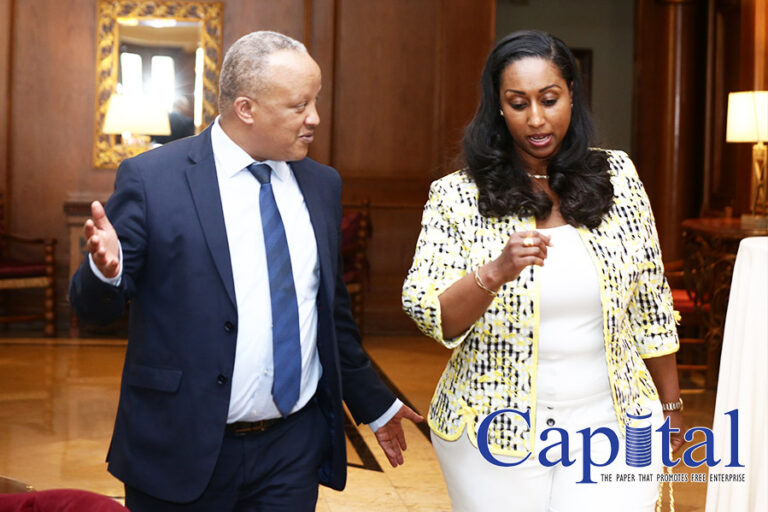
By its own self-assessment, the Ministry of Transport and Logistics (MoTL) projects that the logistics efficiency of Ethiopia will stand at 114th position in the logistics performance index with slight improvements.
On the first general assembly of Ethio Logistics Sectoral Association (ELSA) held on March 4 at Sheraton Addis, Dagmawit Moges, Minister of MoTL, said that despite the sector’s existing challenges, improvements have been recorded.
In the World Bank’s 2016 logistics performance index (LPI), where Ethiopia was last included, saw the country being ranked 126 out of 167 countries, with an average score of 2.38.
With a strategy that pushes for continuous improvement, Ethiopia in its ten year plan targets to become the 40th in rank in the international logistics performance index.
“As a result of what we have accomplished in the previous years, we are expecting ranking improvements,” said the Minister.
It is to be recalled that the Logistic Transformation Office which is regulated by MoTL disclosed that the country logistics sector has shown some improvements by citing its internal assessment.
LPI which is an interactive benchmarking tool was created to help countries identify the challenges and opportunities and thus gives scores from six key dimensions, such as: customs performance, infrastructure quality, ease of arranging shipments, logistics services quality, consignments tracking and tracing and timeliness of shipments.
The LPI, which is published every other year, saw Ethiopia missing from the rankings in the 2018 index and in 2020 the report was not published by the World Bank. However, this year Ethiopia is said to be included. “We expect changes in the upcoming publication,” said Dagmawit expressing her hope.
The government is working aggressively to change the bottleneck through different instruments, and it has applied policy changes, besides hardware developments.
The formation of institutions in the logistics sector in combination of the private sector representatives is part of the new initiatives.
ELSA, which was established about three years ago with the guideline of Ethiopian Maritime Authority (EMA) and 176 founding members under public private partnership joint mission, is part of the new interventions on the sector development.
ELSA that is already engaged on various activities to support the sector has designed a five year strategy that will be implemented until 2025.
At the general assembly, Elizabeth Getahun, Board Chairperson of ELSA, said that the association has been tirelessly working with the support of partners to strength ELSA since the organization is on its initial stage. As a result the association is conducting different activities with stakeholders.
Abenet Belay, Project Manager of ELSA, said that the association has designed five key strategy areas that will be done i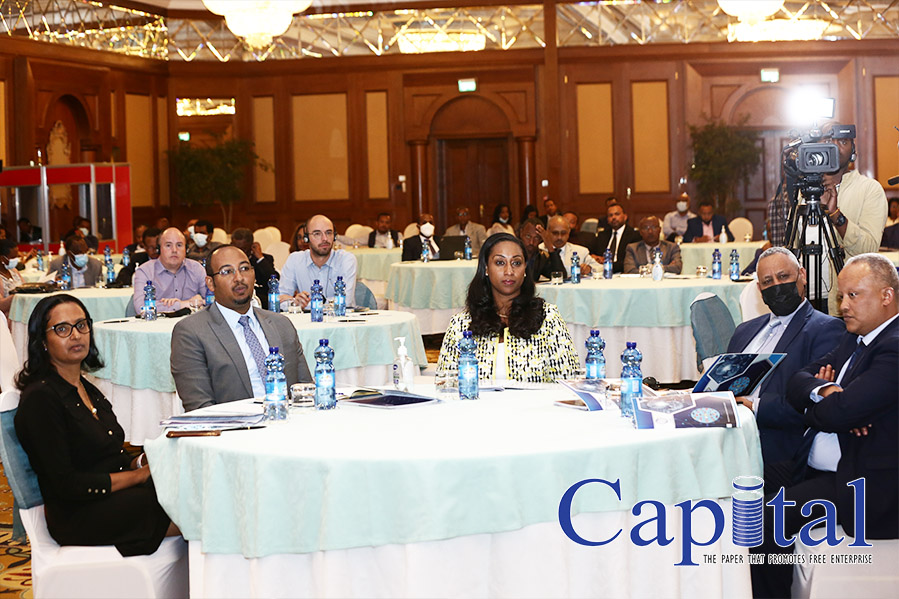 n the coming period. Advocacy and intervention of the sector, research documentation and information dissemination, institutional strengthening, partnership and networking, and making ELSA active in the National Logistics Strategy, are the pillars stated on the key strategies.
Abenet said that the association has contributed its part in different areas for the sector development including sharing its part for new policies and strategies of the government besides solving challenges.
At the general assembly, six new board members were elected, while three existing members have continued to serve in the board of directors.
The logistics guru and founding Director General of EMA, Mekonnen Abera, CEO of Ethiopian Shipping and Logistics Services Enterprise, Roba Megersa, Robel Tesfaye of Ethiopian Electronic Single Window, were included on the new board, while Elizabeth, Elias Geneti and Matiwos Ensermu are serving as members re-elected to continue for the coming three years.
Ethio-Djibouti logistics giants ink deals to launch ‘sea-air’ logistics
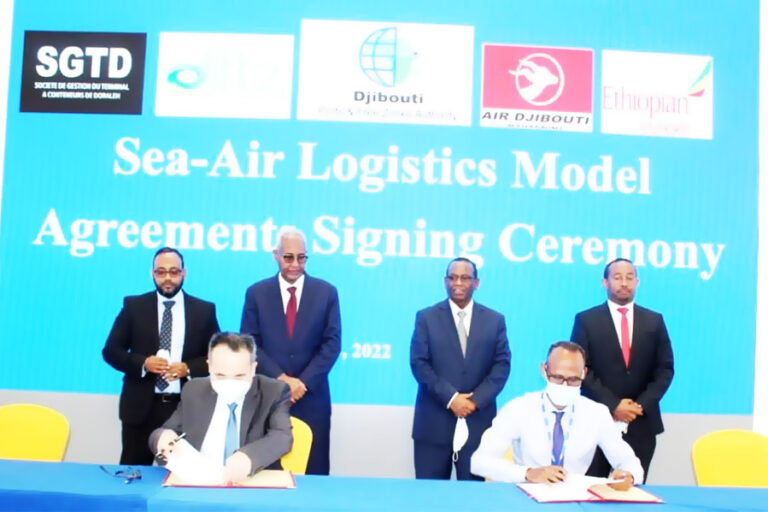
The four cemented their agreements on a ceremony held on Thursday March 3 in Djibouti to harness the multimodal operation, ‘sea-air’ logistics.
Djibouti Ports and Free Zones Authority (DPFZA) stated that the signing agreements will implement fully operational ‘sea-air’ logistics following various pilot operations. “This will include Djibouti as not only a business hub but also as a major actor in regional integration through an innovative multimodal transport system.”
During the ceremony International Djibouti Industrial Park Operation (IDIPO) which is the managing company of Djibouti International Free Trade Zone (DIFTZ), and SGTD signed on sea-air freight cooperation, while IDIPO, Ethiopian Airlines and Air Djibouti penned tripartite service level agreements. In addition, IDIPO and Ethiopian Airlines further inked on air freight service agreements.
Aboubaker Omar Hadi, Chairman of DPFZA, appreciated the four companies’ success during the trial period. He expressed that this achievement constitutes the ultimate step towards the implementation of a fully geared sea-air logistics model and should be noted as another milestone to bolster regional integration.
He reminded that over the past few years, Djibouti has built new infrastructures and upgraded the existing facilities to improve the connectivity whilst promoting a fully functioning multimodal system. “Today, we are witnessing the signing of a project that will complete the missing link in the multimodal transport system and will further consolidate Djibouti’s position as a hub,” remarked Aboubaker.
He added that sea-air logistics model is a game changer for the trade between Africa and the rest of the world in general, and Africa and Asia in particular. Djibouti’s geographical location gives her a key competitive advantage to become an efficient sea-air logistics center.
According to the Chairman, the advantage of the sea-air logistics is that it allows customers to manage their supply chains more cost-effectively and efficiently, offering a 50 percent faster service comparing to sea freight and 50 percent cheaper when compared to standard airfreight.
“For Ethiopia Airlines and Air Djibouti, this new approach has the potential to double the cargo volume and offers new solutions to the traders. As for DIFTZ, this service can work with the newly launched E-commerce platform Djimart.com, to meet customer’s evolving expectations, while for SGTD, this signifies more cargo flow,” he said.
“We are convinced that with our well performing infrastructures combined with the extensive networks of Ethiopian Airlines; this win-win cooperation will certainly unleash the economic potential of Africa,” he concluded his remark at the signing ceremony.
DIFTZ, SGTD, Djibouti and Ethiopian airlines which are the parties that signed the agreement bring a wealth of logistical expertise to the table. For DIFTZ whose role is as an operator in the sea air logistics has been able to attract customers through its innovative and competitive models. On the other end, Djibouti and Ethiopian airlines have been constant national flagship carriers which partner to connect Africa to the world and vice versa while SGTD is a former Doraleh Container Port.
“Today, our multimodal system is taken to higher lever with the launch of the sea-air logistics model, which is nearly unique in Africa,” Mohamed Aref, Head of Marketing Department of DPFZA, said.
“For almost four months now, we have been handling trial operations to create a smooth and well-coordinated chain. If today we are here to witness the signing of the agreement, it means that the parties are all well prepared for a larger rollout of the business,” he added.
The latest move that was on trial for months shall make Djibouti as a hub for air-sea logistics in the continent. “The signing of the agreements today will further consolidated the gains,” Mohamed Aref said.
Abel Alemu, Managing Director of Ethiopian Airlines Cargo and Logistics, Abdourahman Ali, CEO of Air Djibouti, Abdillahi Adaweh, CEO of SGTD, and Jeffrey Ho, CEO of DIFTZ inked on the agreement documents, as Mohammed Hassen, Deputy Head of Mission of the Embassy of Ethiopia to Djibouti, and DPFZA Chairman bore witness to the proceedings.
DESTRUCTIVE CLOSEDMINDEDNESS

Many conscious dwellers of our planet earnestly believe the ways of modern humans are doomed. Moreover, the belief that all round sustainability is achievable within the prevailing world order has become increasingly tenuous. Therefore, the burning question of our time is; can the various alternatives proposed and gradually coming to the fore, by those desirous of maintaining life and its support system, win the day? Obviously, new ideas that are capable of challenging the dominant and visibly destructive system won’t be welcomed by the status quo. Be that as it may, unless the global sheeple is willing to open up its mind to new ways of organizing societies, from the bottom up, the future of humanity might not be all that rosy!
Again, critical thinkers have no qualm categorizing the prevailing global economic order as very shortsighted. That it is inherently set and socially organized for permanent expansion, hence continuous wars and limitless exploitation of the natural world, is no more debatable. History is testimony to these repetitive blunders; after all, what is imperialism, or colonialism, if not a not-so veiled pretext for primitive/violent accumulation? We have to come to terms with our conscience and accept the fact that the current global system (which has been blooming since the early 1500s) cannot be sustained any longer. To reiterate the major reasons again; the natural limits of the planet are breached, in almost all categories. In addition, progressive enlightenment of the human condition has reached a stage where societies will no longer accept veiled slavery imposed on them by narrowly focused entrenched interests, always at the service of capital! Defying natural limits has already brought unexpected phenomenon. Climate change, in forms of intensified hurricanes/typhoons; temperature increase, etc. have become routine and threaten to get even worse. In light of such various warnings, the system’s only response is to continue, or even double down, on the usual dumb behaviors!
The good thing is, despite the massive and all-encompassing indoctrination of the world system, increased human awareness about all and sundry is on the rise. That is why certain enlightening mediums, leveraging modern informatics, are becoming difficult to access, compliment of the power that be (TPTB). The whole intensified surveillance of the global sheeple by nation states is part and parcel of the grand scheme to control and enslave the world’s population! The prevailing global institutions of orientations (read indoctrinations) are only eager to stamp out drones that will obediently serve the destructive world system without much hesitation. These ‘flocks of the mill’ are trained to avoid serious inquiries and abhor deep/original thinking. If these drones stray from the delineated path set by the masters, there will be consequences; like forfeiting lucrative jobs or even being ‘blacklisted’ all over the world. In this sense, the proverbial ‘useful idiots’ are lucky, since they are successfully immunized from critical inquiries and don’t have to bother with difficult issues of global importance!
Let us look at one example, amongst many, which the dominant system systemically propagates. The shallowly inculcated narrative, ‘war on terror’ is phrased in such a way as to thwart interrogation about the massive violence persistently perpetuated by the formally constituted powerful states of the global order. After all, what is terrorism, if not war itself! Terrorism is a violent activity, a kind of war, mostly carried out by those who do not have the means to wage formal massive wars. It then follows; ‘war on terror’ is nothing more than saying ‘war on war’ or ‘war on small wars’ to be more precise, since the main difference between the two is one of scale and legitimacy. And unlike those days of old, when ‘collective security’ was an integral part of international law, ‘wars of aggressions’ or illegitimate wars, (by states) are now a dime a dozen. At the end of the day, the real question that should be posed here is; ‘whose war are we supposed to rationalize and legitimize’? In these dying days of the modern world system, the deconstruction of all narratives disseminated by dominant interests should be the order of the day, per force!
We should not lose sight of the core strategy of the status quo, at least when it comes to valid critiques. It is either to stifle or completely discredit inquiries that will lead to societal transformation. For instance, the irrational economic supposition of infinite growth is not to be questioned. The associated financial system that is based on unadulterated fraud is also sacrosanct. ‘Fractional Reserve Banking’, which is the foundation of the debt based global financial system is, arguably, the worst (non-violent) crime of the millennium. This fraudulent activity still anchors all the means of destruction directed against nature as well as cohesive/harmonious collective human existence! Fraudulent systems piled on other fraudulent systems, etc., will ultimately collapse. For example, the current pension system as it exists within the OECD (the rich countries) is nothing more than a sham, a fairy tale. Nonetheless, it is almost taboo to talk about it. The already retired and those on their way to retirement are going to be in for some rude awakening. At the end of the day, either the states have to raise tax (don’t forget inflation is also a form of tax on the poor) or retirees have to settle for drastic cuts in their overall entitlements, (including monthly pensions) or both. Whatever the measures states will be forced to take, life in the OECD might not be as comfortable as it used to be!
