

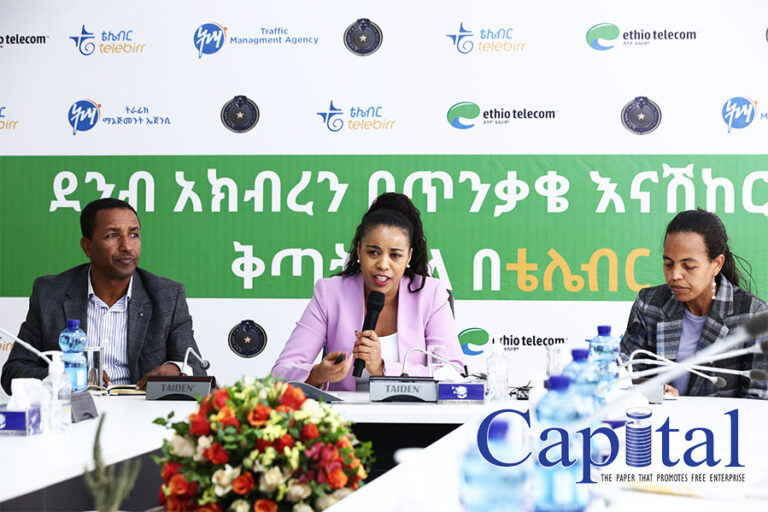
The country’s telecommunications giant, Ethio-telecom on Thursday March 03, 2022 implemented the drivers’ traffic penalty payment through telebirr under the theme “Respect the traffic rules while driving; if there is a breach, settle your penalty via telebirr.” The paperless traffic fines payment system was implemented through a memorandum of understanding with the Addis Ababa Traffic Management Agency, and Addis Ababa Police Commission.
The firm also announced that it gets USD 317.5k in transaction from International remittance which started November 20, 2021 via its mobile money telebirr.
The payment system is said to modernize and replace the age-old paper-based payment system of the Addis Ababa Traffic Management Agency and other concerned authorities.
In order to settle a traffic penalty payment via telebirr drivers are expected to inform the traffic police in advance their preference to settle the payment though telebirr before the police issue a receipt.
This service, which allows for the payment of traffic penalty through telebirr payment system, can replace the age-old paper-based payment system and save the drivers’ time and money as well as transform the stakeholders operation to digital technology system. In connection with this, more than 1,500 traffic police officers have been trained by Ethio telecom for the success of this technology-based service. Thus, the traffic police can issue traffic penalty payment by using a 6050 short number and by sending short message service (SMS).
Tele rolls out paperless traffic fines payment
Borena receives an oasis of hope amidst drought concern
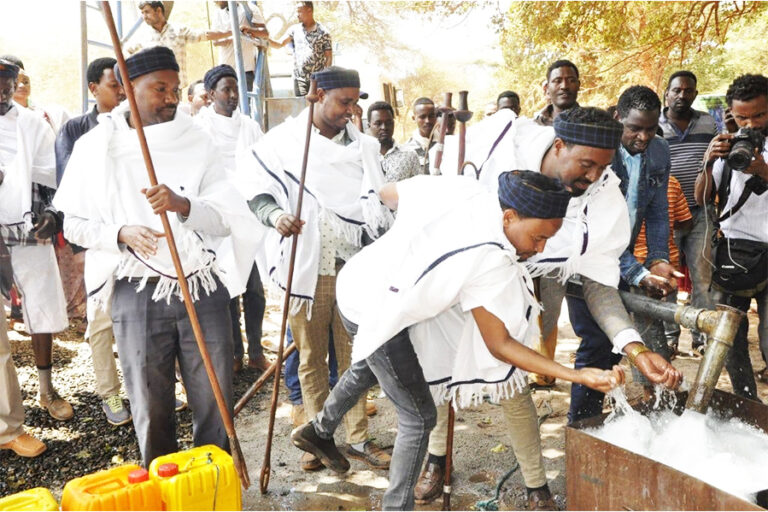
Climate change takes a toll on the greater part of southern Ethiopia rendering parts of the Somali and Oromia region to be affected by severe drought.
The government, some NGOs, and the private sector actors in this regard have come together in different settings with emergency support to try to mitigate the problem that mainly affects the pastoralist communities.
On Saturday, February 27 ‘Top Beverage and Trading Industries’ have inaugurated a water well at the drought-affected zone of Borena, Oromia region.
The well that cost five million birr was commissioned to support the pastoralist community in Borbor kebele of Das wereda, which is 900 km south of Addis Ababa, providing drink to both the community and livestock.
As Jarso Boru, Head of Borena zone explains, for the past two years the area did not receive regular rain which has significantly affected the community. He appreciated the concerted support from the government, NGOs, and private sector for mitigating the problem through various initiatives and projects in the zone that has about 6.5 million cattle resources.
Shimeles Ajema, Deputy Managing Director of Top, said that the constructed well has a capacity to produce 10 liters of water per second which makes it better when compared with other similar wells in the area.
“If other companies chip in and join hands in such initiatives, the problems that plague this region shall be sustainably averted,” suggested Shimeles encouraging other companies in the private sector to follow suit.
Nevertheless, the drought is expected to continue since the upcoming seasonal rain seems highly unlikely to fall as per previous forecasts. Prime Minister Abiy Ahmed on his late last week call indicated that further collaboration and support is crucial to change the drought and hunger rhetoric that affects Ethiopia for decades. “Drought has far long being the biggest threat to Ethiopia as opposed to the enemies that have tried to threaten Ethiopia,” remarked the Prime Minister.
He directly called on the financial firms to consider giving the much-needed financial support to boost the agriculture industry so as to change the problem from the ground up.
Ethio Health Exhibition and Congress
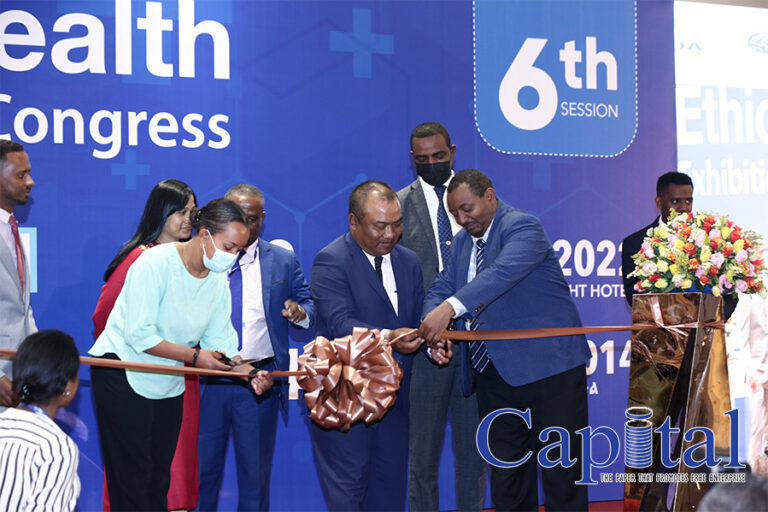
The 6th Ethio Health Exhibition and Congress was held from March 3 to 5, 2022 at the Skylight Hotel, Addis Ababa.
Participants from 8 countries; Bangladesh, India, Jordan, Sudan, South Africa, Thailand, Turkey, United Arab Emirates, and the United States of America participated on the exhibition which attracted official country pavilions from India and Bangladesh for the first time in the event history. Organized by Prana events, the exhibition cultivated interactive discussions on business with more than four thousand trade and healthcare professionals from all over Ethiopia creating possible market linkages whilst drawing technology transfer.
The Indian Pavilion was organized by The Federation of India Chambers of Commerce with the support of the Ministry of Commerce and Industry while the Bangladesh delegation was led by the Minister of Commerce, accompanied by senior officials from the Export Promotion Bureau, Federation of Bangladesh Chamber of Commerce, and Bangladesh Association for Pharmaceutical Industries.
This prestigious exhibition and congress was meticulously planned to provide the best possible chance for manufacturers, suppliers, service providers, educational facilities, and research institutions to promote their products and services for the valuable stakeholders operating in the field. The congress aimed at assisting the Healthcare System with practical solutions to meet the ever-increasing demand being placed on clinical services and hospital resources due to the huge economic development in the country. It covered an extensive program of conferences and panel discussions mainly focused on: Clinical Excellence, Patient Safety, Imaging and Diagnostics, Primary Healthcare and Pharmaceuticals supplemented by topics such as Healthcare Leadership and Value Health Care.
Call for ethics intensify in the development of artificial intelligence applications at MWC
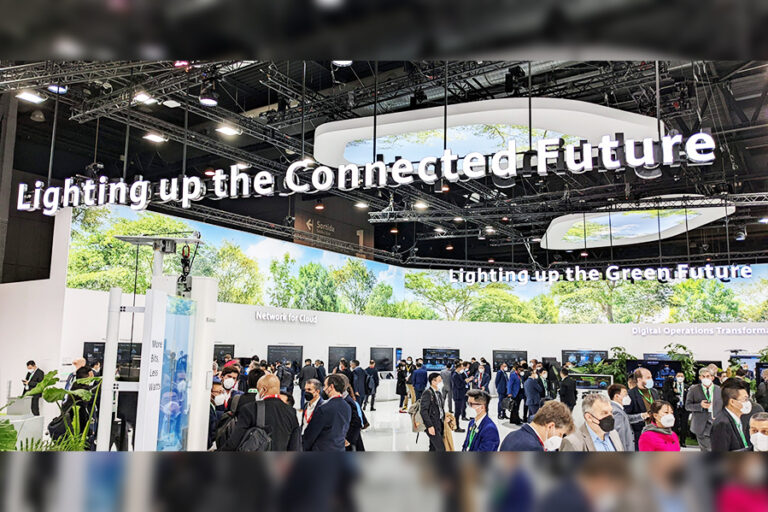
The Catalan Data Protection Authority (APDCAT) has called this week, as part of the celebration of the Four Years From Now (4YFN) event, at the Mobile World Congress (MWC), to promote an ethical look at the development of artificial intelligence (AI) applications, in order to prevent this increasingly present technology from having negative consequences for people.
In this sense, the APDCAT has organized the session ‘Artificial Intelligence. An Ethical Overview’, at the MWC which was held in Barcelona from February 28 to March 3, to analyze the challenges of implementing AI technologies, and highlight some of the dangers this technology can pose: discrimination, inappropriate use of facial recognition, and unethical practices in e-commerce, among others.
The director of the APDCAT, Meritxell Borràs i Solé, opened the session, which included the intervention of Ricardo Baeza, Director of Research at the Institute of Experiential AI at Northeastern University, Silicon Valley, and a member of the DATA Lab at Khoury College of Computer Sciences, as well as other experts in the field.
The session served to address the state of this technology, learn about the relevant regulations, cultural differences, cognitive biases, and also to discuss what society can do to meet these challenges in the near future.
During his speech, Borràs spoke about the opportunities and also the risks involved in artificial intelligence systems and applications, which have become popular in society in the last decade. For Borràs, “we cannot appreciate its impact or the risks it hides, because AI transforms the world in an unprecedented way”. The goal, among other things, is to avoid the biases that can arise with the design of algorithms, which can influence or discriminate against us, the indiscriminate use of mass video surveillance with facial recognition and the control of social behavior.
The director of APDCAT added that from a technical point of view, the available technology needs to be improved in terms of transparency and reliability, and also pointed out the need to have legal mechanisms to guarantee citizens the protection of their rights.
The most urgent, however, is to “maintain a critical view of AI”, which questions the operation of systems to find those elements that have a negative impact on people that are not obvious from a technical point of view. “Therefore, ethics must be incorporated into AI, and in the process we must be demanding, beyond proposing ethical codes”, concluded Borràs.
HUAWEI AppTouch Debuts at MWC 2022
HUAWEI AppTouch has been unveiled to global app developers at the Mobile World Congress 2022 held in Barcelona this week. The platform helps developers distribute apps and games to a global user base and significantly grow their revenue by pooling resources from global mobile carriers and automotive enterprises. AppTouch has partnered with over 60 carriers serving 40+ countries and regions across Europe, the Middle East and Africa, Latin America, and the Asia Pacific region. As of December 2021, AppTouch had helped developers reach more than 400 million users around the world.
Full-Stack Data Center
Huawei also held its Industrial Digital Transformation Summit during Mobile World Congress (MWC) Barcelona 2022 in Spain. At the summit, Huawei unveiled brand-new solutions for data center and intelligent campus scenarios. Campuses have high requirements for data center storage, computing power, and energy efficiency, and face challenges in managing their vast assets. Together with industry customers, opinion leaders, and global partners, Huawei discussed industry trends, introduced latest practices in digital transformation, and shared the vision of an innovative future where digital technology, business value, and eco-friendly development come together.
During his opening speech, Li Peng, President of Huawei West European Region, emphasized that digital transformation and environmental protection are key topics in the future. Huawei provides innovative Information and Communications Technology (ICT) and a full portfolio of products to help global customers build robust ICT infrastructure and enable industrial digital transformation. In fact, over the last few decades, Huawei has been focusing on reducing energy consumption and carbon emission through continuous product and solution innovation.
Intelligent Power Transmission Line Inspection Solution
At the Mobile World Congress 2022, during the industrial digital transformation summit, Huawei again unveiled the Intelligent Power Transmission Line Inspection Solution 2.0. Through two sub-solutions – channel visualization and tower foundation safety – it addresses some of the key issues in manual line inspection and tower foundation perimeter safety. The solution is slated to help electric power enterprises detect each risk and protect each line.
Traditional manual inspection of power transmission lines faces a plethora of issues, including safety, management, efficiency, response, real-time performance, and operational risks. To address these, Huawei developed the Intelligent Power Transmission Line Inspection Solution 1.0, which integrates intelligent vision, site energy, and microwave backhaul. It ensures reliable data backhaul and visualizes the status of power transmission lines in environments where signals are missing, power supply is unavailable, and imaging is difficult. The upgraded version 2.0 adds several key functions. This includes radar-video linkage that constantly monitors the conditions around the tower foundation, securing the power grid.
The tower foundation is the skeleton that supports the stable and reliable operation of power transmission lines. However, it faces many artificial and natural threats. At the same time, manual inspection is dangerous and performed in harsh environments.
