

Deputy Mayor Adanech Abeibe and Addis Ababa Trade Bureau Director Abdulfeta Yesuf were engaged in consultative discussions with the business community on the reasons for the high cost of living in the city. Hundreds of businesses’ representatives of the business community participated on the meeting held on August 21, 2021 at Elilly International Hotel.
The Addis Ababa City Administration Trade Bureau said that it is working to increase supply in goods especially on agricultural production. As Abdulfeta said there has not been massive observed shortages of supply in the city while greedy traders are trying to destabilize the market and reduce the cost of living by creating economic fraud by hoarding goods. However to reduce inflation and shortage of goods in the market the bureau expressed that it is thoroughly working on this.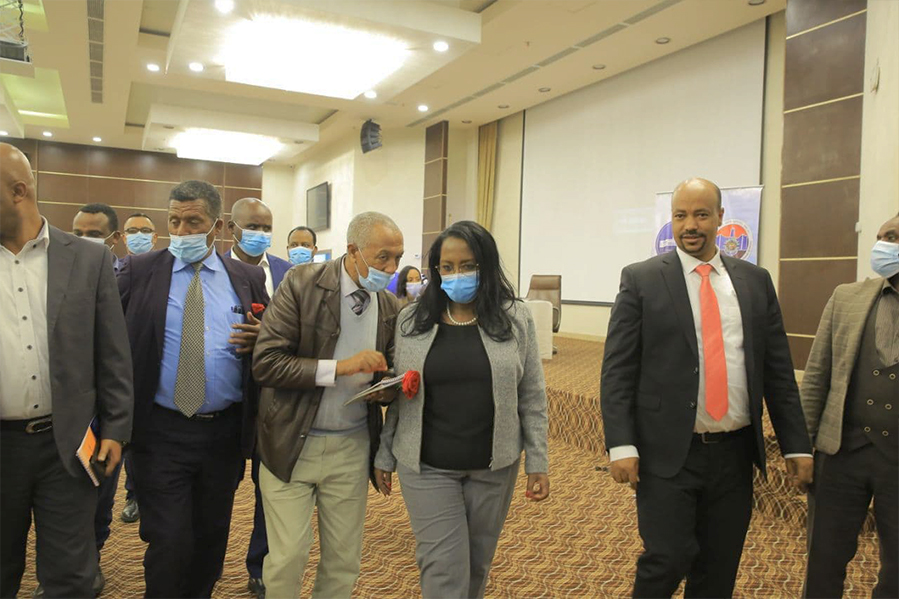
Further raising certain issues regarding the price hike and inflation, traders have asked the trade bureau to set a price book with defined limit of price points. To that regard, the trade bureau has said it will consider setting a maximum price to regulate the market in a way that fosters competition and protects the interest of consumers.
The deputy mayor called on the business community to help in taking top control by handing over greedy traders who in an effort to take advantage of the current national situation create a shortage of products in the market which leads to increase in prices which ultimately leads to engagements in illegal activities.
In recent time, the price hike has been seen on food items, manufacture items and house hold goods. For instance, teff, wheat and rice have been showing a 10percent jump in the capital in under a month. However, the traders suggested that due to certain involvements that the city administrations have made in the last few months, the prices have been showing a slight decrease.
Prices for table salt jumped up to 20 birr a kilogram last week, around a third higher than the going rate earlier this month as the city administration suspend 3 distributers. Salt traders blame the price surge on the interruption of transport services as war spills over into Afar Regional State, which is the source of almost all of the country’s salt, while government officials claim it is the result of market speculation and misinformation.
The bureau is taking different measurement to control price hikers, said Abdulfeta adding that until now 80 traders have been taken to court.
As the Mayor said, the city administration has launched a task force which will be set up to monitor and control the market.
Solving Addis’ escalating costs
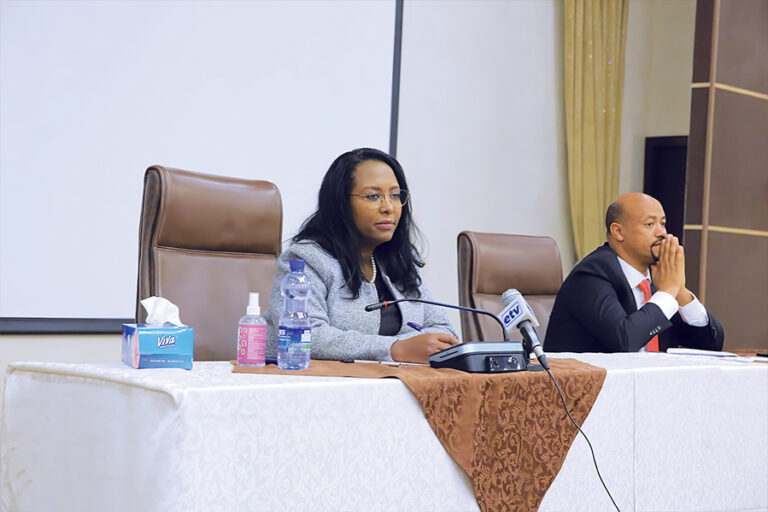
Gov’t decides to consider convertibility guarantee for PPP
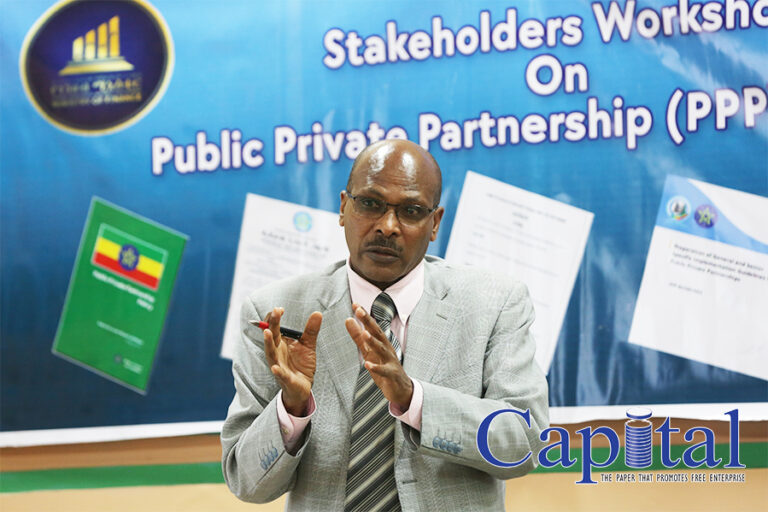
In a major policy shift the government now decides to provide a convertibility guarantee for public private partnership (PPP) projects.
The decision that is taken by the government has been considered as a big deal for those who are interested to be part of huge projects under PPP.
After massive study and legal document development through Ministry of Finance (MoF), the government enacted the PPP 1076/2018 proclamation that makes it formalized for private sector involvement through public projects for the benefit of both sides.
The February 2018 proclamation allows establishing a favorable and binding legislative framework that promotes and facilitates the implementation of privately financed infrastructure projects by enhancing transparency, fairness and long terms suitability.
Since then the PPP Director General (PPP-DG) was also established under MoF to harmonize the operation between contracting authority from the public side and private party.
PPP-DG that is looked after by the board combined by directors; seven from public and two from the private sector has also a responsibility to sort projects, mostly mega projects, that shall be included under PPP or not as per the proposal of contracting authority that may include state owned enterprises or public offices.

Under the PPP; efficiency on project handling, innovation, and knowledge transfer and using as alternative financing to reduce government project financing has been stated as the pillars.
As per the initial stage the government has designed the PPP to be financed through a scheme that has never been backed by the government guarantee.
It was recalled that the first PPP bid for Scaling Solar schemes at Gad and Dicheto had been opened in September 2019. Then the first PPP solar energy project had been awarded to the Saudi based Acwa Power, which offered the lowest independent power purchase (IPP) tariff compared with similar projects on the continent and one of the lowest globally.
As per its financial offer the company gave USD 0.252/kWh for the Gad scheme in the Somali region and USD 0.0598/kWh on the Dicheto scheme in the Afar region.
However, as per the bid requirement the company had also promised that it would come with the finance from Chinese sources without the government guarantee, since access to foreign currency in Ethiopia is not easy.
Tilahun Tadesse, PPP-DC Secretariat, said that project that was awarded to Acwa has delayed up to now due to different reasons but mainly because of the impact of COVID 19.
After the COVID 19 impact, the financiers who promised to finance the 125 MW each solar projects had come up with changes on its operation and stated that it has paused some operations because of the pandemic impact. The 250 MW power project is expected to consume USD 250 million.
Due to that the Saudi company was forced to look for other financing sources, while most of the interested financers have set convertibility guarantee from the government as a precondition.
However, based on National Bank of Ethiopia (NBE) foreign currency guideline it has stated that the government would not give convertibility guarantee and based on the country law there is not convertibility guarantee for the private sector investment.
Tilahun said that most of companies that are interested to engage on PPP highly insist that the government gives them the guarantee to realize the projects, “we have assessed different alternatives to solve the concerns of companies or financiers to come up with a way out for their demands. We are now considered that we have to come up with some degree of flexibility on the up coming project.”
“For instance currently 6 solar projects are on bidding process under PPP and most of interested bidders are requesting to get convertibility guarantee,” he added.
As per the assessment to solve the challenges three optional areas have been evaluated; saving some amount of foreign currency that Ethiopian Electric Power generates from power export in order to use it for services and other payments, to establish a revolving fund under a pool, and the third option being for any public projects to give guarantee from the government (MoF).
“These projects are renewable power projects. Whoever the government of private sector develops these projects have their end goal in generating power due to that guarantee may be considered on it for the private sector,” he explains, adding, “by itself generating energy is a means of earning foreign currency due to that the only thing we have to be is cautious and to use the crucial alternatives to tap the needed development.”
As per the evaluation of PPP-DG, the government shall consider to give convertibility guarantee and the case has been evaluated in depth up to the senior level at the Office of the Prime Minister.
Tilahun told Capital that the government has considered that in order to operationalize the PPP some sort of flexibility for few periods should be required.
MoF, which is responsible to give guarantees, may select projects that would get guarantee.
According to Tilahun, the Scaling Solar schemes would be the first project to benefit the government first policy shift that has come to effect about two weeks ago.
Acwa is expected to come up with financiers from South Africa and Europe, while Tilahun said that they have not disclosed it. “We are waiting for them,” he remarked.
The company might manage the project for twenty years with an optional five year extension.
The financial close that was postponed for more than two times mainly because of the pandemic would be ended early October. 23 projects have been identified under PPP from over 100 proposals, while from the selected project some shall not be executed under PPP as per the recommendation that came from detailed studies. Roads, energy, housing, and health are included on the selected projects.
Except in some special cases, the PPP project threshold is USD 50 million and above.
As per the government’s projection, 25 percent of all projects will be covered by PPP.
FAG forges alliances to recover illegal assets
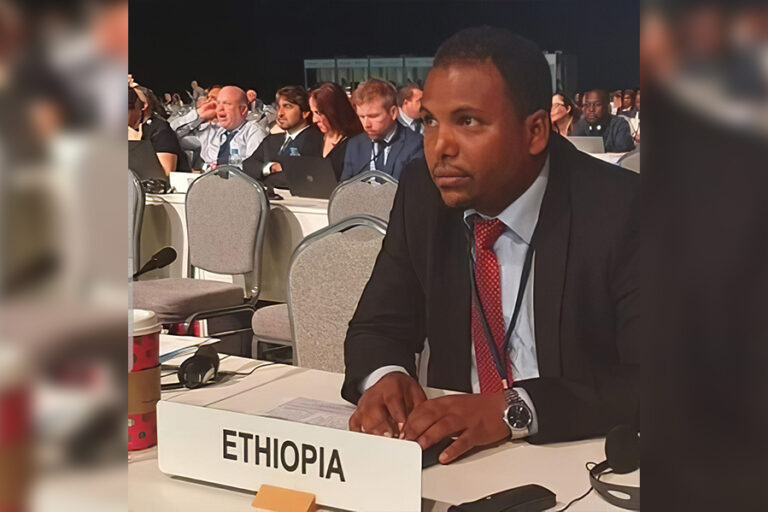
The Federal Attorney General (FAG) announces that it is working with different countries for mutual legal assistance (MLA) to repatriate illicit asset of the country.
FAG has also repossessed close to 2.2 billion birr worth of asset to the public. Additional 1.4 billion birr worth of asset is under investigation or in different stages to be restored to the public.
Alemante Agidew, Director General of Asset Recovery Directorate General said that FAG is working with countries and international organization to repossess illegally smuggled property of the country.
The FAG report that was issued on Friday stated that it has formed a new directorate to look into the cross border organized crimes against the country and its economic security.
Alemante told Capital that under MLA Ethiopia is working with various countries and international organization, “it includes the request for joint investigation and cooperation.”
He said that besides that capacity building is part of one of the major moves to identify and repossess Ethiopia’s assets.
“Under Stolen Asset Recovery (StAR) Initiative that was formed by the World Bank and UNODC capacity building is provided for the Directorate General Asset investigators and asset recovery prosecutors,” Alemante explained.
He said that the StAR capacity building is very intensive training that is gone parallel with MLA to identify and reposes the country properties that illegal fled from the country.
“Various cooperation is taken from global partners to identify illegal acts,” the recently formed division Director General explained.
“Formal and informal approaches are the schemes for MLA. The formal one is information sharing platforms with mutual institutions, agencies and individuals in foreign countries. While the informal approach is taking the diplomatic channel that we are using both schemes for MLA,” he elaborated.
It said that in the past budget year it has been engaged in massive investigation of fraudulent assets and criminals and has been able to repossess huge amounts of illegally generated assets to the government.
Alemante said that recovery and repositioning of fraudulent asset, which is public property, is a crucial part besides penalizing illegal actors.
He said that in the 2020/21 budget year that ended early July, 2.16 billion birr worth of fraudulent assets were repositioned to the public and the directorate in different stages of clearing to which led to recovery of close to 1.4 billion birr worth fraud assets.
At the same time, 5.8 billion birr worth of assets that was suspected on illegal accumulation has been frozen by the courts.
He said that different amount of money, several buildings and other properties have been transferred to the third party to be administered on the aim to prevent possible crimes by using these resources.
Ethio-Telecom announces competitive strategic plan
Ethio telecom plans to generate about 70 billion Birr income in the newly started budget year 2021/22, yet the number could decrease to 66.2 billion birr if certain sensitive issues including the northern region crises are not solved in a short period of time. Moreover, if the telecom service interruption continues due to the security issues, this could make Ethio telecom lose up to 5.1 billion birr annual in revenue.
Briefing the media on August 19, 2021, Ethio telecom CEO Firehiwot Tamiru said that new technologies and additional features will be implemented to enhance customer experience, quality and accessibility of services to achieve the set strategic plan.
“By expanding its local and international telecom service packages, Ethio telecom will work to intensively meet its plan by strengthening telecom infrastructure, service quality, flexibility and accessibility,” said the CEO. Through the last three years with regards to the implementation of its three year BRIDGE growth strategy, Ethio telecom has commenced to realize its aspiration to become a preferred telecom operator among customers and partners.
Ethio telecom has also planned to increase its total subscribers by 14% to 64 million customers. A further breakdown of their target includes: Mobile Voice subscribers by 13% to 61.37 M, Data and Internet users by 16.2% to 28.5M, Fixed broadband subscribers by 48% to 554K. This is expected to bring telecom’s penetration to 61%.
By engaging in new business streams and shifting revenue source from traditional to value-added services and by offering more than 100 new and revamped local and international products & services, Ethio Telecom targets to generate 70 billion birr in revenue in the 2021/22 budget year. The target is 24 percent greater than the revenue Ethio telecom had generated in 2020/21 budget year which was 56.5 billion. It also targets to generate 178 million dollars in foreign currency which is 11.6 million dollars or 7 percent greater than the foreign currency generated in the 2020/21 budget year, which was 166.5 million USD.
In particular, Ethio-Telecom has been working hard to become a competent and preferred telecom service provider in the fast and dynamic telecom market to meet the growing demand for telecom services. By building a people oriented company with a competitive strategy, Ethio telecom will work to increase its capacity in the sector and will have a capacity to handle 3.8 million new customers. Moreover, 984 sites will be beneficiaries of 4G network while 490 new mobile stations will be built, with further 2500 2G sites being upgraded to 3G in the process.
“On the other hand, infrastructure sharing, interconnections, wholesale roaming and collocations will make up the foregone revenue due to competition. Conflicts in some parts of the country, telecom fraud, inflation and gaps in foreign currency are the main challenges the company faces” highlighted the CEO.
With regards to the Northern region crisis, the telecommunication firm hopes that the issue will be resolved within a short period of time. In case of persistence, the targeted subscribers and revenue will be affected and this has been taken into account in the strategy.
Also infrastructure vandalism as earlier stated is one of the biggest challenges, and as the CEO explained even if Ethio telecom has started to talk with the new operators on infrastructure, unless all the stakeholders make major interventions to minimize infrastructure vandalism, Ethio telecom will not be obliged to share its infrastructure since it will cost the firm the fulfillment of its agreement to provide 99.99 percent availability on infrastructure.
The CEO stated that about 71 new 4G LTE advanced network infrastructures would be introduced to improve network availability as the data traffic growth and demand from customers for the 4G/LTE have been increasing.
In the budget year, the company will work to prioritize digitalization and simplification on its services whilst also empowering customers to use Ethio Telecom as the first choice. Furthermore the telecommunication’s firm aims to enhance its after sales services loyalty program in accordance with its three-year growth plan.
Regarding its loan repayment, “Finance and loan repayment is vital for the success of any business, to this end, in the last three years 936.2 million dollar or 32.47 billion birr has been repaid,” said the CEO. The Total Issued Promissory Notes (NGN + TEP) accounted for 2.34 billion USD. Of this, USD 1.56 billion accounted for the total paid loan which was 67% of the total while the remainder of 781 million USD was the remaining amount which is to be settled until 2029.
