

The National Bank of Ethiopia’s (NBE) short order to suspend fresh loan approval and disbursement with selected type of collaterals is received with different views from the financial sector.
The text message sent by Frezer Ayalew, Banking Supervision Director of NBE, on Wednesday August 11 for financial firm executives ordered banks to suspend releasing any fresh loan loans for clients who use real estates and similar properties as collateral.
Bank executives that Capital spoke to about the case stated that it would be difficult to comment on the latest measure since there are there is no officially written circular from the regulatory body.
However, they underlined that the decision might be triggered to correct some economic mischievous that directly and indirectly benefit the banking industry and the country in general.
Some of bank leaders also said that despite there being no given timeframe for how long the decision will stay it may affect their activity.
NBE ordered banks to suspended loan provision for clients who use fixed asset as collateral.
According to the sector expert, the service on non fixed asset collaterals like sells contract that exporters mainly using are not prohibited.
“The behavior of dollarization in the economy is observed, the parallel market sudden spike and related issues are questionable that should have answers,” experts in the banking industry explain, adding, “The parallel market all of a sudden picked. Individuals are selling their properties and converted the birr to foreign currency to hoard it or smuggle it to abroad.”
One of the bank executive, who demands anonymity, explained that the major source of money for property sales and purchase is a loan from banks. “It may seem that the bank expands the loan provision that would push its profitability but actually harms the banks,” he explained.
One middle level bank president agreed with the idea that one of the long established bank leader said.
He told Capital that banks may expand their loan but he argued that the money that provided for clients should be transacted in the economy.
“If the loans are spent to buy fixed asset and those who benefited from the sales draw the money from the banking system and make idle by converting to foreign currency at illegal market or smuggled to abroad is staking the market and the economy. It is directly affecting the banking system and the economy,” he elaborated the possible challenges that may come to banks.
He added that in this circumstance rather than waiting directions from the regulatory body banks by themselves have to sense it and keep their business from harm.
Experts said that the rash property sales that may support by financing from banks may also create unnecessary bubble.
“In this condition the property price shall create unhealthy price spike but when situation calm down, it would not express the actual market rate,” they say, explaining that, “when banks are looking to dispose the loan they may be covered by the collaterals.”
They added that the current condition and the decision of the central banks have to be seen in different directions rather than focusing only on the prohibition.
They said that the parallel market’s unusual increment also brings several effects on the general market and may harm the majority of the pubic since traders shall increase price on basic goods as well as hoard them.
“If you know the real estate market is among the reason for the parallel market spike you have to take measures like what NBE has taken,” one of banks presidents said.
Executives said that they are unable to explain the impact at this stage. While they added that normally this agriculture season is a slack period in the financial sector.
In the first three quarter of the 2020/21 fiscal year, the disbursement of fresh loans (including CBE bonds) from the banking system was 123. 6 billion birr, while on the stated period banks collected loans (including corporate bonds) was 118.2 billion birr.
The private banks average share was 65.7 percent and 63.6 percent for disbursed loans and collection in the stated period respectively.
Most of banks that Capital approached expressed that they are now free from liquidity pressure.
Capital’s effort to get further information from Frezer was unfruitful.
Banks back NBE’s decision

Tackling the critical shortage of milk supply in Ethiopia

The Ministry of Agriculture has planned to cut all kinds of imported milk and milk products in the coming five years as the ministry has started a new kind of national milk production development program.
The program under the Ministry is funded by the World Bank to milk production in Ethiopia, the World Bank has financed 4.2 billion birr in loan to begin artificial insemination and improve dairy productivity through cross-breeding.
The ministry is importing 10 million Birr worth of frozen bovine semen from Cogent Breeding Limited, a company based in the United Kingdom (UK). The imported semen will be sexed, a procedure used to produce a specific gender of offspring.
The project will implement for the coming three years at the government level and will eventually supply conventional bovine semen straws to farmers and private industries with a subsidized price to boost milk production.
“The imports of semen are part of a project the authorities in the livestock sector are gearing up to boost milk production through artificial insemination,” said Omur Hassen, minister of agriculture, stating that currently the ministry is working to improve cattle from Horo, Borana, Fogera,and Begait through selection. To begin the implementation of the project, the ministry has bought 200 heads of indigenous Borena cattle with 170 million birr, which are quarantined inside the compound of Holeta agricultural research institute. “After one year this will be used as seed bank,” explained the minister.
Artificial insemination (AI) has been defined as a process by which sperm is collected from the male, processed, stored, and artificially introduced into the female reproductive tract for the purpose of conception. The first successful AI was performed in Italy in 1780 and over 100 years later, in 1890, it was used for horse breeding.
Currently, the milk yield stands at 1.5 liters a day and in the coming five years the ministry is planning to increase production of milk to 12 liters per cow and stop all kinds of import production of milk. The Livestock & Fisheries Sector Development Project (LFSDP) under the Ministry has been tasked to orchestrate the artificial insemination project, which officials expect would boost the milk yield of cows to a staggering 18lt a day.
“When we administer the imported semen to our cows as a pilot project, which are already disease-resistant, they will be able to give more milk, which would, in turn, boost productivity in the dairy sector,” said Thomas Chernet (PhD), project coordinator.
“The new types of the cattle will be disease resistant and more productive, each cross bread cow will give 18 litters of milk per day,” said Fikru Regassa /PhD/ State Minister of Agriculture.
The diary sector has registered significant growth through the last few years; yet there is critical shortage of milk supply in Ethiopia remains a challenge. At the current production rate there is an annual shortage of about 15 billion liters. At a country level in Ethiopia annually 22 billion liters of milk is required for self-sufficiency. However, currently the country has 7.3 billion liters of milk production annually from about 15 million milking cows.
The ministry has planned to enrich the production capacity to 10.2 billion liters in ten years, which translates to 39 liters of milk consumption per capital.
According to the data from ministry of agriculture, the country has paid about 48.6 million dollars to import milk from 2013-2017. Currently, the average milk yield in Ethiopia is 1.5 liters per day.
According to the central statics agency, there are 70 million cattle in Ethiopia. It has been 73 years since cross breeding started in Ethiopia, where modern diary started in 1947. Still now cross breeding is done in research institutes, private companies, and small holder farmers. As the Ministry of Agriculture stated, only 2 percent of milking cows have improved through the cross breeding measures.
MoA finalizes plan to provide land for oilseed cultivation

Ministry of Agriculture has completed preparing its plan which will be used to propose cultivation land for edible oil producer industries, Capital has learnt.
Though the local edible manufacturing factories have production capacity to fully meet the demand of the country, Ethiopia is forced to import the product because of raw material shortage. On a meeting held on June 28, 2021 with the edible oil producers and the two ministries: that is, Ministry of Trade and Industry and Ministry of Agriculture showed that the ministers had said that local production of oilseeds cannot meet raw materials demand for the local food processing industry, and this is stated as one of the challenges in the local production of edible oils. The Ministry of Trade and Industry and the Ministry of Agriculture have also promised to give land within one month to oil producers to cultivate oilseeds in collaboration with regional governments. The ministries plan to do so before the rainy season ends.
As Omar Hassan, minister of agriculture tells Capital, the two ministries have completed preparing their plan, “as we have said on the meeting to propose the land to the industries, the two ministries have finalized their proposals, whereas we are waiting to have meeting with the industries.”
The two ministries together are focusing to boost oil seeds production and create strong linkage between the agriculture and the manufacturing sector to end spending of hard currencies for importing processed agri-products.
As Omar said the plan will indicate where cultivation lands are found near the industries and after holding talk with the industries, they will avail the land.
The total number of active edible factories in Ethiopia has doubled in the past few years as joint ventures between government and private investors undergo to meet the demand over the past three years to substitute the importation of edible oil with domestic production. According to the Ministry of Trade, there are 232 oil industries in the country, 26 big industries and 206 medium and small industries which is still in vain. Together the industries have capacity to produce 1.25 billion liters of oil annually where the national consumption is 906 million metric ton annually, however as a result of shortage of input most of the industries are working under their capacity can’t meet the demand. Meanwhile only 40 percent of the total demand is currently covered by local edible product.
Some are under construction, when all of these edible oil factories become operational in a few years, the country is likely to substitute cooking oil imports more and more with local production and in the long-term, it should drive increased production of oilseeds locally.
“The government is assisting farmers in planting large pulse and oilseed plants on suitable land to reduce edible oil imports,” said Umer Hussien, Minister of Agriculture, adding that, “The country has huge capacity on producing oilseeds, there are huge industries but still there is huge oil shortage problem in the country, thus it requires an integrated work of all stakeholders.”
Oilseed production covers only 2.7 percent of the total production which is 6.61 percent of cultivated land from the total cultivated lands. Similarly, both new and old factories are facing challenges with input material.
The first mortgage financial firm to start operation soon
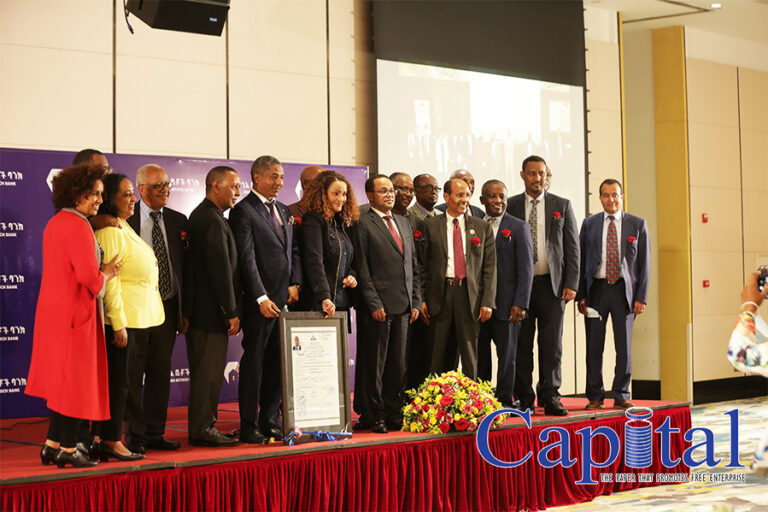
Goh Betoch Bank SC, the extraordinary and first mortgage financial firm, sees daybreak to open its doors starting from the Ethiopian New Year.
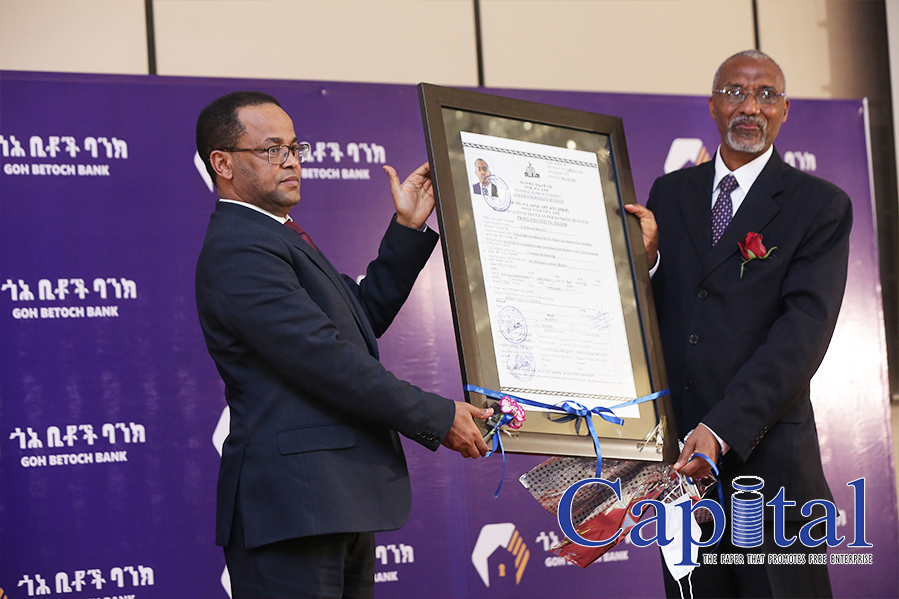
National Bank of Ethiopia (NBE) has officially provided the green light for the bank to commence operation.
The bank announced that it expects policy support from the regulatory body, NBE to amplify the required success, while Yinager Dessie, Governor of NBE, promised to back the operation of the first private mortgage bank.
At the official ceremony of awarding the license from NBE Getahun Nanam, Chairperson of Board of Directors of Goh and former Vice Governor of NBE said that the bank has been in process for three years to realize the dream to become the first mortgage bank in the country.
He said that the housing financing scheme in Ethiopia is very poor despite the demand being very high making the housing issue a top priority.
Getahun cited a study that to ease the current accumulated housing demands, at least 1.2 million houses ought to be built as soon as possible, “besides that every year 100,000 houses have to be constructed to cover fresh demands.”
According to the veteran financial pundit, 70 percent of the existed houses in cities are under standard that actually need reconstruction.
“Meanwhile this is the reality; the existed financial firms are not providing the required fund for the housing and construction sector. Due to that we are formed to fill the gap,” the Board of Directors Chair explained.
According to data from NBE the construction and housing sector has not benefited more than 10 percent of the total loans that banks provide.
Goh that is also expected to provide other banking products targets to provide one billion birr loan in the first year of operation and would get bigger to 6.4 billion birr in its fifth year.
Mulugeta Asmare, founding president of Goh, said that the bank is expected to see some policy changes from the regulatory body and the government in general to attain its target, which is also one of the government top economic development pillars that is mentioned on its ten year economic plan.
“Currently, except the Development Bank of Ethiopia all banks have similar operation and with similar policy but when it comes to Goh, we are coming with different services that needs different regulation and policy from the regulatory body,” he elaborates, adding, “due to that starting from policy change we need support from NBE to amplify our operation.”
“We want to see preferential treatments on NBE policies like the composition on long term loans portfolio, which is now 20 percent of the total portion of loans and advances for commercial banks, and enable to be partner with foreign fund sources,” Mulugeta, who is well know by his role to register massive success at Bank of Abyssinia as a president, told Capital.
The policy change on the composition of loan portfolio would allow the bank to get huge amount of long term deposit and at the same time provide long term loans that are given for more than five years.
Goh has targeted that the majority share of loans portfolio would be long term.
“There are also opportunities that Goh shall work with international institutions to access and using idle funds to support our mortgage business, due to that on this side also NBE is expected to make consideration,” he explains, while he added that so far the bank would use the current environment for operation.
Mulugeta said that the bank is also expects conducive policy environment and other segments of supports from Ministry of Urban Development and Construction and similar public offices in regions and cities to realize the housing solution in the country.
Yinager said that NBE will consider supports for such kind of specialized financial firms “the country needs different specialized banks besides the existing commercial banking scheme.”
He said that currently, most of the existing banks are financing the commerce, while residential housing problem mainly in urban areas is very high that should be backed by a financing scheme.
The governor appreciated the initiative of Goh, which formed to support the housing and construction sector that is also one of the tools for economic growth in the country.
“On our ten year economic plan, the government and political leaders have underlined that special support shall be provided for banks that are forming on the focus of housing financing,” Yinager says, adding, “the sector and demand is very high that needs more similar banks and the government will also provide special support.”
“As per the NBE rule, we have to have core banking and to do that we have already hired Temenos, Geneva, Switzerland based technology firm that is engaged with different banks in Ethiopia in related with technology support,” Mulugeta who will become the first private mortgage bank president in Ethiopia, explains adding that it will be fully ready in few months time.
Until Temenos’s project becomes operational, the bank has planned to carry an installed system as transitional core banking scheme that is developed locally, while Websprix is also finalizing the establishment of the data center that is crucial to make effective the core banking technology.

Goh includes 6,658 shareholders. Its subscribed capital is 1.056 billion birr of which 521.5 million has been paid up.
Goh is the first after the Housing and Saving Bank (HSB) that was formed by the merger of Imperial Savings and Home Ownership Association and the Savings and Mortgage Corporation of Ethiopia mid 1970 during the Derg period. HSB was also reconstituted to Construction and Business Bank (CBB) in 1994 before it became defunct and merged under the state giant Commercial Bank of Ethiopia in 2016.
Even though these days banks are providing some sort of financial schemes to obtain housing it is mostly focused on the upper class of the society that may have already the facility and want more or for those whose income is extraordinary, as opposed to the general public or civil servants.
During the Derg era several urban dwellers mainly civil servants and housing associations benefited from a plan by HSB to own their property in cities and towns of the country. Even though the HSB loan scheme realized their wish to own houses, the scheme did not continue as usual after the fall of the Derg regime. Due to the former HSB that changed its name to CBB focused on commercial banking services.
Since then the housing scheme has been neglected from the loan scheme of the financial firms until the condo housing project which was introduced by the government in 2004, which is fully controlled by the government. Lease has also been the other option to secure a plot and construct residential houses; however it is not affordable for the masses. Experts argued that the condo housing project is vulnerable to corruption in the construction stage and lottery process besides poor performance in the accomplishment.
Currently, the government has introduced different housing scheme including the housing association to ease the residential house problem.
The formation Goh at the initial stage was led by Getahun Nana; Gebreyesus Egata, founder and CEO of Gift Real Estate, Kefeni Gurmu, legal expert, Wubishet Jekale, Professor at Addis Ababa University and General Manager at Jekale CM Consultancy, Heyaw Terefe, Professor at Addis Ababa University, Yoseph Assefa, well known on the financial industry, Fasika Kebede, former president of Enat Bank, Amerga Kassa, former president of Nib International Bank, and Araya Gebreegziabher, former president of Wegagen Bank.
