Sunday, April 5, 2026
Home Blog Page 3288

Telecom’s privatization, liberalization draws a step closer

The telecom liberalization and privatization process has progressed to another step. The bid for including two additional operators is expected to be floated in the coming few weeks.

The process to open up some monopolies and partial privatization that had been laid by the former ruling coalition EPRDF, that is, from mid-2018, has now been progressing with regards to the telecom sector.

Before arriving at this decision this week, there have been extensive discussions conducted both on direct meetings and virtual feedback gathering inclusive of emailed documents.

Early September, in a consultation held at the Office of the Prime Minister (OPM) chaired by Prime Minister Abiy Ahmed inclusive of different stakeholders like the privatization committee, which comprised individuals from different direction like the business community, different professions and political parties, and macroeconomic team; evaluated the process and decided to conduct three consultations that were organized by the  Ministry of Finance, Ethiopian Communication Authority (ECA), and Ethio Telecom as the last public dialogue to transfer to the next step. The outcome of the three and last consultation have been presented in the meeting at OPM on Monday October 26 and the issue was discussed.
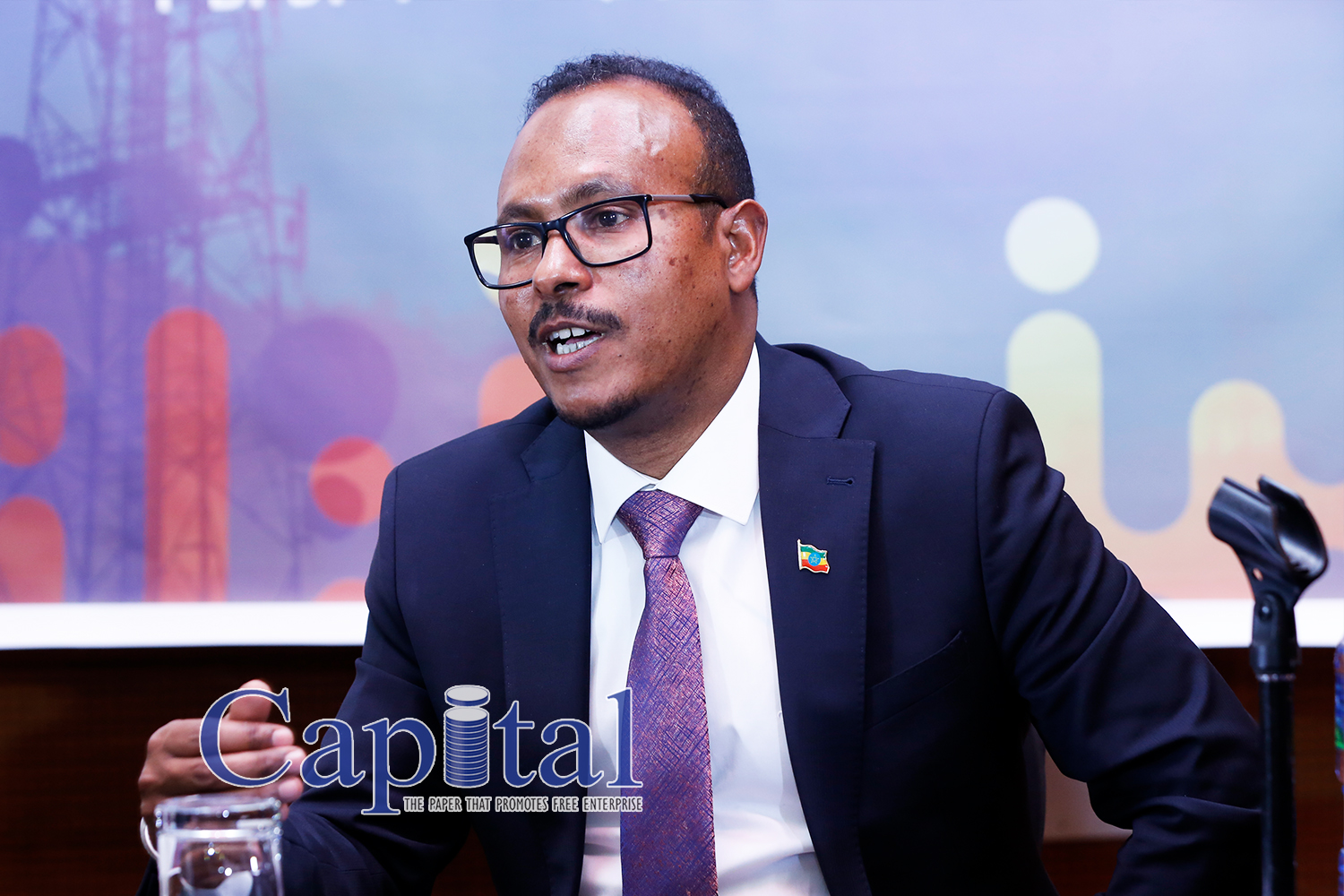
(Photo: Anteneh Aklilu)

PM Abiy, who led the discussion, emphasized that the government is not deciding to open up the telecom sector just for the sake of others to say that we are opening the economy, “We are conducting the process for the benefit of our national interest, not for others,” he elaborated.

The process will entail two different schemes; this includes, partly selling the share of Ethio Telecom on the direction of privatization and selecting to more operators, which is the liberalization process.

Balcha Reba, head of ECA, said that after the final review on bid document and process with the relevant body, the document it will be floated in the coming few weeks to get two more operators.

The process of selecting two operators is expected to be finalized until mid 2021. The bid for adding shareholders at Ethio Telecom is also expected to be on air in the near future. The government has disclosed to sale out 40 percent of state monopoly share to foreign investors and five percent to Ethiopians.

“We expected that the two processes are going parallel,” Balch told journalists after the OPM discussion on Monday. The final decision is now up to the higher body of the government.

Recently, ECA floated an expression of interest and 12 companies from different continents and businesses besides involving the telecom sector have shown their interest in being the two new operators.

Early Monday, at the press conference held at Hilton, Balcha highlighted that some individuals described COVID 19 as a threat. He expressed that they argued that the time would not be good for selling new spectrums and may even affect the revenue that the country is supposed to get in the process.

“Some experts compared the economic slowdown by the pandemic with that of the financial crisis in 2007, with regards to the adverse effects on the financial sector. But the two are different. The 2007 crisis was the result of the effect on finance sector that significantly damaged the economy. The COVID 19 effect is not correlated with the finance sector, but the finance sector is in good hands and keen to provide finance for investments that has slowed down because of coronavirus. Therefore for investors it is not so much a worrying time since the process will not affect the process of adding more operators. Furthermore, with good and competitive rates the country will receive great benefit,” he clarified.

According to Balcha, the expression of interest targeted to prove the interest of new investors and evaluate the concerns of those who were afraid that COVID 19 may affect the process.

He added that the COVID 19 challenge clearly shows the need of the telecom sector which further demonstrates how lucrative the business is for the sector.

“The telecom service was a good instrument in the lockdown period,” experts said.

To realize the opening up of the telecom sector, ECA has issued and drafted different directives and regulations.

So far it has issued 18 directives.

The companies that have shown interest are: Global Partnership for Ethiopia (a consortium of telecom operators made of Vodafone, Vodacom, and Safaricom), Snail Mobile, Liquid Telecom, Telekom SA, etisalat, Liquid Telecom, Orange, Axian, Saudi Telecom Company and MTN from telecom operators.

Non telecom operators that expressed their interest are Kandu Global Telecommunications, Electromecha International Projects and Group of Associate Djiboutian Investors, who have not fulfilled the demanded requirements on the expression of interest requests.

Abiy has stressed that individuals who are involved on the process of privatization and liberalization of the telecom sector should work amicably and keep themselves from misdemeanors.

He warned that if there are any illegal acts it may take time to trace but eventually the acts will be identified.

New operators are expected to have coverage of 25 percent in the first year of their operation in the country that will expand to 40 percent in the second year, 55 percent in the third year, 70 percent of in four years, 80 percent in five years, 90 percent in seven and 95 percent in 10 years time. According to the plan companies would cover 97 percent of the country on their service by their 15th year operation period and the operation license period will be 15 years.

“Any country would not have full coverage on the telecom sector but at least close to hundred percent shall be tried to be filled,” the ECA head told Capital.

Regarding to universal access service, the authority targeted to achieve the same in five-years-time.

Balcha said that the Request for Proposal (RFP) will be floated until mid this month. “The process shall be finalized until April next year,” he said.


A cyber force introduced to counter security threats

The Defense Force of Ethiopia has established a new force to counter security threats on virtual systems.

The Defense Force that has different divisions has now established a cyber-force to keep the country from virtual attacks.

At the meeting held on Monday October 26 at the Office of the Prime Minister to evaluate the liberalization and privatization process of the telecom sector, Prime Minister Abiy Ahmed said that the Defense Force has established a new wing to counter the security threats that the country may face.

On the discussion held on the day, one of the participants raised his concern that the opening up of the telecom sector may affect the country’s security and make it vulnerable for others.

Similar concerns have been raised in different occasions on the consultations that were held in the past several months with stakeholders on the opening up of the sector for two more operators and selling shares for interested buyers at the telecom monopoly, Ethio Telecom, on the privatization scheme.

For the concern, PM Abiy said that there would not be a system to keep the country from threat because the liberalization has not happened. “I appreciated the concern with regards to national security issue. Even if we kept the sector closed; do we have a capacity to maintain ourselves from attack? As you know we have imported all equipment from aboard that we further don’t know what kind of equipment are installed therein, and how many of us know apparatus and applications installed on our phone?” he rhetorically asked.

He said that the major issue should be the strengthening of the national security and empowerment of the controlling bodies.

“We have established different organizations to countering the threat regarding the cyber system.  One of that is the Information Network Security Agency (INSA),” he added.

“The defense force have had ground force, air force and recently reformed marine force. Now like the marine force it has established the cyber force,” he explained.

Like other forces the cyber force is working to keep the country from virtual attack. “Ethiopia is not in a place of producing and supplying end to end technologies that might be software or hardware, but the priority is establishing end to end encryption capacity based on sector behavior and sensitivity,” Abiy, who is one of the top figures to establish INSA stated.

“Regarding security, there is also the law of interception. Many countries do not have their own telecom operators but they have a managed legal framework in this regard,” he argued as he tried to tackle the issue of security vulnerability if the sector opened for others.

He said that the circumstance will have a chance to strengthen the capacity, “it will give us a chance to see the gap on the issue and strengthen our system.”

“Many countries national security are strengthening the process of attack and counterattack schemes. There is no one who is fully threat free,” he added.

After the political reform, which occurred early 2018, Ethiopia has reformed the marine force to keep the country’s security at the international water surface.  The cyber force will be the new system at the Defense Force. About 13 years ago the government had formed INSA to secure the country from cyber attack. The force formed under Defense Force is the other power to keep the country from the modern world military section.

On the process of opening up the telecom sector the government has targeted to sell 40 percent of the share of Ethio Telecom and to add two more operators.

The process is expected to be finalized before the end of the current budget year.

Service makes lucrative international tender for local bidders

NBE allocates foreign currency for PPPDS

National Bank of Ethiopia (NBE) has approved the request of Public Procurement and Property Disposal Service (PPPDS) to allocate foreign currency for companies which are contracted by PPPDS to supply goods.

The Service has also approved the scheme that will allow local suppliers to entertain international bid to access foreign currency and harmonize the bid process that is mostly undertaken on FOB indicators.

Tsewaye Muluneh, Director General of PPPDS, told Capital that the leadership of PPPDS has decided to facilitate a way out for local bidders on the international tender to benefit the locals.

“We have now local companies that participate on international bid for wheat. These companies are in need of foreign currency to procure the grain if they win the bid, but currently we are paying them in birr therefore we have to bridge this gap,” she said.

On the other hand the procurement of vehicles is mostly included under the international tender because of the threshold.

In this regard, local companies are importing inputs on DDP (Delivered Duty Paid (DDP): Seller bears cost, risk and responsibility for cleared goods at named place of destination at buyers disposal) scheme unlike international bid process that is FOB (Free On Board: Risk passes to buyer, including payment of all transportation and insurance costs, once delivered on board the ship by the seller).

“To harmonize the scheme and allow local firms to be part of the bid we have considered the DDP with FOB on the aim to fill the gap on procurement process,” she explained.

According to the 2010 procurement directive, the procurement value of goods that is 10 million birr and overshall be conducted under international tender.

The Director General of PPPDSsaid that for companies who have an agreement with the Service to supply goods, the service has secured foreign currency from the central bank.

“To allocate the foreign currency fairly we have developed a working plan that was discussed with suppliers and has now been applied,” she added.

PPPDS has also decided to change the disposal process of old vehicles. Previously the disposal process was just sold out to anyone who was interested in buying the vehicles either to re-operate the vehicles or use their parts or as scrap.

On the new scheme, all vehicles would be sold for scrap purposes. “Allowing the old vehicles to be driven has contributed to pollution and accidents as a resultthe vehicles shall no longer receive permit from the Transport Authority to operate rather they will be an input for the steel industry,” she said.

She said that the Service is working with the Transport Authority and other stakeholders to implement the new process.

The Service by itself evaluated the economic advantage of the framework contract procurement as per its set target.

Wheat is one of the strategic products that PPPDS procures and in the first quarter of the year it has floated a tender to buy 680,000 metric tons of wheat for different organizations. Of the stated volume the process for 80,000 metric tons have been concluded and transferred to the World Bank, which is the buyer of the grain for Safety Net Program of Ministry of Agriculture.

Since the last budget year PPPDS has hired S&P Global Platts, an international global wheat market analyzer, to offer the international daily rate that shall help the public procurement body to evaluate the financial offer on the bid process.

The subscriber, PPPDS, agreed to pay about USD one million per annum.

The country is importing wheat that is worth close to USD one billion every year, while the federal government is working to cut this in short period by replacing it by local production.

PPPDS is responsible for the undertaking framework contract procurement for different public organizations as per their request. On this scheme it shall buy similar products for different organizations on bulk that shall also contribute for lower rate and transparency.

Raxio Group to build the first certified tier III data center

0

The US investment firm, The Raxio group, is going to build the first private up time certified tier III collocation data center with a 15.5 million dollar investment.

To build and operate a tier III standard data center facility with high security physical infrastructure which has 7 layers of security, Industrial park development commission has secured land to Raxio Group to build the first kind of tier III data center fully-owned subsidiary in Ethiopia, Raxio Data Centre PLC at ICT Park.

A tier III data center is a location with redundant and dual powered servers, storage network linkage and other IT components.  IT components are powered with multiple, active and independent sources of power and cooling resources.

The company is expected to finish the construction of its data center with projections being till the third quarter of 2021. The center will offer an optimized environment with IT equipment in a state of the art facility where customers can house their computing, network, storage and critical IT infrastructure. It will also entail a modular facility, fully equipped with industry best in technology, security, AC/DC power compatibility and redundancy.

Sandokan Debebe, CEO of Industrial Parks Development Corporation informed Capital that the company will build a nationwide data center that could give cloud services to governmental and nongovernmental organizations including website and any other internet based services. “Following the holistic reform that our nation is undergoing, new mobile operators are expected to be licensed soon which could increase the internet usage,  Raxio Ethiopia will play a paramount role in strengthening and developing the country’s digital infrastructure capabilities.”

With its investment and project plans completed in late 2019 and initial design underway, Raxio signed a Memorandum of Understanding (MOU) with the Ethiopian Investment Commission (EIC) in December 2019.

The company is planning to deploy its units to accommodate an IT capacity of 1.5MW supplying approximately 400 IT ranks which will be increase up to 3.0MW when the need grows.

Robert Mullins, President of Raxio Group, states that “Raxio’s facilities enable companies such as mobile network operators, content delivery networks and financial service providers to run their critical IT systems in a built-for-purpose, always-on environment. With our module build, we will be able to support growth quickly and tailor our build to the needs of our customers. Raxio Ethiopia will provide a critical and missing part of the nation’s digital infrastructure at an exciting and fast-evolving time in the broader telecoms sector in the country,” he explained.

The Raxio Group (“Raxio”), a premier pan-African data centre developer and operator, has officially secured land at the ICT Park, in the outskirts of Addis Ababa, through its fully-owned subsidiary in Ethiopia, Raxio Data Centre PLC (“Raxio Ethiopia”) where they will construct the country’s first private uptime certified Tier III collocation data centre.