

Aimed to support small and medium farmers’, the Ministry of Agriculture (MoA) submits its final draft plan to the micro economy team for the formation of the agricultural policy bank.
The agricultural bank is expected to be formed mainly with the aim to expand access to finance for the sector that has been working on the plan for the last three years starting from pointing out problems and solutions on the sector.
On the formation of the bank which is expected to be named as Cooperative bank, different stakeholders are participating including the federal cooperative agency, according to Director General of the Federal Cooperative Agency Usman Surur, who said that the sector is denied adequate finance compared with other sectors. “The sector is the major source for the economy but it is not supported when it comes to finance,” he indicated highlighting that besides an exclusive bank for the sector, cooperative banks should be established to support the sector and improve financial inclusion.
According to data from the total loan disbursed in the country, the agriculture sector only secures less than 10 percent.
The reform strategy identified that the agriculture policy should consider the supply and demand side together with the formation of the bank which will also add an optional financing scheme like warehouse receipt and contract farming. Change to the supply and demand side, improving the market linkage and grading of products is also stated as a crucial point to modernize the sector and encourage the actors.
As Usman said, the government has been working on the plan for the last three years starting from pointing out problems and solutions on the sector and in the coming New Year after the formation of new government this will become reality.
The NBE first quarter report for the 2019/20 fiscal year indicated that 39.6 billion birr was disbursed in fresh loans, while the agriculture share was 4.1 billion birr or 10.3 percent of the total amount.
From the total outstanding credit of the banking system that was 574 billion birr in the first quarter of the budget year, the agriculture sector only took 18.7 billion birr or 3.6 percent.
Ethiopia has 16 million farmers including pastoralists that are still engaged on poor productivity. From the total farmers most of them own land less than half hectare.
As experts explain, in Ethiopia 80 to 90 percent of food production is from the small farm sector, credit, along with improved financial instrument must be provided in a form that can serve these farmers. They in turn, must increase production to keep pace with the productivity of urban population and this requires the application of expensive technology.
According to the director, the bank could consider the linkage of urban to rural, since formation of rural towns improves the agriculture sector.
MoA drafts plan for bank formation
Gov’t dismisses starvation as “war weapon”
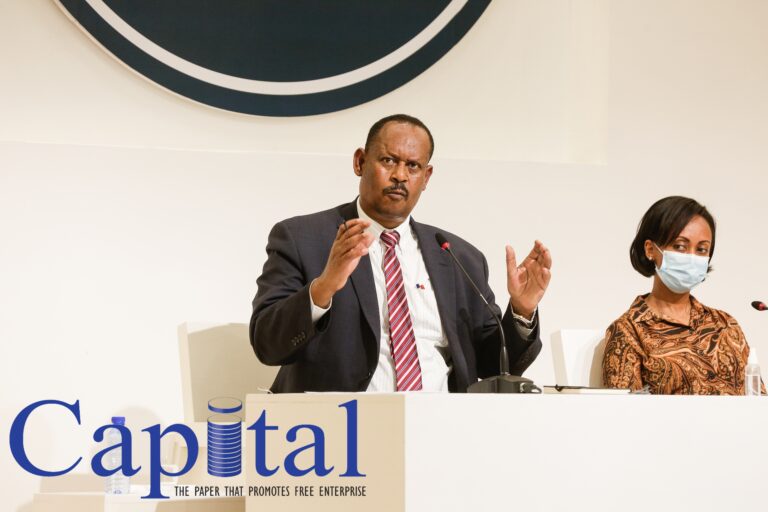
The government ridicules the accusation that it is using starvation as a weapon of war. Government argues that it never took in to account the reality on the ground that is mainly covered by non-government bodies.
The government said most of the food supply is covered by humanitarian partners and it is confined only on the place of western part of Tigray.
On the latest briefing at the Office of the Prime Minister Mitiku Kassa, Commissioner for the National Disaster Risk Management Commission (NDRMC) said that is baseless accusation since the role of the government is loss regarding food supply.
“As long as 91 percent of the food distribution is covered by 5 nongovernmental partners; how can we imagine that we are using starvation using as a weapon of war,” he dismissed the allegation that is being circulated in different foreign media outlets, adding, “Had it been that the government controls the whole part of the region, we can imagine that, but the government of Ethiopia is only limited to 14 woredas in western part of Tigray which are in a conducive environment. Therefore, the pretext shall be corrected based on the reality.”
Before the question and answer session with journalists started, Mitiku had indicated that the government is only covering 8.7 percent of the food supply and distribution in the place of western part of Tigray and the remainder is covered by international and local partners.
On his update report Mitiku said that 4.5 million people in Tigray region were in humanitarian assistance in the first round and 5.2 million for the second and third round.
On the support, 170,700 thousand metric tons of food worth 5.4 billion birr has been distributed.
The food distribution was covered by government (70 percent) and the remainder by partners for the first two rounds. Since the third round six operators; World Food Programm (WFP), World Vision, Care International, Relief society of Tigray (REST), Food for Hungry (FH) and the government has been providing support.
Out of the 93 woredas (local districts) in the region; WFP covers 21 woredas (22.58 percent) in the north western and south zones, World Vision 7 woredas to eastern and south eastern zones, Care 6 woredas in central and eastern zones, REST 40 woredas (43 percent) central, north western, south eastern and south zones, FH 5 covers woredas in central zone, and the government covers 14 woredas (15.05 percent of the total area coverage of the region) in western area of the region.
Regarding food supply and distribution, WFP addressed 18.3 percent, World Vision 5.8 percent, Care 6.3 percent, REST 54.6 percent, FH 6 percent, and government 8.7 percent of the beneficiary. In general the five humanitarian partners covered 84 percent of the woredas and address 91.3 percent of the food supply and distribution, whereas the remainder is covered by the government.
“The role of the government is confined to monitoring and creating conducive environment for partners, and mainly focusing on the rehabilitation activities,” he said.
He added that on the beneficiary number, the report of humanitarian partners has been leased indicating that 5.2 million people or 90 percent of the population need immediate humanitarian assistance, “while we are looking into the breakdown of this number, we can observe that 1.01 million are productive safety net program beneficiaries and 40,336 are Eritrean refugees who are included on the two schemes that should not be included under the beneficiary list of humanitarian assistance.”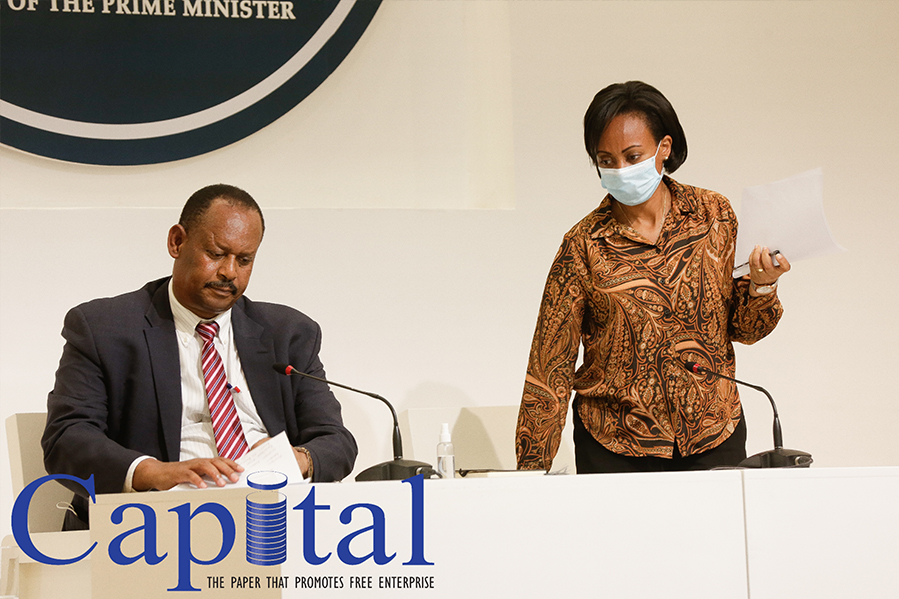
Regarding the non-food items, more than 98,500 emergency shelters and non food items kits that estimate 796 million birr has been supplied to cover more than 292,810 internally displaced people.
Mitiku said there is a significant gap in the non-food items which the partners cover only 33 percent.
Regarding to the coming agriculture season the supply of 322, 864 quintal of fertilizer from port of Djibouti and 214,864 quintal in carry over from last season has already made available and from the stated amount 210,795 quintal have distributed. 73, 440 quintal seeds have transported to the region.
With regards to the famine threat that similarly international media reported and global partners expressed their concern, the NDRMC head responded that there are criteria for the endanger of famine which have not transpired for the context in the region.
“There are at least three criteria that must happen to declare famine, while none of them are faced at the place. According to the standard, there is no incoming situation regarding the famine,” he ridiculed the concern.
He added that there is no food shortage because 91.3 percent of the beneficiaries have been provided by five operators, which are supported by USAID.
“The government is limited in the western part of the region. So they do have ample resource to address the needy ones in their areas of operation. Now the challenge is how to address the needy ones at the grass root level since there are sporadic gun fires every now and then. However, we are working with the regional administration to solve it,” he added.
He responded that the government is not in a position to declare famine currently in the Tigray region.
On his latest report that Mitiku gave on Wednesday June 9 the challenges like access and security issues that is related with sporadic firing in very few areas that need military escort to address the needy in the region, shortage of emergency shelter and non-food items, and supplementary food that is critical for children and lactating pregnant women have to be solved as soon as possible. He said the government is working with local supplementary food producers to provide the items and to buy from international market with partner.
On the day Billene Seyoum, Press Secretary for the Office of the Prime Minister, said that efforts have been embarked on the emergency recovery plan for Tigray.
She said that it is being developed by the government together with partners and will be lunched soon.
“It is in the pipeline in discussion with partners as well,” she says, “the response plan builds on existing successful whole-of-government approaches and aims to strengthen and scale up development and emergency programs, and community structures.”
Mitiku added that the recovery and rehabilitation intervention, Ministry Finance and Ministry of Peace are working with EU, the World Bank and UNDP in order to build back better the damaged and destroyed economic and social infrastructure in the region.
Schools in Mekelle have opened except only that they have been designate to host displaced persons. Likewise, others schools in different towns are also finalizing their process to commence their regular service.
Lia Tadesse (MD), Minister of Health said that the health facilities in the region are restoring, and she indicated that there are several progresses in the health system in the region.
She said 55 percent of the hospitals (22 out of 40) and 52 percent of the health centers (117 out of 227) in the region have currently been made functional and that a total of 52 percent of hospitals and health centers are functional.
PM Abiy, high officials inaugurates WA Edible Oil Factory

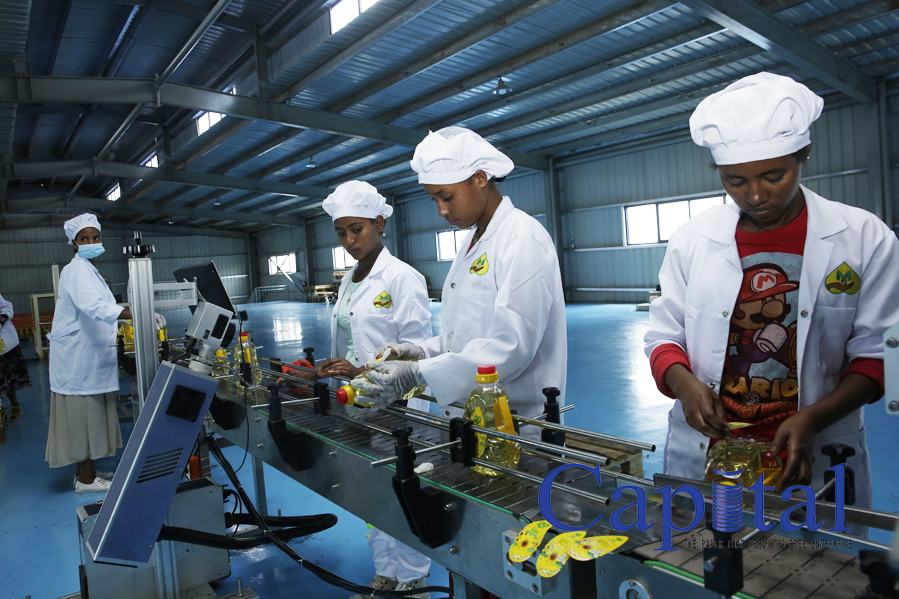
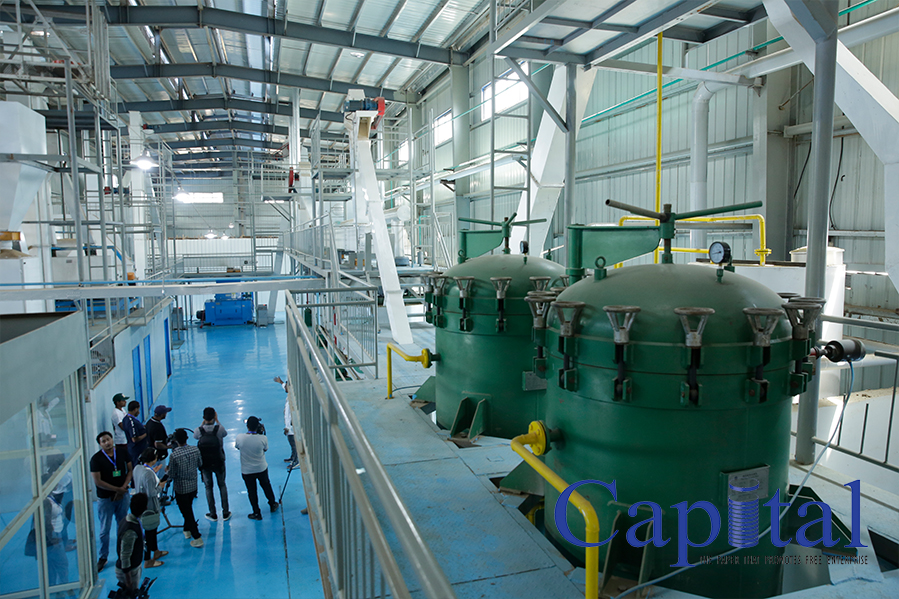
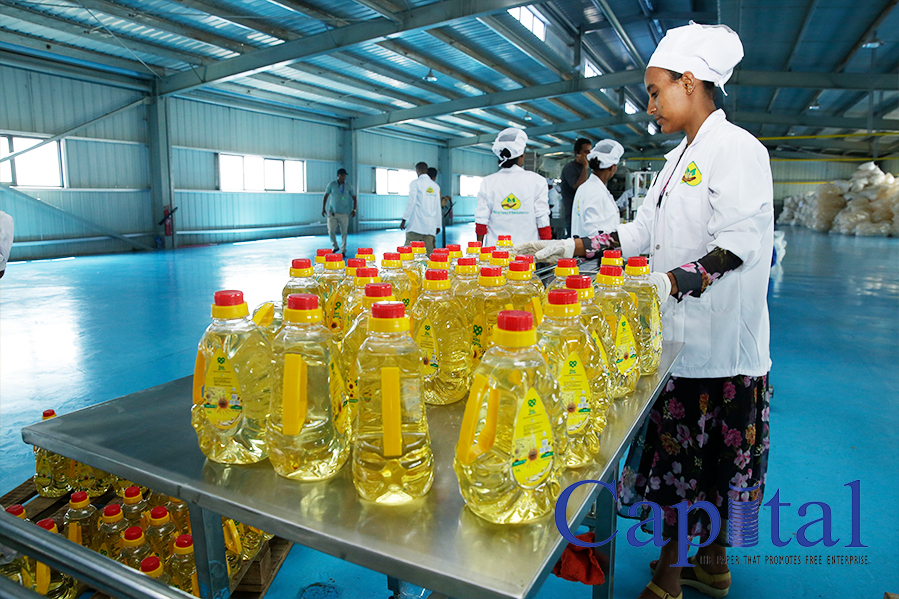
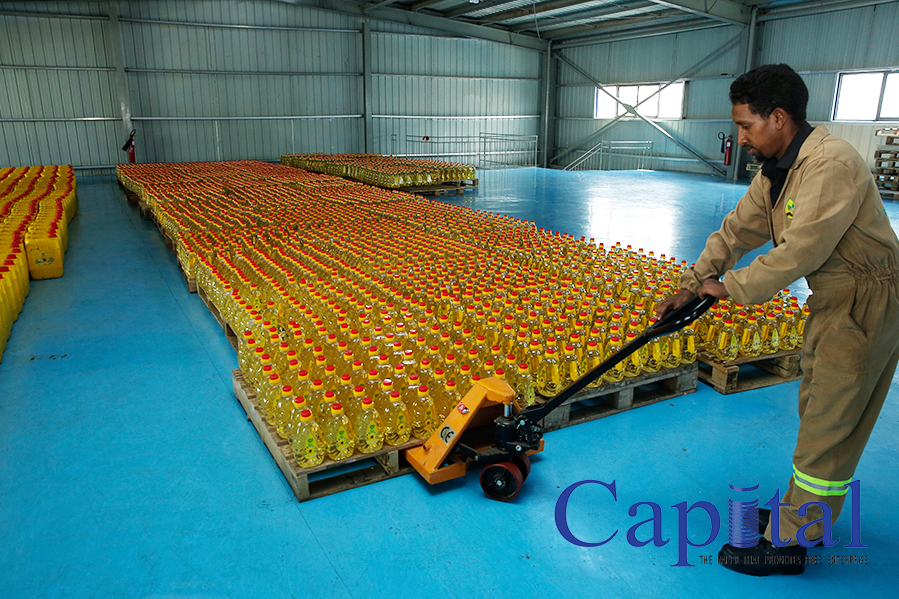
The third largest oil Factory in Ethiopia W.A Oil Factory was inaugurated on Monday June 7, 2021 in the presence of Prime Minister Abiy Ahmed and different senior government officials.
W.A oil factory Located in Debremarkos town in Amhara region was built at a cost of 5.2 billion birr investment which took 3 years to complete.
W.A is said to be working to produce 40% domestic demand this year which could minimize the shortage of oil in the market.
When the plant is fully operational, it will be able to produce more than 1,350,000 liters of oil per day using various oilseeds. It has so far created employment opportunities for 1,500 citizens and is expected to create more than 3,000 jobs in a single shift.


Berhan Bank aims to surpass capital threshold

Berhan bank aims to stretch its capital to 8-10 billion birr in the coming five years.
In accordance with the National Bank of Ethiopia regulation which states that with in the transition period of five years the existing commercial banks ought to boost their capital to five billion birr; Berhan plans to pump its capital to 8-10 billion.
According to Abreham Alaro, president of the bank, currently the initial capital of Berhan bank stands at 3 billion birr. To this end the president stated that the bank will work to increase its capital by engaging in various new services.
On Wednesday June 9, 2021 the bank signed an agreement with the Ministry of Revenue to start giving Electronic tax /E-tax/ service.
As Abreham stated, the agreement will help to increase digital financial service by improving the service income collection of the ministry. “The bank has been working to test the system by fulfilling all the pre requirements where all the effort to connect the bank system with the ministry has been completed. Customers who both live locally and broad can pay their tax using all the digital options that Berhan offers,” the president noted.
Moreover as the president told capital, the bank is working to connect its system with Ethio telecom to work on Telebirr. Berhan with in the coming few days will link itself with Telebirr services enabling customers to transfer money from their Berhan account to Telebirr.
In addition to Berhan, The Ministry of Revenue has also signed an agreement with three private banks, including the Commercial Bank of Ethiopia, to make the tax system more efficient and cost-effective.
State Minister for Legal Affairs of the Ministry of Revenue, Zemede Tefera, said the agreement is a good one as it will benefit taxpayers from all parts of Ethiopia except Addis Ababa.
The Ministry has been working with the Commercial Bank of Ethiopia (CBE) to integrate the electronic tax system into the system.
The Director General of the Information Network Security Agency, Shumete Gizaw, has said that taxpayers have a responsibility to ensure the security of their information wherever they pay their taxes.
