

Following the announcement by the African Union Chairperson, President Cyril Ramaphosa on the 14th of January 2021 that the African Union has secured a provisional 270 million COVID-19 vaccine doses for Africa through its COVID-19 African Vaccine Acquisition Task Team (AVATT), the Africa Medical Supplies Platform (AMSP), on behalf of the Africa Centres for Disease Control and Prevention (Africa CDC), commences the COVID-19 vaccines pre-order programme for all African Union Member States. Afreximbank will facilitate payments by providing advance procurement commitment guarantees of up to US$2 billion to the manufacturers on behalf of the Member States.
While AVATT has secured a provisional 270 million COVID-19 vaccines doses from Pfizer, Johnson & Johnson and AstraZeneca, AMSP – the single-source platform enabling faster, more transparent and cost-effective access to COVID-19 supplies – has opened today pre-orders, offering an equitable access of COVID-19 vaccines doses for 55 African Union member states.
“These are historical times. For the first time in history, Africa has secured access to millions of vaccine doses in the middle of a pandemic as most of Western countries,” said African Union Special Envoy Strive Masiyiwa. “There is still a huge shortage of vaccine doses and that is why this continental collaboration has designed a fair allocation coupled with timely and equitable access of COVID-19 vaccines across the continent.”
AMSP opens COVID-19 vaccines pre-orders for 55 African Union Member States
The security situation of civilians and internally displaced persons from Tigray region risks becoming a humanitarian crisis: EHRC
The Ethiopian Human Rights Commission (EHRC) stated that the security situation of civilians in the war affected areas in the Tigray Region as well as surrounding areas and persons displaced as a result could turn into a humanitarian crisis. The Commission has published a Brief Monitoring Report of its investigative mission in Gondar and Dansha from December 15 to December 20, 2020 and in Bissober and Ullaga Kebeles/Villages of Chercher Woreda in Raya Azebo from December 31,2020 to January 5, 2021. The report presents the findings from EHRC visits to affected areas, hospitals and temporary shelters for displaced persons as well as testimonies from government and non-government sources, victims and other relevant bodies.
EHRC further stated that the findings of the Commission’s on-going investigation missions in Mekelle other parts of Tigray region since January 10, 2021, will also inform upcoming reports as it continues to monitor developments in the region and the situation of civilians and internally displaced persons.
In Dansha, Humera, Bissober and Ullaga, where the investigation mission principally focused for this report, the war has led to civilian casualties including death, bodily harm, exposed civilian residences and commercial properties to looting and various damages, and caused the destruction of infrastructure in the areas. The continued disruption of public services such as electricity and water risks further exacerbating the humanitarian situation for residents and displaced persons. In Bissober and Ullaga, 31 civilians have died, 104 residential houses were partially or completely destroyed by fire and the local school and health centres sustained heavy damage.
Inaugurated Taitu Culture and Education Center
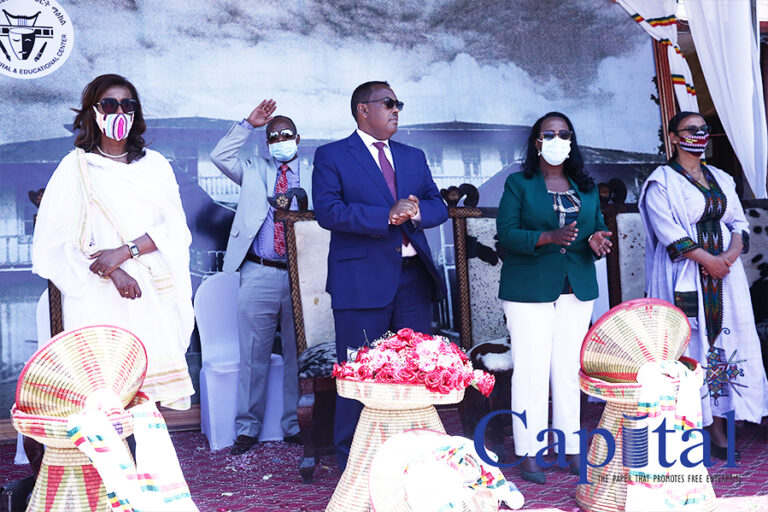
Deputy Prime Minister and Foreign Minister Demeke Mekonnen along with other high government officials inaugurated Taitu Culture and Education Center which is initiated by Alemtsehay Wodajo. Supreme Court President Meaza Ashenafi, Deputy Mayor of Addis Ababa, Adanech Abibie, founder of the Center Alemtsehay Wodajo and representatives of various communities have attended the launching ceremony. Fundraising session has also been started on the occasion to finance the center.
The center is founded in a historical residence which was formerly owned by Bitwoded Hailegiyorgis Woldemichael and transferred to the center by the City Administration of Addis Ababa. Demeke said on the occasion that the center will have a paramount significance in preserving and promoting cultural, historical and artistic values of the country. Tayitu Cultural Center is named after Itege Tayitu Betul, an iconic figure in Ethiopian History.





NBE sets new directive to cripple the black market

The National Bank of Ethiopia (NBE) revised the diaspora account holders which is highly anticipated to cripple the parallel market besides expanding the remittance.
Experts in the banking industry said that the new decision of NBE mainly affects the import of non-essential goods import like luxury goods and vehicles and allow very few players to import such products than the existed trend.
The NBE revised directive of ‘establishment and operation of foreign currency account for non-resident Ethiopians and non-resident Ethiopian origin directive no. FXD/69/2021‘ that replaced the directive of FXD/64/2019 stated that the beneficiary shall only use the foreign currency for the import of priority items like agricultural and manufacturing input, medicine and related items, nutrition for babies, education materials, chemicals and some other basic commodities services.
The national bank’s directive prohibits foreign currency acquired either from forex bureaus or foreign exchange held locally from crediting and/or open a foreign currency account. Experts in the sector argued that one of the major sources for crediting the diaspora account is the illegal foreign currency market.
Experts on international banking sector explained that currently the Diasporas are using the special account to import small items like vehicles, ceramics, liquor, chewing gum and others with small amount. However, under the new directive foreign account holders are supposed to import priority goods that needs higher foreign currency rather than importing the products it used to import.
According to one of the banking sector leaders, under this circumstance the diaspora would not have that much amount to import priority products so it will stop using the foreign account that leads to discouraging the black market, which currently has a significant gap compared with legal market in terms of exchange rates.
“Significant amount of the diaspora account is credited by the foreign currency that collects from illegal markets or by those who received the sum for their foreign trip from banks only to recirculate it back to banks. Due to that the black market will lose one of its major buyers which totally discourage the illegal market,” he expressed foreshadowing what is to come following the effective decision of NBE as of March 8.
A bank expert expressed his suspicion that the diaspora secure foreign currency from banks for foreign trip but may not travel at all or not use it on their foreign trip but prefer to be credited on the foreign account so as to present themselves with better opportunities.
One of the senior bankers recommended the government to introduce digital currency which will enable to control and trace those who tried to be involved in the illegal currency market with regards to credit on their foreign currency account and to know further the amount they use (if) they used it on the expenditure of their foreign trip.
Experts said on the contrary the very few players that have foreign currency access will control the market of the products that is rejected under the new directive of NBE.
“Products like cars, cloth, or other non-crucial goods will be imported by very limited individuals or companies that have the opportunity to use foreign currency for any purpose,” they say and pretend it will inflate the unessential products.
Some of the sector experts mentioned the newly amended directive, ‘retention and utilization of export earnings and inward remittances directive no. FXD/70/2021’ that became effective as of March 9 by replacing directive no. FXD/66/2020; for those who may have better opportunity to access foreign currency and import whatever they like.
The directive that was issued this week revised the former directive and said exporters of goods and services, as well as recipients of inward remittances, shall have the right to retain only 45 percent of the export earnings and remittances in foreign currency after the deduction of 30 percent surrender requirement from the total earnings.
The previous directive has been given a right for foreign currency generators to use anytime they want to import products from abroad, which is now increased to 45 percent for the import of any products they want.
The amended directive no. FXD/70/2021’ in contrary with the oldest directive give full right for banks to surrender at the prevailing buying exchange rate immediately, while the directive no. FXD/66/2020 had given right foreign currency earners to use it within 28 days for related business import of goods.
Experts said the retention and utilization of export earnings and inward remittances directive has given better advantage of the percentage of using of the foreign currency for earners to import any products so they may fill the gap that the diaspora account holders loss. “I expect exporters will have big role to import non-essential products because they have additional 15 percent share to use their foreign currency earnings,” one of the import export business players said.
