Monday, October 12, 2026
Home Blog Page 3644

Africa marks six months of COVID-19

0

Many countries experiencing gradual rise but difficult to discern a specific peak

Africa marks six months on Friday 14 August since COVID-19 was first detected on the continent. While the virus has raced through many other regions of the world, the pandemic’s evolution on the African continent has been different.
Preliminary analysis by the World Health Organization (WHO) finds that an exponential surge in cases which peak about two to three weeks later is not occurring in Africa. Instead, many countries are experiencing a gradual rise in COVID-19 cases and it is difficult to discern a specific peak. Transmission patterns also differ between countries, but more importantly within countries.
At the onset, COVID-19 mainly affected capital cities. However, the virus is now moving from high density urban areas to informal settlements and then onward to rural areas that have a lower population density.
“In Africa, curbing COVID-19 is a marathon and not a sprint,” said Dr Matshidiso Moeti, WHO Regional Director for Africa. “We are observing multiple local outbreaks each with their own infection patterns and peaks. It is by bolstering the response at the community level that we will win this race. The COVID-19 response must be integrated into the fabric of every health district.”
In the past six months, countries have made a lot of progress. Many African governments were quick to impose lockdowns and key public health measures that helped to slow down the virus. Over time preventive, diagnostic and treatment measures have been strengthened. All countries can now diagnose COVID-19, with 14 performing over 100 tests per 10,000 population. Production of oxygen, critical for severely ill COVID-19 patients, has also considerably increased, with the number of oxygen plants in the region rising to 119 from 68 at the onset, while the number of oxygen concentrators has more than doubled to over 6,000.
A recent WHO assessment based on self-reporting by 16 countries in sub-Saharan Africa found that the countries improved their capacity to respond to COVID-19. WHO measured countries’ readiness in a range of areas including coordination, surveillance, laboratory capacity, case management, infection prevention and control. Six months ago, the score was 62% and now it is 78%. While much progress appears to have been made at the national level, at the district level countries are generally lagging behind. The scores for coordination (38%), infection prevention and control (46%) and clinical care for patients (47%) are all particularly low at the district level.
While progress has been made, it is important that governments step up readiness and response measures, particularly at the subnational levels. With the loosening of movement restrictions, there are risks that the virus may spread even further into remote areas of the continent.
“Not only must we keep up with the evolving trends, we must also anticipate, predict and act faster to head off potentially disastrous outcomes,” said Dr Moeti. “Areas of high transmission as well as localities with relatively fewer infections both deserve attention. In short we must be strong on all fronts.”
WHO has worked with partners to provide technical support, training and essential medical supplies including the delivery of more than 2.1 million testing kits and the training of around 100,000 health workers.
WHO is also supporting countries witnessing a large number of COVID-19 infections. Last week, the first members of a surge team arrived in South Africa. WHO is also increasing support to other countries that have requested urgent assistance by mobilizing more technical experts on the ground and by scaling up training to build local capacity, particularly at the provincial and district level.

Ethiopian Diaspora Trust Fund releases funds for five projects

0

The Ethiopian Diaspora Trust Fund (EDTF) announced the release of funds for the first set of five projects in the country that were previously approved by the EDTF Board of Directors.
“The projects were reviewed by expert Technical Review Teams which had confirmed their compliance with EDTF’s project eligibility criteria,” a statement from EDTF reads.
“Before final funding, each project was subjected to rigorous and transparent capacity assessment and budget review focusing on organizational capacity, operational and financial management and effectiveness to deliver on proposed project outcomes,” the statement further reads.
Among the key evaluation criteria included were: project sustainability, potential impact, scalability, innovation and creativity, cost efficiency (value for money), accountability and transparency. The release of the funds was approved by the Advisory Council of fEDTF (Friends of EDTF) on 9 August 2020 after a final round of thorough inspection of the projects and the applicant organizations. The total first quarter installment of the project funds amounting to 5.9 million birr was transferred directly to the Bank accounts of the implementing organizations.
The five funded projects are:
Help for Persons with Disabilities-Organization (HPD-O) – Construction of special needs education units for disabled and neglected children in selected primary schools in 3 Woredas of Amhara Region, Semien Shewa Zone.
Hiwot Integrated Development Organization (HIDO) – Early Childhood Care and Education Services for Orphans and Vulnerable Children (OVC) at Woreda 06 of Addis Ababa.
Pro Development Network (PDN) – Promotion of Safe Water Supply, Hygiene and Sanitation – Forhard-to-reach communities using renewable energy in Afar and Tigray Regions.
Gurmuu Development Association (Gurmuu) – Improving children’s learning environment in four primary schools in Oromia Regional State.
Korah Great Hope Charity Organization (KGHCO) – Hygiene and sanitation promotion education and practices in Kolfe Keraniyo Sub-City Qoshe area of Addis Ababa.

The COVID 19 Pandemic

0

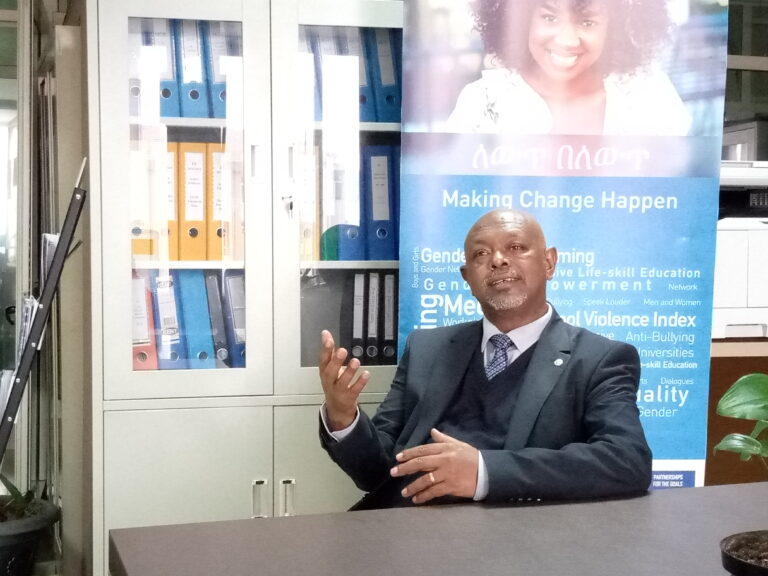
The COVID 19 Pandemic has brought to the forefront a lot of discussions some of which are on gender based violence and management of schools. Capital Newspaper conducted an interview on these issues with Yehualashet G/Michael, Acting Director of Initiative Africa, a local Civil Society Organization working on gender equality, quality education, reducing gender based violence and business support programs.

Capital: Since the first case of COVID 19 in Ethiopia was announced, stay at home was advised as the best precaution. In the following weeks, media reports surfaced of an increase on Violence against Women and Girls. As an organization working on reducing gender based violence, what is Initiative Africa’s response to the situation?
Yehualashet: Gender based violence has been one of the major challenges of most patriarchal societies who are way behind achieving gender equality like Ethiopia. I think the COVID-19 crisis brought new challenging situation and also became an eye opener to understand more about gender equality and see our gender structure.
As you have said there is more news of gender based violence on the media though we are short of statistical evidences to show the increase. For example, in Addis Ababa there are three one-stop-centres – Tirunesh Beijing, Gandhi and Menelik hospitals – which serve those victims of sexual violence but have seen a decrease in reported cases of sexual violence. This is perhaps because women and girls fear going to health centres during this crisis, or perhaps because they live with the people who have caused them harm and they do not have the privacy to report the abuse. On the other hand, there are some studies which disclosed preliminary results that the number of confirmed rape cases and domestic violence is increasing by 25-30%. The instances of the violence have been executed by close relatives, family members and abusive partners. Different regional states have also reported early marriage cases.
Hence, as part of our Making Change Happen Project, we are conducting a survey to have the evidence and plan an intervention.

Capital: Kindly, elaborate more about the Making Change Happen Project.
Yehualashet: In Ethiopia, gender inequalities prevail and are affecting everyone. Not everyone experiences inequality the same way. The situation is worse, and often different, for women and girls. Women are vulnerable to increased risk of acts of violence. Women still remain severely under-represented in key, growth-enhancing fields of education such as science, technology, engineering and mathematics. The labour markets exhibit many “gender gaps” particularly beyond the lowest level of hierarchy. Women remain underrepresented as subjects of news stories, as sources and positively influencing the media than men.
In order to address such issues Initiative Africa started to implement the Making Change Happen Project as we are an organization striving to contribute to the country’s development goals by increasing women’s participation, leadership, influence and decision making. The Making Change Happen Project is focused on addressing gender issues in the workplace, schools and communities, and the media. It is a three years project which ends in June 2021 and supported by the Embassy of Sweden/Sida. The project targets 92 Woredas in six regional states and is working to directly benefit more than 178,590 girls and boys in and out-of-school.

Capital: What is the progress of the project with regards to the components you mentioned?
Yehualashet: As always, we are working with government offices, local civil societies and the community in the project target areas.
With this project we have been trying to propel women in the decision making structure of the private sector and non-governmental organizations; improve sexual and reproductive health of adolescents in secondary schools through health/sport clubs, training materials, equipment’s, information/ education/ communication materials, workshop training; assist secondary school girls in 92 schools gain confidence and capacity they need to get rid of gender based violence in schools and their community by using School Violence Index and making their voice heard and taken into account; and support work places achieve gender equality by building capacity of media that support gender equality objectives.
In response to the pandemic situation, apart from conducting the survey I mentioned earlier, we are organizing online discussion forums on issues of gender based violence and gender equality. Aiming at reaching girls who are staying at home, we are now screening 42 episodes of secondary school science lab experiments performed by Ethiopian girls on the MOE TV Channel in collaboration with the Ministry of Education.

Capital: What is the way forward?
Yehualashet: In the coming 9 months we will be focussing on completing the planned activities and mobilizing more resources for scaling up the project outcomes and the initiatives underway. We are also now getting ready to provide our support to the education offices and the community in the target areas on their efforts of preparation for school re-openings.

Free employment service

0

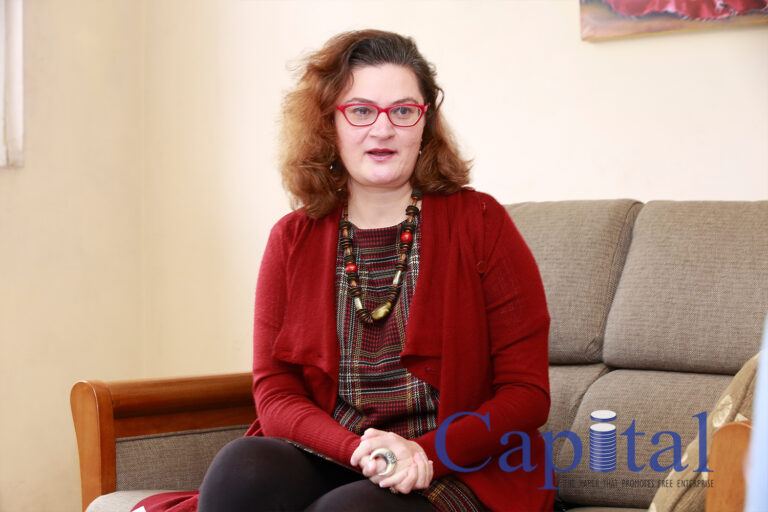
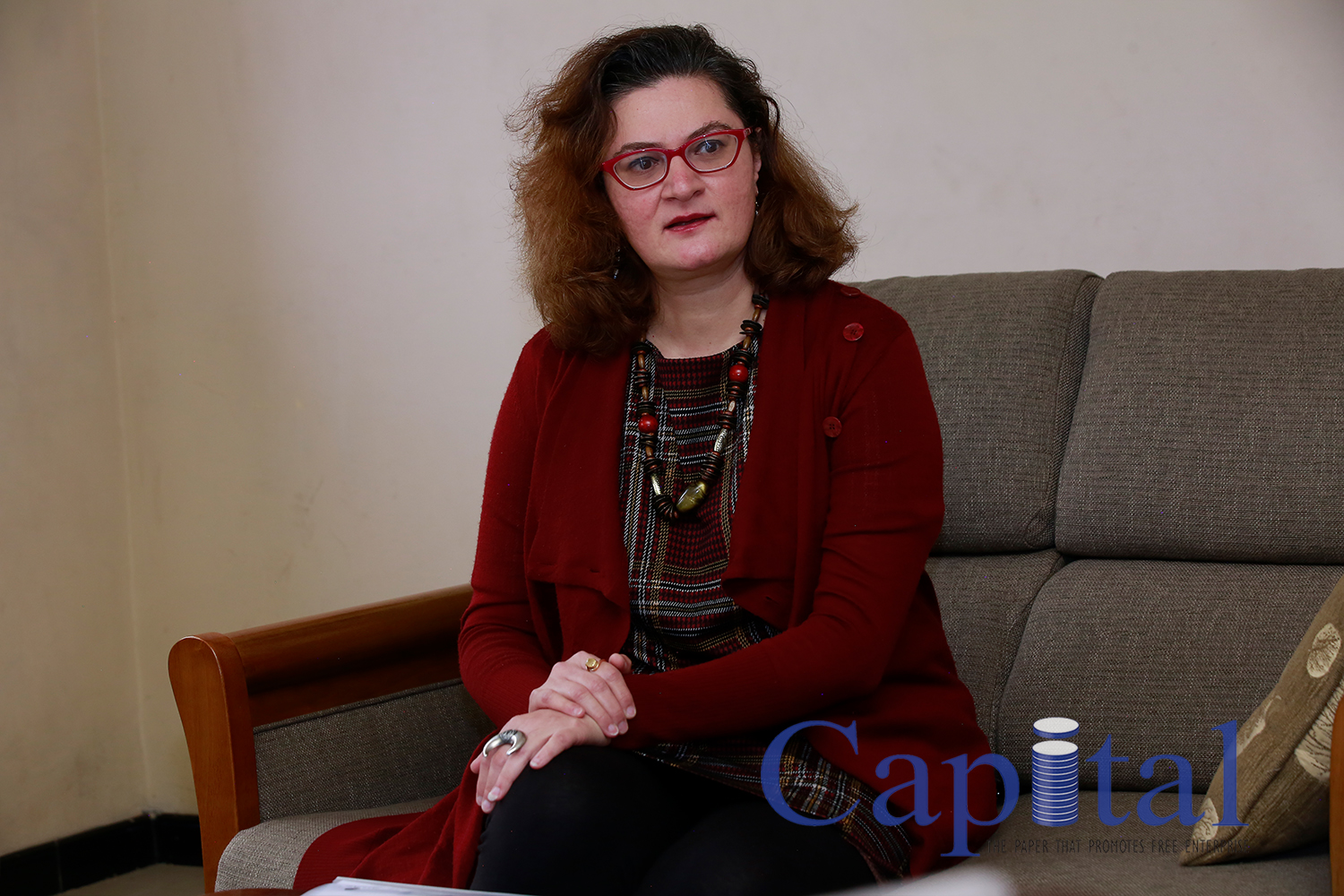
Ruchika Bahl is the Chief Technical Advisor for the EUTF Project under the International Labor Organization (ILO), Addressing the Root Causes of Migration, a part of the Stemming Irregular Migration in Northern and Central Ethiopia’ (SINCE) Programme. The project is strengthening National employment programs and youth employment services aiming to create decent work and employment opportunities for large number of potential youth and women migrants in Ethiopia, hence making migration an informed choice for them.

Ruchika has 20 years of work experience on development cooperation and policy advocacy with leading INGOs, bilateral and UN agencies across Asia, South America and Africa. Over the last two decades she has worked with diverse stakeholders on labor migration, advocated for migrant workers’ rights and designed financial inclusion and economic development programs for vulnerable groups at national and regional level. Ruchika is a lawyer with additional qualifications in Gender & Social Policy, Social Work and Psychology.

Capital: Can you tell us about the project you are heading?

RuchikaBahl:I currently address the root cause of migration. The project is funded by European Union Trust Fund and it is the first project of its kind not only in Ethiopia but also in Africa. Here in Ethiopia it is managed by the Italian Embassy. The project mainly focuses on the enhancement and increment of possibilities for young people in the labor market. But this is primarily based on their migration choice, that is, if they would want to stay in their country to participate in their economy or migrate elsewhere to do so. The project kick started in 2016 and we chose Bahirdarin AmharaRegion. The project’s major focus was to increase information about employment opportunities thus enhancing opportunities for young people. This was achieved by allowing job seekers to have access to vacancies. This further led to a match making process where the job seekers were matched to employers and or the private sector. We chose to start our pilot project in AmharaRegion because youth unemployment in that region was the highest. The decision was made in partnership with thegovernment of Ethiopia, specifically with the Ministry of Labor and Social Affairs.

Capital: What are the successes of the project in the three years of implementation?

Ruchika: As of now we have set up two successful centers. The first one is a youth employability service center- which is set up at a Sub-city administration level in Bahirdar, in three Kebeles. We have found the existing platform in Amhara as a valuable one stop service center.We have used the existing system to embark on our new process. We have trained staff ranging from the Bureau of Labour and Social Affairs and TVET to help the youth to better identify their choices. They can opt to pursue for self-employment or wage employment, because not every person is interested in setting up an enterprise. To that effect we have set up a platform where the youth can come and register themselves as job seekers. We have also reached out to the private sector through the Amhara Employers Federation, which is our key partner in our technical group. Through them the private sector has played a huge role in orienting and highlighting to the youth on benefits of sending applications forthe vacancy posts as well as provide them with jobs through the vacancies. We have also introduced additional services such as employability services- which in turn means the youth can build up their soft skills currently required to navigate the work environment. This service educates the youth on how to look for a job and also how to well prepare for the interview. This is a priority for us because the Private Sector often say that the youth lack some soft skills, thus this service combats that. Secondly, we have set up unemployment centers at the city administration level. We have trained staff from BOLSA and TVET to run this particular center in partnership with the regional government. The two centers have been operational for two years.

Capital: How do you evaluate the demand and the challenges?

Ruchika:We can say that there is a huge demand. For instance we have approximately registered about 3,500 youth as job seekers. And so far we have received 330 vacancies, which translates to only 10 percent in comparison to the job seekers out there. So our current focus is on how to encourage the private sector on fair employment services. This is in link with government’s obligation to provide free employment services, since the government of Ethiopia has ratified the ILO convention on public employment services. Aspart of this convention it is obligated to provide free employment service to anybody who requires it. This is also in line with the critical elements of the National Employment Policy of 2016 and more recently the National Plan of Action for Jobs. So we are using the existing government institutional framework to build the capacity of staffs in the institution to deliver these services. That summarizes it all. The other thing is that when we started the project we were posed with a lot of challenges. Youth employment is something that cuts across several ministries mandates, thus this can create chaos when it comes to ministries demanding from us. However, for this not to be a barrier, we set up Multi-Ministerial technical working groups. This comprised of the Bureau of Labor and Social Affairs- which is responsible for labor and employment Bureau of TVET- responsible for vocational training and delivering right skills and the Bureau of Women, Children and Youth whose mandate is youth mobilization and mainstreaming. We also engaged employers and trade unions with this technical groups to create collective responsibility and ownership amongst ministerial offices.

The second challenge we faced was on the side of digitization. Lack of Information Technology being used by government presented us with a drawback. Moreover, there was lack of skill in the operationalization of digital technology. So the center initially started as a manual labor exchange center, but we then transition to a digital way of things. We developed a company website and mobile application, so that one can easily visit the website and register as a potential job seeker. Various jobs are available on the site which are sent and shared to the job seeker.

Capital: There are a lot of donor funded projects operating on empowerment, what makes your project unique?

Ruchika:I think youth employment is a national urgent priority for Ethiopia’s government and several donors are investing on the same. But there is always room for others to invest in this sector since it is huge. What makes ILO unique is the fact that it is a technical agency that works in partnership with Ethiopia’s government. We believe in the principle of ‘TRIPARTITE’- which means that employers, trade unions and governments are the three key partners in essentially running the world’s workforce. We believe that government is not able to do everything, thus it needs the participation of private sector and trade unions. What’s also unique of our project is that it is the first pilot project. We are therefore not duplicating existing  government’s framework but rather strengthening government’s capacity to deliver the expected services.

We can say we are killing two birds with one stone because, we are providing youth employability through government platforms as well as investing to build governments capacity by training staff to deliver on it. We do not source external staff so this is a working progress. This progress has led to other regions wanting us to replicate the same in their areas. Since it has been a successful demonstrative project, the government can now say if it works in Bahirdar, it can work in other places as well.

Lastly what makes us unique is the participation of private sector and trade unions. This partnership leads to the private sector having a transparent recruiting procedure, which was a challenge before.

Capital: Do you have plans to expand the project to other places?

Ruchika: This is a pilot project, and we have also closely worked with the government through the Job Creation Commission (JCC) on the development of the national plan for job creation. Furthermore, the Ministry of Labor and Social Affairs in conjunction with JCC are developing a new vision and a new roadmap on public employment services in the country. So we are working on a new way to redefine how public employment services should be. We are making structural changes that will be effective and efficient on ground. In terms of capacity, upon implementation it will create a much easier role to replicate what is planned for the country at regional level.

Capital: Ethiopia’s youth is very high, beside there is a high scarcity of jobs, can we say that the government is working with its full potential on employment?

Ruchika: Ethiopia is a very young country. 77 percent of the population is below the age of 35 and about 73 percent of the youth are between the ages of 0-25 years. The working population is between 15- 64 and this comprises of 65 percent of the population. This demographic bulge of youth presents some challenges. The challenge is on how to channel this youthful population as some want to migrate and others want to participate in the labor market through self- employment. There is a huge skill mismatch since even the graduates in the country are just going for available jobs. To combat this, some private sector companies have trainee programs but not all companies are investing in jobs and skill creation. Furthermore, the youth are challenged with finance as the salary is too low, thus demotivating them not to keep the jobs.