

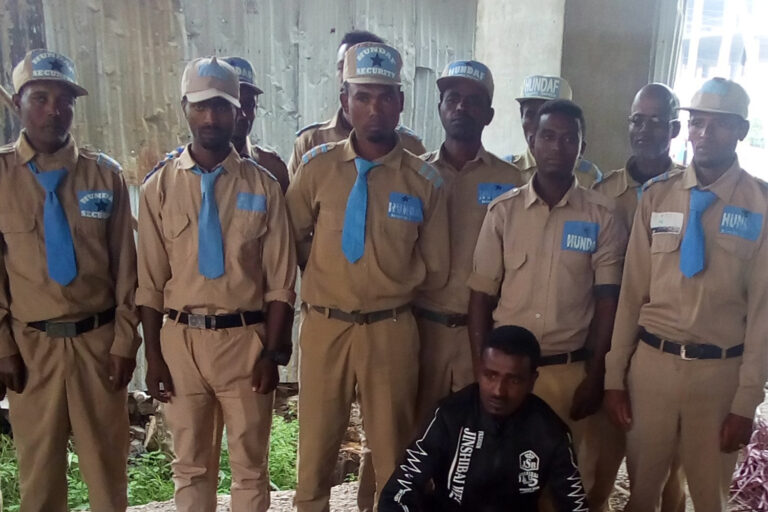
Security service providers formed a new association named Abay by 21 member companies.
According to Abel Worku Managing Director of Lion Security Service PLC which has more than 5,000 employees over the country and founder of the union, “the union gives us strength to stand for ourselves, it helps us to respond the grievance raised on the service providers.”
These companies are known by providing security personnel to international organizations, non-governmental organizations, governmental organizations, private companies, hotels and private residential quarters.
Mostly these service providers are said to be taking advantage of their employees as most of the employees saying that the percentage share the companies took compared to what they pay their employees is not fair. The employees say that the agencies share up to half percentage of their salary.
“The first thing which need to be understood is that we are not an agency, we are employer companies, we get the license from Ministry of Trade and Industry not from the Ministry of Labor and Social Affairs,” says Abel.
The Ministry of Labor and Social Affairs recently developed a protocol which set 20 percent share to be taken by the agencies and the rest 80 percent to the employees.
Even if the protocol is adopted by the Ministry, Abel said that the service provider companies did not agree on the issue. “The protocol is currently suspended by court after the agencies took the case to court,” Abel said.
The Ministry is planning to enact the protocol starting from June 30, 2020.
“We have to pay tax, pension, uniforms, and such other things for the employees and this is why we understood the need of establishing a union, to strength our stand,” said Abel adding that the service is serious with huge responsibility.
There are 287 security service providers in the country. According to Abel, membership of this union is based on their performance, legal documents and should be taxpayers.
Security service providers for an association
Import value drops
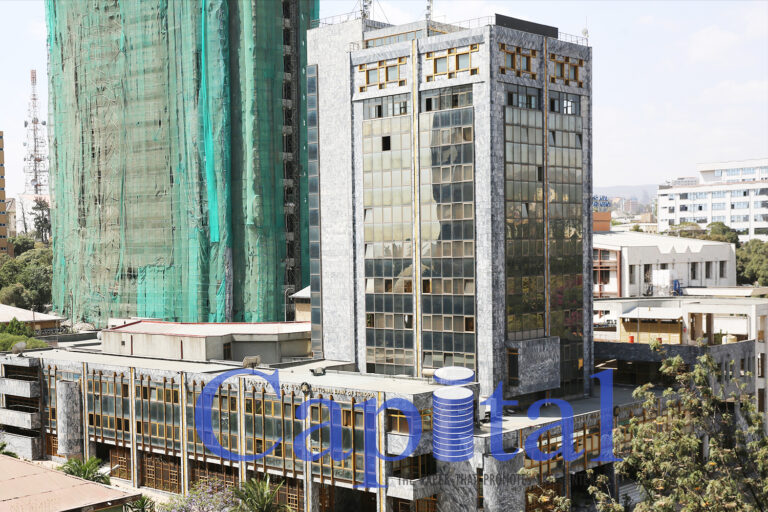
The recent released quarterly bulletin report of National Bank of Ethiopia (NBE) second quarter report for the 2019/20 fiscal year indicates that the total merchandise import stood at USD 3.8 billion during the second quarter of 2019/20.
The report stated that the import value shows a 13.9 percent decrease over the last year same quarter due to lower import values of fuel, capital goods, consumer goods and miscellaneous goods.
The report further stated that import bill of capital goods fell by 28.2 percent and 88.4 percent decline in payments for transport capital goods despite 33 percent increase for industrial capital goods and 123.3 percent surge for agricultural capital goods. Hence, the share of capital goods in total goods import bill stood at 34.3 percent compared with 41.1 percent a year earlier.
Meanwhile the value of oil import dropped in the quarter, which is from October to December 2019, the volume has continued in its growth as in the past.
“Likewise, fuel import value decreased by 5.1 percent while its share in total import payments rose 16.7 percent from 15.2 percent last year same period,” the report states.
According to the NBE quarter report, besides fuel payments, consumer goods went down by 11.6 percent over the last year same quarter due to lower import payments for durable and non-durable goods.
“Nevertheless, the share of consumer goods in total imports slightly increased to 27.5 percent from 26.8 percent a year ago,” it added.
The total import value in the same period of last year was over USD 4.4 billion. “In juxtaposition, total merchandise import bill at USD 3.8 billion depicted a 13.9 percent annual decline due to lower import values of fuel (5.1 percent), capital goods (28.2 percent), consumer goods (11.6 percent) and miscellaneous goods (4.5 percent),” the quarterly report of NBE shows the sectors whose values are reduced for the period in the current fiscal year.
Such kind of report is rare. Even the quarterly report in the past shows slight value increment and expansion of trade balance gap. While the latest report of value reduction on import has also narrowed the trade balance.
According to the quarterly review the average price of Brent crude oil, which is used as a benchmark for international oil price, exhibited a 6.3 percent slowdown from USD 67.7 per barrel to USD 63.4 per barrel. The reduction of oil price has contributed for value reduction on import.
According to the report, the total current account payments also decreased by 13.6 percent and reached USD 5.2 billion due to a 13.9 percent decline in merchandise import payments and 13.7 percent in service payments.
The current payment on the same period in last year was almost USD 6 billion.
Meanwhile the current payments reduced, private transfer payments and public transfers showed significant increase. “Hence, the current account balance recorded USD 1.2 billion deficit which was 35.7 percent lower than that of a year ago,” it explained.
Service payment for second quarter of the fiscal year was USD 1.3 billion that was 1,520.4 in the same period of last fiscal year.
At the same time the total current account receipts amounted to USD 4 billion registering a 3.7 percent decline over last year same quarter owing to slowdown in receipts from public transfers (55.6 percent) in contrast to an increase in merchandise export proceeds (4.5 percent), services receipts (3.4 percent) and private transfers (21.1 percent).
The current receipt at the same period of last year was over USD 4.1 billion.
Regarding balance of trade in the second quarter also narrowed because of import reduction. It stated that during second quarter of the fiscal year merchandise trade deficit narrowed to USD 3.2 billion from USD 3.9 billion a year ago as merchandise export receipts improved and merchandise import bills declined.
In the period the export that was USD 610.5 million has increased by 4.5 percent from last year same quarter, while the horticulture and livestock export have registered marvelous performance.
The report explained that current account balance (including official transfers) registered USD 1.2 billion in deficit which was 35.7 percent lower than that of a year ago.
Regarding monetary development at the end of second quarter of 2019/20, broad money supply stood at 950.55 billion birr, showing a 20.5 percent growth over the corresponding quarter of last fiscal year. “The annual growth in broad money was attributed to 23.2 percent increase in domestic credit while 162.2 percent drawdown of net foreign assets,” it said.
On the other hand the total deposit liabilities of the banking system reached 958.9 billion birr by the close of the second quarter of 2019/20, indicating 21 percent annual growth rate. Branch expansion, saving culture, growing of access to finance is stated as a reason for growing of saving.
“Likewise, during the review quarter, 58.7 billion birr was disbursed in fresh loans, indicating a 27.6 percent annual increase. Of the total new loans disbursed, the share of state owned banks was 46.9 percent while that of private banks was 53.1 percent,” the quarter report stated.
Tax payers express frustration on the implementation of tax amnesty

Tax payers express their confusion on the implementation of tax amnesty that targets to mitigate the coronavirus economic effects.
The Council of Ministers recently issued a directive to lift a tax claim in two separate schemes that is based on the period of the tax arrears.
The first group listed under the tax dispute stayed until a period of 2015. In this group the government closed the case and called the tax payers to access their clearance. On the other group the tax payers that are in dispute with Ministry of Revenue (MoR) for tax arrears from 2016 to 2019 are beneficiary to settle their outstanding tax and exempted the interest payment and penalties.
In the second option tax payers have got two types of option for their settlement. The first one is settled the 25 percent at an initial stage and the balance within a year, while the second option is that companies will settle the 90 percent at a time and get a relief for the ten percent.
According to tax payers that Capital talked said that they are facing challenges when they try to settle their payment.
“A tax branch that we are reporting told us that we should settle 100 percent of the tax immediately against the scheme that the Council of Ministers issued,” a tax payer told Capital.
The tax payer said that they talked to Tesfaye Tule, State Minister of MoR, to claim their case while they got a response that the detail procedural document of the directive will not allow them to go with the new scheme.
“They told me that the new relief is given for those who finalized their process before the issuance date, which was May 6, of the directive, and due to that we settled all the outstanding taxes at a time,” claimed the tax payer.
According to one of the tax payers, their company planned to pay the 25 percent first and the balance in a year time. “They told us we can only be exempted from the interest and penalty but should pay 100 percent immediately.”
The tax payers claimed that they are confused by the tax authority’s decision and the directive given by the government.
“As the behavior of my business and the current situation I could not settle all the 100 percent of the taxes,” a tax payer, who hoped to pay their duty in different stages, expressed frustration.
The government stated that its tax revenue would be shrinking due to the virus. Recently Ahmed Shide, Minister of Finance, said that government will lose 11 billion birr in the months before the end of the budget year.
“The government said that the tax and non tax collection in the coming months of the budget year will shrink by 11 billion birr, while the indirect tax collection for March has dropped by close to 15 percent compared with the same period of last year,” Ahmed said.
In March the direct tax collection growth rate was limited to 1.6 percent, while the average growth rate pre COVID 19 months was 22.8 percent, according to Ahmed.
WHAT IS GOING ON?
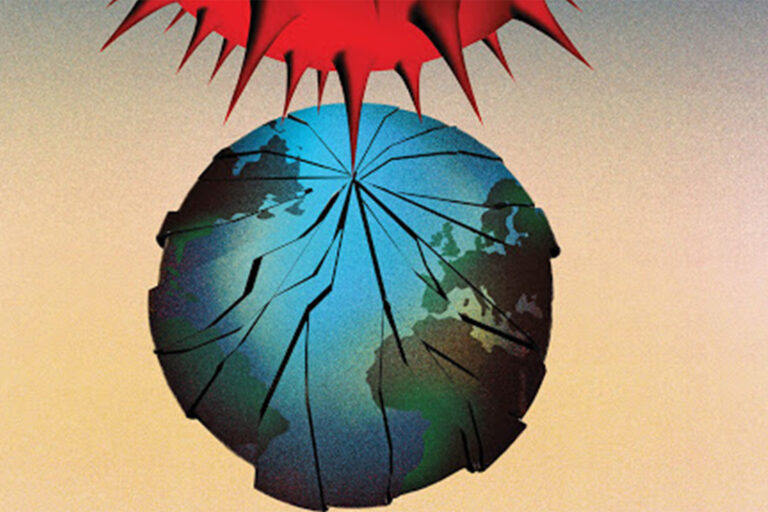
Our decaying global order is ominously signaling rapid collapse. To the uninitiated, the current various happenstances that are impacting the global order seem sporadic and unrelated to each other. As always, connecting these symptomatic dots is a bit tricky. The ability to bring the seemingly stand alone events together, with a view to make a coherent sense, requires, amongst other things, a worldview that is sufficiently detached from the existing lie based politics, debt based economics, identity obsessed social relations, (racial, religious, etc.) and an intellectual/emotional strength that forces a healthy distance from the overbearing techno-sphere. Obviously, this is easily said than done. Be that as it may, one can still attempt a heuristic approach to the generalized problematic by starting to rethink perplexing events/situations afresh. ‘What is going on?’
In late 2019, a microbe made a conspicuous entrance in China. Its presence was immediately felt, not only in China, but also across the seas, in places like Iran and Italy. By early 2020, the whole world was traumatized and infected by the invisible bioterrorist, so to speak. Panicking beyond comprehension, countries after countries closed their borders and implemented either partial or complete locked-downs. As a result, economies were shattered, literally. Social distancing caused more than psychological problems. To alleviate the economic mess, governments started to print, yet again, massive phony money. For example, the US government printed trillions of dollars, and handed it to the power wielding connected oligarchs and their corporations. A little bit, relatively speaking, managed to trickle down to the sheeple (human mass) as well as to small businesses. At the same time, tax revenue came to a screeching halt and unemployment reached a record high! Printing money with abundance, as a sole panacea, is bound to cause havoc, sooner or later. One cannot help but ask: ‘What is going on’?
Unprecedented freedom curtailing/constraining laws were swiftly promulgated by nation-states all over the world, within weeks. There was no serious debate anywhere, about the whole issue, as the narrative was steered by the DS (Deep States) and its subservient politicos in power. The scared politicians rushed to appease their bosses (the DS) by upholding the preeminence of ‘paid science’ over actual science! Capable scientists were muzzled and were disallowed to openly communicate/express their findings and considered opinions. Facts from world-class scientists/institutions (Stanford University, etc.) about actual data on Covid-19 were out rightly dismissed, while phony modeling was feverishly promoted. So far and the obvious manipulations notwithstanding, Covid-19 is not the microbe monster as the DS wants it to be. CDC (Center for Disease Control, USA), Swiss Policy Research and other luminaries in the relevant fields (Nobel Laureates, etc.) have consistently and emphatically stated that the death rate from Covid-19 is only around 0.2%, i.e., about the same or even lower than the death rate from normal flu, but to no avail, conveyance wise. Yeah, ‘What is going on’?
The whole world is mobilized and galvanized to fight Covid-19, with plenty of money to wit. In the US, if someone dies on the account of Covid-19, the hospital/nursing home will get around $13,000. If the patient was on the ventilator before his/her passing, the hospital/nursing home gets an additional USD 29,000. No wonder many institutions decided to revise their death certificates. Death from Covid-19 as reported by DS and affiliates was and still remains highly exaggerated. Ditto other nations. Testing, testing, testing, is still the mantra of WHO as well as the status quo. Take note; the world does not routinely/widely test for the good old flu, so why all the rage about universal testing for this microbe, which has even a lower fatality rate than the normal flu? Even in countries where the virus is stubbornly unavailable, the call for ‘testing’ is persistent. We sense something fishy might be on the offing in the usually dormant world of bio-weaponry. For example, Covid-19 seems to have significant negative bias towards humans with pigmentation. One wonders; what the DS (Deep State) and its subservient are up to? Seriously: ‘What is going on’?
The US police routinely kill about four people on a daily basis. Since the US is a highly race/ethnicity obsessed society, no matter what the unfolding situation is, the event has to be color tinted, per force! More than anything, identity politics (ethnicity, racial groupings, religious affiliations, etc.,) form the basis of the entrenched ideologies of the US political classes, if we may say so. These dominant tendencies, always loaded with all kinds of insinuations, seem to be under interrogation today. The Minneapolis incident was just the spark that propelled the oppressed multitude to action; blacks, whites, etc.! The establishment might not see the rage behind the protestors, all protestors (not only the blacks), as they are pathetically fixated only on the looting jamboree. Recall; Occupy Movement & Yellow Vests, had their own strategies, which proved difficult to sustain. The Occupy Movement was systemically decimated. The leaders, nay the coordinators, that were heavily relying on the Internet for all and sundry, became easy preys to the highly sophisticated DS (think Snowden’s surveillance states). Some were framed (drugs, weapons, …the usual) others were sickened, suicided and accidented, if you know what we mean! The ‘Yellow Vests’ (YV) learned from Occupy Movement and changed their tactics. As it stands, the YV congregate in town centers on weekends, without leaders, coordinators, etc. From the point of view of the DS, this tactic has to be contained, if not eliminated, thus the new laws forbidding congregation, compliment of Covid-1984! How will the ongoing apprising in the West, mostly in the US unfold? ‘What is going on’?
During the Vietnam War the US propaganda machine was unrelenting. Here is one narrative that was pushed by the DS at the time: ‘unless we fight socialism in Southeast Asia now, we will have to fight it here (in the USA) later.’ In 1970, a perplexed artist wrote a song about Vietnam that went viral, globally. Ironically, this black person was killed by his own father, in the safety of his own home. Admitted or not, the USA, as a society, has always been and still is quite violence prone!
‘What is going on’?
Mother, mother
There’s too many of you crying
Brother, brother, brother
There’s far too many of you dying
You know we’ve got to find a way
To bring some loving here today, yeah
Father, father
We don’t need to escalate
You see, war is not the answer
For only love can conquer hate
You know we’ve got to find a way
To bring some loving here today
[Chorus]
Picket lines and picket signs
Don’t punish me with brutality
Talk to me, so you can see
Oh, what’s going on
What’s going on
Yeah, what’s going on
Ah, what’s going on”
Marvin Gaye. Good Day!
