

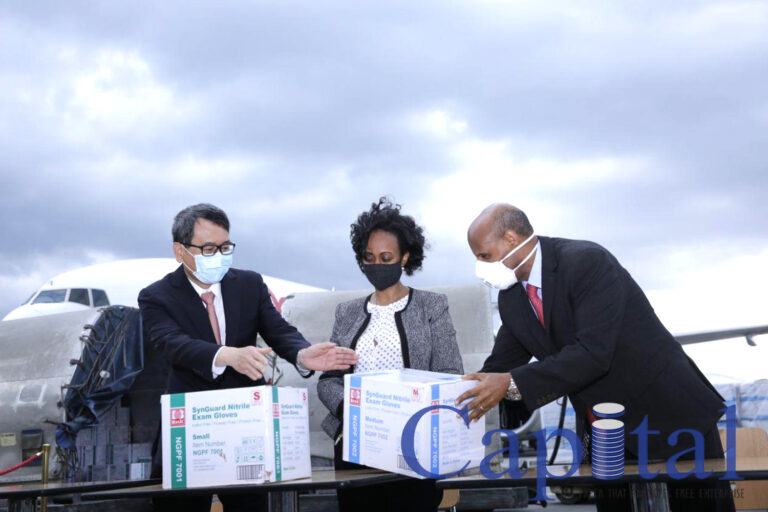
Ethiopia received 100,000 testing kits and 2 million gloves from the Chinese Tencent Foundation in support to the fight against the COVID 19 pandemic.
“The donation is important which helps us to grow our strategies we have in fighting the pandemic,” said Dr Lia Tadesse Minister of Health, adding that “expanding testing is one of our strategy in responding to the pandemic, we are working very hard to increase our daily testing capacity over the country.”
“We are working to increase our capacity in testing trying to get through donations and to buy from the market” said Dr Lia.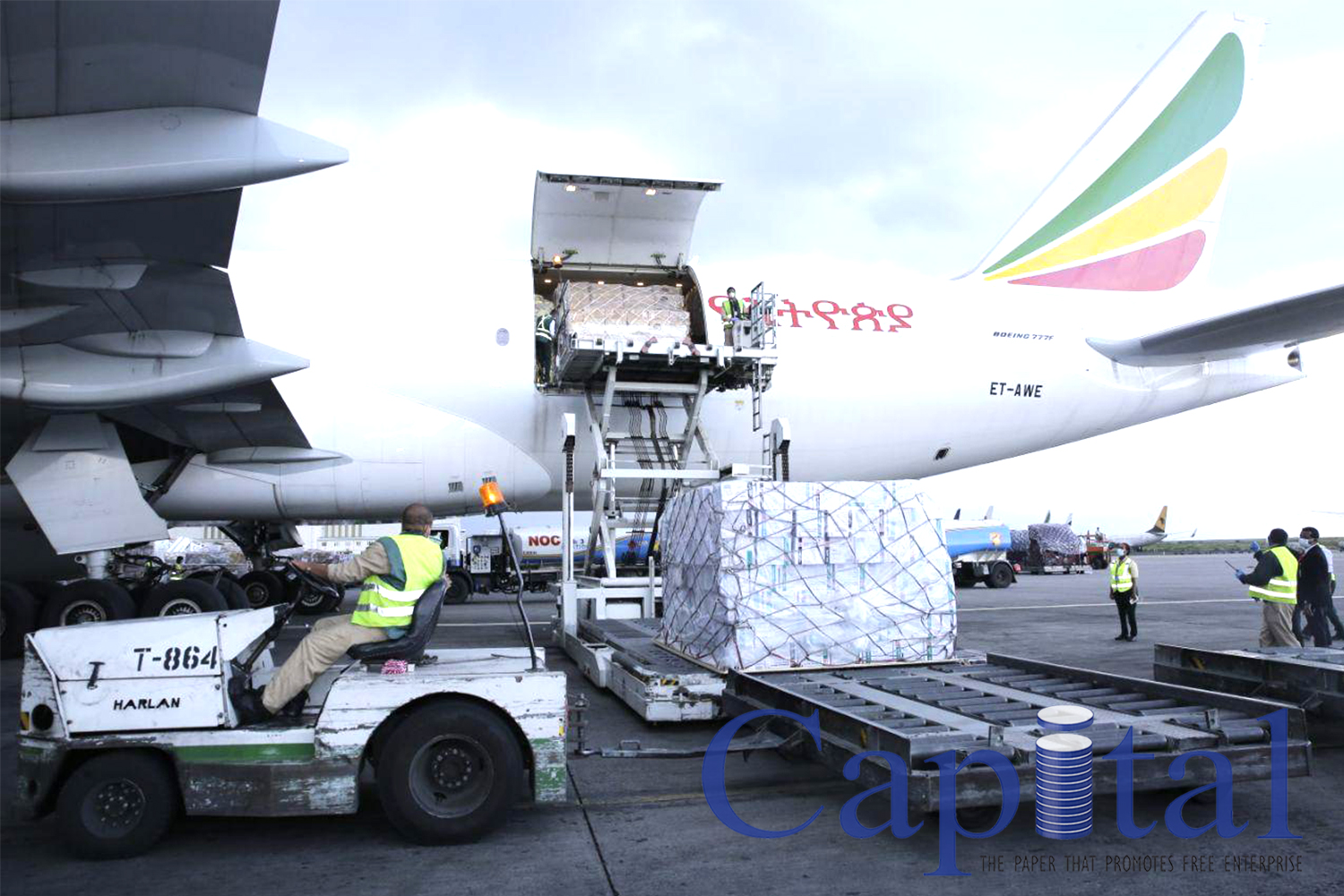
The equipment is transported by Ethiopian Airlines from China, Guangzhou to Addis Ababa on May 21, 2020.
After the outbreak of the virus in Ethiopia Prime Minister Abiy Ahmed called for global support to the whole Africa. Since then Ethiopia has been receiving donations from different institutions, from all over the world.
“We have been transporting different donations from all over the world but Chinese donation is much greater,” said Tewelde Gebremariam CEO of Ethiopian Airlines.
China and Ethiopia have maintained close partnership supporting each other and sharing experience since the Covid-19 outbreak.
“China is always ready to support Ethiopia’s effort in fighting the Covid 19 pandemic,” said Ambassador Tan Jian. “From the beginning Ethiopia and China has been working together, even when the whole world cut flights to China Ethiopian Airline sayed with us,” the ambassador said.
On April 16, Chinese task force with urgent medical supplies, including surgical masks, personal protective equipment, “non-invasive” ventilators and traditional Chinese medicine, arrived in Ethiopia.
Also following Prime Minister Abiy’s call to combat the spread of the virus and support the response in Africa, the Chinese billionaire and co-founder of Alibaba group Jack Ma has made three batches of donations to the continent. The three round donations mainly includes millions of masks, swabs and test kits, ventilators, sets of protective clothing, face shields, temperature guns, body temperature scanners, and pairs of gloves that were distributed to Africa Center for Disease Control and the 55 African countries through Ethiopian airlines.
The Tencent Charity Foundation was founded in June 2007 operating under Tencent Holdings Ltd. which is a Chinese multinational conglomerate holding company founded in 1998, whose subsidiaries specialise in various Internet-related services and products, entertainment, artificial intelligence and technology both in China and globally.
Tencent donation will increase Ethiopia’s capacity of testing COVID 19
EPHI, CDC lab experts conducting a COVID-19 lab test at the EPHI Reference lab
Ethiopian Public Health Institute (EPHI) and CDC lab experts are conducting a COVID-19 lab test at the EPHI Reference lab. During the current COVID-19 pandemic, CDC is working closely with the Federal Ministry of Health, EPHI and other public health partners to ensure the people of Ethiopia have access to better diagnostic services to protect them from COVID-19 and help prevent the further spread of the virus. As part of this effort, CDC experts are working on the frontlines with EPHI leadership as part of the national emergency COVID-19 response team, providing support to improve and expand laboratory testing, epidemiology and surveillance, infection prevention and control, and planning.
Through these response efforts, CDC has embedded two senior laboratorians to provide direct hands-on technical assistance at the national COVID 19 testing laboratory. CDC’s direct support has helped the national laboratory to build its capacity to develop a national testing algorithm for COVID-19, conduct verification of multiple testing kits, and implement quality assurance activities during rapid expansion and decentralization of testing. CDC is also supporting the procurement of supplies for COVID-19 testing to maintain and expand capacity.
Just three months ago, Ethiopia had to send its COVID-19 samples abroad. Now the country is typically testing more than 4000 specimens a day and is planning to open more laboratories in Addis Ababa and in various regional states that are capable of conducting routine COVID-19 testing. This is a critical step in being prepared given the importance of early detection and response during outbreaks of pandemic potential like COVID-19.
CDC Ethiopia has invested more than $64 million to build the capacity of Ethiopia’s laboratories and health facilities to strengthen the country’s public health infrastructure over the past two decades.
Locust swarm will multiply 20 times in coming years if not contained

The locust swarm in horn of Africa is expected to grow by another 20 times more over the coming years if the fight against the locust does not increase from the current state in the areas.
According to the Food and Agriculture Organization of the United Nations (FAO), more needs to be done to prevent a food security crisis, as the ongoing rainy season not only provides livelihoods for farmers and pastoralists but also favorable conditions for locusts to breed in the countries which are experiencing high level of food insecurity.
Ethiopia, Somalia and Kenya has been the hotspots of the locust activity and FAO estimated that more than 20 million people will suffer from food insecurity in the second half of the 2020. Also in Yemen where locusts have been reproducing in hard-to-access inland areas, an additional 17 million people will be acutely food insecure.
The Director-General of FAO, Qu Dongyu said “more people are at risk of losing their livelihoods and worsening food security in the coming months.”
According to the UN agency preliminary estimation indicate that 720,000 tons of food has been saved in ten countries by preventing the spread of desert locust which is enough to feed five million people. An additional 350,000 pastoral households have been spared from distress.
The Desert Locust is considered the most destructive migratory pest in the world and a single swarm covering one square kilometre can contain up to 80 million locusts. FAO’s Desert Locust appeal, launched in January, now covers ten countries – Djibouti, Eritrea, Ethiopia, Kenya, Somalia, South Sudan, Sudan, Uganda, Tanzania and Yemen.
While locust control and surveillance operations are led by national governments, FAO is providing critical support in the form of pesticides, bio-pesticides, equipment, aircraft and training.
“We can and must protect vulnerable people from the impact of multiple crises: conflicts, climate extremes, desert locusts and COVID-19, which threaten to cause a further dramatic deterioration in the food security,” Qu said. “To do this, we need to intensify our efforts further and focus not just on controls but on supporting the livelihoods of farmers and pastoralists so they can get through this.”
Since FAO launched its desert locust response in January, its appeal has been funded with $130 million, the report said. However, funding has concentrated on locust control activities and much more backing for livelihoods support activities is needed.
In related development Ministers responsible for Agriculture and Livestock of the Member States of the Intergovernmental Authority on Development (IGAD), including representation from Saudi Arabia and Yemen, held a virtual ministerial meeting with key desert locust control organizations to upscale desert locust control operations and boost coordination efforts between IGAD and the Middle East region.
Discussions revolved around current control operations, surveillance, contingency plans, infestation mapping and impacts. Also present were representatives from international and regional organizations involved in Food Security and Nutrition, and Desert Locust Control Operations (DLCO-EA, CRC, ICIPE, FAO and other UN Agencies, Development Partners and Non-Governmental Organizations).
The objective of the inter-regional meeting was to provide a platform for IGAD Member States, neighbours, regional and international partners to share experiences in pest control, deliberate on establishing a Joint Inter-Regional Contingency and Response Action Plan, that will guide the upscaling of cross-border and cross-regional control operations, improve coordination and join efforts to contain the desert locust invasion both in the IGAD region as well as in the breeding areas of the Arabian Peninsula.
Ethiopia invites companies for expressions of interest to issue telecom licenses

The Ethiopian Communications Authority (ECA) invites interested companies to come up with Expressions of Interest (EOI) to award two new telecommunications licenses.
The government invited interested companies to be shareholder at the state monopoly Ethio Telecom on its program to liberalize the sector.
The recently formed authority has now invited interested companies to take the proposed two licenses to be part of the competition with the oldest and only telecom enterprise in the country, Ethio Telecom.
In a statement the authority sent to Capital on Thursday May 21, the ECA is managing the license issuance process, which is a major development in the liberalization of Ethiopia’s telecommunications market.
“The issuance of the two new licenses to telecommunications companies, in addition to the existing license held by Ethio Telecom, is part of the government of Ethiopia’s Homegrown Economic Reform Agenda to introduce competition into the sector,” it added.
ECA stated that the primary goals of the government are to increase access to reliable and efficient communications services for all Ethiopians, leading to improvements in quality of life and in connectivity to support rapid economic transformation, and to maximize the opportunity presented by the digital economy.
Few weeks ago the government has tabled a draft proclamation of electronic transaction that targets to develop digital economy, improve the capability of the technology and expand the job creation in the sector.
“The launch of the EOI represents a significant milestone. Since the public consultation held in November 2019, we have undertaken a number of important activities, such as hiring the International Finance Corporation (IFC) as a transaction advisor and drafting numerous directives that will shape a robust legal and regulatory framework,” the ECA statement said.
Late April the authority drafted a new guideline for the award of new telecom licenses following the new telecommunications regulatory framework.
The two weeks consultation on proposed rules for licensing new entrants into the country’s telecom sector, alongside related directives on consumer rights and dispute resolutions stayed until May 11.
According to its statement issued on Thursday, the authority said that the sector liberalization process is continuing amid the Covid-19 crisis which shows the government’s strong will to fight the pandemic while keeping track of the ongoing economic reforms.
“The pandemic has underscored the importance of having reliable and accessible telecommunications to ensure the safety and well-being of Ethiopians and to maintain business continuity. Therefore, we remain committed to opening up the telecom sector and unlocking the transformational power of the digital economy,” it said.
Fitsum Assefa, Commissioner of Planning and Development Commission told Capital that COVID 19 enforced it to redefine its Ten Year Perspective Development Plan. Fitsum said that COVID 19 has given a lesson to redefine the plan. She emphasized the improvement of technology is mandatory for the growth in the coming years by showing how the current electronic operation and meetings are undertaking because of COVID 19.
“It shows us how things shall be changed and several operations shall be conducted online without physical appearance. We are now providing e learning and other operations that was not going online in the past and it has also improves the day to day activity,” Fitsum explained how the technology transformation would be the next major pillar for the country development.
The EOI will stay until June 22.
