

The wide gap on seeds demand and supply is affecting the vegetable farming and experts insist that the government should focus on seeds production in the country besides the import business. Currently the price of seeds skyrockets due to COVID 19 effects.
Experts in the agribusiness said that the country’s vegetable farming is highly attached with imported seeds. The seeds that are imported from Europe like the Netherlands, Israel, India and Kenya are supplied for the local vegetable farming, while experts in the sector like Gebremichael Habte, an agribusiness advisor, the country should change the trend and focus on local production.
“Currently more than 95 percent of vegetable seeds are imported except few local producers that are engaged on seed production, including onion seeds,” Gebremichael told Capital.
Experts said that the supply of vegetable seeds is not meeting the demand that should be totally solved to improve the agriculture sector.
“Exclusive right to import seeds is also one of the major challenges for the shortage of seeds in the market,” experts said.
Companies who have exclusive rights should wait to get foreign currency to import the product that affects the demand side, according to experts.
Gebremichael agreed on this idea and said that the government should open the supply and bypass the exclusive rights to expand the import and allow more importers to be engaged on the seeds import, “it is now implemented for the chemical business,” he said.
“Until the country develops its capacity such kind of short term strategies should be applied,” he added.
Experts said that the country should transform its capacity to produce seeds locally. “Vegetable seeds strategy has been developed few years back that should be implemented,” Gebremichael, who was part of the experts that were engaged on developing seeds strategy said.
“So far some non-governmental organizations are trying to expand the seeds production that should be supported by the government as soon as possible,” experts said. “Ethiopia can easily produce seeds,” Gebremichael added.
An agronomist, who is involved in export of horticulture products, raised his concern saying that relevant government officials always speak about agricultural input but they don’t mention anything about seeds. “For instance the duty free scheme for seed sector is allowed very recently,” the horticulture exporter told Capital.
He recommended that the accessibility of hybrid seeds should also be increased as soon as possible for the sake of sustainable development in the sector.
He said that the seed shortage has affected the agriculture activity and the vegetable productivity.
The global lock down and slow down of cargo flight affects the supply of seeds. Due to the price hike on cargo and lack of access to market makes the price of seeds to hike globally. Experts in the sector said that the seeds price in the local market also doubled.
Ethiopia should focus on seed production

Djibouti offers crew change support for all ships
Djibouti announced at the United Nations its readiness to facilitate crew change operations in Djibouti for any ships passing through the Bab el Mandeb strait, with the necessary support provided by the Djibouti Ports and Free Zones Authority (DPFZA).
The country is responding to the joint statement of the IMO and UNCTAD – the UN’s maritime and trade bodies respectively – to support crew changes and ensure that maritime personnel can return home safely when the time comes to do so.
Travel restrictions imposed due to COVID-19 mean that crew changes have been delayed but they cannot be postponed indefinitely; it is estimated that starting in mid-June 2020 as many as 300,000 seafarers a month will require international flights to enable ships’ crew changeover and 70,000 cruise ship staff are waiting for their repatriation.
“DPFZA recognises and is grateful that the maritime community continue to provide essential services through the global pandemic to ensure that word trade continues to flow and is committed to being part of the global solution to support these key workers,” DPFZA said in a statement sent to Capital. “DPFZA also calls on other countries to take similar steps to facilitate coordinated support for seafarers around the world and calls on all ship-owners to support the effort by availing air repatriation solutions for maritime personnel,” the statement adds.
Maritime transport depends on the 2 million seafarers who operate the world’s merchant ships, which carry more than 80% of global trade by volume, including most of the world’s food, energy, raw materials, as well as manufactured goods and components and is vital to sustainable development and prosperity.
IMO and UNCTAD have been continuously highlighting the risks to shipping and trade arising from the COVID-19 impacts and have called for collaborative efforts to address the challenge.
“For shipping to continue to operate safely, we are seeking the support of Governments to facilitate crew changes and ensure crew wellbeing, by facilitating repatriation and safe return home of seafarers, marine personnel, fishing vessel personnel and offshore energy sector personnel, as well as access to medical care for sick or injured crew and to medical prescriptions,” said in a joint statement.
The global movement

The global movement relay of former Lycée Guebre-Mariam students provided one month worth food supply, mask, sanitizers and sanitary items for 100 families who live around the school and who are vulnerable to food security in collaboration with Mary Joy Center. 
Also the association is planning to give another batch of donation for additional 100 families who are living around Alliance Ethio Francaise to alleviate the food security of the vulnerable people and also provide assistances to health care products to visually impaired and the disabled.
During the handing out ceremony Amakeletch Teferi said “the spread of COVID-19 pandemic in Ethiopia, beyond its impact on health, has a huge implication and effect on the livelihoods of the most destitute and most vulnerable segments of the urban society. It is the awareness of this fact that pushed Alumni of the Lycée Guebre-Mariam to create a relief committee “I Care Ye Lycée Lij”, and undertake the launching of a fund-raising campaign both locally and globally in order to help the most vulnerable citizens elevate the challenges they are facing.”


Axian Group shows interest in Ethiopia’s telecom sector
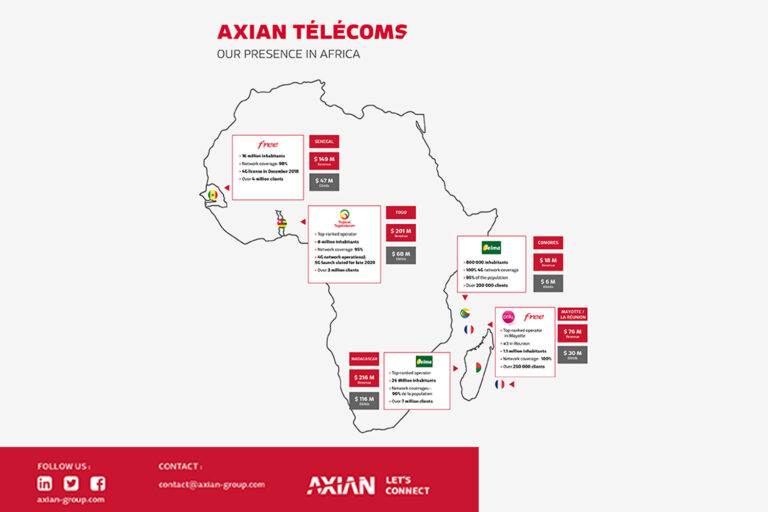
AXIAN Group has become one of the African telecom operators to express interest to invest in Ethiopia.
At the last week of submission of expression of interest (EOI) for telecommunications service licenses that will come to an end tomorrow mid-day a handful companies have filed their EOI.
According to the information Capital obtained, AXIAN, who is stated as the fastest internet provider in the continent, has expressed its interest to be one of the two private telecom operators in Ethiopia.
Two years ago the then ruling collation EPRDF decided to open the telecom sector besides sell a share on the state owned monopoly, Ethio Telecom.
In its statement the company that commence operation 150 years ago from Madagascar and operate in six African countries said that it would like to expand its foot to Ethiopia and execute its best experience on telecom operation in other countries.
“In Ethiopia, the second most populous nation in Africa with more than 105 million population with median average age of 18, AXIAN Telecom will bring economic prosperity to Ethiopians through affordable, seamless, fast and state-of-the-art Tiers 1 telecom services that will allow job creation, nurturing entrepreneurship and supporting Ethiopia’s Digital Transformation Strategy that was just approved by the Council of Ministers on the 15th of June 2020,” the group said in a statement.
Different reports indicate that the telecom operators enabled to boost the internet connectivity of the biggest island in the continent that will create jobs and hard currency earnings.
“By making Madagascar the country with the fastest internet connection in Africa, we have addressed the challenges of economic development, rural isolation and geographic disparity with an ambitious investment policy that involves installing more than 10,000 km of fiber-optic cable and modern mobile technologies, including 4G, 4G + and soon 5G,” in its statement the company says, “Madagascar has become the global centre of BPO, resulting in significant employment gains as well as bringing revenue from abroad into the country´s economy.”
“We see similar traits of our operation in Madagascar existing in Ethiopia, that a large tech-savvy young graduates look for employment and strong connectivity being a game changer for both forex revenue generation and job creation by making Ethiopia preferred destination for international outsourcing & BPO center through fast connectivity,” the company said.
The information Capital obtained indicated that AXIAN Group recorded USD 1.1 billion in global turnover in 2019, with USD 1 billion investment in its operations.
AXIAN also operates the largest network of petrol stations and distribution network of petroleum products in Madagascar, as well as several telecommunications and mobile-money operators across the Indian Ocean and Africa.
By developing and investing in new infrastructure on an international scale, AXIAN advances financial inclusion in the countries where it operates.
The company also claimed that these investments materialize by delivering the fastest internet in Africa (and even faster than few European countries) have made us the number-one telecommunications operator. AXIAN Telecom also possess around 3,300 telecommunications towers on the African continent that support its telecom operations and cutting-edge mobile networks in Madagascar, Reunion Island, Mayotte, Comoros, Senegal and Togo.
In all the countries where it operates and AXIAN Telecom now boast having deployed more than 13,600 km of terrestrial fiber optical backbones and invested in 13 international submarine cables.
The Group is also a partner of the upcoming 2Africa submarine cable project, which will shore up connectivity throughout the continent while creating better connections between Africa, the Middle East and Europe.
According to the Ethiopia Communications Authority EOI invitation document issued on May 21, the initial license term that will be given to an operator will be 15 or more years with the possibility of renewal.
