

Total Ethiopia invested 1.3 million birr to provide road safety cube materials to be distributed to primary and elementary schools in and around Addis Ababa in the presence of Dagmawit Moges, Minister of Transport and Mulu Gebregziabher, State Minister of Transport.
The cubes will be distributed to children at elementary schools in order to help them take precaution against road traffic accidents.
Road safety cube is a tool whose objective is to help in deploying a road safety awareness campaign for children in school and support the actions to minimize road accidents.
The project is said to be Part of the social responsibility of Total Ethiopia and in collaboration with the concerned stakeholders.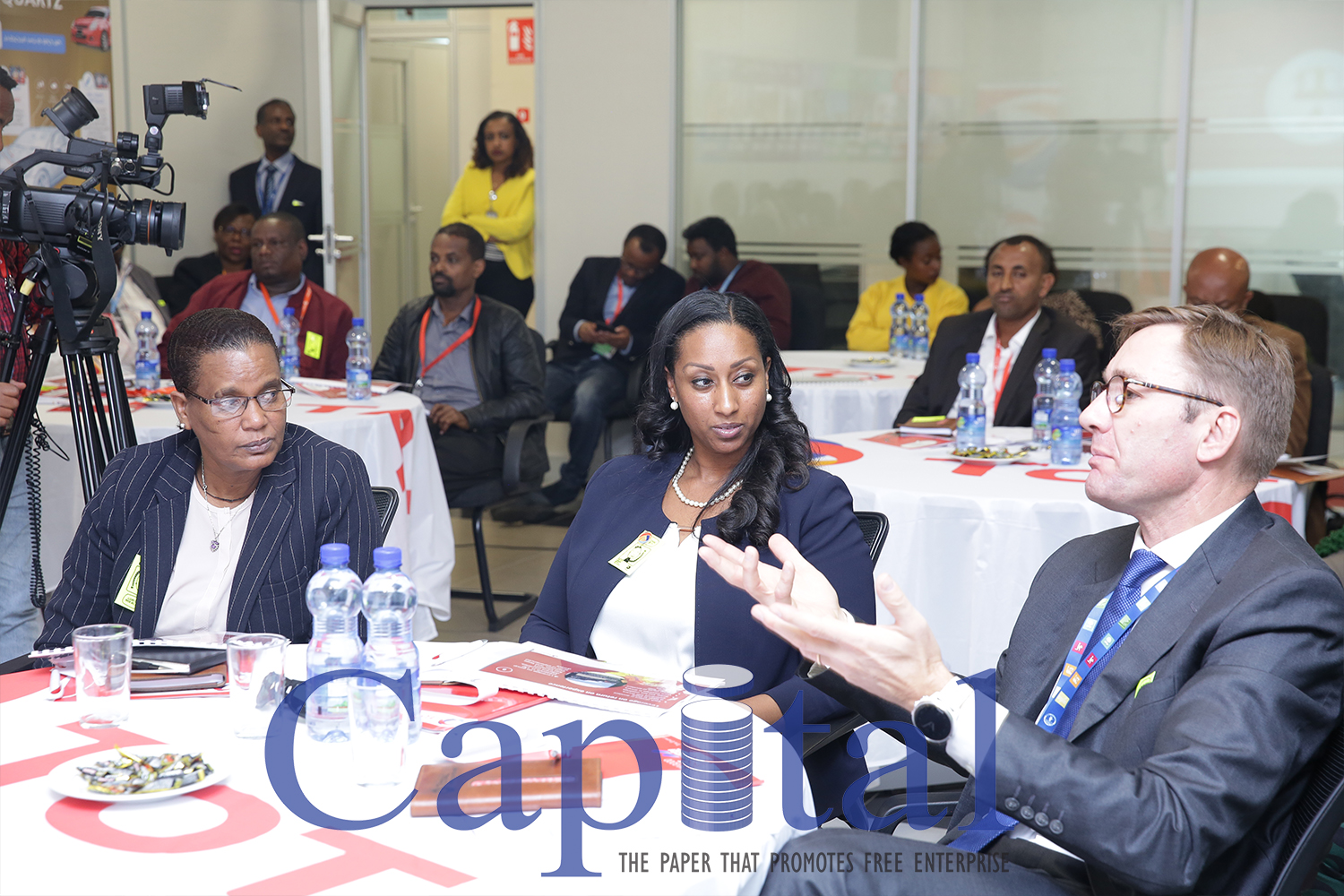
Total has prepared 36 safety cubes to distribute to primary and elementary schools located in the risk zones of Addis Ababa and Oromia region located around Addis Ababa.
On February 14, 2020 Addis Ababa Education Bureau received 10 safety cubes and Oromia Education Bureau received eight safety cubes. Beside the education bureaus, other stakeholders working on the road safety issues including World Vision Ethiopia and Plan International also received the safety cubes.
“The program will help to emphasis awareness of children’s and youngsters about the danger on the road as well as to help them acquire the understanding about road safety rules and regulations with visual identities” said Hayleyesus Assefa, Corporate Communication and Social Responsibilities Director of Total Ethiopia.
This safety cubes will also be used as reference and teaching aid in the primary elementary schools. With this 36 safety cubes more than 7,200 students are expected to be trained.
10 of the 36 safety cubes are English version imported by Total Ethiopia to scale up the project and the rest 26 are made locally in Amharic.
Total Ethiopia is working to minimize road accident in the country. Total has installed dual on board camera computer on trucks. According to Hayleyesus, there are around 600 trucks in total. 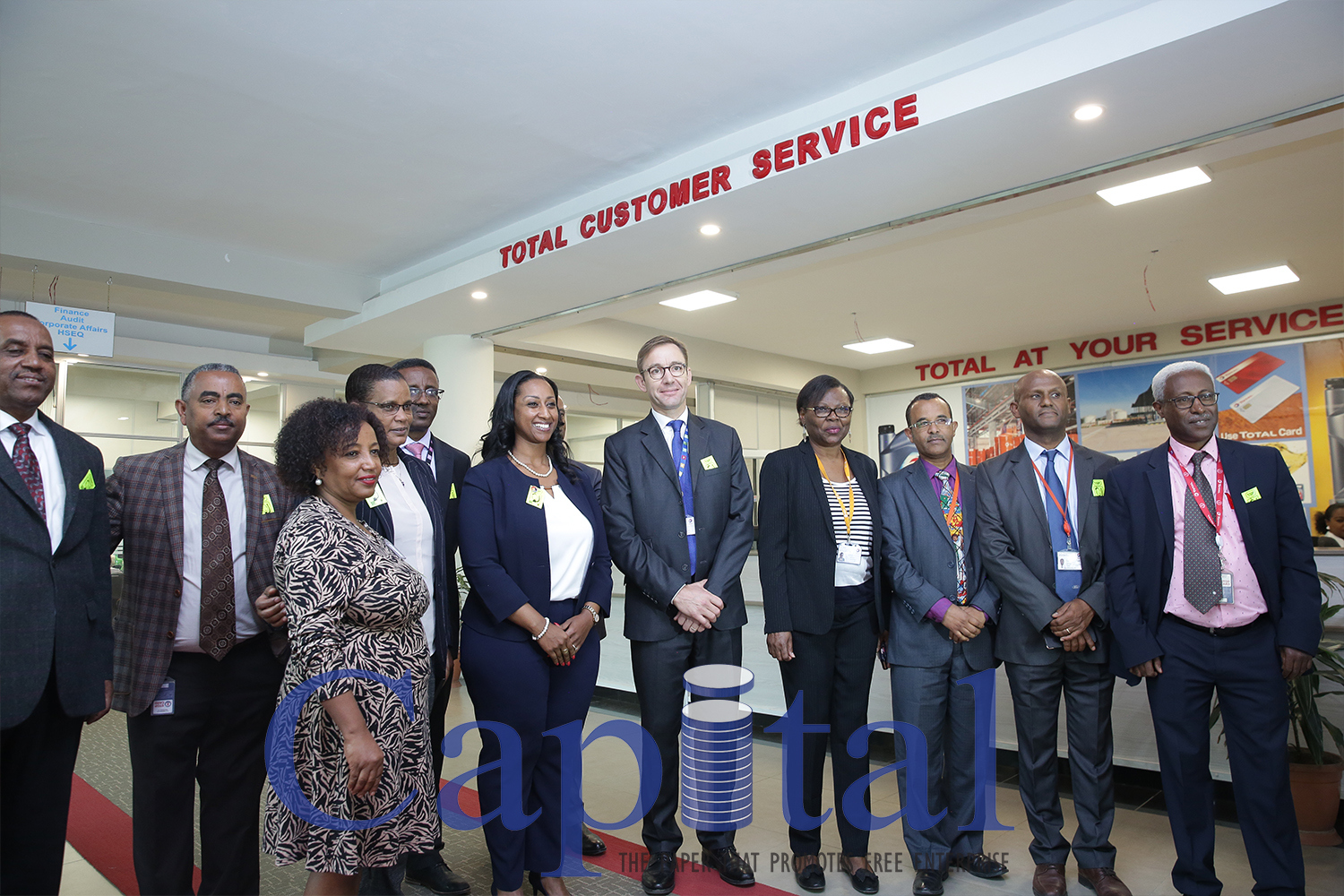
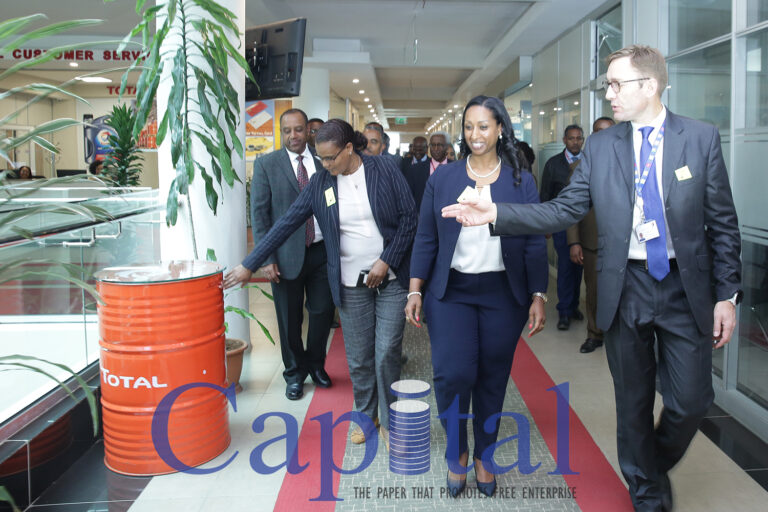
“Even if the installation is expensive, Total gives more attention to human lives,” said Thibault Lesueur, Managing Director of Total.
On February 5,2020 Total has celebrate two years of anniversary of “Zero Death Accident”, which in the stated period trucks of Total were not involved in death to a human life.
“Every sector of the country should take such kind of experiences as example to minimize the rising number of road accidents in our country,” the MD added.
Reports shows that Ethiopia loss tens of thousands of lives due to road accident and millions victims directly and indirectly from the accidents. Lack of road safety education, unfavorable traffic condition and speed are some of the reasons for the high traffic accident in Ethiopia. 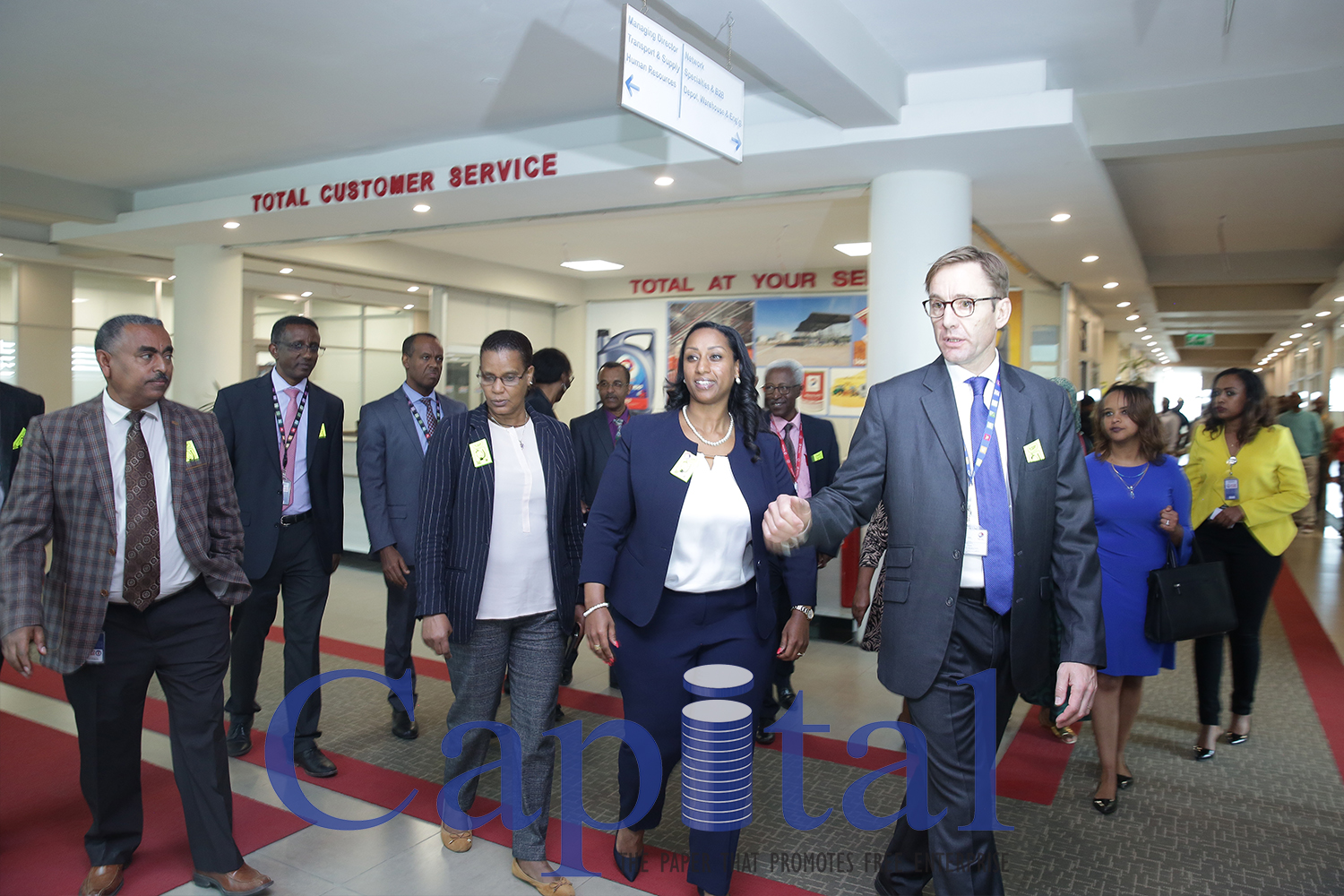
Total Ethiopia to road safety and zero accident
Revenue ministry announced implementation of excise tax right after parliament approval

The Ministry of Revenue (MoR) announcement that the ratified excise tax proclamation no. 1186/2020 has become effective the day after the ratification of the proclamation by the parliament, was dismissed by businesses who argued that it is against the country’s law.
The revenue collection body announced on February 13, the same day of the ratification of the proclamation by parliament; the new law will be in place as of February 14.
MoR in its announcement published on its social media page stated that the tax calculation will become effective immediately, however the business community expressed their confusion about the announcement.
They said that according to the country’s law, the implementation of the proclamation should wait the publication on Negarit Gazette.
They said that the proclamation stated that the calculation will be applied when products come out from the factory but sometimes products will come out from the factory and stored at different warehouses in the country.
“For instance a company that has a water bottling factory about 200km from Addis Ababa will have a warehouse at the capital, which is the major market area, and it should have transport the product here,” Ashenafi Merid, General Manager of Ethiopian Bottled Water and Soft Drinks Manufacturing Industries Association, explained, “transporting the product from the production centre to the warehouse does not mean sales.” “But MoR considered that as a sales and look for their tax,” he added
He told Capital members of his association shall face challenges regarding this.
Final version
The final document of the proclamation has given more room for used small cars that were in service for less than four years.
The document of the excise tax proclamation no. 1186/2020 indicated that a used car for not above two years with less than 1300 CC will have the excise tax of 55 percent. On the draft proclamation it was 80 percent. At the same time the final version of the proclamation reduced the tax for up to less than four years used car of the same cc to 105 percent from 130 percent that was tabled on the draft document.
Lemlem Hadgu, Chairwoman for Revenue, Budget and Finance Standing Committee at the parliament, explained that the percentage has reduced on the aim to reduce the impact on middle class of the society.
Lemlem said that such kind of cars are accessible for the middle class and the former percentage that was tabled on the draft documents shall affect them, “due to that the percentage was revised to address the middle class of the society.”
The proclamation is also dropped the percentage of the brand new and locally assembled less than 1300 cc cars to 5 percent from 30 percent of the original rate.
The excise tax for cigarette has been proposed to be 30 percent and five birr per packet that has now climbed to eight birr per pack.
New excise tax rates reduced minimum taxes from 10 percent to five while the highest tax will be a whopping 500 percent.
The last time excise taxes were set it was 2002 and the minimum rate was 10 percent.
President of the European council visits Ramsay shoe factory
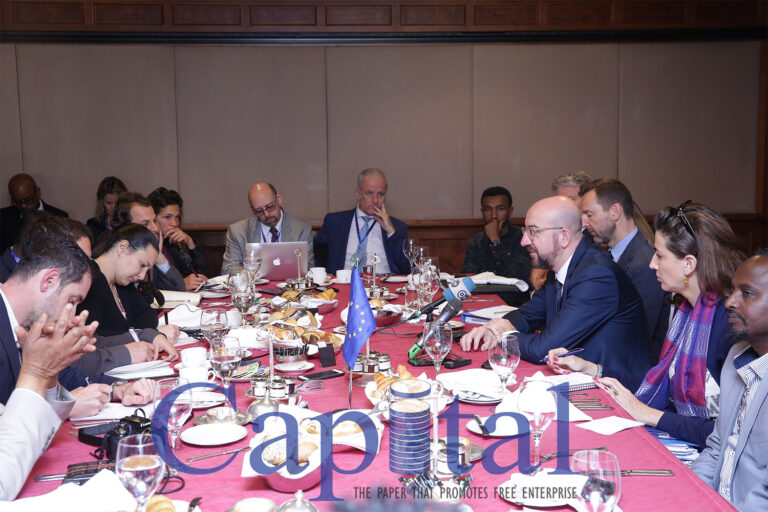
Charles Michel, President of the European council visits Ramsay Shoe Factory on February 10, 2020, one of the partners to the project of stemming irregular migration in northern and central Ethiopia /SINCE/ implemented under the European trust fund for Africa, on the sidelines of the African Union Summit.
The main focuses of SINCE is to enhance the employment skill of potential migrants and returnees focusing on women and youth in the target regions managed by the Italian ministry of foreign affairs, embassy of Italy in Addis Ababa and implemented in the four most migration prone regions of Ethiopia and in the city of Addis Ababa by five NGOs led partnership together with private sector, technical vocational training centers, regional bureau and CSOs.
SINCE project in Addis Ababa works on training and enhancing employment opportunities for youths on leather products, metal work and construction sector.
Ramsay shoe factory is one of the partners working on the project by actively hosting trainees under the SINCE apprenticeship.
“I have visited the Ramsay Shoe factory, I met with many women workers who look to the future” said the President.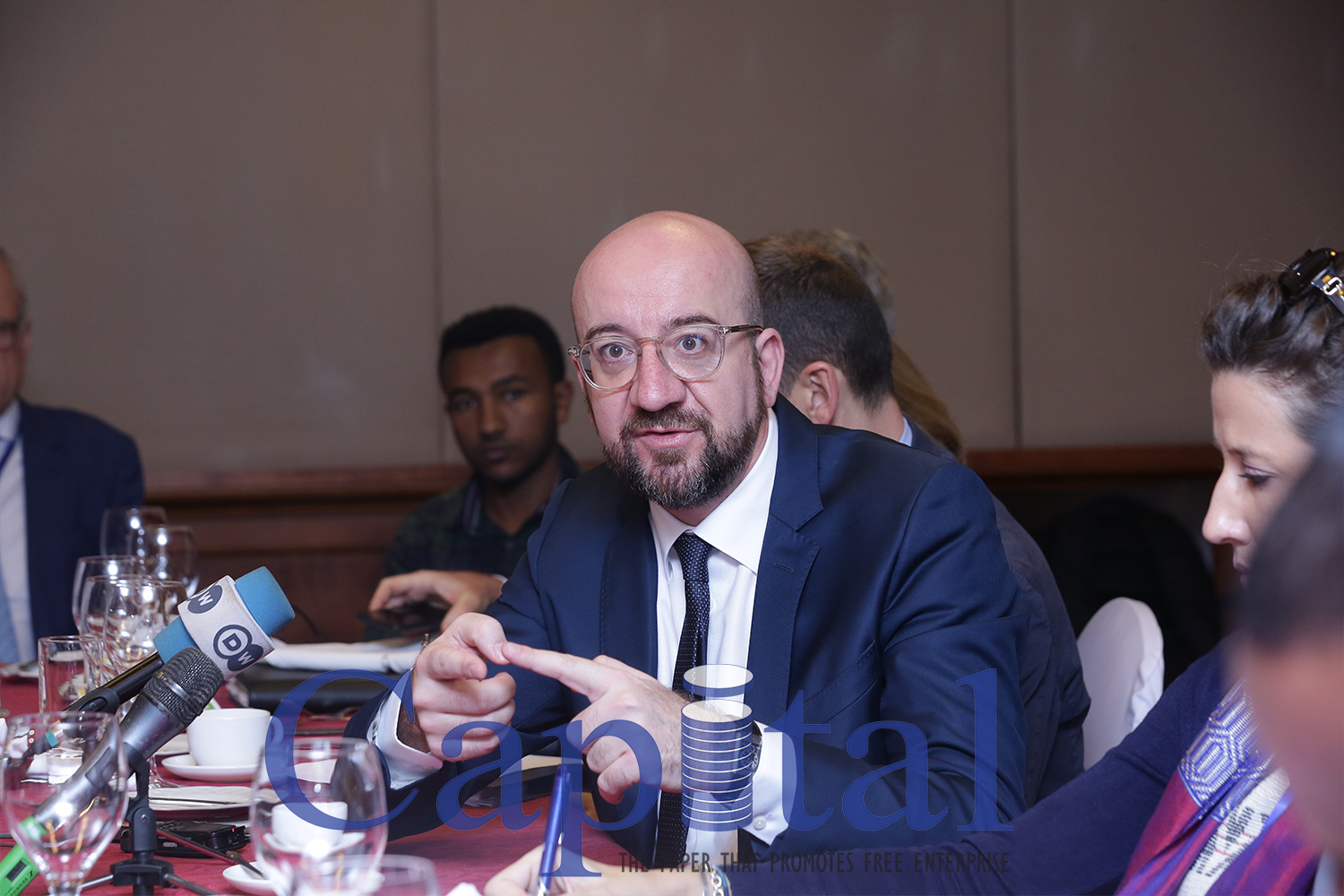
The 25 years locally owned company currently hosts more than 19 trainees and previously Ramsay has provide employment opportunities for about 13 trainees of SINCE.
The European emergency trust fund for Africa established at the Valletta summit on migration in November 2015, to address the root causes of instability forced displacement and irregular migration and to contribute to better migration management. The first program signed under the trust fund was SINCE an action that aims at contributing to the reduction of irregular migration from the northern and central Ethiopia by improving the living conditions of the vulnerable population through decent job opportunities by financing 20 million Euros for the four years and nine month project.
Starting from 2016 SINCE has planned to responses to facilitate wage employment to 8,200 people through the provision of training courses relevant to private sectors needs until the end of 2020, the program works to create employment opportunities in six labor intensive value chains such as leather products, construction, metal work, textile and garment, agribusiness and hospitality.
Currently, beneficiaries from the project reach more than 3,000 youth, women and returnees, 28 small and medium enterprises have been created and supported within the last four year.
“We are not only benefiting the trainers rather this project is working to mutual benefit for both of us, since we are getting trained work force it minimize the time it took to train the employees” said Zelalem Habte, Managing Director of Ramsay.
Beside his visit to Ramsay, the president has also visited Addis Ababa University and Sunday Market of Shiromeda.
The president travel to meet with the African leaders on the 33rd summit of the African union held in Addis Ababa and had series of bilateral meetings with African leaders.
“Europe is Africa’s main partner for trade, investment, cooperation and development” said President Michel.
IATA expects cargo transportation to be doubled

Ethiopian Airlines Group hosted the International Airlines Transport Association’s (IATA). More than 23 countries and different stakeholders have been participating on the workshop. According to IATA in the coming years the development of air cargo transportation is expected to be doubled.
Since the demand continues to boost, service givers should also strength their services, improve the system handling, packaging and transporting the goods.
High staff turnover, low retention, shift in compilation has been raised as organizational challenges for the development of cargo transport.
IATA provide different kinds of technical knowledge, products, services and training solutions, to the industry needs on the definition of standards for documentation, handling and training, as well as their promotion and use, contributed to achieving a very high degree of safety in the transportation of dangerous goods by air.
“Development of new products powered by these dangerous goods is driving the demand,” said Fistum Abadi, managing director of Ethiopian cargo, since these goods are dangerous to the environment and human, Ethiopian airlines is working based on the international standards.
Ethiopian cargo and logistic service gives General Cargo services and also provide Special Cargo services like Perishable, Valuable Cargo, Pharmaceuticals, Live Animals, Human Remains, Dangerous Goods and Mail and Courier.
Experts of IATA also cautions airlines, cargo handlers and freight forwarders on the transportation of dangerous cargo by air. Hosted by Ethiopian Airlines at the Ethiopian Aviation Academy, the IATA Cargo Workshop on Dangerous Cargo attracted 60 delegates from 23 countries representing airlines, cargo handlers and freight forwarders.
The growth of cargo globally impacts everyone. IATA sees a global growth of 100 percent in the next 15 years. The cargo industry in Africa, too, is growing. African carriers like Ethiopian Airlines are investing heavily on cargo fleet, cargo terminal and technologies.
In related development Ethiopian Airlines Group secure 800 million dollar from cargo transportation in the last fiscal year of 2018/19 which is 88 percent of its target. The airline was planning to secure 906 million dollar.
Ethiopian is one of the largest cargo network operator and one of the major global cargo players, serving 57 global freighter destinations and over 103 destinations on both freighter and belly hold services.
Ethiopian Cargo & Logistics Services gives airport-to-airport services with 12 dedicated freighters, including 10 Boeing B777-200LRF with capacity to transport 103 tons each and two Boeing B737-260F with capacities of 22 tons each.
Ethiopian operates in major trade lanes between Africa and Europe, Middle-east and Asia providing a convenient and reliable cargo service to and from the continent. Currently, Ethiopian Cargo & Logistics Services operates a warehouse with over 450,000 tons annual capacity in which the air line has the capacity to transport around 1.6million kilograms of goods per day.
